


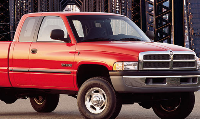
Is it worth it to get headers on my 01?


Grand Champion
Joined: Apr 2008
Posts: 7,055
Likes: 7
From: Lee County, North Carolina

I ran cheap shorty headers for years on my truck. I put the stock manifolds back on it earlier this year.
I had cheap (lead?) gaskets and never had a leak at the block. Two times I had to pull one off and weld it where the collector meets the flange because my factory y pipe didn't line up quite right and I forced it into place so it was stressed from the get go. Since you're having a mechanic do it then he should have a pipe bender so he'll be able to make the y pipe line up like it should.
The heat coming off the big loop on the rear cylinders is not friendly to the guts of spark plug wires so check them once in a while. The rear plugs are also a pain to get to with that loop.
I put the stock manifolds back on to make it easier to get to those back spark plugs and I think I might have gotten another leak.
As far as gains: maybe a couple ponies.
I had cheap (lead?) gaskets and never had a leak at the block. Two times I had to pull one off and weld it where the collector meets the flange because my factory y pipe didn't line up quite right and I forced it into place so it was stressed from the get go. Since you're having a mechanic do it then he should have a pipe bender so he'll be able to make the y pipe line up like it should.
The heat coming off the big loop on the rear cylinders is not friendly to the guts of spark plug wires so check them once in a while. The rear plugs are also a pain to get to with that loop.
I put the stock manifolds back on to make it easier to get to those back spark plugs and I think I might have gotten another leak.
As far as gains: maybe a couple ponies.

Administrator


Joined: Apr 2010
Posts: 87,478
Likes: 4,223
From: Clayton MI
A typical HP/TQ dual y axis chart with stock manifold vs shorty from idle to 3k rpm would be relevant to the discussion. Can't find it though, every comparison I see starts at 3k rpm.... my working theory is, the story is bad for the aftermarket part, so no one is telling it - for obvious reasons. Until I see that data, its stock manifolds for me 


Legend


Joined: Nov 2014
Posts: 8,098
Likes: 318
I think a fair bit of it is because chassis dyno's aren't incredibly accurate below about 2K RPM, either because of issues holding the correct gear, or some other nebulous reasoning. Engine dyno's, on the other hand..... can start at idle, and go as far as you want. Why the folks posting engine dyno charts don't start the graphs until north of 2K RPM is a mystery to me. If there were a shop with a dyno that wasn't 80 miles away, (and expensive, for the engine dyno) and would be tempted to run some of my own tests.

Veteran


Joined: Jan 2017
Posts: 475
Likes: 41
From: Imperial Beach CA
I installed Pacesetter shorties and they are CARB approved with an E.O. number. They bolted right up to the exhaust pipes with no problem and no leaks using the supplied gaskets. I'll be putting a Flowmaster Super 40 on in a couple of weeks. The stock muffler really quiets them down, sounds stock to me. I only have about 300 mile on them at the moment.

I think a fair bit of it is because chassis dyno's aren't incredibly accurate below about 2K RPM, either because of issues holding the correct gear, or some other nebulous reasoning. Engine dyno's, on the other hand..... can start at idle, and go as far as you want. Why the folks posting engine dyno charts don't start the graphs until north of 2K RPM is a mystery to me. If there were a shop with a dyno that wasn't 80 miles away, (and expensive, for the engine dyno) and would be tempted to run some of my own tests.
The higher rpm gains are nice yes. But where headers can really shine is in part throttle operation. The problem with header discussion is nobody EVER considers the vehicle specific application in conjunction with aftermarket availability and intended use.
First, let's consider the different aspects of headers. If you look at different kinds of race cars you'll notice how different many header designs can be. A typical weekend warrior muscle car will often have a traditional longtube header. A top fuel dragster on the other hand will often have a short zoomie type header. Circuit track/autocross will often have more of a Tri-Y design. Headers are built around specific RPM ranges and uses.
By concept:
longtubes produce the widest range of power with good peaks in the lower and midrange
Shorties/zoomies produce the more gains in the high rpm range
Tri-Ys are very specificly designed for about a 1500-2000rpm gap.
By reality:
longtubes still produce the widest overall power gains across the rpm range. Being most street vehicles don't rev above 6500rpm, it's not considered very high rpm
Shorties, in order to comply with factory fitment, are shrunk down on pipe size and often feature bad collectors to mate to factory downpipes (these trucks are a prime example)
Tri-Ys are again, a specialty setup. They're rarely if ever not.
Long primary tubes promote tq production through scavenging. Short primaries promote high rpm flow as the exhaust doesn't sit in the pipe very long. Large diameter primaries promote flow at elevated rpm and sacrifice part throttle or low range scavenging. Small diameter primaries do the opposite and promote scavenging at the expense of higher cfm capability.
If you look at what is available on the market you'll see that most available off the shelf shorties for any engine feature rather small primary pipes due to fitment constraints. This balances the 2 competing concepts of primary pipe size and length for a factory exhaust system. Available off the shelf longtubes on the other hand tend to have larger primary diameters to broaden the tq curve produced by their length.
Now, ignoring collector design and just keeping the overall idea of header theory in mind, what do we have available? We have shorties with a 1.5" outer diameter primary, midlengths with either a 1-3/4" outer or 1-7/8" outer diameter, and lastly longtubes with a 1-3/4" outer diameter. Ignore the mid-length option for now as they're best suited to the lighter dakotas used for drag racing by combining various aspects of both short and longtube. They're also $800 new minimum. The primary size on the available shorties is a bit too small for the displacement of these engines and even their base output. It's just not enough flow. In fact, for the displacement and output of these engines, the "ideal" all around diameter would be about a 1-5/8". However, nothing of that size exists for us. In come the Pacesetter longtubes and their knockoffs. 1-3/4" primaries may be a tad large for stock output of these engines BUT they make up for it with their length. In fact, they're longer than most "longtubes" for other engines on the market and with less bends. Another boon.
Now we can consider the collector. Shorties and factory exhaust use a small ball collector flange that knocks the exhaust down to sub 2". That's just not enough flow. The install of shorties on these trucks is nothing short of a pain in the *** because the primary tubes bend so closely to the bolt holes and the collector bolts are in a rough enough to reach spot I would much much rather change a crank sensor with the factory keg still installed. Though the primaries of the longtubes are a hair big for a completely stock engine, the length they provide does wonders in the part throttle performance of the truck and WOT there's no comparison to be had. The shorties have shown to not provide much of anything as they are provided. You CAN substantially upgrade them by cutting off the 2-bolt ball collector, welding in a 2.5" 3-bolt flange or v-band clamp and running at least a 2.25" downpipe, 2.5" preferred. For a stock setup, this is actually a pretty decent combo and will do plenty for a guy until the intake manifold is changed. It's torquey and noticeable and getting rid of the crap that follows the primaries will allow more of sound change that many seek.
If you're interested in the longtubes though, you can have what has shown to be very surprisingly decent quality setup for less than posted earlier.
https://www.protuninglab.com/hds-dr9652l-y.html
$290 for the original knockoff producer vs the $380 or whatever was posted earlier.