


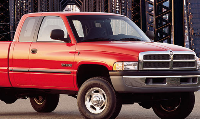
Upgrading Payload Capacity on a 2000 1500 5.9l 4x2 Short Bed


Thread Starter
|
Professional

Joined: Aug 2022
Posts: 212
Likes: 5
From: CA
 Upgrading Payload Capacity on a 2000 1500 5.9l 4x2 Short Bed
Hey all,
As the title suggests I'm looking to upgrade the overall payload capacity of my truck. It's a 2000 Ram 1500 with the 5.9l engine, 4x2, and a short bed. From what I can find online the stock payload capacity, including passengers, is 1,696 pounds. I'm trying to build my own camper for the bed and don't want to be extremely limited weight wise.
wise.
From what I've read, I can likely upgrade the leaf springs and rear suspension and maybe squeeze another 500 lbs out, but my limiting factor is going to be my axle. The way I currently have the camper designed, the most significant weight, the water tank and batteries, is going to be placed up against the wall closest to the cab. Does anyone have any experience in pulling this off? I've put a ton of work into this truck so I don't exactly want to just try and swap it for a 2500.
Thanks!
As the title suggests I'm looking to upgrade the overall payload capacity of my truck. It's a 2000 Ram 1500 with the 5.9l engine, 4x2, and a short bed. From what I can find online the stock payload capacity, including passengers, is 1,696 pounds. I'm trying to build my own camper for the bed and don't want to be extremely limited weight wise.
wise.
From what I've read, I can likely upgrade the leaf springs and rear suspension and maybe squeeze another 500 lbs out, but my limiting factor is going to be my axle. The way I currently have the camper designed, the most significant weight, the water tank and batteries, is going to be placed up against the wall closest to the cab. Does anyone have any experience in pulling this off? I've put a ton of work into this truck so I don't exactly want to just try and swap it for a 2500.
Thanks!

Veteran

Joined: Mar 2013
Posts: 277
Likes: 37
From: Sunny ****ing Nevada, Rockies to B.C.
You can bag the springs, whatever, the limitation will always be the outer axle bearings.
Already been there:
https://dodgeforum.com/forum/3rd-gen...not-to-do.html
Trashed a bearing mid-nowhere in Nevada, long flatbed ride home after trying roadside repair. In my defense the design of the carrier seems to limit lube flow to the outer axle with the LS 9.25.
Might be worth it if you continue, to pull the axles, inspect axle surfaces, change for new Timkens and seals, good synthetic lube.
If you are building a full on self contained camper, weight is an issue. If you are building something much smaller, you are likely good.
Already been there:
https://dodgeforum.com/forum/3rd-gen...not-to-do.html
Trashed a bearing mid-nowhere in Nevada, long flatbed ride home after trying roadside repair. In my defense the design of the carrier seems to limit lube flow to the outer axle with the LS 9.25.
Might be worth it if you continue, to pull the axles, inspect axle surfaces, change for new Timkens and seals, good synthetic lube.
If you are building a full on self contained camper, weight is an issue. If you are building something much smaller, you are likely good.

Champion


Joined: Sep 2012
Posts: 4,869
Likes: 434
From: Central VA
You could possibly swap onto your truck Dana 60 front and rear axles, along with front and rear springs, however, you may run afoul of legal weight limits in the event of an accident and having to deal with the auto insurance company, since the truck would be modified. The 2nd gen truck frames of the 1500 and 2500 are pretty much the same.

Record Breaker

Joined: Jan 2004
Posts: 1,429
Likes: 192
From: United States
Starting at Post #15 here I document my approach for a u-bolt flip and spring upgrade including adding upper overloads.
https://dodgeforum.com/forum/2nd-gen...dations-2.html
This also leads to the not-insignificant consideration of the condition of your axle tubes due to WWSPD (World's Worst Spring Plate Design)
As 1/2 ton axles go I've always considered the 9.25 pretty robust.
The truck I modified hauls ~400 gallons of water 3 to 4 times per week, BUT each trip is only about 11 miles round trip. It had a very hard life prior to the modifications and the rear is original.
Other options: swap for a D60 or D70 rear and carry two spares. I'm not sure what might be involved in swapping a 2wd front to 8 lug. For 4wd the D60 front is basically plug 'n play. If you're gonna do this it would be nice to use 3" springs from the 2500 and grab all the upper overload stuff. Or you'll have to change the D60/70 perches to 2.5". Bonus for 4.10
Grab a 14b rear which will likely have 2.5" perches but spacing will be wrong so you'll have to move them regardless. Carry 2 spares. Bonus for 4.10. edit: you'll have tone ring issues. I would reco a Ford 10.25 as it'll have a tone ring but I wouldn't wish a 10.25 on anyone.
The Ford 9" would share wheel bolt pattern but I honestly have no idea if a 9" would be better on GAWR
https://dodgeforum.com/forum/2nd-gen...dations-2.html
This also leads to the not-insignificant consideration of the condition of your axle tubes due to WWSPD (World's Worst Spring Plate Design)
As 1/2 ton axles go I've always considered the 9.25 pretty robust.
The truck I modified hauls ~400 gallons of water 3 to 4 times per week, BUT each trip is only about 11 miles round trip. It had a very hard life prior to the modifications and the rear is original.
Other options: swap for a D60 or D70 rear and carry two spares. I'm not sure what might be involved in swapping a 2wd front to 8 lug. For 4wd the D60 front is basically plug 'n play. If you're gonna do this it would be nice to use 3" springs from the 2500 and grab all the upper overload stuff. Or you'll have to change the D60/70 perches to 2.5". Bonus for 4.10
Grab a 14b rear which will likely have 2.5" perches but spacing will be wrong so you'll have to move them regardless. Carry 2 spares. Bonus for 4.10. edit: you'll have tone ring issues. I would reco a Ford 10.25 as it'll have a tone ring but I wouldn't wish a 10.25 on anyone.
The Ford 9" would share wheel bolt pattern but I honestly have no idea if a 9" would be better on GAWR
Last edited by Keith_L; Nov 16, 2022 at 11:24 PM.

Grand Champion


Joined: May 2019
Posts: 5,158
Likes: 724
From: S.W. Indiana
Your truck will be limited by the axles. It's up to you to decide how the axle will hold up. The heaviest weight being towards the cab will spread the weight to all the wheels so that will help. If you're going to add air help to the rear, be sure to plumb both sides of the axle separately. if you run a single air line to both sides, if you drop a wheel in a dip, all the weight will go to the upper side. With a camper, you don't want this. If you look at a truck hauling a fifth wheel camper, you'll see two Schroeder valves. One for each side. My last heavy truck I had a pump mounted with controls in the cab. I'm old and lazy.
Record Breaker
Joined: Jan 2004
Posts: 1,429
Likes: 192
From: United States
You can bag the springs, whatever, the limitation will always be the outer axle bearings.
Already been there:
https://dodgeforum.com/forum/3rd-gen...not-to-do.html
Trashed a bearing mid-nowhere in Nevada, long flatbed ride home after trying roadside repair. In my defense the design of the carrier seems to limit lube flow to the outer axle with the LS 9.25.
Might be worth it if you continue, to pull the axles, inspect axle surfaces, change for new Timkens and seals, good synthetic lube.
If you are building a full on self contained camper, weight is an issue. If you are building something much smaller, you are likely good.
Already been there:
https://dodgeforum.com/forum/3rd-gen...not-to-do.html
Trashed a bearing mid-nowhere in Nevada, long flatbed ride home after trying roadside repair. In my defense the design of the carrier seems to limit lube flow to the outer axle with the LS 9.25.
Might be worth it if you continue, to pull the axles, inspect axle surfaces, change for new Timkens and seals, good synthetic lube.
If you are building a full on self contained camper, weight is an issue. If you are building something much smaller, you are likely good.
More power is harder on a rear end overall. Although, granted, GAWR is GAWR and the wheel bearings ultimately bear that regardless.

Administrator


Joined: Apr 2010
Posts: 87,475
Likes: 4,223
From: Clayton MI
You can do all the upgrades you want, but, overweight is overweight, regardless of upgrades. If you exceed your trucks rated capacity, and something bad happens, your insurance company can deny coverage, due to being over weight. If you need more capacity, you need a bigger truck.
Trending Topics
Grand Champion
Joined: May 2019
Posts: 5,158
Likes: 724
From: S.W. Indiana
A 2000 is a second gen. With proper gearing I assume a 5.7 will be comparable. I just prefer the older engines for simplicity of repair.