


Changing to synthetic


Thread Starter
|
Registered User
Joined: May 2009
Posts: 2
Likes: 0
From: Harrington, DE
 Changing to synthetic
I'm getting ready to do some work on my truck. (96 2500 v8 360) I'm leaking oil at the rear main seal and also at the plenum, so I plan to replace both. I just got the hughes kit in. I've been reading through all the threads I could find and have been making a list of items that I should also replace. I plan on also replacing the front main seal. After replacing these items would I be safe to go to full synthetic? I currently have 178k and have always run conventional. I would like to cover as much as possible. I'd hate to get everything back together and realize I missed something.

its just a preference and also how your truck runs with synthetic. i was like you, i wanted to run synthetic after replacing some parts. however, there is an article on here somewhere where they compare synthetic and conventional. this article changed my idea of running synthetic. i am not running a high performance motor, and i dont run at high RPMs like 3000-4000. i also like changing my oil at 5000 miles. so after wanting to run synthetic since ive had my truck, i have decided to stay with conventional. i will run a high mileage oil. if anything i MIGHT do a synthetic blend down the road but as of now, im staying conventional.
other members will chime in i'm sure. this is a "hot" topic.
other members will chime in i'm sure. this is a "hot" topic.


Record Breaker
Joined: Oct 2007
Posts: 1,680
Likes: 0
From: Allentown, PA
Why would it unclog things? Switching from dino oil to synth shouldnt unclog dirt or grim in your engine. Unless there are cleaning addatives in the synth (which there are in some)
Sythetic oil has protectents(sp?) for wear and tear. You dont need to run full synth. if you run mixed, you'll pretty much be getting all the benefits from full synth w/o the full price.
The moment I got my ram I put full synth in it. Just recently I changed oil and put in pennzoil ultra with the " new amazing , factory clean stuff" We'll see after next oil change, so far though its running well.
That being said, unless you want to add a few cleaning agents, change your oil at longer intervals, and add some protectives, and spend a few more $, might as well stick with dino. You not giong to see a huge differance from the switch,....I did however notice my oil comes out cleaner now. Not much, but still cleaner.
P.S... Just so its out there for people to know. There does not need to be any time, magic, or whatever to happen before switching from dino oil to synth. Just drain and replace with w/e you want.
Sythetic oil has protectents(sp?) for wear and tear. You dont need to run full synth. if you run mixed, you'll pretty much be getting all the benefits from full synth w/o the full price.
The moment I got my ram I put full synth in it. Just recently I changed oil and put in pennzoil ultra with the " new amazing , factory clean stuff" We'll see after next oil change, so far though its running well.
That being said, unless you want to add a few cleaning agents, change your oil at longer intervals, and add some protectives, and spend a few more $, might as well stick with dino. You not giong to see a huge differance from the switch,....I did however notice my oil comes out cleaner now. Not much, but still cleaner.
P.S... Just so its out there for people to know. There does not need to be any time, magic, or whatever to happen before switching from dino oil to synth. Just drain and replace with w/e you want.


Grand Champion
Joined: Apr 2008
Posts: 7,055
Likes: 7
From: Lee County, North Carolina
Here's something to think about. I'm switching back to conventional oil on the next change.
The graphs are accurate however, there's one thing that must be taken into consideration and that is, the fact that most older engines have hydraulic lifters along with the fact the motor was designed to be run with dino oil- not synthetics and, since synthetics (most anyway) do not contain detergents (unless you purchase them separately and add them in to your oil), this represents a new problem that was not to be seen when using conventional motor oil and that is, lifter ticking and, the other issue is, over time, the engine parts build up a hard crust in the valve train area.
This I know for a fact after witnessing this on my own Dodge after using nothing but synthetics for 200K miles. After removing and replacing the heads and intake, the lifter valley was totally crusted up as were the old heads.
Now, at the time I discovered this, I called Rob Stark ( an Indy car builder and classic car restoration specialist and, in my opinion, THE best mechanic I've yet to encounter -bar none) www.robstark.com and, I asked him what the deal was with this. He told me it's from running synthetics.
That was also backed up by three engines that were tore down that also had the same issue at California Horsepower. The owner swore up and down never to use synthetics and, while at his shop, he presented a rather strong argument along with physical evidence that the synthetics are not designed to clean the engine for one and, secondly, they fail to hold hydraulic pressure at the lifter thus leading to premature lifter collapse or, intermittent lifter ticking and rough idle conditions. He had a new, Chevy vette and, it had been failing to hold pressure due to they now come from the factory running 100% synthetic motor oil. He changed the oil- problem solved.
Now, I must admit, I didn't know how to respond because, this was knew to me. I let him present his case along with the evidence along with conducting some real world tests on my own Dodge. I listened, I observed and I asked some questions. I found it rather eye opening to say the least so, I went home and experimented.
I ran 0-W -30 Amsoil full synthetic for test 1. I had noted noise and clatter at startup (Sharps). It did not work well. It was way too watery at hot and, I had noted rough idle and lifter ticking that was sporadic. Keep in mind - I do have over 200K. With new lifters, this probably would not have been an issue so much as it was. Due to serious time constraints, I did not have time to change the lifters.
I noted premature lifter collapse under heavy loading and valve popping due to that as well. Not something that I like to hear. This was partially due to larger compression forces / larger springs at the valves.
I removed the oil and filter and displaced all motor oil with conventional 10-40. Now, yes, it's a heavier weight and, I am aware of viscosity index but, hang on just a moment until we get to the next test which was 20-50 Amsoil full synthetic.
When running Valvoline 10-40-dino oil, it was smooth, quiet and idled perfectly. I ran this across country for 7000 miles (changing it of course on both ends of the trip) I didn't use all but a half quart on the way out and another half quart on the way back. This includes mileage to and from Boston to NY as well on the weekends. When using synthetics, I had to keep refilling it as it would thin out and make it's way past the seals, rings and valve guides.
Next test was to run Amsoil 20-50 100% synthetic. NOTE: While better than their 30W, I still noted startup noise and occasional lifter tick and valve clatter.
I purged out the regular motor oil and changed the filter as I did in the previous test.
I filled it to MAX using 20-50 as noted above. I ran it, noted startup noise, erratic oil pressure and worst yet, rough idle due to sporadic loss of hydraulic pressure at the lifters.
I immediately removed it after only a few days and repackaged it.
I replaced it with Valvoline 20-50 and noted it's smooth as silk, no lifter noise, no valve train noise either.
Now, in no way during any of this testimonial am I inferring that synthetic does not protect the engine as it surely does however, it's not just a matter of protection as far as lubrication is concerned, there's some other considerations to think about when using synthetic motor oil in an older vehicle that does not run solid lifters but, old, hydraulic lifters that were designed around dino oil.
One of the issues is, full synthetics have tendency to drain out of the lifters thus not holding hydraulic pressure at time of startup thus the clacking, or, worse yet, while operational hence, lifter collapse. Couple that with roller rockers and you've got more noise.
Now, again, I am not advocating one over the other just yet and, I am still going to run another run of their 20-50 with a modifier and possible detergent. Work in progress on that one and, in time, I hope to have some results.
CM
This I know for a fact after witnessing this on my own Dodge after using nothing but synthetics for 200K miles. After removing and replacing the heads and intake, the lifter valley was totally crusted up as were the old heads.
Now, at the time I discovered this, I called Rob Stark ( an Indy car builder and classic car restoration specialist and, in my opinion, THE best mechanic I've yet to encounter -bar none) www.robstark.com and, I asked him what the deal was with this. He told me it's from running synthetics.
That was also backed up by three engines that were tore down that also had the same issue at California Horsepower. The owner swore up and down never to use synthetics and, while at his shop, he presented a rather strong argument along with physical evidence that the synthetics are not designed to clean the engine for one and, secondly, they fail to hold hydraulic pressure at the lifter thus leading to premature lifter collapse or, intermittent lifter ticking and rough idle conditions. He had a new, Chevy vette and, it had been failing to hold pressure due to they now come from the factory running 100% synthetic motor oil. He changed the oil- problem solved.
Now, I must admit, I didn't know how to respond because, this was knew to me. I let him present his case along with the evidence along with conducting some real world tests on my own Dodge. I listened, I observed and I asked some questions. I found it rather eye opening to say the least so, I went home and experimented.
I ran 0-W -30 Amsoil full synthetic for test 1. I had noted noise and clatter at startup (Sharps). It did not work well. It was way too watery at hot and, I had noted rough idle and lifter ticking that was sporadic. Keep in mind - I do have over 200K. With new lifters, this probably would not have been an issue so much as it was. Due to serious time constraints, I did not have time to change the lifters.
I noted premature lifter collapse under heavy loading and valve popping due to that as well. Not something that I like to hear. This was partially due to larger compression forces / larger springs at the valves.
I removed the oil and filter and displaced all motor oil with conventional 10-40. Now, yes, it's a heavier weight and, I am aware of viscosity index but, hang on just a moment until we get to the next test which was 20-50 Amsoil full synthetic.
When running Valvoline 10-40-dino oil, it was smooth, quiet and idled perfectly. I ran this across country for 7000 miles (changing it of course on both ends of the trip) I didn't use all but a half quart on the way out and another half quart on the way back. This includes mileage to and from Boston to NY as well on the weekends. When using synthetics, I had to keep refilling it as it would thin out and make it's way past the seals, rings and valve guides.
Next test was to run Amsoil 20-50 100% synthetic. NOTE: While better than their 30W, I still noted startup noise and occasional lifter tick and valve clatter.
I purged out the regular motor oil and changed the filter as I did in the previous test.
I filled it to MAX using 20-50 as noted above. I ran it, noted startup noise, erratic oil pressure and worst yet, rough idle due to sporadic loss of hydraulic pressure at the lifters.
I immediately removed it after only a few days and repackaged it.
I replaced it with Valvoline 20-50 and noted it's smooth as silk, no lifter noise, no valve train noise either.
Now, in no way during any of this testimonial am I inferring that synthetic does not protect the engine as it surely does however, it's not just a matter of protection as far as lubrication is concerned, there's some other considerations to think about when using synthetic motor oil in an older vehicle that does not run solid lifters but, old, hydraulic lifters that were designed around dino oil.
One of the issues is, full synthetics have tendency to drain out of the lifters thus not holding hydraulic pressure at time of startup thus the clacking, or, worse yet, while operational hence, lifter collapse. Couple that with roller rockers and you've got more noise.
Now, again, I am not advocating one over the other just yet and, I am still going to run another run of their 20-50 with a modifier and possible detergent. Work in progress on that one and, in time, I hope to have some results.
CM
Well that makes me re-think using the valvoline synpower full synthetic 5w30 that I've used for the last couple oil changes.
I had that crusty baked on oil all in my lifter valley and the valve train.
actually, I have pictures of it to back up what you're saying. I've run full synthetic for 54,000 miles.
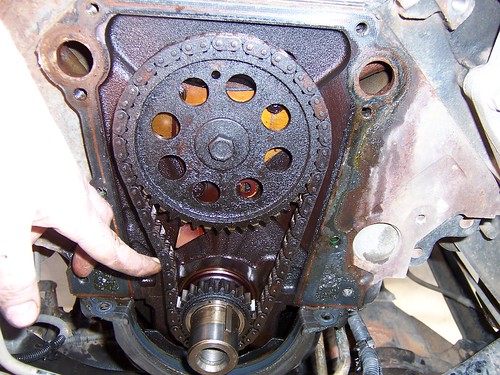

The picture I have of the lifter valley has shop rags stuffed in it, but it looked like the timing chain.
I had that crusty baked on oil all in my lifter valley and the valve train.
actually, I have pictures of it to back up what you're saying. I've run full synthetic for 54,000 miles.
The picture I have of the lifter valley has shop rags stuffed in it, but it looked like the timing chain.
Yes,
That's exactly what I am talking about regarding that baked on crust. So, that right there is more evidence to support that argument. This was exactly the case with those engines that I had seen myself at Cali Horsepower.
It was this baked on crust that you will not find on an engine that has been running dino oil. When pulling apart a engine that uses dino oil, it's parts are all shiny metal and, those parts clean up perfectly. Inside the valve covers, to the valve train etc- it all looks new.
I am glad that there's pics to back this up so that others can see what this looks like. I wasn't sure what the hell it was when I took mine apart but, I damn well knew something was up with that baked on s-h-i-t inside there- that's not supposed to be there for sure and, oh, before I forget again, here's another one to further add to the damage:
Listen to this one: (I almost forgot about this completely) When that baked on crust starts to "flake off" it ends up floating around in the engine thus blocking or restricting the oil passages / ports to some degree. This is the worst thing to have happen because, what you end up with is either a starved journal or bearing coupled with erratic oil pressure due to building and release of pressure. I've had this happen on a few occasions and couldn't for the life of me figure out what was going on.
Again, it wasn't until very recently that this was brought to my attention thus, the reason I felt the need to post.
The thought of using dino oil may seem like a step backwards in technology. At least, in my mind it is however, the proof is in the pudding so-to-speak and, after getting the facts, seeing more and more evidence along with performing real world tests on my own vehicle and noting the results, I now am almost 100% convinced that dino oil is the way to go.
I noted that even after days of the truck sitting, when it starts up, it does not clack, tick or make a racket as it had when using synthetic motor oil. Oil pressure is retained at the lifters and the roller rockers as well thus meaning less noise, less friction and possibly, less wear on the engine at startup as well.
The problem with those non-real world tests is that they are really testing how well the motor oil protects against wear / friction but, this is a continuous test that factors out everything in attempt to isolate the variables and minimize variation in the test which, is exactly the right thing to do when simply testing JUST the motor oils being compared. The test results and graphs are extremely accurate and in no way are manipulated or deviated from the original results. In good test practice, the labs used are industry standard labs, run by private parties who are not biased. They simply run / conduct the tests and post the results to which, all those tests are stored for a period of seven years at the labs for future examination or in some cases, legal cases.
However, those tests do not factor in cold starts, hot starts, loss of hydraulic pressure in the lifters during cold starts, and most importantly, the environmental affects over time. Those are not factored in at all.
When we look at the affects of what it has on the engine in other ways other than just lubrication properties, one has to look at the overall affect and weigh that out.
There's a reason why dino oil turns black. It's cleaning the engine. It's not breaking down, but rather doing what it was designed to do which is keep the engine parts clean. When using Amsoil, the first thing I noted was it almost remained new looking after 1k miles. I thought this was great. I didn't know- I simply thought it was holding up better. It was after the fact that someone older with way more experience explained why it still looked new- it was because it was NOT cleaning anything. And, it's not designed to clean anything either. When I spoke to a tech support and a chemist, they informed me that when putting a detergent into a synthetic oil, it causes other issues thus the reason that there's no detergents included. There's some chemical reaction that ends up having a negative influence on how well the oil flows and protects as well as inducing premature break down over time thus reducing the lubrication properties of the oil / synthetics.
After looking at the evidence, hearing other testimonials and running real-world tests on my own vehicle, I have come to the conclusion that running full synthetics in my old Dodge truck is not advantageous and have decided to simply use good old fashioned dino oil for the remainder of it's life span.
CM
That's exactly what I am talking about regarding that baked on crust. So, that right there is more evidence to support that argument. This was exactly the case with those engines that I had seen myself at Cali Horsepower.
It was this baked on crust that you will not find on an engine that has been running dino oil. When pulling apart a engine that uses dino oil, it's parts are all shiny metal and, those parts clean up perfectly. Inside the valve covers, to the valve train etc- it all looks new.
I am glad that there's pics to back this up so that others can see what this looks like. I wasn't sure what the hell it was when I took mine apart but, I damn well knew something was up with that baked on s-h-i-t inside there- that's not supposed to be there for sure and, oh, before I forget again, here's another one to further add to the damage:
Listen to this one: (I almost forgot about this completely) When that baked on crust starts to "flake off" it ends up floating around in the engine thus blocking or restricting the oil passages / ports to some degree. This is the worst thing to have happen because, what you end up with is either a starved journal or bearing coupled with erratic oil pressure due to building and release of pressure. I've had this happen on a few occasions and couldn't for the life of me figure out what was going on.
Again, it wasn't until very recently that this was brought to my attention thus, the reason I felt the need to post.
The thought of using dino oil may seem like a step backwards in technology. At least, in my mind it is however, the proof is in the pudding so-to-speak and, after getting the facts, seeing more and more evidence along with performing real world tests on my own vehicle and noting the results, I now am almost 100% convinced that dino oil is the way to go.
I noted that even after days of the truck sitting, when it starts up, it does not clack, tick or make a racket as it had when using synthetic motor oil. Oil pressure is retained at the lifters and the roller rockers as well thus meaning less noise, less friction and possibly, less wear on the engine at startup as well.
The problem with those non-real world tests is that they are really testing how well the motor oil protects against wear / friction but, this is a continuous test that factors out everything in attempt to isolate the variables and minimize variation in the test which, is exactly the right thing to do when simply testing JUST the motor oils being compared. The test results and graphs are extremely accurate and in no way are manipulated or deviated from the original results. In good test practice, the labs used are industry standard labs, run by private parties who are not biased. They simply run / conduct the tests and post the results to which, all those tests are stored for a period of seven years at the labs for future examination or in some cases, legal cases.
However, those tests do not factor in cold starts, hot starts, loss of hydraulic pressure in the lifters during cold starts, and most importantly, the environmental affects over time. Those are not factored in at all.
When we look at the affects of what it has on the engine in other ways other than just lubrication properties, one has to look at the overall affect and weigh that out.
There's a reason why dino oil turns black. It's cleaning the engine. It's not breaking down, but rather doing what it was designed to do which is keep the engine parts clean. When using Amsoil, the first thing I noted was it almost remained new looking after 1k miles. I thought this was great. I didn't know- I simply thought it was holding up better. It was after the fact that someone older with way more experience explained why it still looked new- it was because it was NOT cleaning anything. And, it's not designed to clean anything either. When I spoke to a tech support and a chemist, they informed me that when putting a detergent into a synthetic oil, it causes other issues thus the reason that there's no detergents included. There's some chemical reaction that ends up having a negative influence on how well the oil flows and protects as well as inducing premature break down over time thus reducing the lubrication properties of the oil / synthetics.
After looking at the evidence, hearing other testimonials and running real-world tests on my own vehicle, I have come to the conclusion that running full synthetics in my old Dodge truck is not advantageous and have decided to simply use good old fashioned dino oil for the remainder of it's life span.
CM
Well I'm definitely going back to dino oil. I've ran synthetic since I got the truck because I assumed it was better because of the higher resistance to heat and longer life before it starts to break down, even though I change it at 3000 miles religiously.
Here's another picture of the baked on crap that was taken pretty soon after I took the timing chain off my truck with the sun on it to give you a good reference.
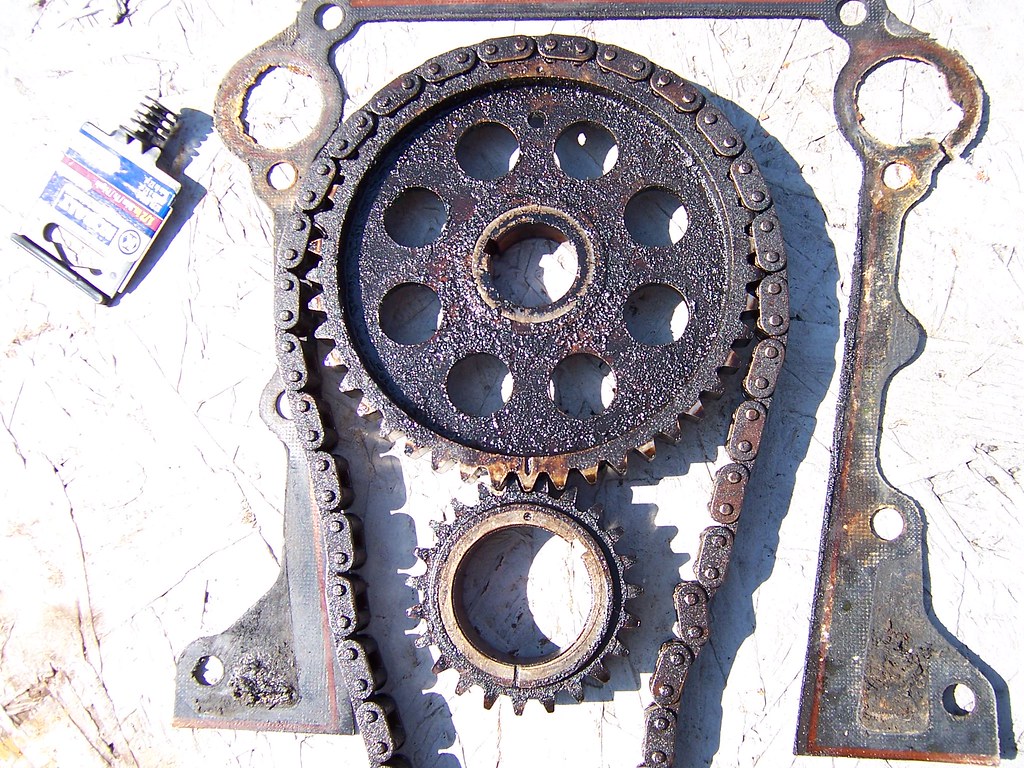
Here's another picture of the baked on crap that was taken pretty soon after I took the timing chain off my truck with the sun on it to give you a good reference.
You should have seen mine after running Mobile 1, Valvoline Synthetic, Penzoil Synthetic and Castrol Synthetic for almost 200k! I only recently started to use Amsoil. Prior to that, it was a "variety pack". Now I know why it didn't matter which brand I went with in terms of it not making a notable difference. The only time I noted a difference and, a BIG difference at that was when I switched back to dino oil. LOL
In the heads, on the valve springs- man, it was huge flakes of crusty material that were loose and floating around in the valve train. The lifter valley looked like a BBQ grill as well as the super crusty chain like yours. Looks like the damage sets in quick as I note you've been running it for what, 50+K miles?
CM
In the heads, on the valve springs- man, it was huge flakes of crusty material that were loose and floating around in the valve train. The lifter valley looked like a BBQ grill as well as the super crusty chain like yours. Looks like the damage sets in quick as I note you've been running it for what, 50+K miles?
CM
Thread Starter
|
Registered User
Joined: May 2009
Posts: 2
Likes: 0
From: Harrington, DE
I appreciate all the info. I don't think running full synthetic would be the best option for me. Would running a synthetic blend cause any issues?
Trending Topics

Legend


Joined: May 2005
Posts: 8,660
Likes: 7
From: Central Oklahoma
That's a myth which should not be perpetuated.

Legend
Joined: May 2005
Posts: 8,660
Likes: 7
From: Central Oklahoma
I am still dubious of these claims that Synthetics cook and can't maintain lifter pressure. Chevrolet and Porsche both use Mobil Full Synthetic in their engines. Those of you who switched to synthetics *after* purchasing your trucks bought the trucks used. You have no idea what kind of maintenance schedule, if any, the PO followed.