


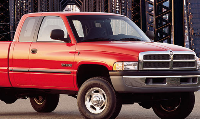
5.2 to 5.9, with an auto to manual Swap to boot.


I also spoke to a friend who had them installed, and the installer never spoke to him about any clearance issues.

Champion
Joined: Sep 2011
Posts: 3,891
Likes: 8
From: NorCal
Yeah the occasional Class 6 road here and there. She's not afraid to get a little dirty. I read that entire forum, WN had posted up before. I think I'm sold on that M1. I think with some EQ 2.02 heads, cam, exhaust and others, this will be additive to the whole set-up.
I do like to have low-end, on the occasional boat tow or especially when cruising on the highway.
The only part of that thread I was lost about is when they talked about EGR. I don't really understand that. I know its a Exhaust Gas Recirculation, but not sure if I will require it or not. Pretty significant price difference between the EGR and Non-EGR.
I do like to have low-end, on the occasional boat tow or especially when cruising on the highway.
The only part of that thread I was lost about is when they talked about EGR. I don't really understand that. I know its a Exhaust Gas Recirculation, but not sure if I will require it or not. Pretty significant price difference between the EGR and Non-EGR.
Did you not see that the Air Gap cfm is well above the stock intake? It's not like it falls on its face. Alot of people here report good results. However, that is all they know and likewise all I know of my own M1 2bbl. Problem is finding M1 2bbl...not made new anymore.
Of the 2, torque is out of the equation anyways. They don't contribute enough to amount to a hill of beans. If you think you're gonna get hung up on torque, you're not looking at your package together. You said street application...so what tire size will you stick with plus gear ratio? Those things will have an immediate impact on torque if matched properly.


Record Breaker


Joined: Sep 2012
Posts: 2,439
Likes: 73
From: S. Florida
And it is not about having the biggest/most/highest... any successful build is about matching the components to work together well.
If you're not building a high RPM race motor, then the highest CFM flow rate manifold isn't going to be any better for you than one of the lesser flow rate manifolds... remember, these max flow rate numbers are what the manifold is capable of... your engine may never flow that amount because of other component restrictions, or you never use it at the top of its RPM range... in fact, looking at the runner length for your application might make more sense than the CFM.
The same goes for choosing larger or smaller valves in your heads... the large valve will flow more at max RPM, but at lower RPM (where you'll be typically running your engine) with a big valve the velocity of the air entering the cylinder will be slow meaning you don't get the best scavenge, and therefore less usable power.
Bigger is not always best...
If you're not building a high RPM race motor, then the highest CFM flow rate manifold isn't going to be any better for you than one of the lesser flow rate manifolds... remember, these max flow rate numbers are what the manifold is capable of... your engine may never flow that amount because of other component restrictions, or you never use it at the top of its RPM range... in fact, looking at the runner length for your application might make more sense than the CFM.
The same goes for choosing larger or smaller valves in your heads... the large valve will flow more at max RPM, but at lower RPM (where you'll be typically running your engine) with a big valve the velocity of the air entering the cylinder will be slow meaning you don't get the best scavenge, and therefore less usable power.
Bigger is not always best...
Did you not see that the Air Gap cfm is well above the stock intake? It's not like it falls on its face. Alot of people here report good results. However, that is all they know and likewise all I know of my own M1 2bbl. Problem is finding M1 2bbl...not made new anymore.
Of the 2, torque is out of the equation anyways. They don't contribute enough to amount to a hill of beans. If you think you're gonna get hung up on torque, you're not looking at your package together. You said street application...so what tire size will you stick with plus gear ratio? Those things will have an immediate impact on torque if matched properly.
Of the 2, torque is out of the equation anyways. They don't contribute enough to amount to a hill of beans. If you think you're gonna get hung up on torque, you're not looking at your package together. You said street application...so what tire size will you stick with plus gear ratio? Those things will have an immediate impact on torque if matched properly.
I'm running 295/75/16 which equates to like 33.7in. I plan on sticking with this tire size. I have 3.55 gears right now, which I really hate but hopefully by summer time that'll change. I'm on the fence about either 4.10 or 4.56. I did some calculations, with 4.10 I'll run just about 2k rpm at 70, and with the 4.56 I'll run about 2200rpm at 70. I'm not too sure. I pretty much do equal highway and around town, maybe a little more around town.
I dorm at school 5 days a week and travel back and forth every week 50 miles each way so just about 100miles in highway each week, but I do travel from Long Island to N.H. a few times a year, and upstate New York. I do drive around town never often hitting overdrive on the weekends and all during the summer, and do some hauling of scrap metal and such occasionally so I'm really drawn between the two gear ratios.
And it is not about having the biggest/most/highest... any successful build is about matching the components to work together well.
If you're not building a high RPM race motor, then the highest CFM flow rate manifold isn't going to be any better for you than one of the lesser flow rate manifolds... remember, these max flow rate numbers are what the manifold is capable of... your engine may never flow that amount because of other component restrictions, or you never use it at the top of its RPM range... in fact, looking at the runner length for your application might make more sense than the CFM.
The same goes for choosing larger or smaller valves in your heads... the large valve will flow more at max RPM, but at lower RPM (where you'll be typically running your engine) with a big valve the velocity of the air entering the cylinder will be slow meaning you don't get the best scavenge, and therefore less usable power.
Bigger is not always best...
If you're not building a high RPM race motor, then the highest CFM flow rate manifold isn't going to be any better for you than one of the lesser flow rate manifolds... remember, these max flow rate numbers are what the manifold is capable of... your engine may never flow that amount because of other component restrictions, or you never use it at the top of its RPM range... in fact, looking at the runner length for your application might make more sense than the CFM.
The same goes for choosing larger or smaller valves in your heads... the large valve will flow more at max RPM, but at lower RPM (where you'll be typically running your engine) with a big valve the velocity of the air entering the cylinder will be slow meaning you don't get the best scavenge, and therefore less usable power.
Bigger is not always best...
I am typically a slow driver, more or less just like to baby my truck, but every now and again I like to get on it. Do you think there will be a big torue difference with 1.92 valves vs 2.02?
I was talking to a guy at a local engine shop the other day and he said I won't really notice a heck of a lot with the larger 2.02 valves, but that's just what he has said.

The ARPs are just a nice quality product, they have beveled washers to get a smooth accurate toque.
Record Breaker
Joined: Sep 2012
Posts: 2,439
Likes: 73
From: S. Florida
Longer runners will give better torque (needed for acceleration) and put your peek HP at a lower RPM than a short runner.
I am typically a slow driver, more or less just like to baby my truck, but every now and again I like to get on it. Do you think there will be a big torque difference with 1.92 valves vs 2.02?
I was talking to a guy at a local engine shop the other day and he said I won't really notice a heck of a lot with the larger 2.02 valves, but that's just what he has said.
I was talking to a guy at a local engine shop the other day and he said I won't really notice a heck of a lot with the larger 2.02 valves, but that's just what he has said.
This is why your shop guy is telling you wont notice the difference in having bigger valves... even at 4500rpm, you haven't reached the maximum flow rate of the 1.92" valves... that's almost twice as hard as you on plan driving.
When I get into mine with hard acceleration, I'm lucky to make it to 3500rpm... on 265/75/16's with 3.55 axle I'm in the vicinity of 2000rpm at 65mph and 2200rpm at 75mph.
Last edited by Spillage; Jan 25, 2015 at 05:35 PM.

