


HHR Fan Installed


King Jackass
Joined: Jan 2008
Posts: 1,610
Likes: 5
From: Aurora, CO

I think it works a little better. However, I don't have a 180 degree thermostat in. I am still running a factory one. So, the temps are just a little lower than what they were with the factory fan.
Thread Starter
|
Grand Champion
Joined: Apr 2009
Posts: 5,293
Likes: 3
From: Kekaha, HI
I'm glad its working for you. I like the SPAL because it gives you complete control over temps, high speed, low speed, A/C and when you want it to turn on/off.

Veteran
Joined: Aug 2009
Posts: 271
Likes: 0
From: Bluefield, WV
I just ordered an HHR fan today from Rockauto.com
I went with a Derale fan controller from summit racing ($40.00)
Its adjustable, has an a/c trigger wire and a 3/8ths npt temp sensor
(shut off is -10°F from trigger temp)
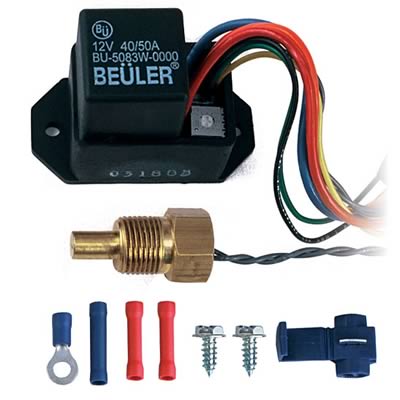
http://www.summitracing.com/parts/DER-16749/
what cha think??
So what extra control does the SPAL give you over the fan?
Thread Starter
|
Grand Champion
Joined: Apr 2009
Posts: 5,293
Likes: 3
From: Kekaha, HI
That is the same controller that Eric has. He might be able to tell you more. The SPAL allows you to control when (i.e. temps, A/C etc) the fan comes on and what speeds the fan runs.
Lets say you want the fan to come on at 150 degrees and run on low speed until 180 degrees and then the SPAL will switch to high speed. Some controllers only give you one fan speed and sometimes its only the low speed.
Lets say you want the fan to come on at 150 degrees and run on low speed until 180 degrees and then the SPAL will switch to high speed. Some controllers only give you one fan speed and sometimes its only the low speed.
Veteran
Joined: Aug 2009
Posts: 271
Likes: 0
From: Bluefield, WV
That is the same controller that Eric has. He might be able to tell you more. The SPAL allows you to control when (i.e. temps, A/C etc) the fan comes on and what speeds the fan runs.
Lets say you want the fan to come on at 150 degrees and run on low speed until 180 degrees and then the SPAL will switch to high speed. Some controllers only give you one fan speed and sometimes its only the low speed.
Lets say you want the fan to come on at 150 degrees and run on low speed until 180 degrees and then the SPAL will switch to high speed. Some controllers only give you one fan speed and sometimes its only the low speed.
I'm pretty confident on my electronics/wiring skills... did I mention I was an electronics tech...

I read up on that SPAL, the only real difference would be cut off temp being set lower, and the ability to run it at half power. Then again, some motors can get picky/pissed if they're not fed what they want resulting in premature failure, so I'm more partial to the on/off system vs the secondary power setting of the SPAL.
Veteran
Joined: Aug 2009
Posts: 271
Likes: 0
From: Bluefield, WV
NOW... I'VE HAD AN EPIPHANY!!!!!!!!!!!!!
Follow my reasoning and it will make sense...
The e-fan conversion can slightly tax the electrical system, our trucks run a 136 amp alternator, while the HHR runs a 115 amp. However the V8 motor runs at a lower RPM then the 2.2/2/5 motor. So a slight boost in alternator performance would ensure efficient/proper electrical system operation...
Our alternators are using a 2 7/16ths pulley, so by installing a smaller pulley it would increase the alternator output at lower RPM/speeds.
http://www.alternatorparts.com/pulley_size.htm
Its late and its dark out so I'm not crawlin under the truck to measure the crank pulley, but I did measure the Alternator pulley.
I'm attaching a chart showing the Diameters of available pulleys and their differences represented in inches and percentage of difference vs the original. Also the factory belt is 88.125" long so I did a comparison with that as a reference for rotations. Do NOT confuse it with actual engine RPMS or you'll give yourself a heart attack!!
Any input or ideas is greatly appreciated as I'm fairly sure I'll be changing my pulley to give more efficient operation in the lower RPM range.
Follow my reasoning and it will make sense...
The e-fan conversion can slightly tax the electrical system, our trucks run a 136 amp alternator, while the HHR runs a 115 amp. However the V8 motor runs at a lower RPM then the 2.2/2/5 motor. So a slight boost in alternator performance would ensure efficient/proper electrical system operation...
Our alternators are using a 2 7/16ths pulley, so by installing a smaller pulley it would increase the alternator output at lower RPM/speeds.
http://www.alternatorparts.com/pulley_size.htm
Alternator and Engine RPM is not the same.
To calculate alternator RPM, determine the ratio between the crank pulley and the alternator pulley diameters.
Ratio = Crankshaft Pulley Diameter/ Alternator Pulley Diameter
Alternator RPM = Pulley Ratio x Engine Speed (example; 2.1 x 870 = 1827 Rotor RPM)
To calculate alternator RPM, determine the ratio between the crank pulley and the alternator pulley diameters.
Ratio = Crankshaft Pulley Diameter/ Alternator Pulley Diameter
Alternator RPM = Pulley Ratio x Engine Speed (example; 2.1 x 870 = 1827 Rotor RPM)
I'm attaching a chart showing the Diameters of available pulleys and their differences represented in inches and percentage of difference vs the original. Also the factory belt is 88.125" long so I did a comparison with that as a reference for rotations. Do NOT confuse it with actual engine RPMS or you'll give yourself a heart attack!!
Any input or ideas is greatly appreciated as I'm fairly sure I'll be changing my pulley to give more efficient operation in the lower RPM range.
Last edited by Ueland; Sep 26, 2010 at 03:57 PM.

Record Breaker
Joined: Jul 2010
Posts: 1,649
Likes: 1
From: Fort Hood, Texas
I dont know if i've already asked this or not...but if our trucks are running at 1/4 temperature gauge does that mean that during winter the heat wont be that good and hot for heat in the cab?
Thread Starter
|
Grand Champion
Joined: Apr 2009
Posts: 5,293
Likes: 3
From: Kekaha, HI
Let us know how that works out for you and throw up some pics. I never really thought about making the alternator more efficient. I definitely want to see how it turns out.

Champion
Joined: Feb 2010
Posts: 3,686
Likes: 0
From: Greenfield, Wisconsin
You have to be careful when putting a smaller pulley on the alternator though dont you? as it will put more strain on the engine .... just like a clutch fan. Can you calculate how much more HP it will take from the engine to turn a smaller pulley, or will it be minimal? Just thinking outloud here.
Veteran
Joined: Aug 2009
Posts: 271
Likes: 0
From: Bluefield, WV
You have to be careful when putting a smaller pulley on the alternator though dont you? as it will put more strain on the engine .... just like a clutch fan. Can you calculate how much more HP it will take from the engine to turn a smaller pulley, or will it be minimal? Just thinking outloud here.
The charging gains would be at low RPM only as the alternator does reach a "critical mass" point where it can only output so much current (which is regulated by the charging system)
Ok.. here's the part where I need help... still trying to figure out the optimal choice and need to double check the figures cause they look pretty high... Anyone got technical data on our alternators? ie spec sheet etc or know where to get one?
Last edited by Ueland; Sep 26, 2010 at 03:58 PM.