


Ride along with me...


Thread Starter
|
Captain

Joined: Oct 2005
Posts: 568
Likes: 8
From: The Summit, Queensland, Australia

Morning came and, as always when I sleep in the car, I woke early. I drove on into Senta, tidied myself up a bit and set the Garmin the task of finding the address I’d been given. It was Saturday morning, about 7am, when I found the place. Tucked away in a leafy back-street with high fences and a gate to match. Beside the gate was a button to operate a doorbell.
Soon the gate opened and the I presented the lady with an envelope addressed to her and her husband. She read it, turned and called him over, he read it too. The gates were swung open and I was ushered to drive in. My hosts for the next two days and nights…
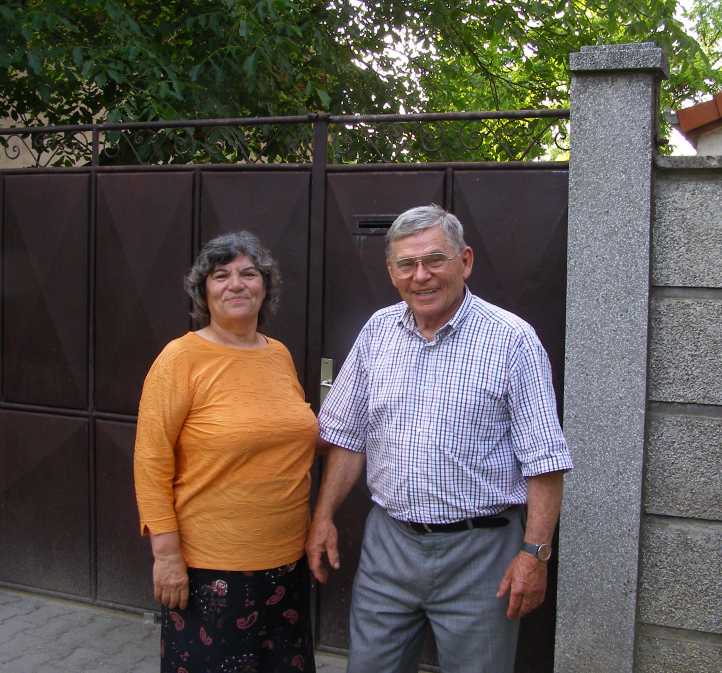
My hosts. Making me totally welcome on the strength of the little letter from our mutual friend, this couple were most welcoming to me.
…had once lived in Australia for a short time, but virtually all recollection of the English language had been forgotten. But they hadn’t forgotten simple hospitality, they showed me to my room:
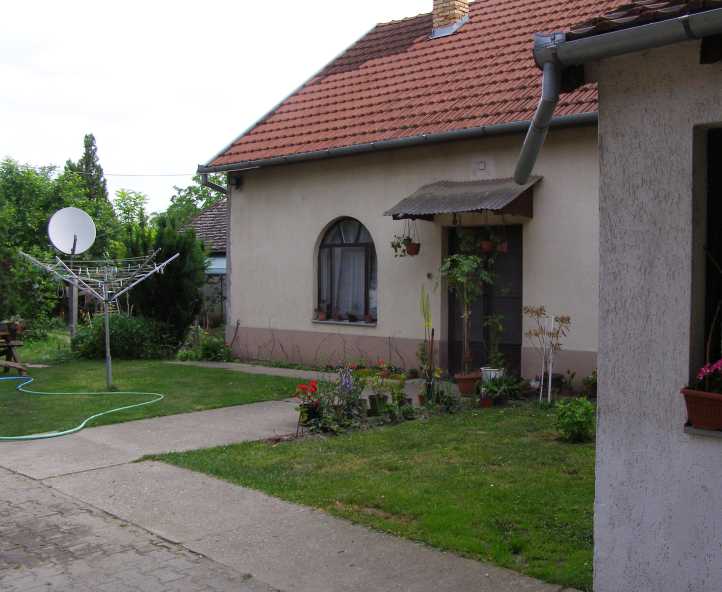
My room. A separate self-contained room with en-suite was my home for the two nights I’d spend here. Just wonderful hospitality.
And speaking of forgetting, I’ve forgotten their names. So throughout this I will assign names to people which are not their real names.
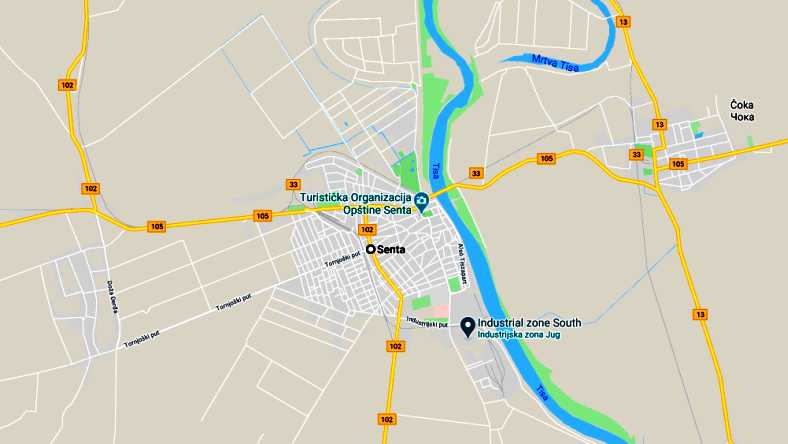
When I’d arrived, Karl had been working on a van which is registered in Austria. He worked for many years in Austria and this was a legacy of that time and it was now due for its annual inspection. A couple of small jobs had to be done, and as he completed one of them I helped him put one of the front wheels back on. After that he was due to meet some of his friends in another part of town… oh, yes, the town. Here’s the local map showing Senta, and across the river is Coka, which comes into the day’s story too:
I drove Karl to the gathering and he lined me up with Jorge, a younger man, a big bloke, who spoke perfect English:
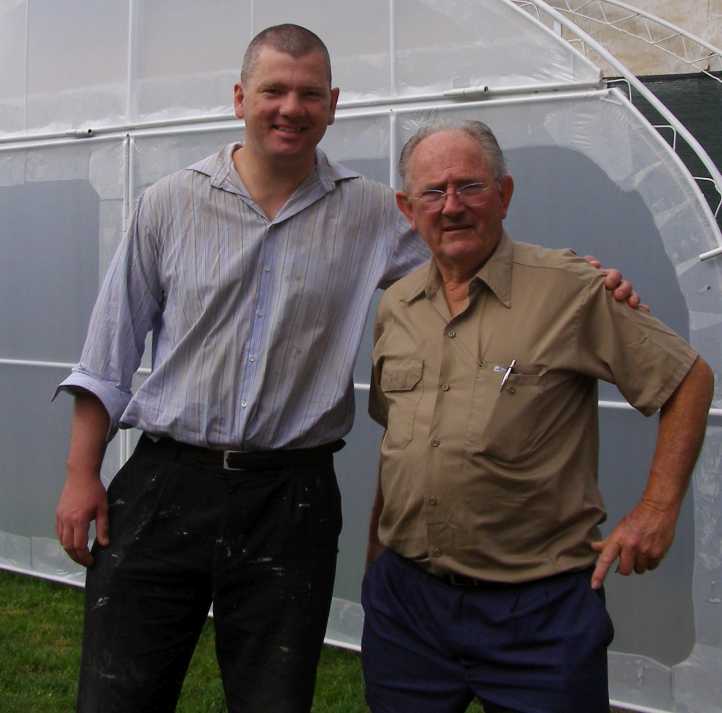
Friends. Jorge and I hit it off very well, he spoke good English and we shared good conversation.
We went for a little drive so he could show me around town. He didn’t have a car and I was rapidly coming to the conclusion that life in these parts isn’t as prosperous as I’m used to seeing. The town mixes leafy green with old-world and wasn’t beset with much in the way of traffic problems. Many people were on bicycles…
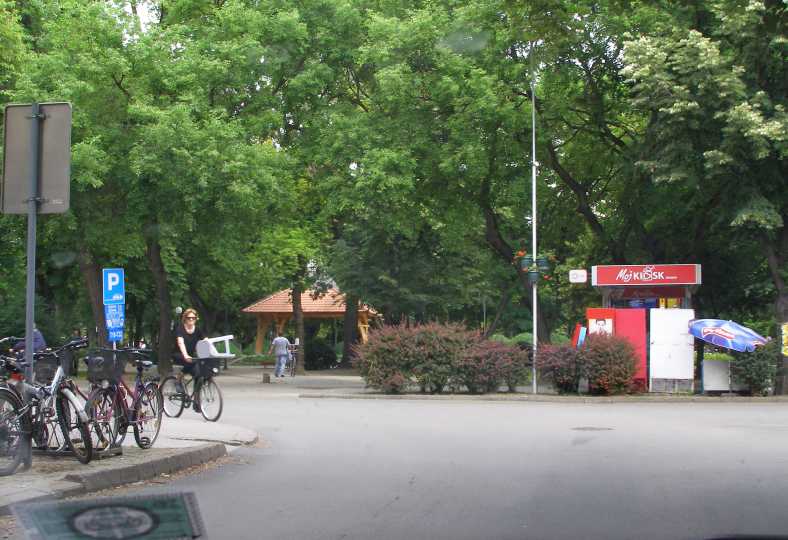
Parklands. This park near the centre of town was green, neat and clean. Note the lady carrying a stool on her handlebars.
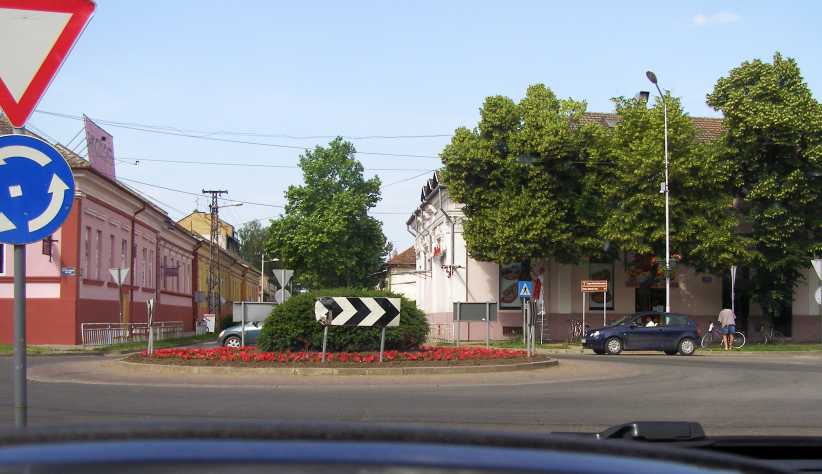
Roundabout. With neatly painted buildings and flowers on the roundabout, some attention is being paid to aesthetics.
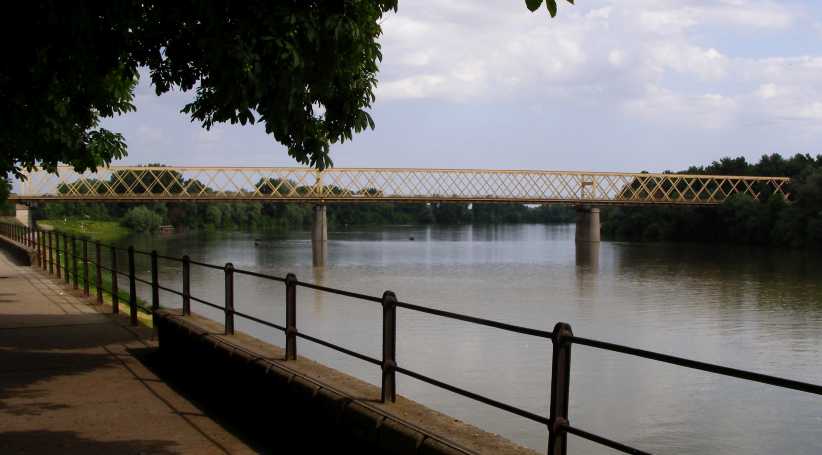
The bridge. The bridge between Senta and Coka looks very plain, a better looking one had been there but in World War 2 it was bombed and it still lies in the mud below this one.
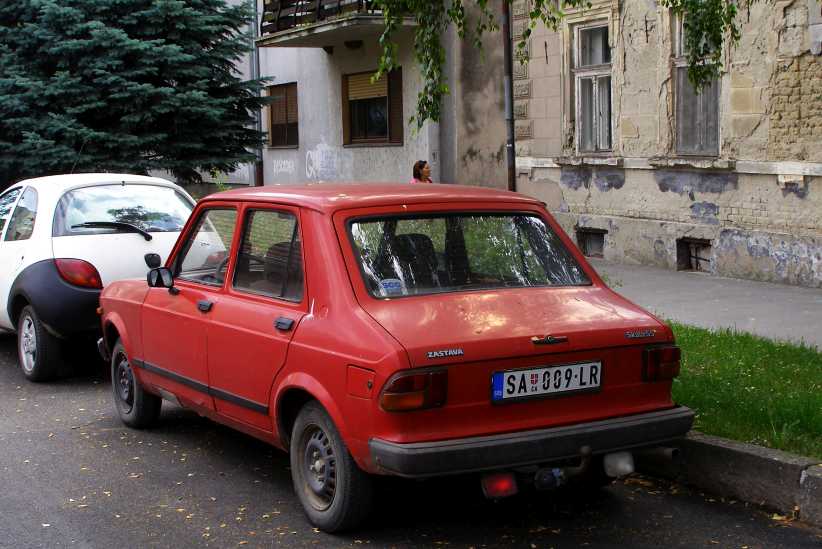
Zastava. A locally-built car made by an armament manufacturer, the car in front of it is a Ford Ka. Some of the buildings here are showing their age.
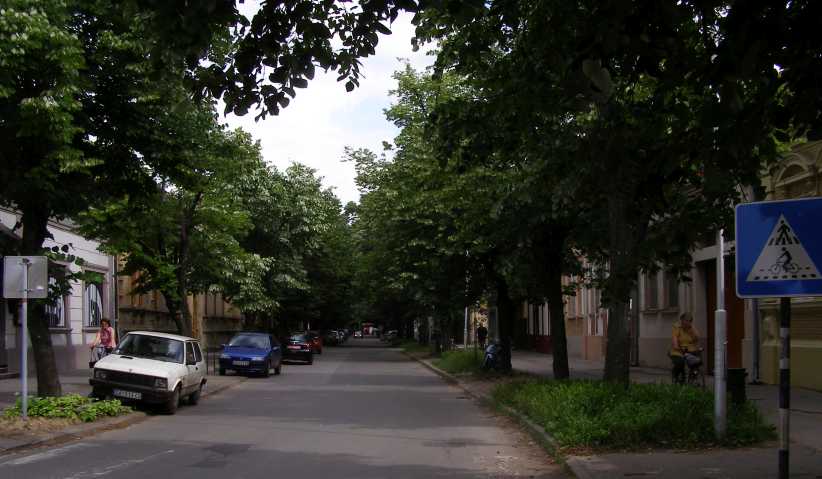
Cyclists. The flat country in Senta lends itself to cycling for local transport. There are three cyclists in this photo.
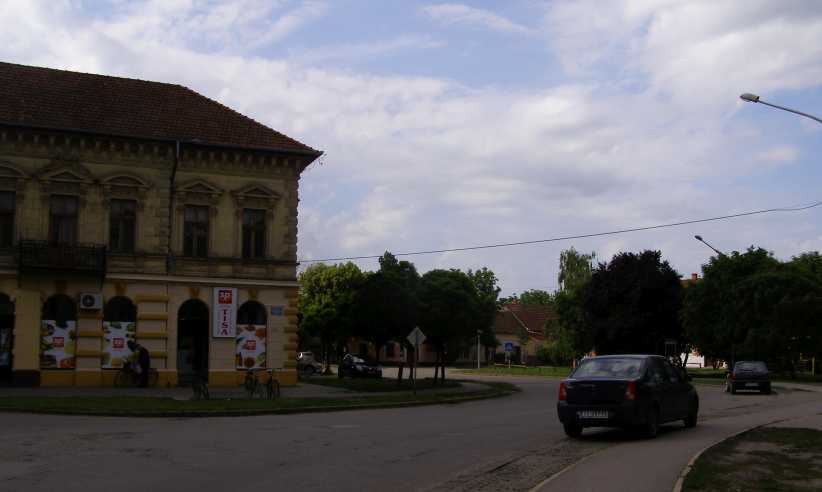
Classical. Many buildings were like this one, reflecting the more intricate building styles of much earlier times.
We looked around and talked about many things, then as I’d decided to buy some meat for my hosts so that I wouldn’t be so much of a burden that evening, Jorge took me to the right butcher so I could get a nice beef roast. I left him about midday, as I did he told me to pick him up again at about 3pm as there was a bit of a get-together at a lady’s place in Coka and I’d been invited. Surprised me.
Back at Karl’s place I handed over the meat and explained about my allergies so that we wouldn’t have any problems with that. Everyday life was going on in their home except that this stranger was there and none of us could understand what we were saying. But we were able to get some things through and having some fun. The family cats had to be fed…
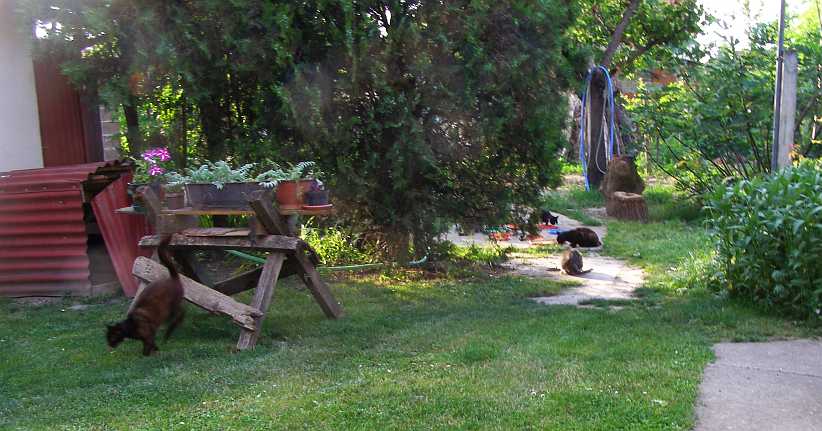
Cats feeding. Karl and Myra had plenty of cats to feed, each knew their own dish.
…and other people came to visit and keep things busy…
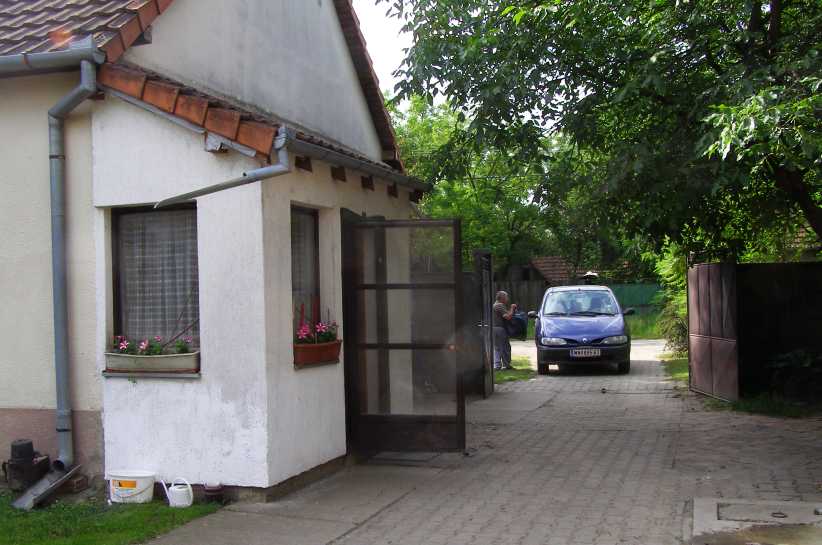
More visitors. Friends dropped around to visit Karl and Myra, the gateway seemed to be earning its keep.
…and Karl played music on a CD player and sang out loudly in the lounge room for a while. He loves to sing.
Jorge phoned to tell me it would be more like 3:30 I had to pick him up, and that soon came. We drove through town, across the bridge and turned into Coka. Following his directions we went out the other side and onto some roads between some farms before finding the place we had to visit.
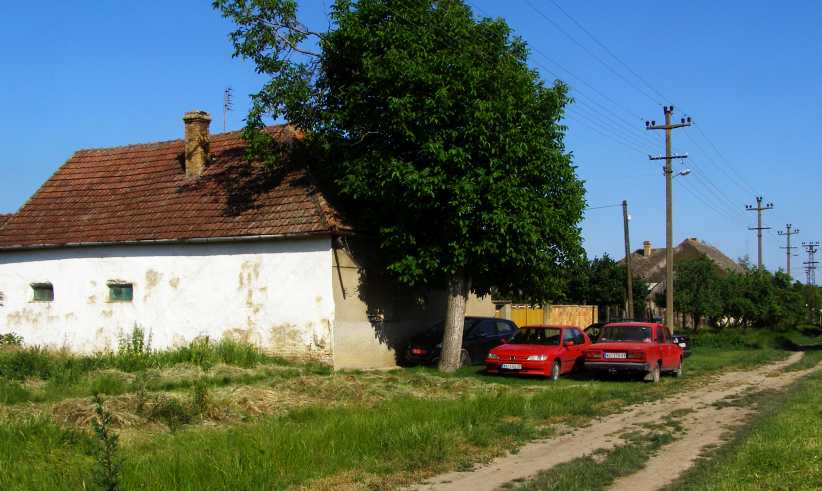
Party house. Nothing extraordinary about the old brick home we went to visit, but what was to take place was something not so ordinary.
We went in though the big gate to find a yard of somewhere between one and two acres. Much of the area was under cultivation, I didn’t ask, but I’m guessing that some of the produce is sold locally and traded with friends for whatever they might be growing. This community is not overflowing with money.
Hospitality, on the other hand, was abundant. I was ushered into the kitchen where I was quickly offered a drink and snacks. We talked about common subjects and before long we were taking the table out of the kitchen to set up in the shade outside as more people were arriving. And someone brought a soccer ball.
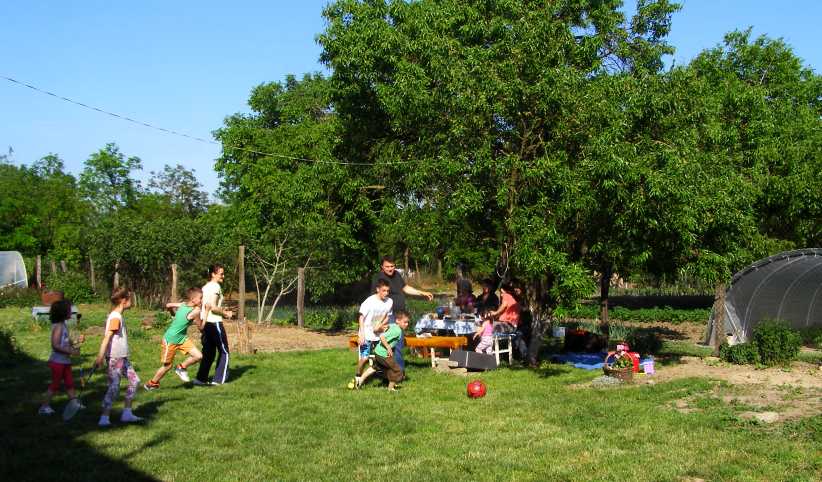
Getting busy. With the table under a tree and conversations going strongly there, others were running around chasing a soccer ball.
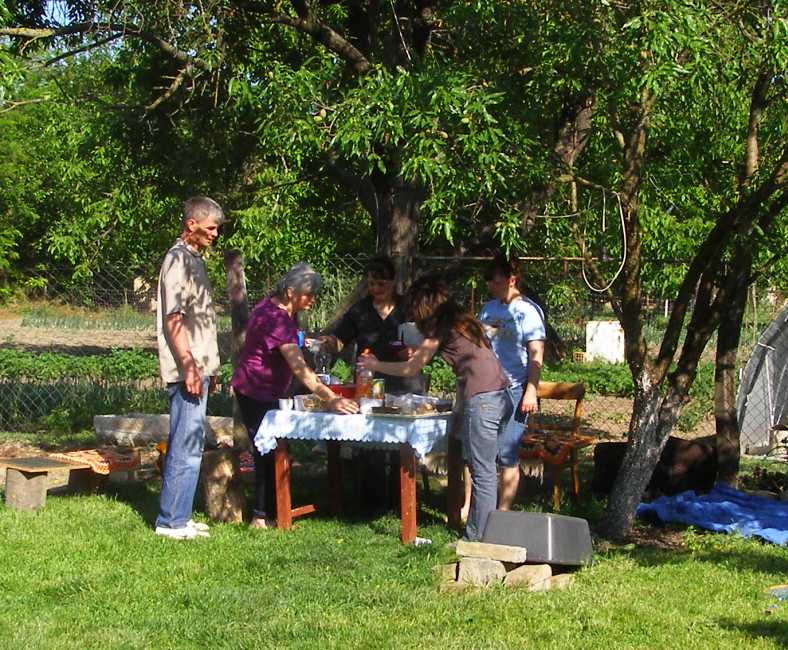
Moving. The table had filled as people arrived and brought more supplies. But the sun was moving too and the decision was taken to move the table back next to the house so it would be in the shade, here they’re preparing it for the transfer.
Just looking at this next photo you can see how ‘weathered’ the home is. Sags in the roof of the laundry in particular, but that was no impediment to those enjoying themselves with good company and friends coming from up to 100kms away.
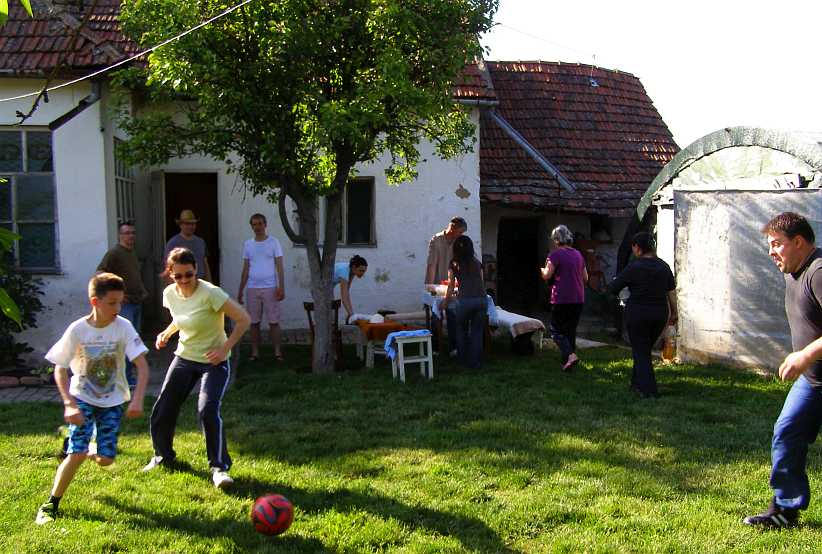
Mums and dads. While the soccer ball was mainly moved about by the kids, some of the mums and dads joined in at times.
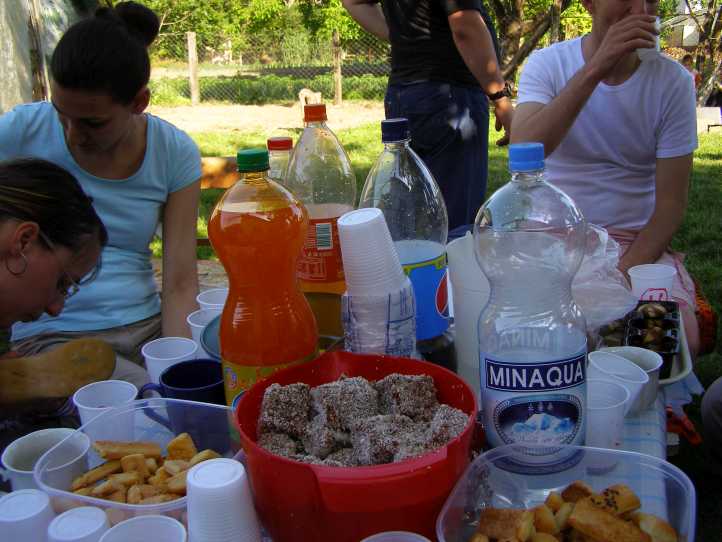
Snacks and drinks. The table became weighed down more as each family arrived, there was plenty for everyone, including the kids.
As one who has heard for years that the ‘lamington’ cake is an Australian invention, I was a little surprised to see the bucketful of them. Supposedly, the ‘lamington’ (sponge cake coated with chocolate sauce and rolled in desiccated coconut) was the invention of the French chef employed by the Governor of Queensland in the late 1800s and was named after him, Lord Lamington.
The lovely people I was with in Serbia told me they called this serving ‘Coconut Cubes’, which makes sense. Personally, I always thought it was a means by which people could convince their kids that two-day-old cake was worth eating. And I think all of this puts doubt on the idea that it was invented for the Governor of Queensland.
Of course, such things attracted children to the table when not running around after the soccer ball. I have since felt that this photo…
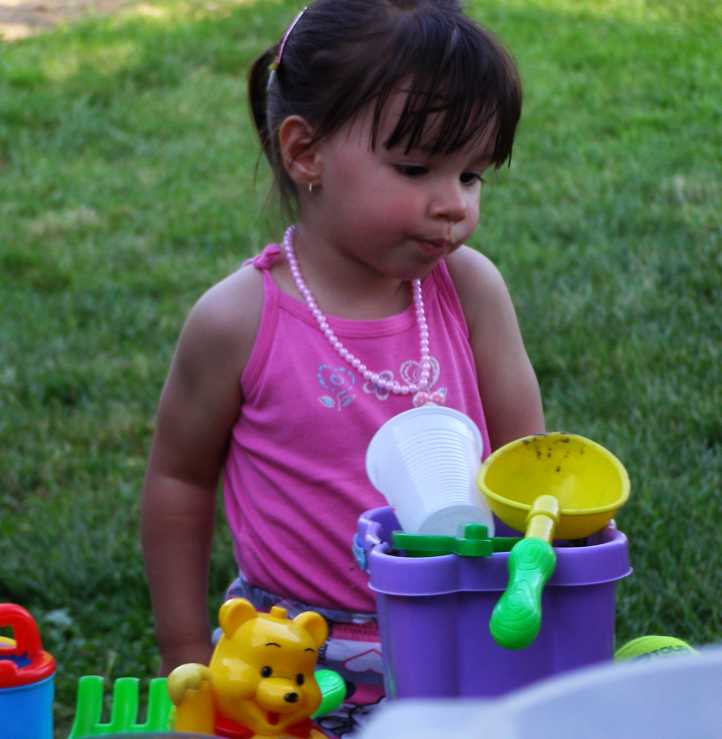
Little Cutey. She might be three, right? And while the bigger kids were running around everywhere, she was leading her own quiet life.
…is just a great little study of a little girl. Her necklace and earrings, the carefree life such a child should have, all is evident in this picture (to me).
Meanwhile, this picture also tells a story…
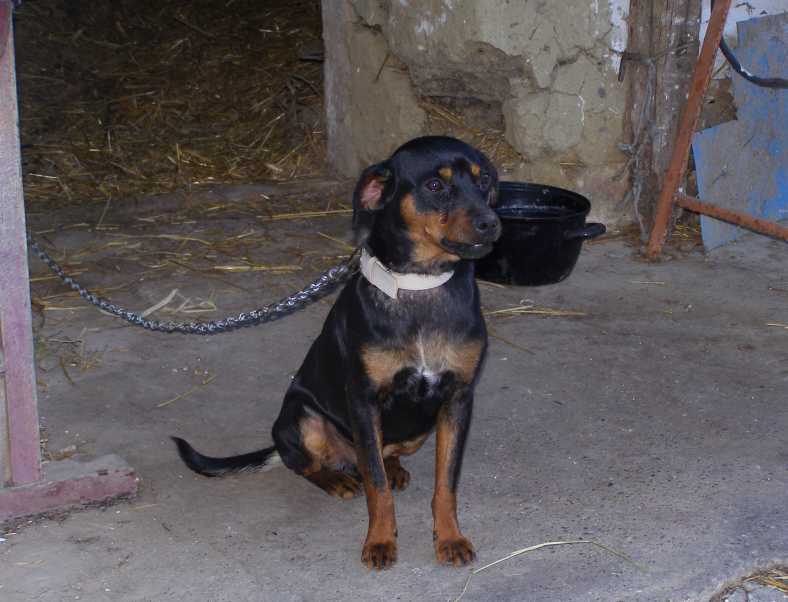
Poor dog! Watching all the fun but tied up at the laundry door…
…as this poor little dog sat there watching all the fun and was unable to join in.
Another character study, note the tongue:
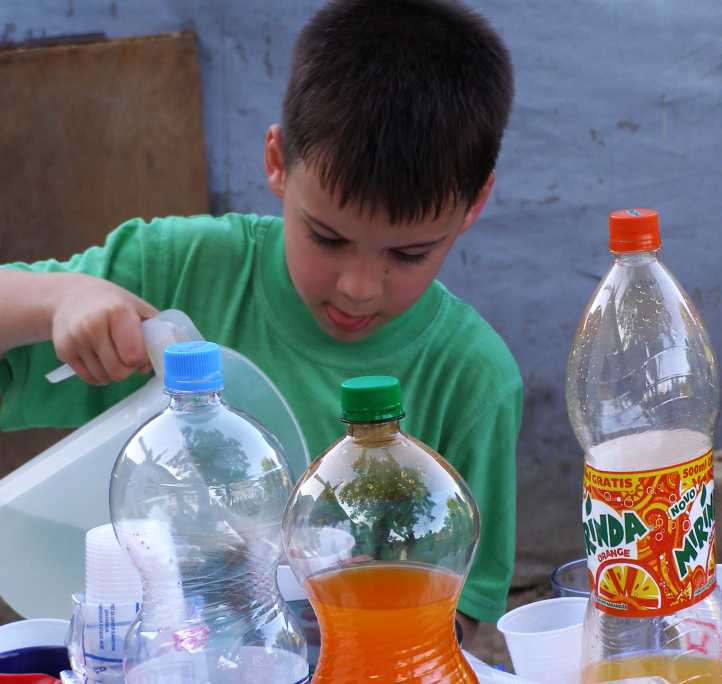
Pouring a drink. One of the youngest of the boys present pours himself a drink between attempts at getting a kick of the ball.
He was soon back into the action, as can be seen here…
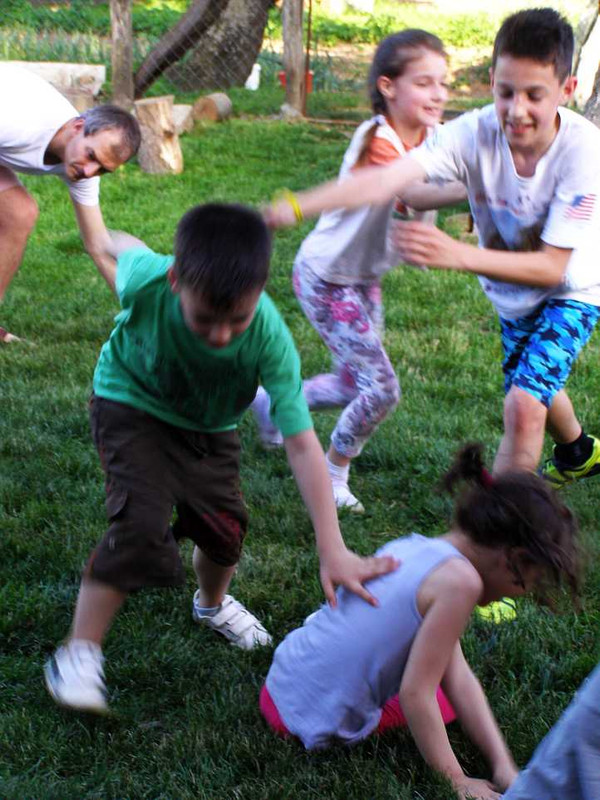
All-in action! Tumbling over each other, adults included, they were having a ball. Literally.
…and some serious attempts were made at kicking goals from well back in the ‘field’ too:
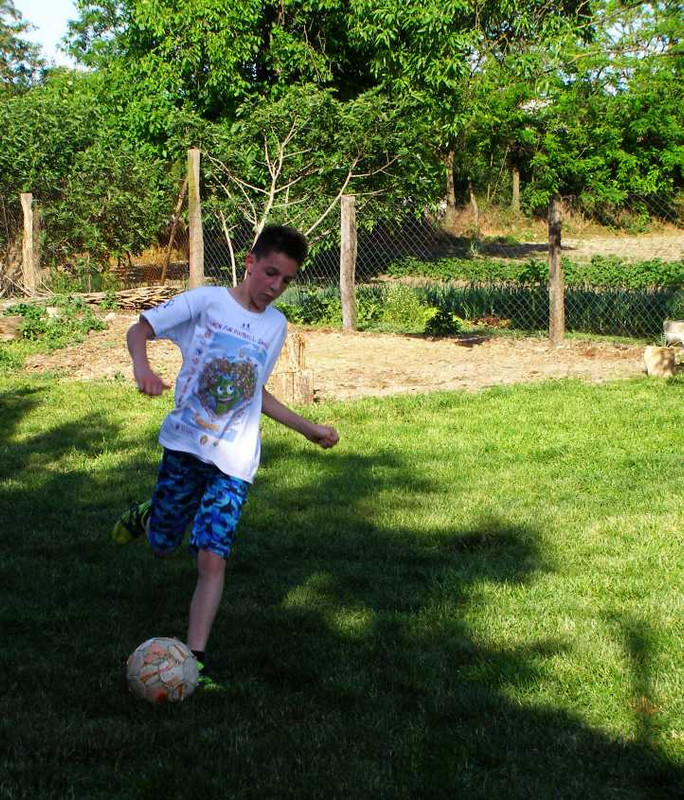
Lining up. You can see that this young bloke is intent on getting one ‘into the net’ as he lines up his shot…
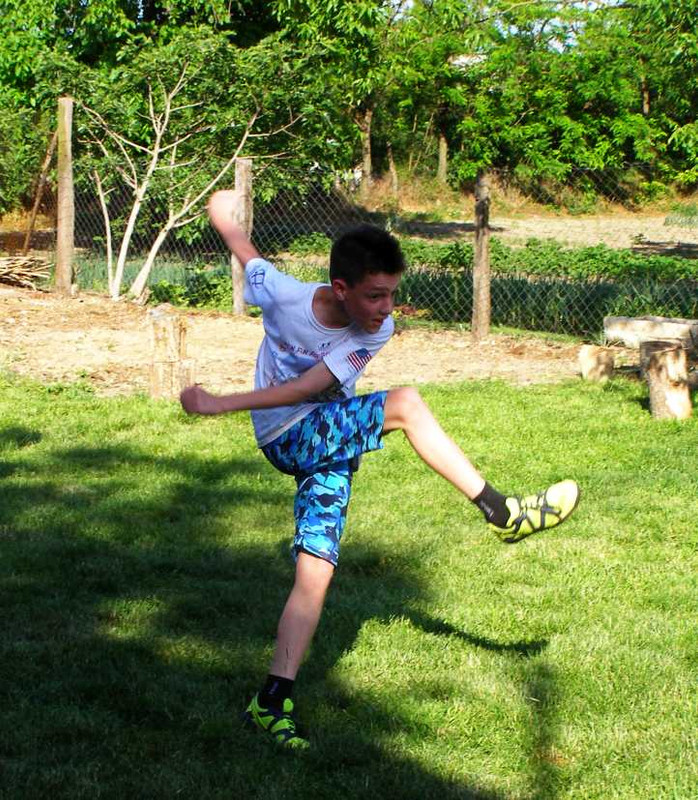
The big kick. …and then he takes his shot, a mighty kick that will go the distance.
There was only one goal as it wasn’t a ‘match’ as such. Just practising for their own pleasure and exercise. But there was always a goalie there to try to stop the ball getting through:
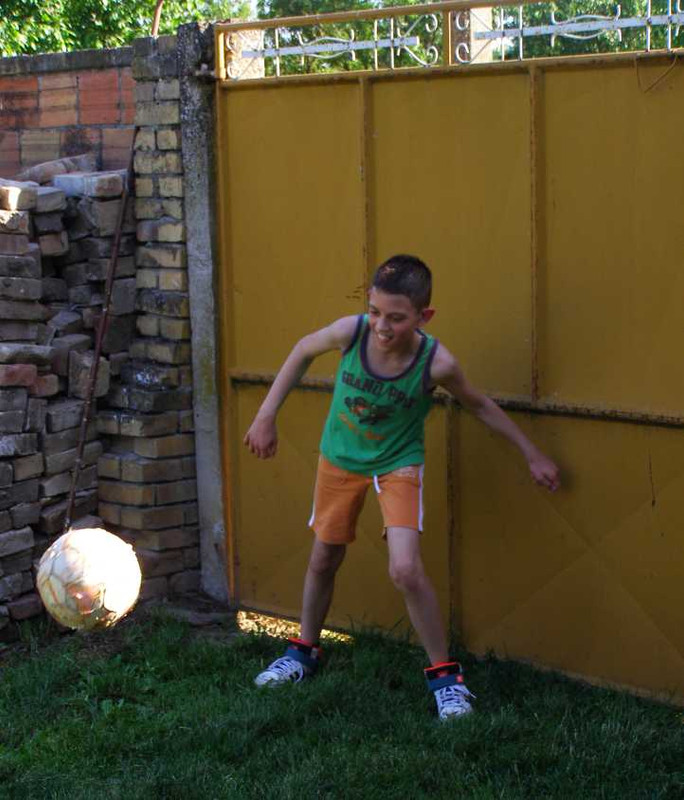
Goalie. The ‘goal’ was the big front gate and it was always to be protected. This bloke is at the ready to do his job of protecting.
The soccer wasn’t the only game, there were shuttlecock racquets in use, mostly by the girls. This one, however, wasn’t too shy to pause the game to have her photo taken…
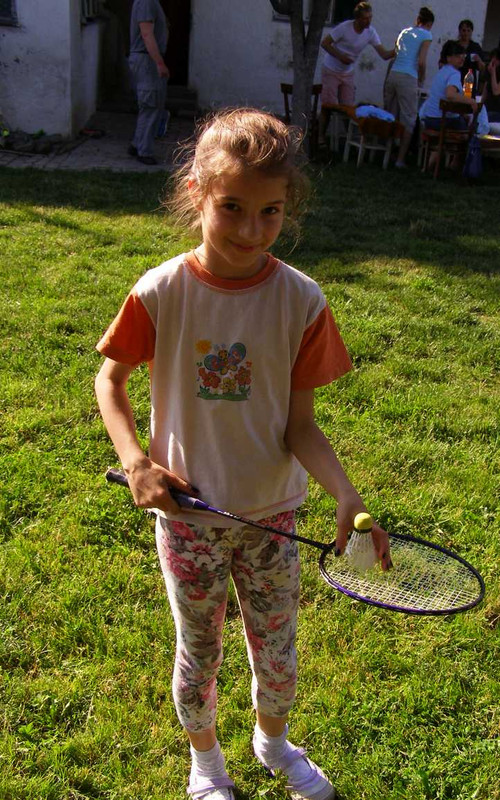
Less exuberant. The young girls playing shuttlecock weren’t as boisterous as the boys with their soccer even though their games used the same territory.
…and she was photogenic too. Her playmate took it a step further…
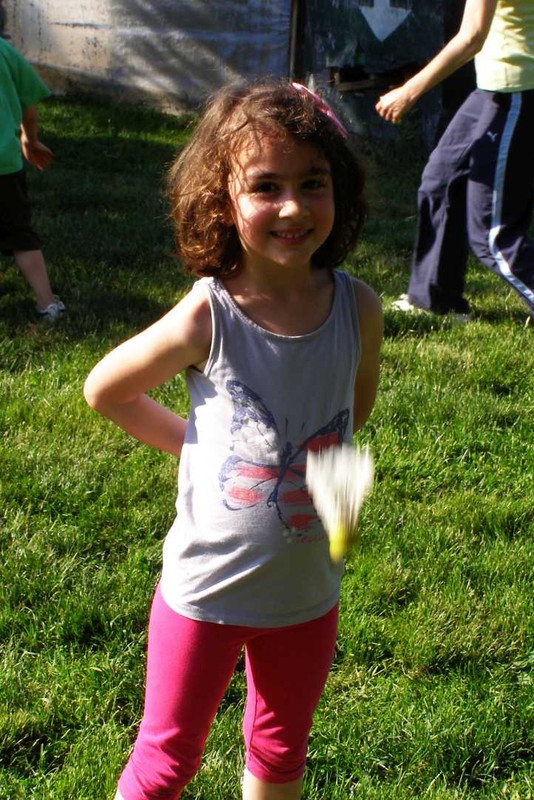
Too cute to worry. The shuttlecock flies toward her, but this one isn’t worrying about that. The camera’s more important.
…and forgot the game altogether as her photo was taken.
In all the afternoon there was nothing but fun and happiness, a very memorable event among the most delightful of people. People who cared for each other and overcame their lack of material wealth to have the wealth that really mattered. The one with the expressive tongue even took a bow:
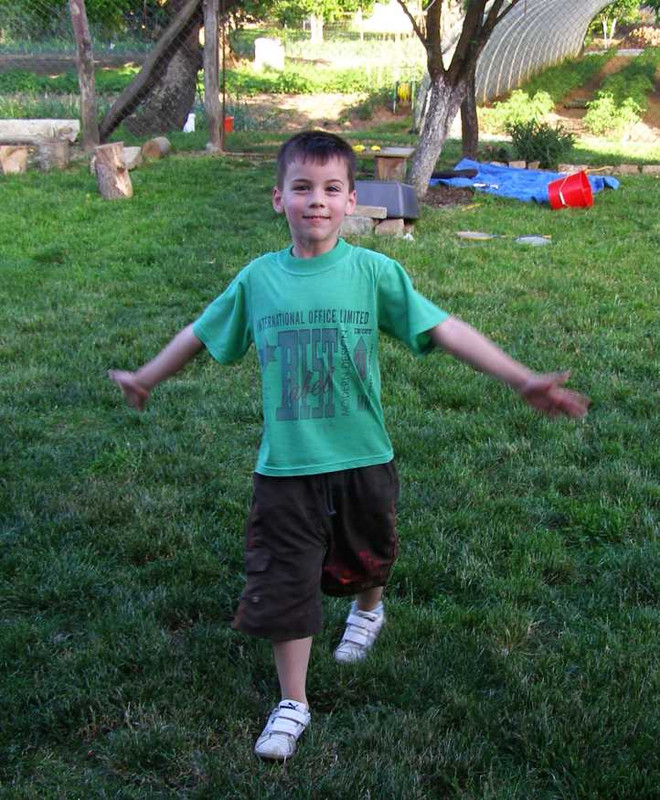
Show-off. As the time to leave drew near this little bloke showed his appreciation for the camera and, indirectly, for my presence.
I drove Jorge back and then returned to my ‘digs’ where Myra was about to serve up a beautiful steak meal. I just love to get a home-cooked meal on my travels, and she’d done a great job of slicing the roast so she could cook steaks. The evening frittered away into the night with high levels of satisfaction all round, Karl singing in the loungeroom and me trying to join in.
It was such a shame that Sandra couldn’t have been there to enjoy this day…
Soon the gate opened and the I presented the lady with an envelope addressed to her and her husband. She read it, turned and called him over, he read it too. The gates were swung open and I was ushered to drive in. My hosts for the next two days and nights…
My hosts. Making me totally welcome on the strength of the little letter from our mutual friend, this couple were most welcoming to me.
…had once lived in Australia for a short time, but virtually all recollection of the English language had been forgotten. But they hadn’t forgotten simple hospitality, they showed me to my room:
My room. A separate self-contained room with en-suite was my home for the two nights I’d spend here. Just wonderful hospitality.
And speaking of forgetting, I’ve forgotten their names. So throughout this I will assign names to people which are not their real names.
When I’d arrived, Karl had been working on a van which is registered in Austria. He worked for many years in Austria and this was a legacy of that time and it was now due for its annual inspection. A couple of small jobs had to be done, and as he completed one of them I helped him put one of the front wheels back on. After that he was due to meet some of his friends in another part of town… oh, yes, the town. Here’s the local map showing Senta, and across the river is Coka, which comes into the day’s story too:
I drove Karl to the gathering and he lined me up with Jorge, a younger man, a big bloke, who spoke perfect English:
Friends. Jorge and I hit it off very well, he spoke good English and we shared good conversation.
We went for a little drive so he could show me around town. He didn’t have a car and I was rapidly coming to the conclusion that life in these parts isn’t as prosperous as I’m used to seeing. The town mixes leafy green with old-world and wasn’t beset with much in the way of traffic problems. Many people were on bicycles…
Parklands. This park near the centre of town was green, neat and clean. Note the lady carrying a stool on her handlebars.
Roundabout. With neatly painted buildings and flowers on the roundabout, some attention is being paid to aesthetics.
The bridge. The bridge between Senta and Coka looks very plain, a better looking one had been there but in World War 2 it was bombed and it still lies in the mud below this one.
Zastava. A locally-built car made by an armament manufacturer, the car in front of it is a Ford Ka. Some of the buildings here are showing their age.
Cyclists. The flat country in Senta lends itself to cycling for local transport. There are three cyclists in this photo.
Classical. Many buildings were like this one, reflecting the more intricate building styles of much earlier times.
We looked around and talked about many things, then as I’d decided to buy some meat for my hosts so that I wouldn’t be so much of a burden that evening, Jorge took me to the right butcher so I could get a nice beef roast. I left him about midday, as I did he told me to pick him up again at about 3pm as there was a bit of a get-together at a lady’s place in Coka and I’d been invited. Surprised me.
Back at Karl’s place I handed over the meat and explained about my allergies so that we wouldn’t have any problems with that. Everyday life was going on in their home except that this stranger was there and none of us could understand what we were saying. But we were able to get some things through and having some fun. The family cats had to be fed…
Cats feeding. Karl and Myra had plenty of cats to feed, each knew their own dish.
…and other people came to visit and keep things busy…
More visitors. Friends dropped around to visit Karl and Myra, the gateway seemed to be earning its keep.
…and Karl played music on a CD player and sang out loudly in the lounge room for a while. He loves to sing.
Jorge phoned to tell me it would be more like 3:30 I had to pick him up, and that soon came. We drove through town, across the bridge and turned into Coka. Following his directions we went out the other side and onto some roads between some farms before finding the place we had to visit.
Party house. Nothing extraordinary about the old brick home we went to visit, but what was to take place was something not so ordinary.
We went in though the big gate to find a yard of somewhere between one and two acres. Much of the area was under cultivation, I didn’t ask, but I’m guessing that some of the produce is sold locally and traded with friends for whatever they might be growing. This community is not overflowing with money.
Hospitality, on the other hand, was abundant. I was ushered into the kitchen where I was quickly offered a drink and snacks. We talked about common subjects and before long we were taking the table out of the kitchen to set up in the shade outside as more people were arriving. And someone brought a soccer ball.
Getting busy. With the table under a tree and conversations going strongly there, others were running around chasing a soccer ball.
Moving. The table had filled as people arrived and brought more supplies. But the sun was moving too and the decision was taken to move the table back next to the house so it would be in the shade, here they’re preparing it for the transfer.
Just looking at this next photo you can see how ‘weathered’ the home is. Sags in the roof of the laundry in particular, but that was no impediment to those enjoying themselves with good company and friends coming from up to 100kms away.
Mums and dads. While the soccer ball was mainly moved about by the kids, some of the mums and dads joined in at times.
Snacks and drinks. The table became weighed down more as each family arrived, there was plenty for everyone, including the kids.
As one who has heard for years that the ‘lamington’ cake is an Australian invention, I was a little surprised to see the bucketful of them. Supposedly, the ‘lamington’ (sponge cake coated with chocolate sauce and rolled in desiccated coconut) was the invention of the French chef employed by the Governor of Queensland in the late 1800s and was named after him, Lord Lamington.
The lovely people I was with in Serbia told me they called this serving ‘Coconut Cubes’, which makes sense. Personally, I always thought it was a means by which people could convince their kids that two-day-old cake was worth eating. And I think all of this puts doubt on the idea that it was invented for the Governor of Queensland.
Of course, such things attracted children to the table when not running around after the soccer ball. I have since felt that this photo…
Little Cutey. She might be three, right? And while the bigger kids were running around everywhere, she was leading her own quiet life.
…is just a great little study of a little girl. Her necklace and earrings, the carefree life such a child should have, all is evident in this picture (to me).
Meanwhile, this picture also tells a story…
Poor dog! Watching all the fun but tied up at the laundry door…
…as this poor little dog sat there watching all the fun and was unable to join in.
Another character study, note the tongue:
Pouring a drink. One of the youngest of the boys present pours himself a drink between attempts at getting a kick of the ball.
He was soon back into the action, as can be seen here…
All-in action! Tumbling over each other, adults included, they were having a ball. Literally.
…and some serious attempts were made at kicking goals from well back in the ‘field’ too:
Lining up. You can see that this young bloke is intent on getting one ‘into the net’ as he lines up his shot…
The big kick. …and then he takes his shot, a mighty kick that will go the distance.
There was only one goal as it wasn’t a ‘match’ as such. Just practising for their own pleasure and exercise. But there was always a goalie there to try to stop the ball getting through:
Goalie. The ‘goal’ was the big front gate and it was always to be protected. This bloke is at the ready to do his job of protecting.
The soccer wasn’t the only game, there were shuttlecock racquets in use, mostly by the girls. This one, however, wasn’t too shy to pause the game to have her photo taken…
Less exuberant. The young girls playing shuttlecock weren’t as boisterous as the boys with their soccer even though their games used the same territory.
…and she was photogenic too. Her playmate took it a step further…
Too cute to worry. The shuttlecock flies toward her, but this one isn’t worrying about that. The camera’s more important.
…and forgot the game altogether as her photo was taken.
In all the afternoon there was nothing but fun and happiness, a very memorable event among the most delightful of people. People who cared for each other and overcame their lack of material wealth to have the wealth that really mattered. The one with the expressive tongue even took a bow:
Show-off. As the time to leave drew near this little bloke showed his appreciation for the camera and, indirectly, for my presence.
I drove Jorge back and then returned to my ‘digs’ where Myra was about to serve up a beautiful steak meal. I just love to get a home-cooked meal on my travels, and she’d done a great job of slicing the roast so she could cook steaks. The evening frittered away into the night with high levels of satisfaction all round, Karl singing in the loungeroom and me trying to join in.
It was such a shame that Sandra couldn’t have been there to enjoy this day…
Last edited by Ray Bell; Apr 3, 2020 at 09:24 AM.
Thread Starter
|
Captain
Joined: Oct 2005
Posts: 568
Likes: 8
From: The Summit, Queensland, Australia
Sunday, May 30, would not be such a busy day for me in Senta. A day for relaxing and a little discovery. It was now over three weeks since we’d touched down in Paris to begin touring Europe, so much we’d seen, and I’d seen, and so much had happened it was probably good to have a quiet day. But don’t misunderstand, it was still a day of joy being among such friendly and outgoing people who took me into their bosom.
After breakfast with Karl and Myra we all went across town again to meet up with some friends of theirs. Along the way I couldn’t help but stop and get a photo of the Yugo…
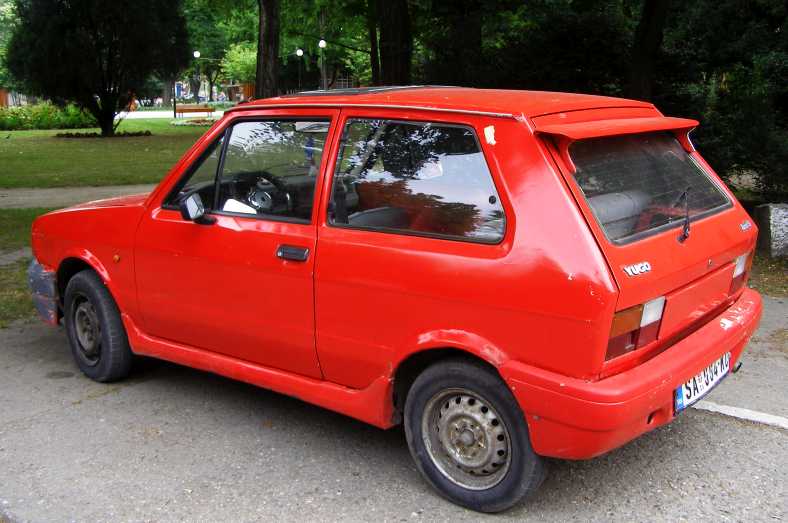
The Yugo. The name is about as imaginative as the car. But cars were sparse in this bit of the world.
…another ‘Eastern Bloc’ car which has succumbed to the intrusion of the West into the East. Reminiscent of an early VW Golf, it was certainly not the kind of car to appeal to me. Cyclists were still prolific and I got this shot of one of Myra’s friends arriving with her bicycle:
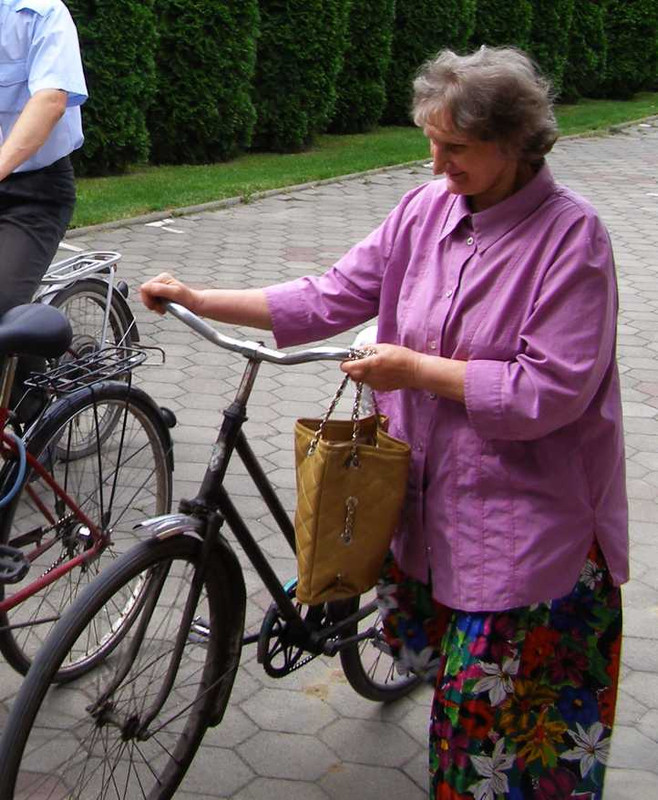
Grey-haired cyclist. So different to home, I don’t know when I last saw a woman over thirty, much less over 60, on a bicycle.
I went from there to see Jorge and his wife. I learned that he makes a living putting up sheds like the samples in the background of this shot…
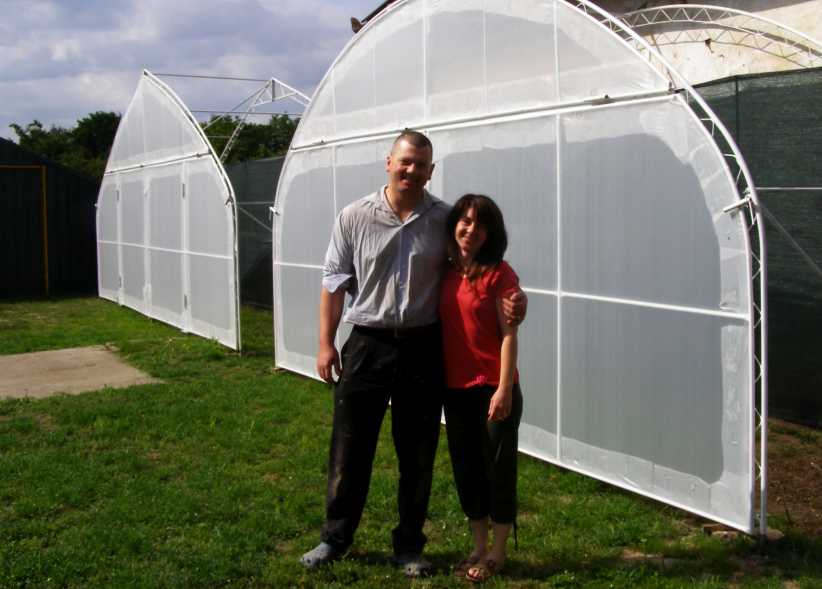
The shed builder. Jorge and his lovely wife, whose personality matches her appearance. So warm and welcoming, I would miss them when I left.
…I guess they are dual purpose providing shelter or becoming hot-houses for growing crops in cold weather. I don’t understand how he can sell and erect these without having a vehicle!
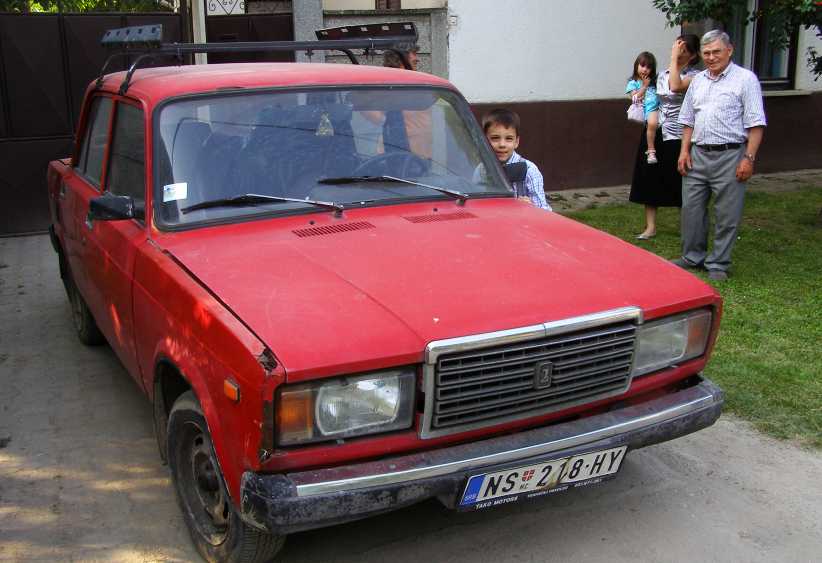
Back at Karl’s place there was more activity as friends came visiting, there was no shortage of them. Some spoke English so I could join in the conversation, but all of them were friendly towards this stranger from Australia. One family was in this Lada…
 [/url]
More friends. Their Lada had seen better days, but their friendliness was not to be forgotten.
…which was as tatty as you’d expect to see. At home it wouldn’t be allowed on the road. But in discussing it with the owner – yes, he spoke English – he was debating with himself whether or not to replace it. Such is the low average income in this area that people are forced to keep on going with relics like this. It is a diesel, by the way.
Down in the backyard Karl has fruit trees. Among those bearing fruit at the time were the cherries, and I snapped a shot of him picking some of these:
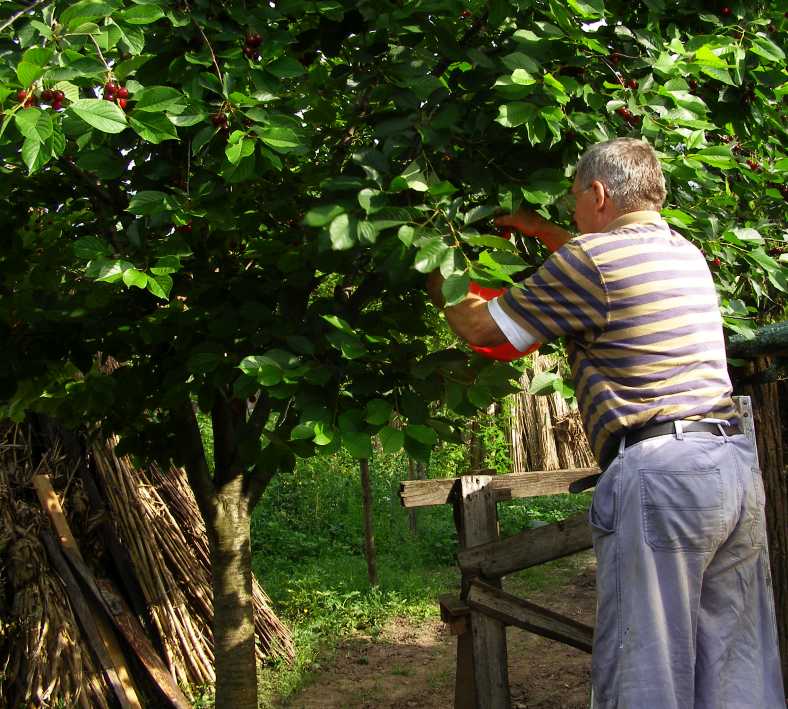
Harvest time. Karl got up the ladder to pick some cherries, he was to give some of them to me to eat as I travelled the next day.
The next day I would be taking some of them with me, but that was still a little bit into the future. Once again we finished up in the loungeroom singing in two languages.
I wondered how different my stopover in Senta would have been had not Johanna and her husband been stuck in Brisbane the extra couple of months and I’d stayed at their place as had originally been planned. Actually, their place was in another town about 20kms from Senta and I would see the outside of their home their the following morning.
For now, however, I relaxed a bit, did a bit of internet browsing and wondered how my new wife was getting on back home.
I also worried a little about that Load & Go Visa not working in this part of the world. I reasoned that I would get in touch with them if it still failed me by the time I got to Switzerland. Everything should work in Switzerland.
But that was still four countries away...
After breakfast with Karl and Myra we all went across town again to meet up with some friends of theirs. Along the way I couldn’t help but stop and get a photo of the Yugo…
The Yugo. The name is about as imaginative as the car. But cars were sparse in this bit of the world.
…another ‘Eastern Bloc’ car which has succumbed to the intrusion of the West into the East. Reminiscent of an early VW Golf, it was certainly not the kind of car to appeal to me. Cyclists were still prolific and I got this shot of one of Myra’s friends arriving with her bicycle:
Grey-haired cyclist. So different to home, I don’t know when I last saw a woman over thirty, much less over 60, on a bicycle.
I went from there to see Jorge and his wife. I learned that he makes a living putting up sheds like the samples in the background of this shot…
The shed builder. Jorge and his lovely wife, whose personality matches her appearance. So warm and welcoming, I would miss them when I left.
…I guess they are dual purpose providing shelter or becoming hot-houses for growing crops in cold weather. I don’t understand how he can sell and erect these without having a vehicle!
Back at Karl’s place there was more activity as friends came visiting, there was no shortage of them. Some spoke English so I could join in the conversation, but all of them were friendly towards this stranger from Australia. One family was in this Lada…
[/url]More friends. Their Lada had seen better days, but their friendliness was not to be forgotten.
…which was as tatty as you’d expect to see. At home it wouldn’t be allowed on the road. But in discussing it with the owner – yes, he spoke English – he was debating with himself whether or not to replace it. Such is the low average income in this area that people are forced to keep on going with relics like this. It is a diesel, by the way.
Down in the backyard Karl has fruit trees. Among those bearing fruit at the time were the cherries, and I snapped a shot of him picking some of these:
Harvest time. Karl got up the ladder to pick some cherries, he was to give some of them to me to eat as I travelled the next day.
The next day I would be taking some of them with me, but that was still a little bit into the future. Once again we finished up in the loungeroom singing in two languages.
I wondered how different my stopover in Senta would have been had not Johanna and her husband been stuck in Brisbane the extra couple of months and I’d stayed at their place as had originally been planned. Actually, their place was in another town about 20kms from Senta and I would see the outside of their home their the following morning.
For now, however, I relaxed a bit, did a bit of internet browsing and wondered how my new wife was getting on back home.
I also worried a little about that Load & Go Visa not working in this part of the world. I reasoned that I would get in touch with them if it still failed me by the time I got to Switzerland. Everything should work in Switzerland.
But that was still four countries away...
Thread Starter
|
Captain
Joined: Oct 2005
Posts: 568
Likes: 8
From: The Summit, Queensland, Australia
Monday morning came and I knew I had to leave. But I’d had such a good time with these lovely people that I didn’t want to. I bade Karl and Myra goodbye and proffered my most grateful thanks for their hospitality, then I drove around to do the same with Josef and his wife. Then I drove across the bridge…
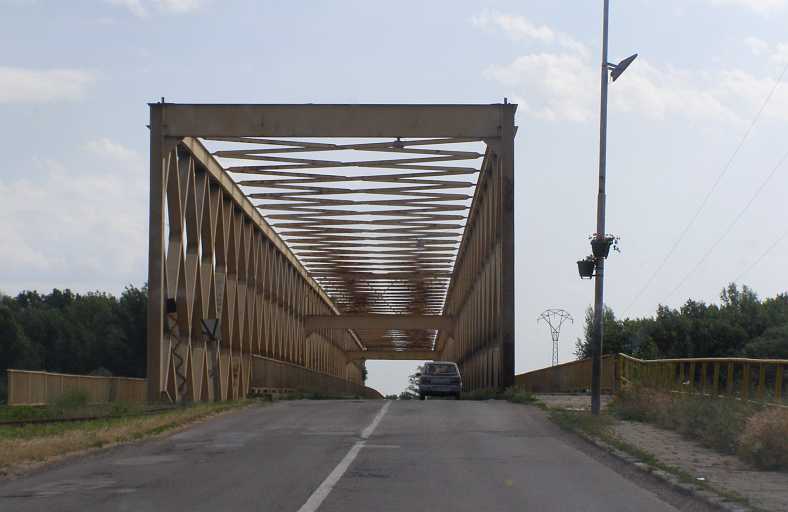
Replacement bridge. After World War 2 a replacement bridge was required. Style and aesthetics were secondary considerations.
On Saturday I had also seen these, but not photographed them until Monday:
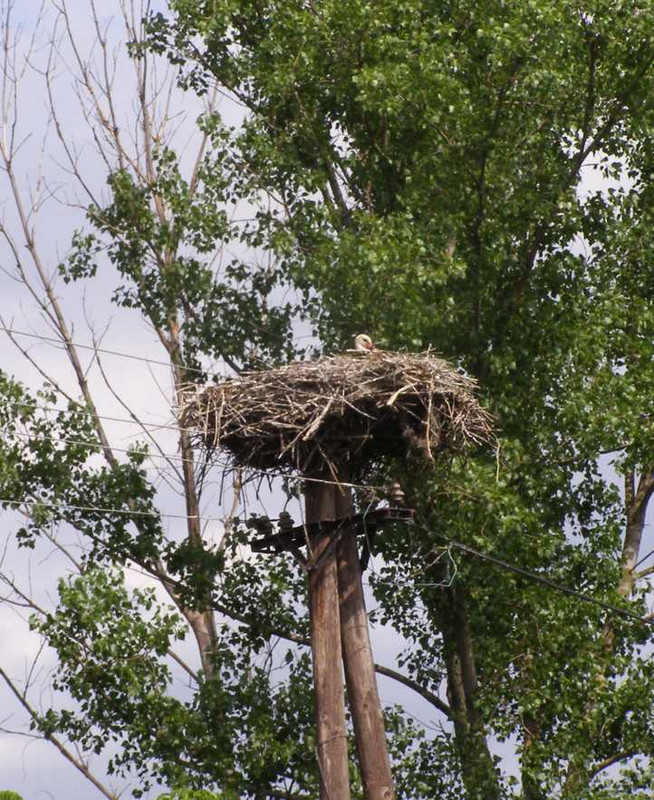
Birdnests. Raising their chicks on the top of power poles apparently comes naturally to the birds of this area.
…and the next part of my European adventure was beginning. My first task was to locate Johanna’s home in the village about 20kms away. As I was about to leave Coka I saw a Trabant:
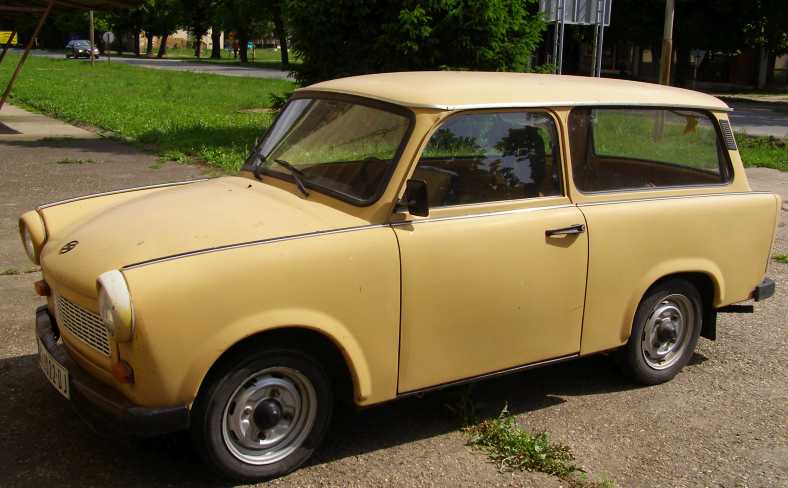
Trabant. A mix of steel, plastic made from cotton waste and ingenuity created the trabant, a car which gave some (unreliable and slow) mobility to Eastern Europe.
The Trabant was well-known throughout the Eastern European countries having been made in East Germany from the late fifties to the end of the eighties with a 600cc 2-stroke twin-cylinder engine driving the front wheels. The steel unit body had a number of bolt-on panels made of a hard plastic and there’s no doubt performance wouldn’t inspire many. One motoring journalist wrote, “The Trabant was loud, slow, poorly designed, and badly built." And you had to pre-mix oil into the fuel.
Driving along I saw more of Eastern Europe in action, tractors towing trailers along the streets and roads, people on cycles and pushing carts…
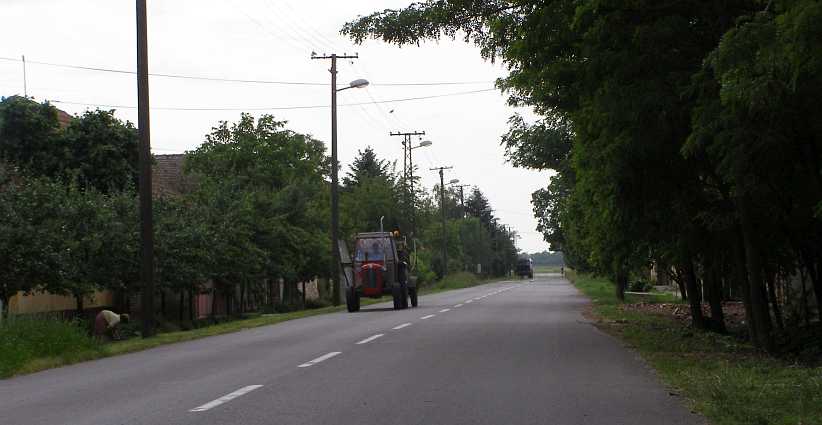
Tractors. While we in Western countries might see an odd tractor on the road going from farm to farm or paddock to paddock, in these parts they are in more regular use. Pickups are rare.
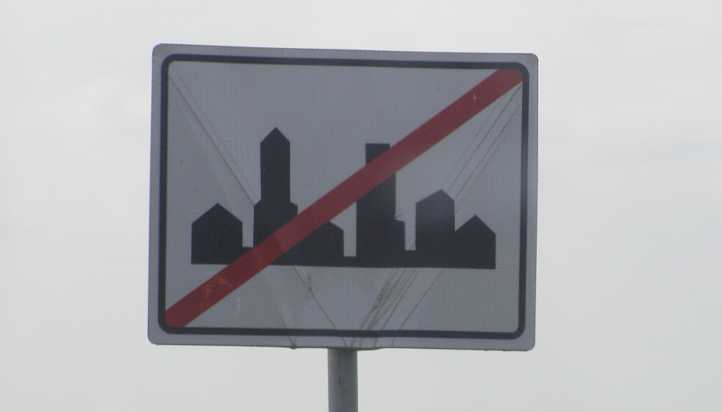
Leaving town. Another local sign I was to get used to seeing.
Homes were often very old but gardens well-kept. I found the address of Johanna’s home and gave the letter she’d sent me to her neighbour. She needed to let him know that they wouldn’t be there for another couple of months as he took care of the place for her…
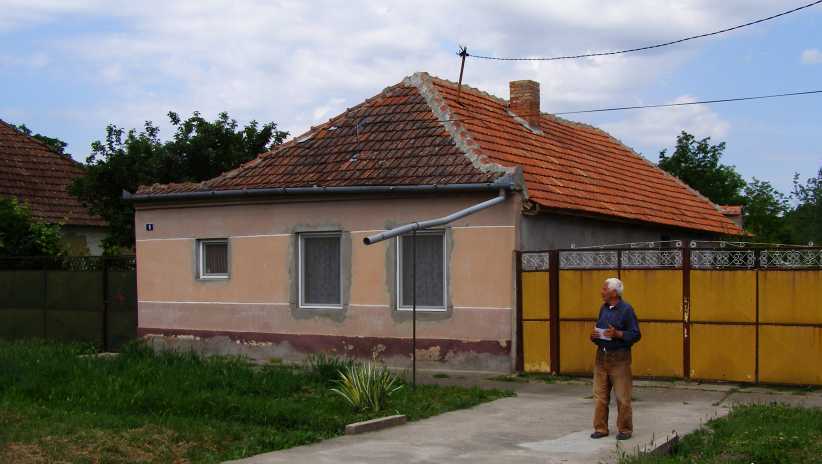
The caretaker. This gentleman tried hard to understand me, but between the language difficulty and his partial dementia it was a problem. However, I did get to see the outside of Johanna’s Serbian home.
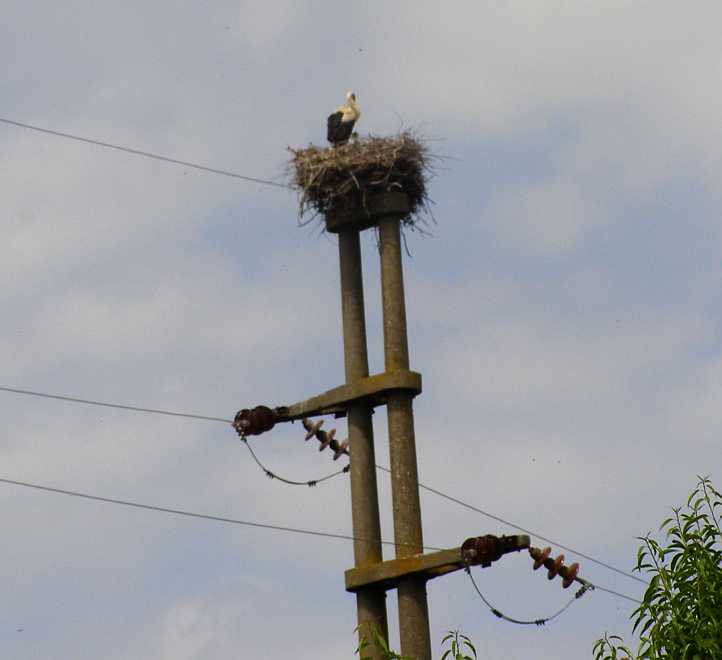
More birdnests. Checking online I learned that these were European Storks. I don’t think they’re an endangered species like we would be if we tried to climb up to them!
Having taken care of finding Johanna’s place I headed for the Hungarian border…
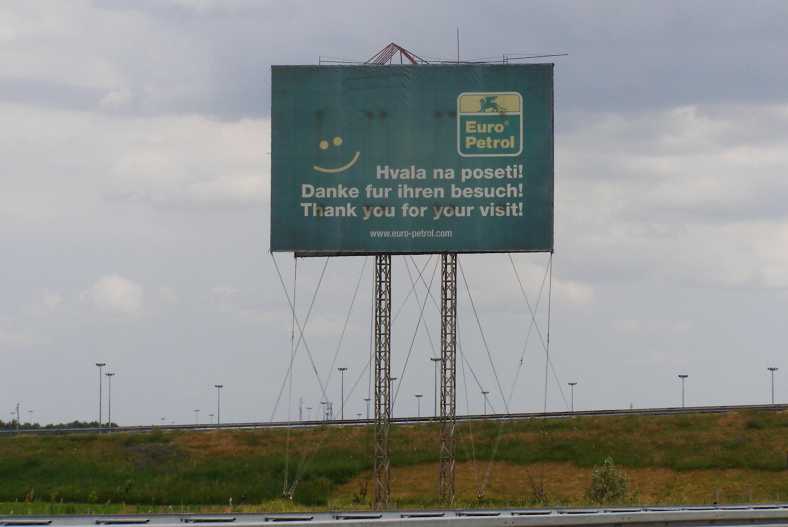
Farewell, Serbia. This sign was seen as I approached the border area.
…which was only about twenty miles away at a town called Horgos. And as I approached that point there was a reminder of what my next purchase should be…
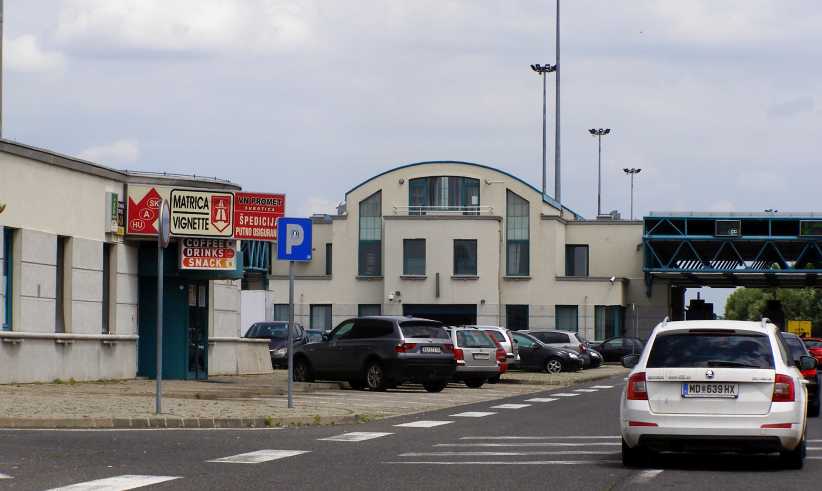
Vignette for Hungary. With about 300kms of Hungary to cross, it was prudent to get a vignette to enable me to drive on the motorways.
…followed, of course, by a sign foreshadowing the need to turn out my passport. One of the few borders I crossed in Europe where this was necessary.
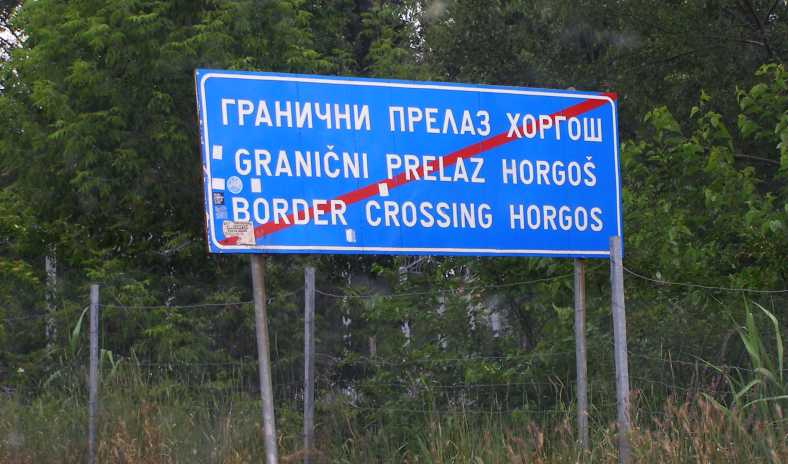
Border soon. The sign might be wonky, but its message is clear enough. ‘Stop for the border, you’re now leaving Serbia.’
There was a long queue, too. But no problems were encountered and I entered the ninth country of my European visit.
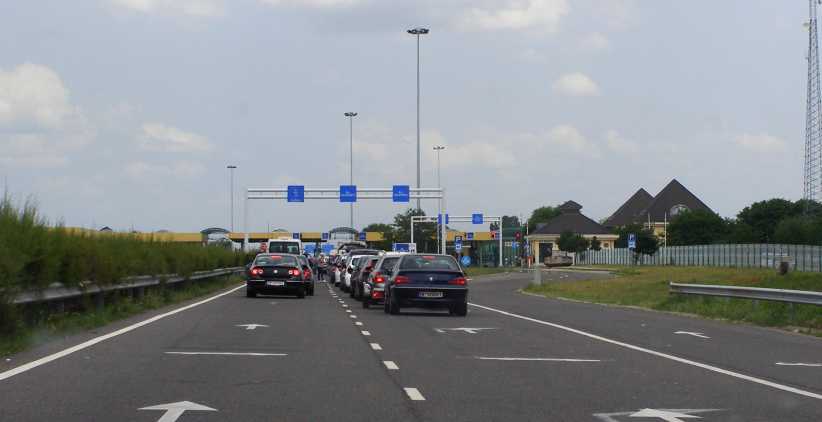
Passport time. One of very few place is had to show my passport in Europe, the queue moved up fairly quickly.
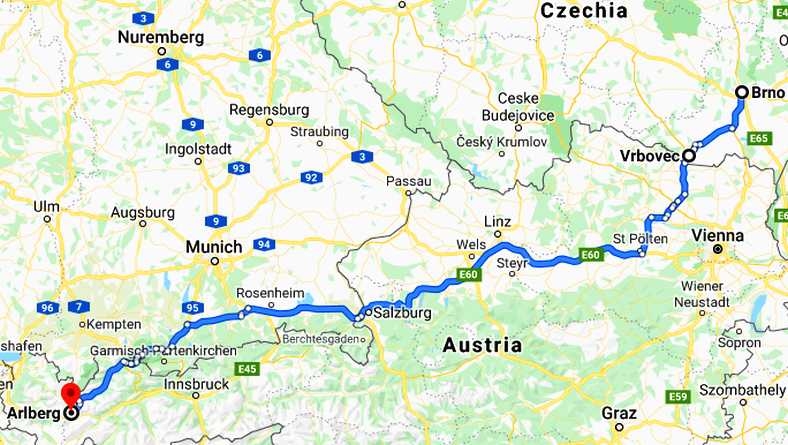
My day’s travel would take me over 500kms, roughly along this path:
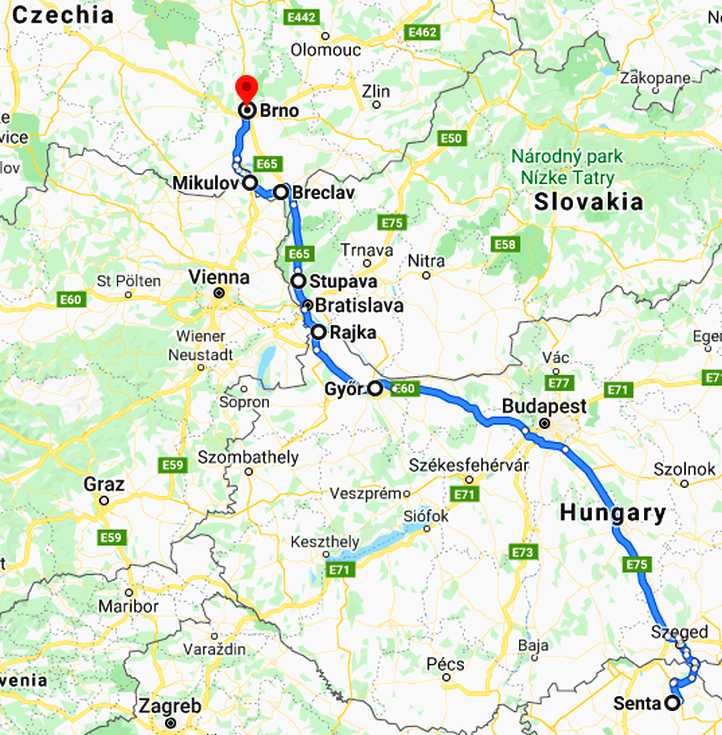
Driving in into Hungary I must have become somewhat bored. It was generally flat and fairly featureless on the road I travelled, if a little busy…
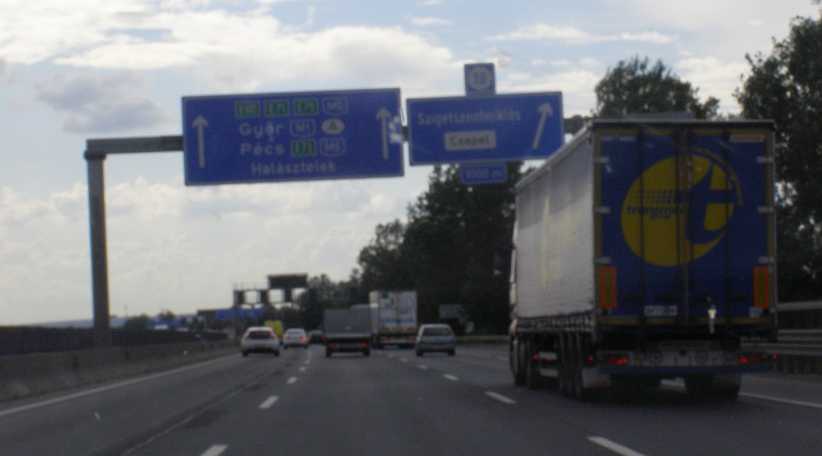
Hungarian highway. The toll road in Hungary carried us swiftly along, many were taking advantage of it.
…but then I did become aware of some of my fellow travellers…
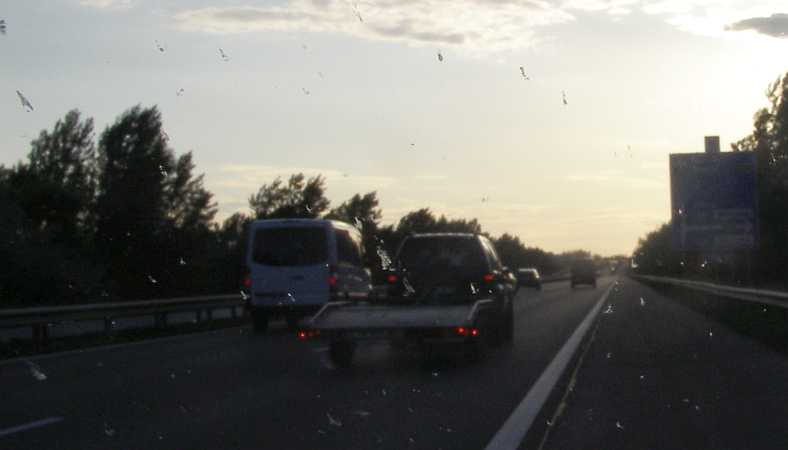
Car trailer. I noted that there were people dragging empty car trailers along this road, and more than just a few…
…there were car trailers and car-carrying rigs just everywhere! And I don’t mean this sort, either:
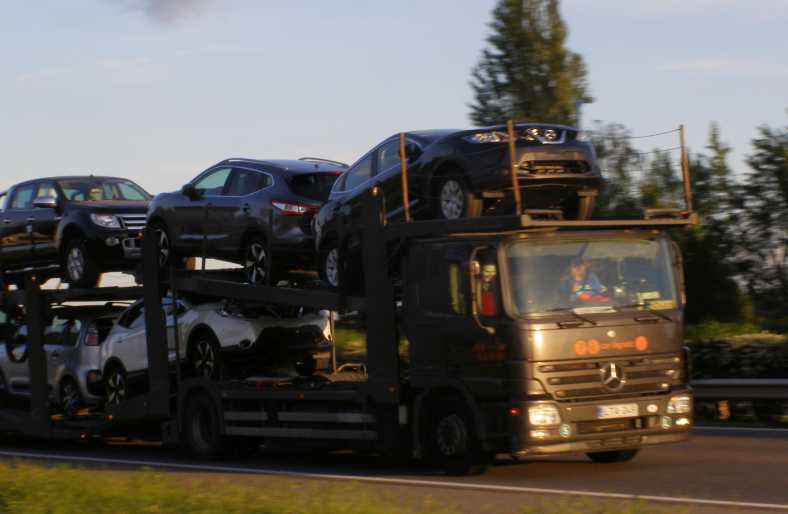
Regular car carrying. These I expected to see, but not so many of the smaller ones.
Here’s another one:
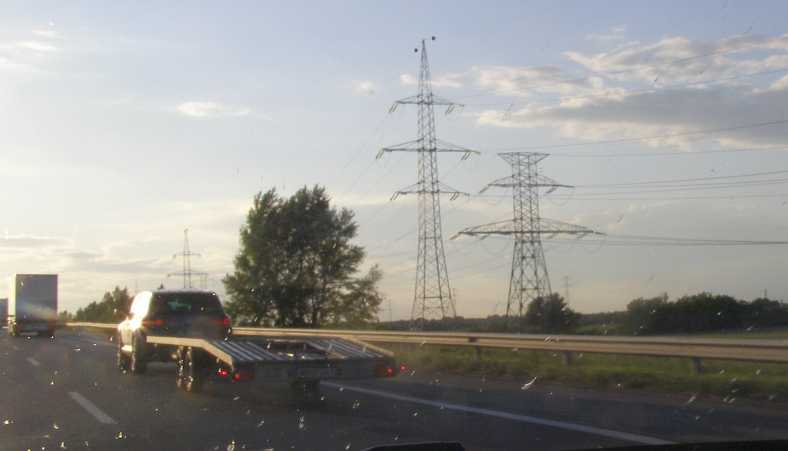
Another one. Seeing this one triggered my mind to look for them. And I’d see many, more than I photographed.
When I stopped for something to eat I saw just more and more of them! One coming into the carpark and one driving by:
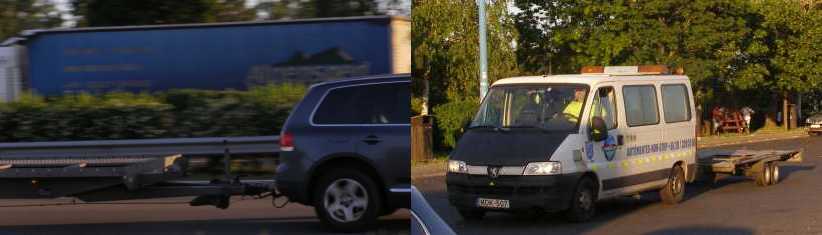
Solo trailers… Some of the trailers were for solo car-carrying work, but not all of them.
Not content with having a car trailer, there were those who had multi-car carrying capacity. Three of these are little trucks which a car can be driven onto via its trailer, enabling them to carry two cars:
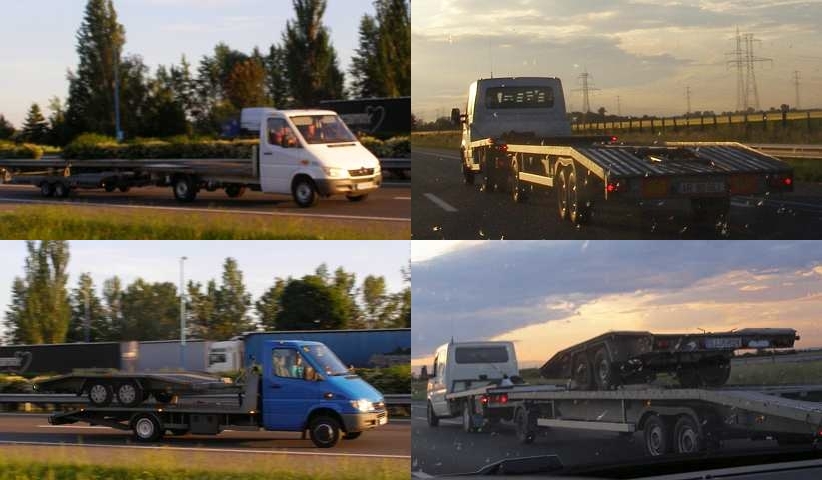
Multi-car capacity. Two at a time capacity was popular, I was impressed by the construction of those 6-wheel trailers.
While the third has another trailer atop its trailer as well!
So I tried to reconcile in my mind why a Monday afternoon would see so many of these about. Could it be that Sunday had been a bad day and all the Yugos and Trabants had broken down, these vehicles had now returned them to their homes and were in turn going home themselves?
Too hard for me. And note the big trailers on a couple of those, they have tandem axles at the back and yet another axle (which steers, of course) at the front. They look very well-designed and made.
It was about 300kms across Hungary and the day was worn right out by the time I got to the Slovakian border somewhere near Gyor. I had refuelled…
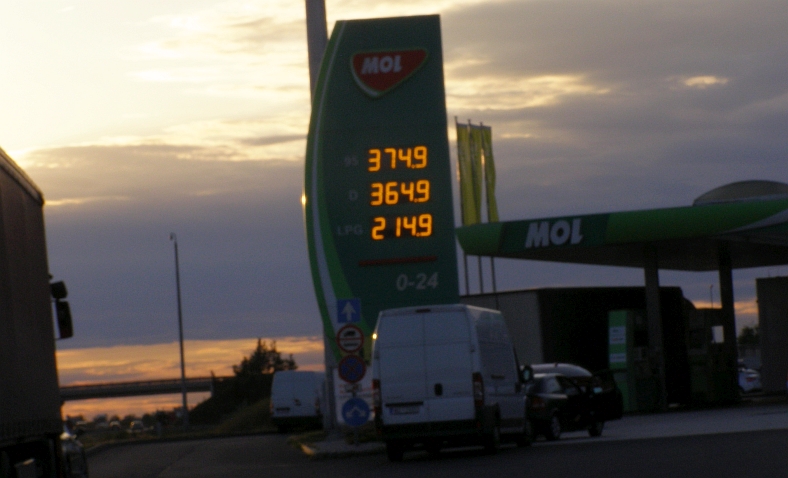
Familiar colours, unfamiliar name. Variety certainly is plentiful when you go from country to country.
…at a service station which looked like BP but had a foreign name, and I simply set the GPS to take me to Brno in the Czech Republic. But across Slovakia and in the Czech Republic I wanted to do that without toll roads, so no vignettas would be required.
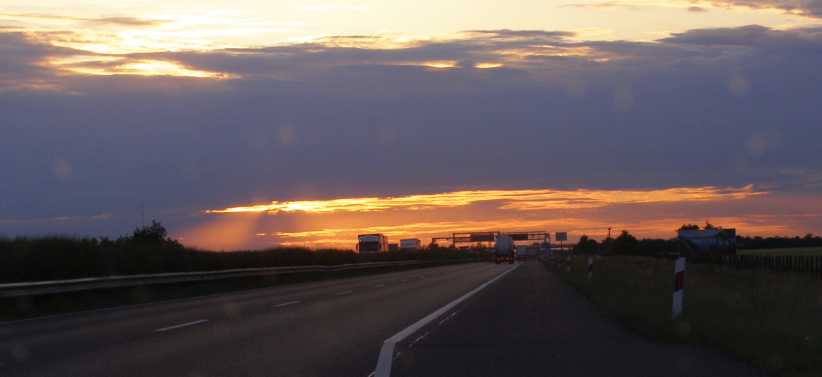
Sunset over Hungary. As the day started to expire I was nearly out of Hungary.
Entering Slovakia in the dark, I kept telling myself it was only about 100kms across. And I’d check the odometer every so often to make sure that 100kms was going down. Not being on freeways it did take me through some oddball places, but I emerged…
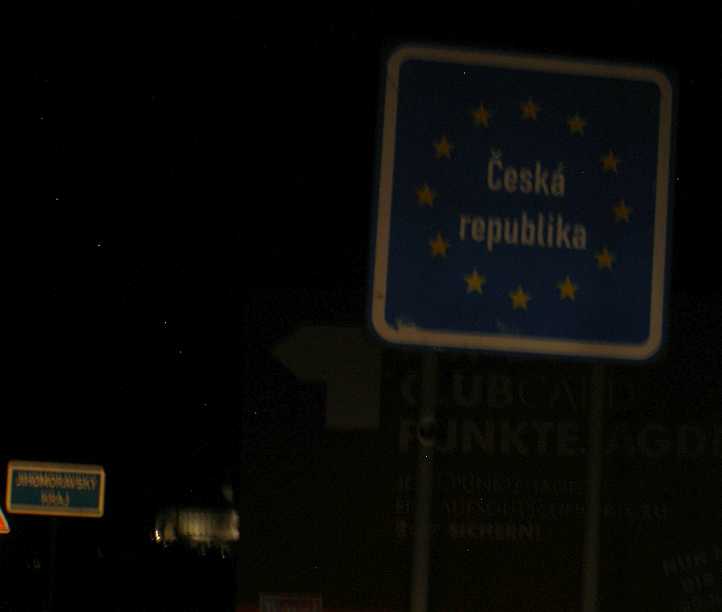
Entry to Czech Republic. After a ragged drive across Slovakia, taking constant instruction from the GPS, I finally got to this welcome sign.
…and was able to press on to be in Brno to pull up and get some rest in the car. Along the way I crossed the Thaya river and I felt it was an impressive sight. The river at this point was more like a placid lake, especially in the dark. Across the other side there were lots of lights, it was Aqualand Moravia, a large water-based theme park on the site of some ancient Roman baths and thermal springs:
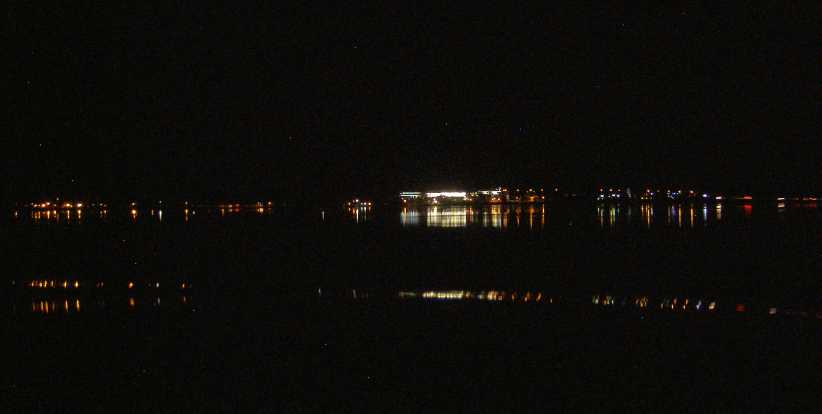
Thaya River. This lake created in the river provided a nice setting for the Aqualand them park near the town of Pasohlavky.
I found somewhere to pull up and sleep in Brno. All the while keeping in mind that I was now in a position to look over the circuit used for about 15 years, 17.7kms of public road that must have been fun to race on. I looked forward to the morning...
Replacement bridge. After World War 2 a replacement bridge was required. Style and aesthetics were secondary considerations.
On Saturday I had also seen these, but not photographed them until Monday:
Birdnests. Raising their chicks on the top of power poles apparently comes naturally to the birds of this area.
…and the next part of my European adventure was beginning. My first task was to locate Johanna’s home in the village about 20kms away. As I was about to leave Coka I saw a Trabant:
Trabant. A mix of steel, plastic made from cotton waste and ingenuity created the trabant, a car which gave some (unreliable and slow) mobility to Eastern Europe.
The Trabant was well-known throughout the Eastern European countries having been made in East Germany from the late fifties to the end of the eighties with a 600cc 2-stroke twin-cylinder engine driving the front wheels. The steel unit body had a number of bolt-on panels made of a hard plastic and there’s no doubt performance wouldn’t inspire many. One motoring journalist wrote, “The Trabant was loud, slow, poorly designed, and badly built." And you had to pre-mix oil into the fuel.
Driving along I saw more of Eastern Europe in action, tractors towing trailers along the streets and roads, people on cycles and pushing carts…
Tractors. While we in Western countries might see an odd tractor on the road going from farm to farm or paddock to paddock, in these parts they are in more regular use. Pickups are rare.
Leaving town. Another local sign I was to get used to seeing.
Homes were often very old but gardens well-kept. I found the address of Johanna’s home and gave the letter she’d sent me to her neighbour. She needed to let him know that they wouldn’t be there for another couple of months as he took care of the place for her…
The caretaker. This gentleman tried hard to understand me, but between the language difficulty and his partial dementia it was a problem. However, I did get to see the outside of Johanna’s Serbian home.
More birdnests. Checking online I learned that these were European Storks. I don’t think they’re an endangered species like we would be if we tried to climb up to them!
Having taken care of finding Johanna’s place I headed for the Hungarian border…
Farewell, Serbia. This sign was seen as I approached the border area.
…which was only about twenty miles away at a town called Horgos. And as I approached that point there was a reminder of what my next purchase should be…
Vignette for Hungary. With about 300kms of Hungary to cross, it was prudent to get a vignette to enable me to drive on the motorways.
…followed, of course, by a sign foreshadowing the need to turn out my passport. One of the few borders I crossed in Europe where this was necessary.
Border soon. The sign might be wonky, but its message is clear enough. ‘Stop for the border, you’re now leaving Serbia.’
There was a long queue, too. But no problems were encountered and I entered the ninth country of my European visit.
Passport time. One of very few place is had to show my passport in Europe, the queue moved up fairly quickly.
My day’s travel would take me over 500kms, roughly along this path:
Driving in into Hungary I must have become somewhat bored. It was generally flat and fairly featureless on the road I travelled, if a little busy…
Hungarian highway. The toll road in Hungary carried us swiftly along, many were taking advantage of it.
…but then I did become aware of some of my fellow travellers…
Car trailer. I noted that there were people dragging empty car trailers along this road, and more than just a few…
…there were car trailers and car-carrying rigs just everywhere! And I don’t mean this sort, either:
Regular car carrying. These I expected to see, but not so many of the smaller ones.
Here’s another one:
Another one. Seeing this one triggered my mind to look for them. And I’d see many, more than I photographed.
When I stopped for something to eat I saw just more and more of them! One coming into the carpark and one driving by:
Solo trailers… Some of the trailers were for solo car-carrying work, but not all of them.
Not content with having a car trailer, there were those who had multi-car carrying capacity. Three of these are little trucks which a car can be driven onto via its trailer, enabling them to carry two cars:
Multi-car capacity. Two at a time capacity was popular, I was impressed by the construction of those 6-wheel trailers.
While the third has another trailer atop its trailer as well!
So I tried to reconcile in my mind why a Monday afternoon would see so many of these about. Could it be that Sunday had been a bad day and all the Yugos and Trabants had broken down, these vehicles had now returned them to their homes and were in turn going home themselves?
Too hard for me. And note the big trailers on a couple of those, they have tandem axles at the back and yet another axle (which steers, of course) at the front. They look very well-designed and made.
It was about 300kms across Hungary and the day was worn right out by the time I got to the Slovakian border somewhere near Gyor. I had refuelled…
Familiar colours, unfamiliar name. Variety certainly is plentiful when you go from country to country.
…at a service station which looked like BP but had a foreign name, and I simply set the GPS to take me to Brno in the Czech Republic. But across Slovakia and in the Czech Republic I wanted to do that without toll roads, so no vignettas would be required.
Sunset over Hungary. As the day started to expire I was nearly out of Hungary.
Entering Slovakia in the dark, I kept telling myself it was only about 100kms across. And I’d check the odometer every so often to make sure that 100kms was going down. Not being on freeways it did take me through some oddball places, but I emerged…
Entry to Czech Republic. After a ragged drive across Slovakia, taking constant instruction from the GPS, I finally got to this welcome sign.
…and was able to press on to be in Brno to pull up and get some rest in the car. Along the way I crossed the Thaya river and I felt it was an impressive sight. The river at this point was more like a placid lake, especially in the dark. Across the other side there were lots of lights, it was Aqualand Moravia, a large water-based theme park on the site of some ancient Roman baths and thermal springs:
Thaya River. This lake created in the river provided a nice setting for the Aqualand them park near the town of Pasohlavky.
I found somewhere to pull up and sleep in Brno. All the while keeping in mind that I was now in a position to look over the circuit used for about 15 years, 17.7kms of public road that must have been fun to race on. I looked forward to the morning...
Last edited by Ray Bell; Apr 23, 2020 at 10:17 PM.
Thread Starter
|
Captain
Joined: Oct 2005
Posts: 568
Likes: 8
From: The Summit, Queensland, Australia
Oh yes, I had a real problem when I awoke in Brno. Well, you know what it’s like when you wake up and you need… well, you need some relief. Here I was in a relatively busy city street which was just starting to hum, people about everywhere, I didn’t know the language and didn’t know where to look for what I needed.
Ordinarily I’d look for a McDonalds, or a public park with a toilet in it, but here I knew nothing about where I was. And I was to learn in just another day that McDonalds might not be an answer either. I parked the car and started to walk… no, run… around the streets and lanes. Fortunately I found a secluded spot on a building site and life got a lot better.
And here in Brno there was an operating trolley bus for me to photograph…
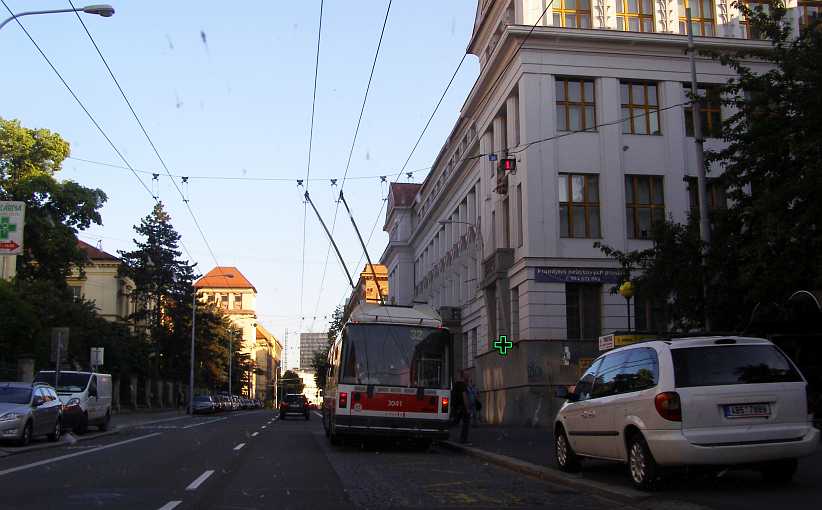
Trolley bus. I still had it in mind that I wanted to show Sandra what a trolley bus looks like. And, I guess, a tiny corner of the city of Brno and the green cross neon sign to indicate a pharmacy.
…and some strange parking signs, showing parking which we’d get a handsome fine for emulating in a city at home:
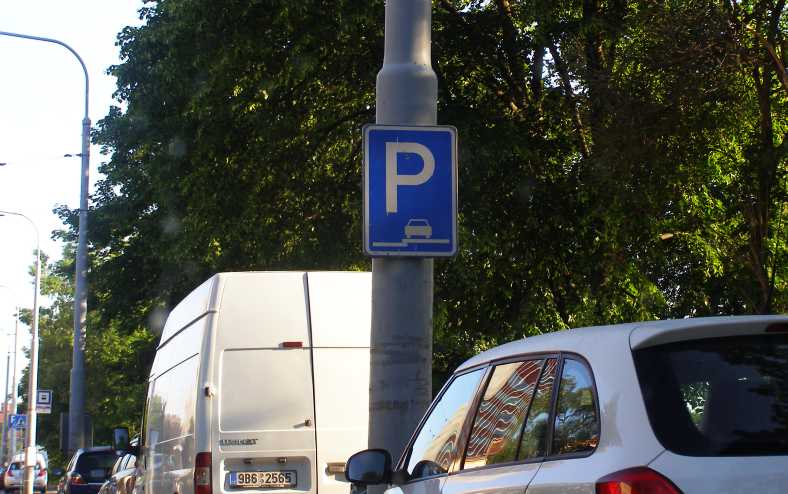
Footpath parking allowed! I’ve never seen signs like this before, though in many places it’s okay to park up on the footpath.
But it didn’t matter what Brno was like, I was going out into the countryside pursuing something very different. These maps show the original 29.1km Masaryk circuit from the 1930s:
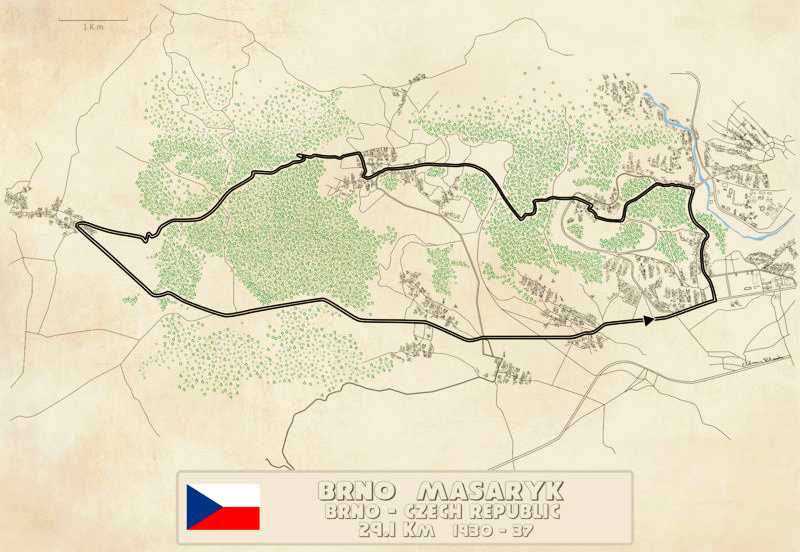
The original. Even longer than Pescara, this is where the big German teams raced against the Italians and French in the thirties.
This one is the one I wanted to see, reduced to 17.7kms (11 miles):
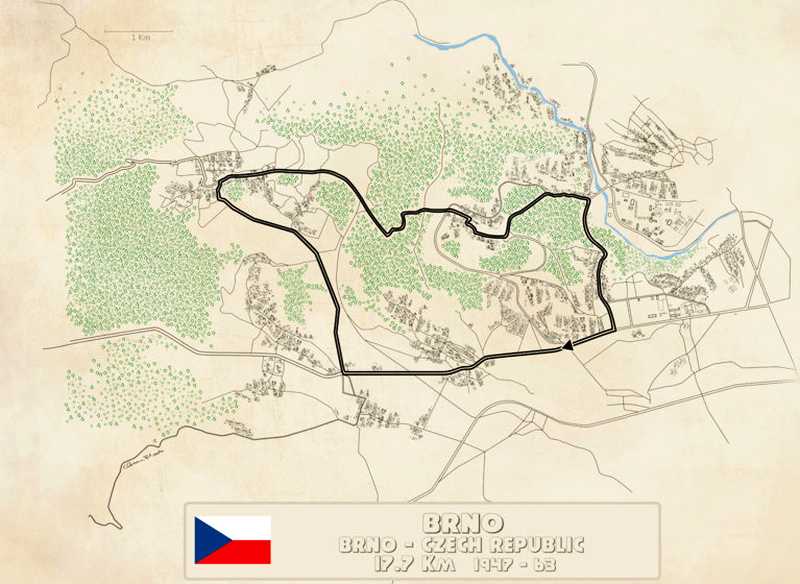
Still a long circuit. The shortened post-war version held more of my interest because I knew people who raced there.
It didn’t take long to locate the roads I wanted nor to take note of this outstanding building, the offices of a wrecking yard:
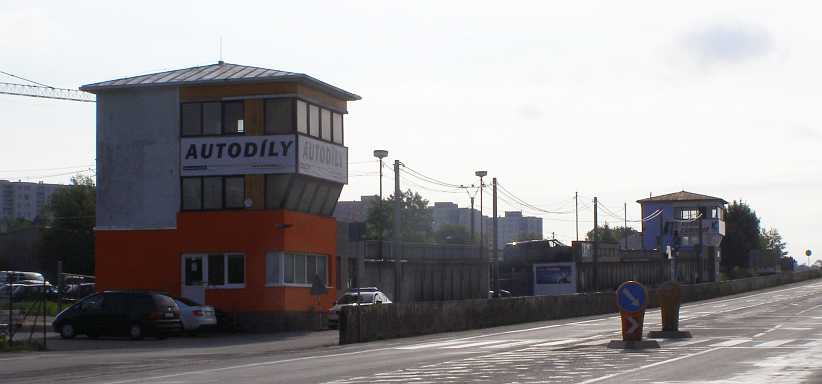
Race control. Well, it was in the past, now used as offices for the wrecking yard.
Note the shape of the buildings, they are in fact designed as control towers for a motor racing circuit, and there’s a pit lane in front of them, all well set-out to cater for the racing once held there. So now I was able to go and explore this exciting circuit, but there was a secondary pursuit relating to this photo:
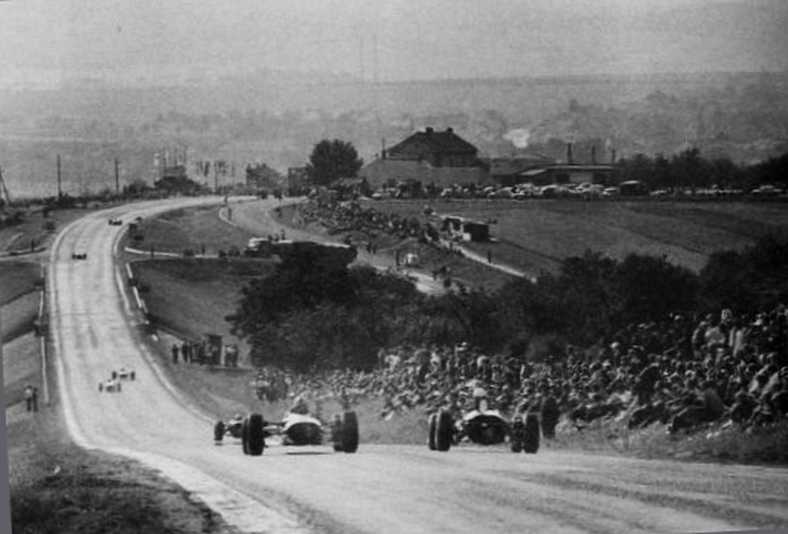
F3 racing in the sixties. A very atmospheric photo of racing little cars on a huge circuit, I wanted to see the spot where it was taken.
Some years ago this was sent to me by someone in Czechoslovakia and I put it up on the Nostalgia Forum, getting a fairly immediate response from Michael Argetsinger that it was “...one of the best motor racing photographs I’ve ever seen.” And he was right, those cars are from the mid-sixties Formula 3, 1-litre openwheelers run by racers from all over the world who would go from country to country, race to race, enjoying mighty circuits like this one and living an enthusiast’s dream.
I had to find the bit of road depicted in this photo!
So I headed off on my lap, starting at the grid area (sorry it’s out of focus)…
…and through the next village, Bosonohy…
…then a little open running…
…before Popuvky, where a roundabout marks where the circuit turned right before getting into the centre of this village:
The roundabout wasn’t there in the sixties, of course, but this road out of town was likely very much the same…
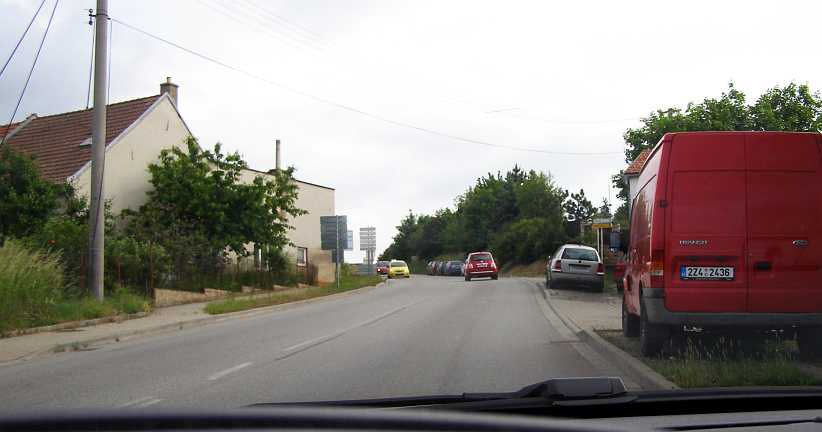
…and led to some uphill and downhill sweeps…
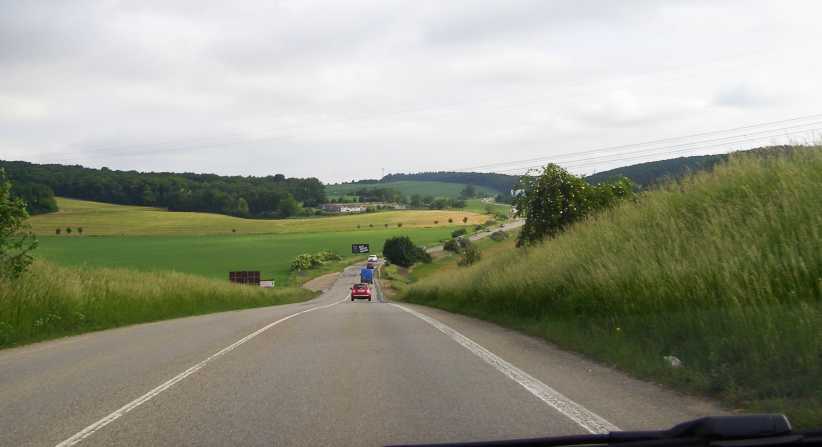
…before we had to turn left. The later, shorter, versions of the circuit cut off this turn and went straight ahead here, but we have a very easy turn to the left, though it doesn’t look that easy in this pic…
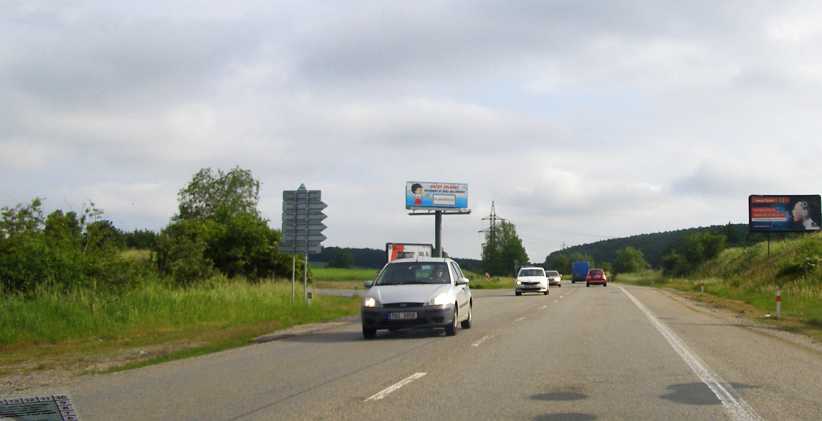
…followed by more open running with a couple of gentle curves and some hills…
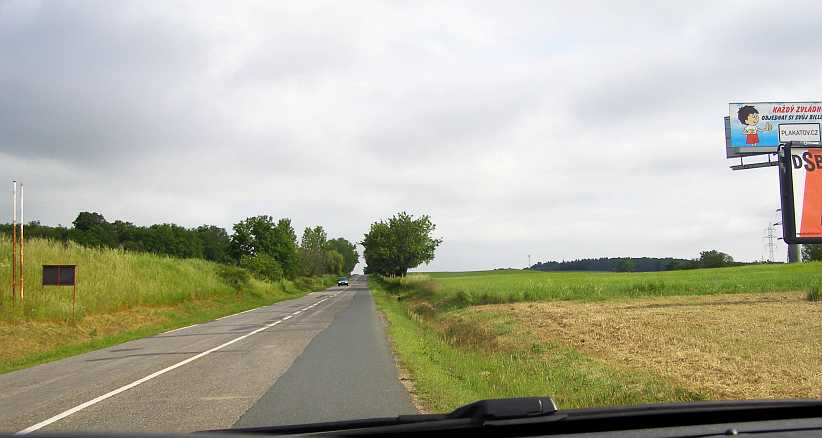
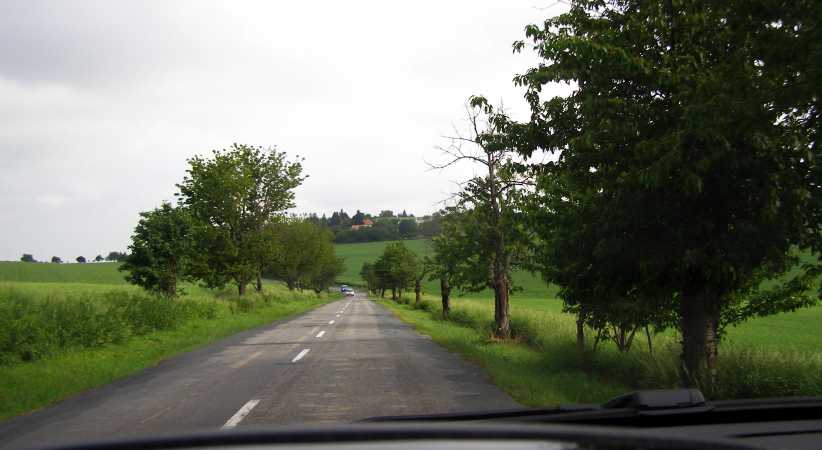
…and then the village of Zebetin…
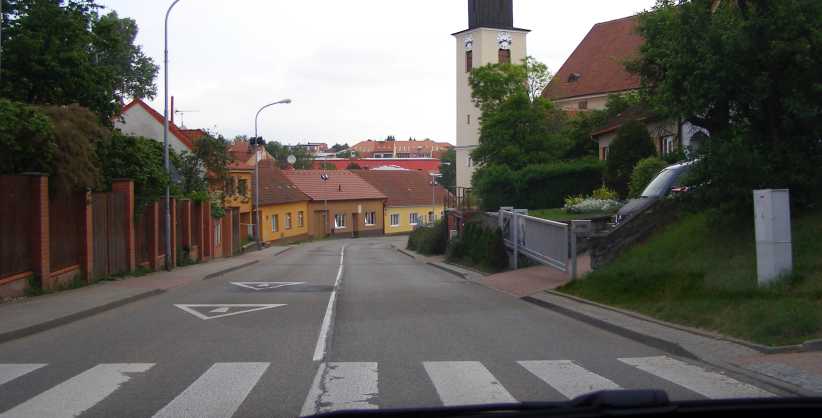
…round some corners then past this little treed area where we have to turn right…
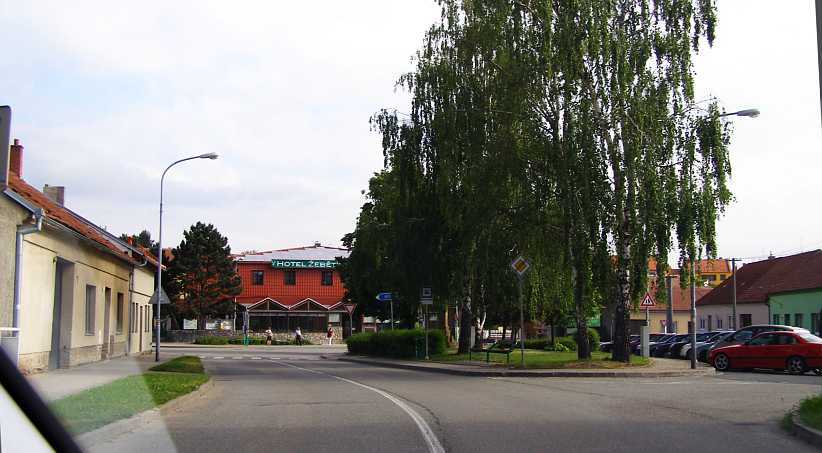
…following this road out of town and towards a forested area:
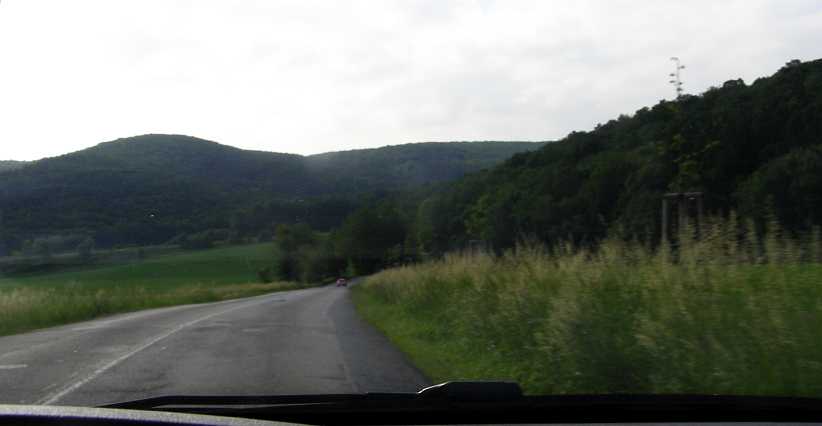
The road did some winding about in this bush area:
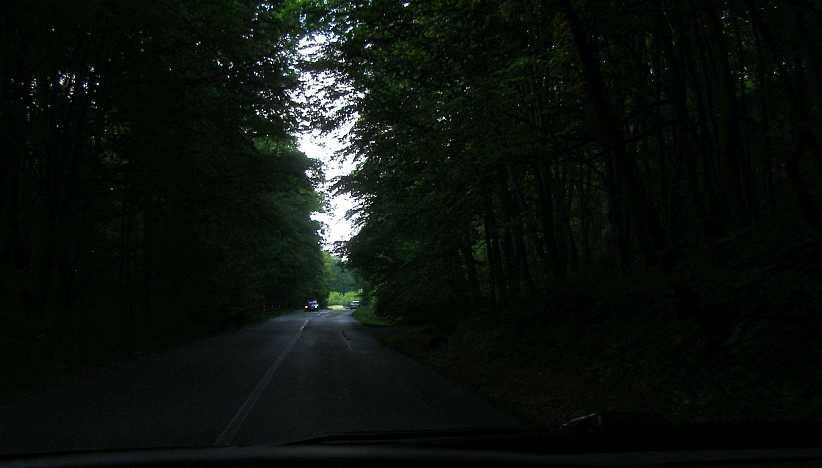
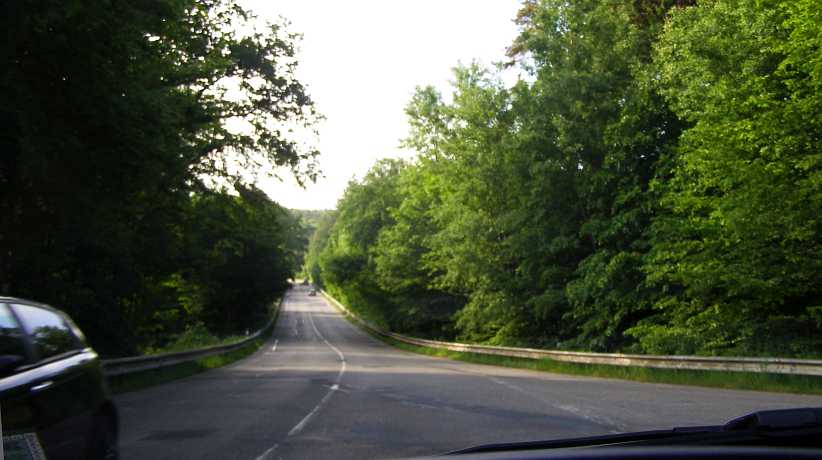
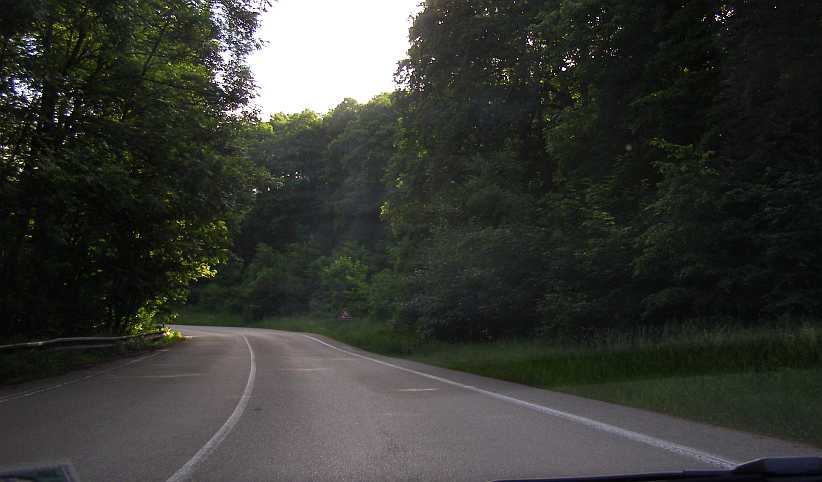
Then, clear of that, we enter Kohoutovice, which is now a very urban area…
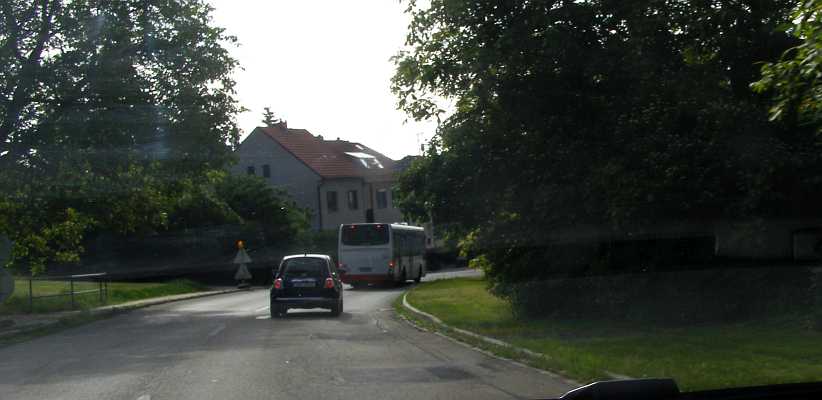
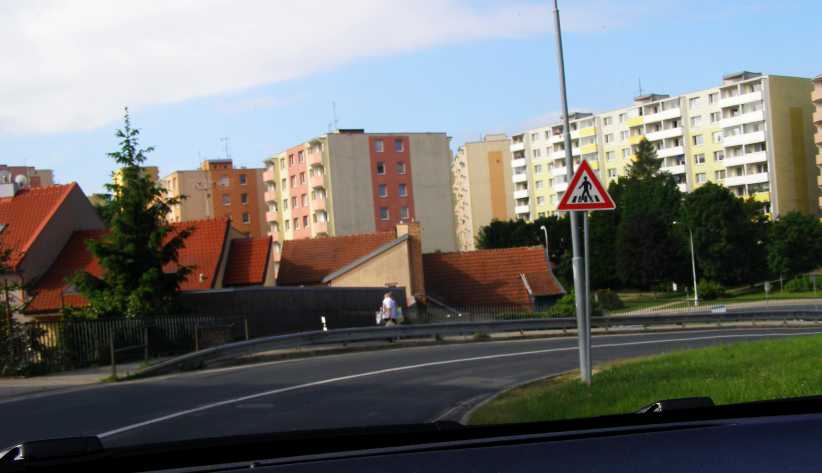
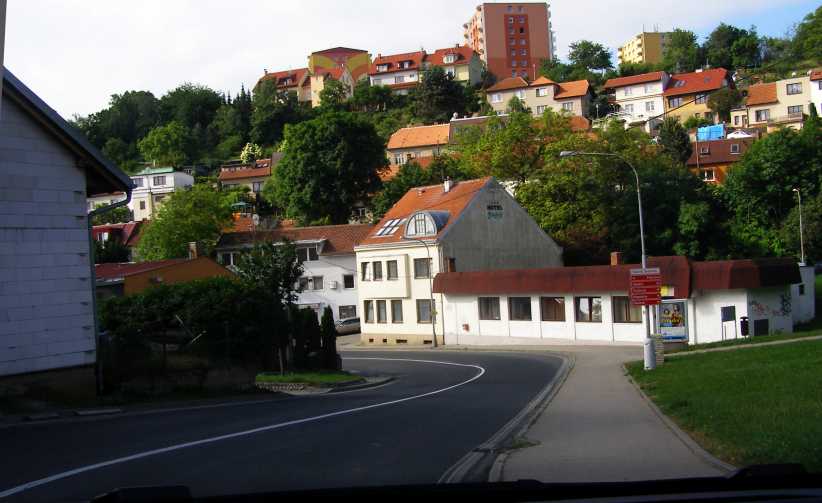
…before we get to a less-densely outskirts of this village…
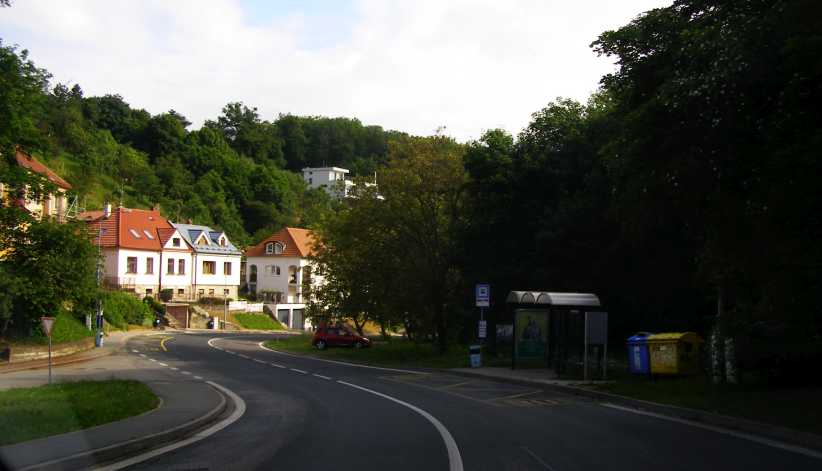
…and then a section through some more trees…
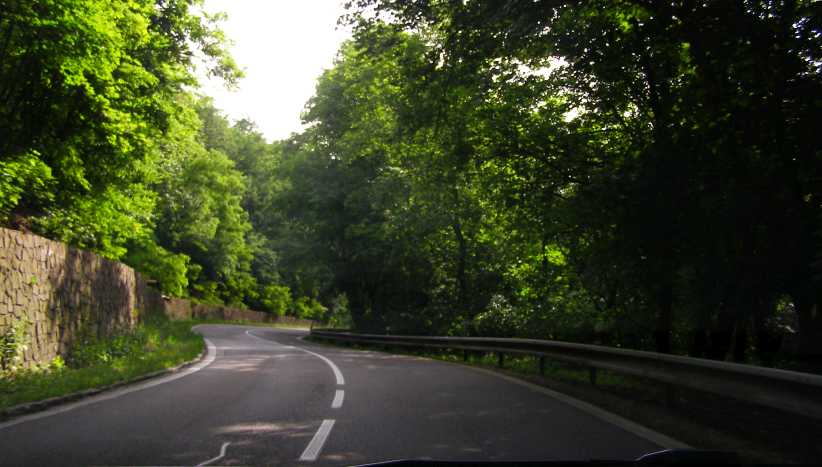
…before turning right onto this main road, trolley buses and all…
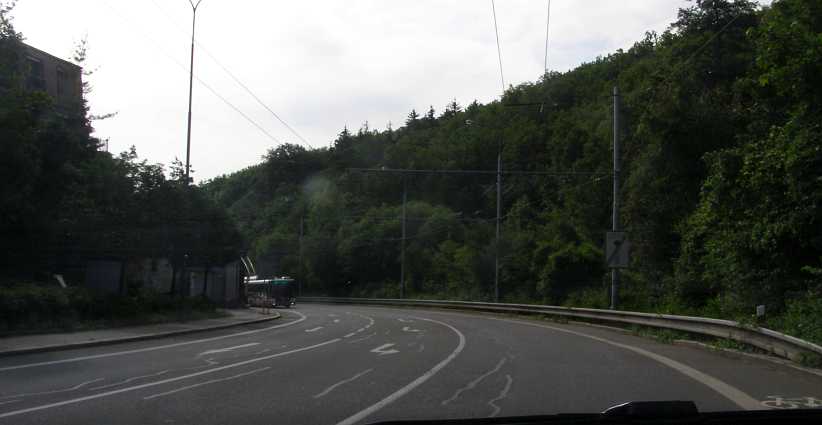
…which leads back into the Brno city area. But we turn right before that…
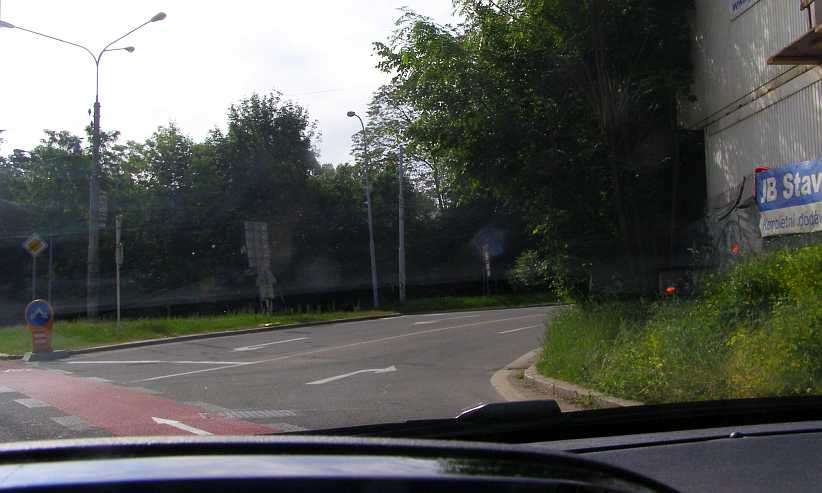
…and along Pisarecka we remain in treed surroundings:
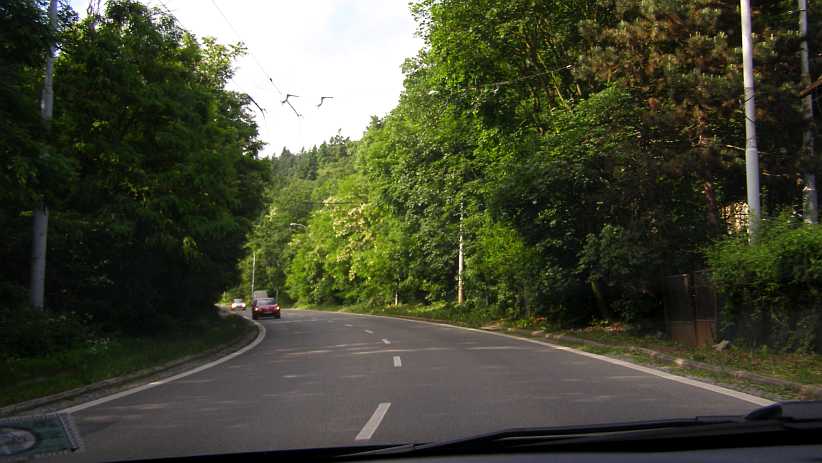
Then we come to the junction where we swing right into Rybnicka…
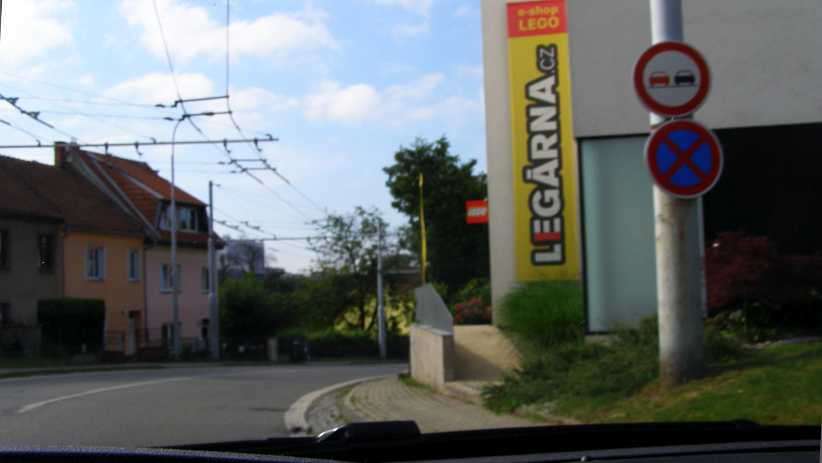
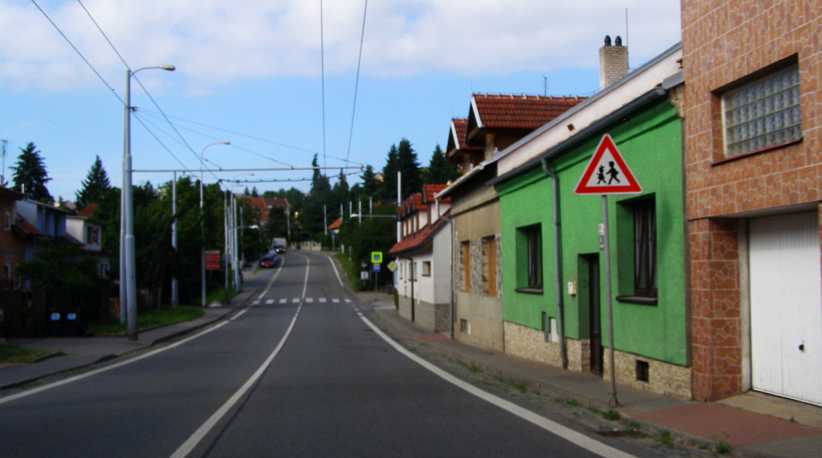
…at the end of which is this bunch of signs. I got a pic of them, but out of focus, so this is from Google Earth:
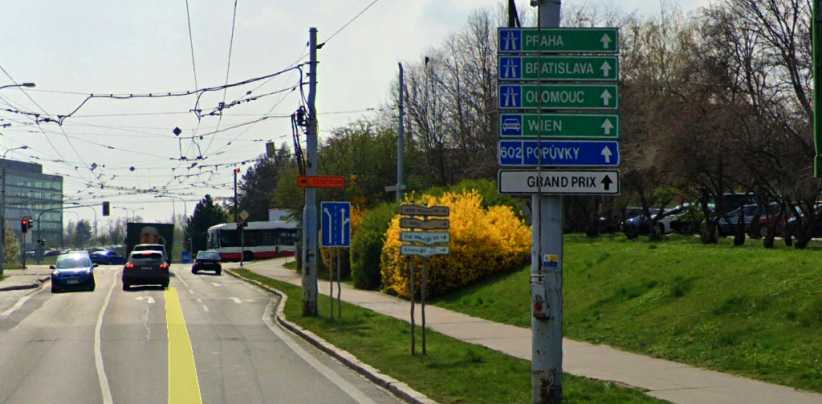
The ‘Grand Prix’ part of this sign is to direct people to the modern-day circuit which lies between Zebetin and Ostrovacice, which was the Western end of that original Masaryk circuit.
From this point things got awkward. ‘Progress’ being what it is, this corner of the circuit has been disrupted by modern city needs, I left the old roads here…
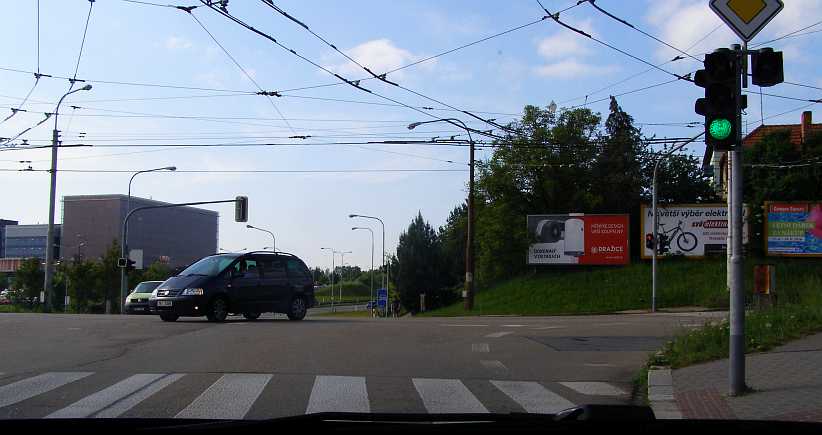
…and found my way back to the right road here:
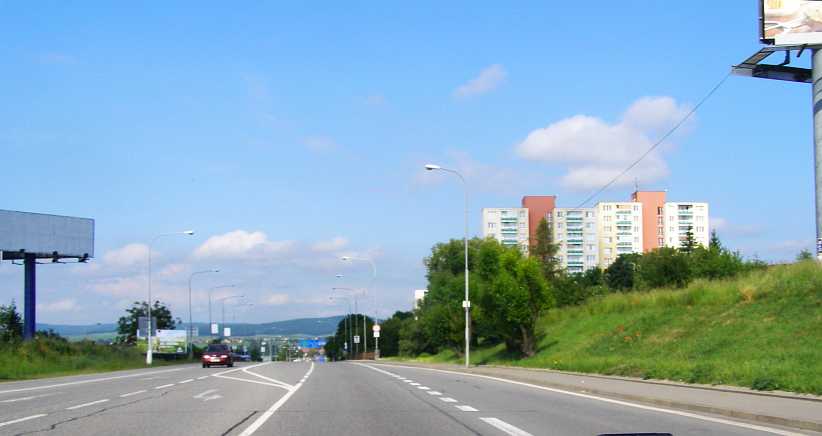
I was now heading back towards that wrecking yard, but on the way down the hill I kept taking odd photos and finally I was able to establish, by going back over them much later and doing Google Earth comparisons, that this picture…
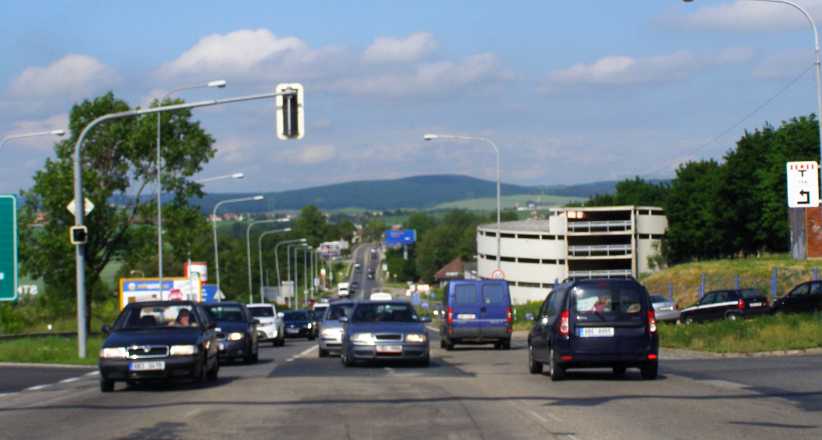
…includes the scene in the black and white pic. The evidence of this is the overpass, which I drove over here…
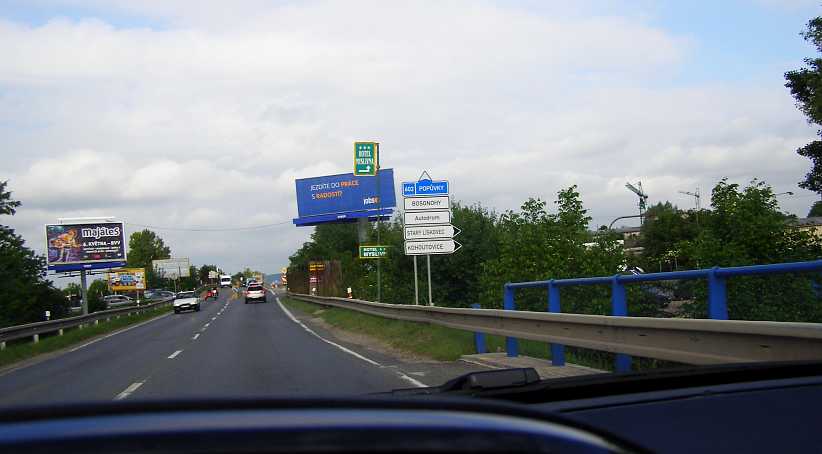
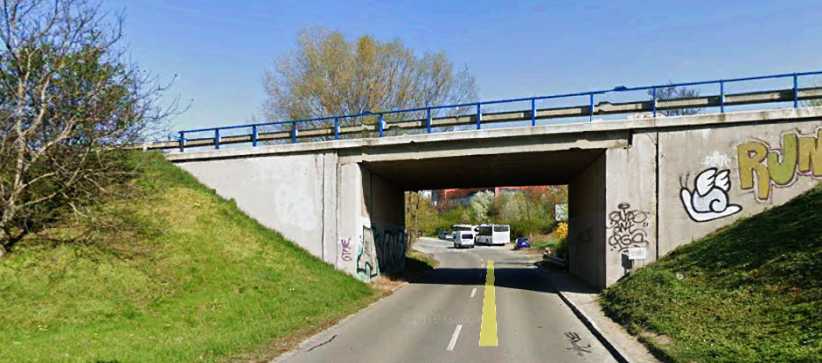
…and which Google Earth shows to clearly have the embankments alongside it, and the road curving out of it, even if camera angles and focal length of lenses try to deny it. Not to mention more modern development of the area. Here’s the Google Earth view under the overpass:
All that remained, then, was the final curve to the start/finish area…
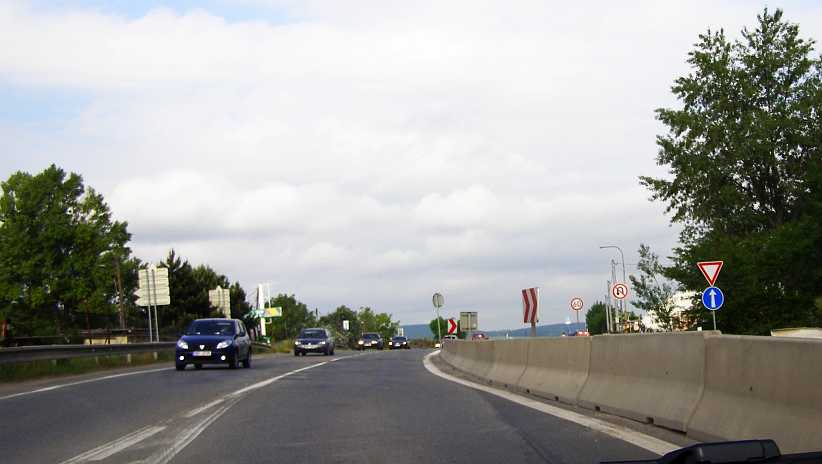
…which was just past the junction where the later shortened version rejoined this road. It’s just visible in the picture from the overpass and in the black and white shot, the road which curves under the overpass goes on to become the road which comes across from Kohoutovice to form the final version of the circuit used between 1975 and 1986.
Over the years the circuit had shrunk from 29.1kms to 17.7kms, then to 13.94kms (1965-’74) and finally to 10.92kms. In motor racing terms there’s a lot of history there, with the high point probably being the visits of the big German and Italian Grand Prix teams of the 1930s.
It was a satisfying morning for me, but I had to make tracks, I wanted to be across Austria this day and I still hadn’t had breakfast! I found a way out of the Brno area that led me towards the Austrian border. A little way out of Brno I stopped on a hillside where there was some nice shade and got out various provisions from the car and made myself some cereal.
It was a nice day… and my path would take me through some nice countryside…
Ordinarily I’d look for a McDonalds, or a public park with a toilet in it, but here I knew nothing about where I was. And I was to learn in just another day that McDonalds might not be an answer either. I parked the car and started to walk… no, run… around the streets and lanes. Fortunately I found a secluded spot on a building site and life got a lot better.
And here in Brno there was an operating trolley bus for me to photograph…
Trolley bus. I still had it in mind that I wanted to show Sandra what a trolley bus looks like. And, I guess, a tiny corner of the city of Brno and the green cross neon sign to indicate a pharmacy.
…and some strange parking signs, showing parking which we’d get a handsome fine for emulating in a city at home:
Footpath parking allowed! I’ve never seen signs like this before, though in many places it’s okay to park up on the footpath.
But it didn’t matter what Brno was like, I was going out into the countryside pursuing something very different. These maps show the original 29.1km Masaryk circuit from the 1930s:
The original. Even longer than Pescara, this is where the big German teams raced against the Italians and French in the thirties.
This one is the one I wanted to see, reduced to 17.7kms (11 miles):
Still a long circuit. The shortened post-war version held more of my interest because I knew people who raced there.
It didn’t take long to locate the roads I wanted nor to take note of this outstanding building, the offices of a wrecking yard:
Race control. Well, it was in the past, now used as offices for the wrecking yard.
Note the shape of the buildings, they are in fact designed as control towers for a motor racing circuit, and there’s a pit lane in front of them, all well set-out to cater for the racing once held there. So now I was able to go and explore this exciting circuit, but there was a secondary pursuit relating to this photo:
F3 racing in the sixties. A very atmospheric photo of racing little cars on a huge circuit, I wanted to see the spot where it was taken.
Some years ago this was sent to me by someone in Czechoslovakia and I put it up on the Nostalgia Forum, getting a fairly immediate response from Michael Argetsinger that it was “...one of the best motor racing photographs I’ve ever seen.” And he was right, those cars are from the mid-sixties Formula 3, 1-litre openwheelers run by racers from all over the world who would go from country to country, race to race, enjoying mighty circuits like this one and living an enthusiast’s dream.
I had to find the bit of road depicted in this photo!
So I headed off on my lap, starting at the grid area (sorry it’s out of focus)…
…and through the next village, Bosonohy…
…then a little open running…
…before Popuvky, where a roundabout marks where the circuit turned right before getting into the centre of this village:
The roundabout wasn’t there in the sixties, of course, but this road out of town was likely very much the same…
…and led to some uphill and downhill sweeps…
…before we had to turn left. The later, shorter, versions of the circuit cut off this turn and went straight ahead here, but we have a very easy turn to the left, though it doesn’t look that easy in this pic…
…followed by more open running with a couple of gentle curves and some hills…
…and then the village of Zebetin…
…round some corners then past this little treed area where we have to turn right…
…following this road out of town and towards a forested area:
The road did some winding about in this bush area:
Then, clear of that, we enter Kohoutovice, which is now a very urban area…
…before we get to a less-densely outskirts of this village…
…and then a section through some more trees…
…before turning right onto this main road, trolley buses and all…
…which leads back into the Brno city area. But we turn right before that…
…and along Pisarecka we remain in treed surroundings:
Then we come to the junction where we swing right into Rybnicka…
…at the end of which is this bunch of signs. I got a pic of them, but out of focus, so this is from Google Earth:
The ‘Grand Prix’ part of this sign is to direct people to the modern-day circuit which lies between Zebetin and Ostrovacice, which was the Western end of that original Masaryk circuit.
From this point things got awkward. ‘Progress’ being what it is, this corner of the circuit has been disrupted by modern city needs, I left the old roads here…
…and found my way back to the right road here:
I was now heading back towards that wrecking yard, but on the way down the hill I kept taking odd photos and finally I was able to establish, by going back over them much later and doing Google Earth comparisons, that this picture…
…includes the scene in the black and white pic. The evidence of this is the overpass, which I drove over here…
…and which Google Earth shows to clearly have the embankments alongside it, and the road curving out of it, even if camera angles and focal length of lenses try to deny it. Not to mention more modern development of the area. Here’s the Google Earth view under the overpass:
All that remained, then, was the final curve to the start/finish area…
…which was just past the junction where the later shortened version rejoined this road. It’s just visible in the picture from the overpass and in the black and white shot, the road which curves under the overpass goes on to become the road which comes across from Kohoutovice to form the final version of the circuit used between 1975 and 1986.
Over the years the circuit had shrunk from 29.1kms to 17.7kms, then to 13.94kms (1965-’74) and finally to 10.92kms. In motor racing terms there’s a lot of history there, with the high point probably being the visits of the big German and Italian Grand Prix teams of the 1930s.
It was a satisfying morning for me, but I had to make tracks, I wanted to be across Austria this day and I still hadn’t had breakfast! I found a way out of the Brno area that led me towards the Austrian border. A little way out of Brno I stopped on a hillside where there was some nice shade and got out various provisions from the car and made myself some cereal.
It was a nice day… and my path would take me through some nice countryside…
Last edited by Ray Bell; Apr 23, 2020 at 10:24 PM.
Thread Starter
|
Captain
Joined: Oct 2005
Posts: 568
Likes: 8
From: The Summit, Queensland, Australia
Having eaten breakfast I was ready to carry on with the day. The road I took headed generally in the direction of Vienna, but was more to the West, and I would intersect the Austrian Motorway before I got to be too far to the West.
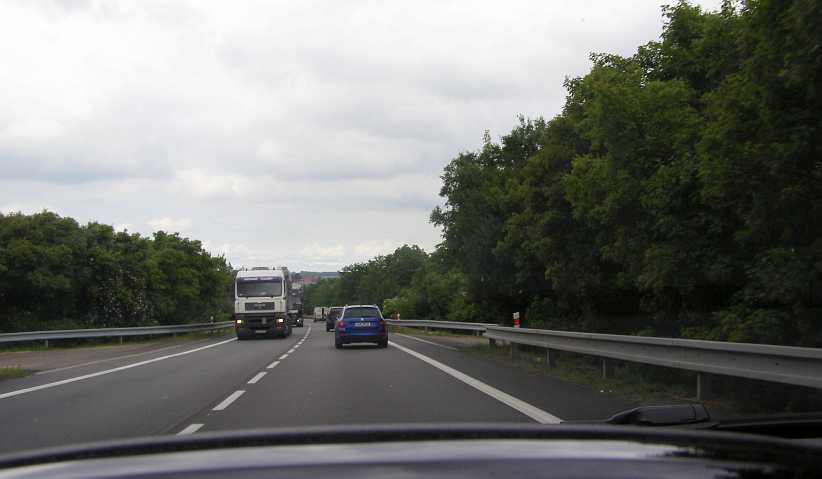
Plenty of traffic. Occasional bunches of traffic were encountered such as this lot, but the country was nice and open and green.
One thing I noticed as I got closer and closer to the Austrian border was the number of signs (billboards) advertising strip clubs, casinos and girls for hire. I came to the conclusion that Austria must have tighter controls on such things and that the Czechs have set things up close to the border to entice their Southern neighbours to come visit and spend their money on things deemed immoral in their own country.
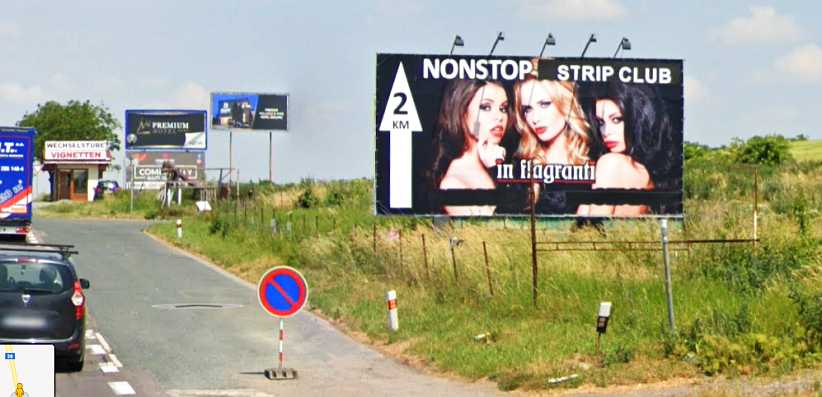
Looser rules? Advertising for a strip club or two, for casinos and for ‘ladies of the night’ were a feature of the area near the Austrian border.
Then, right near the border, there was a cluster of ‘tourist trap’ places, headed by one called Excalibur City. It looked like there was a lot of shopping areas, and big signage for a theme park that was very colourful, and out the front was this colourful item too…
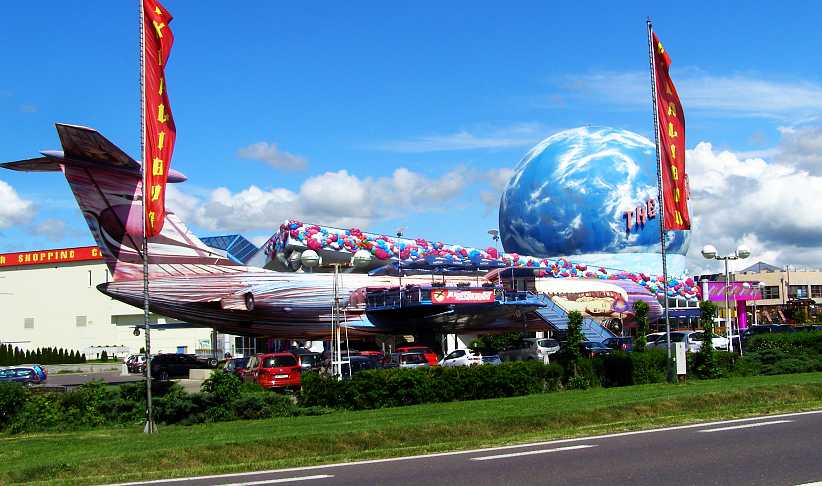
Low flying. This Iluyshin IL62 has become a restaurant, with dining both inside and outside on a balcony based on a wing.
…an Iluyshin jetliner converted into a restaurant.
Passing that by I drove into Austria. This was to be, essentially, a ‘transit’ day to get me to my next destinations. That didn’t stop me admiring the scenery, of course, but I wasn’t planning on any stops anywhere.
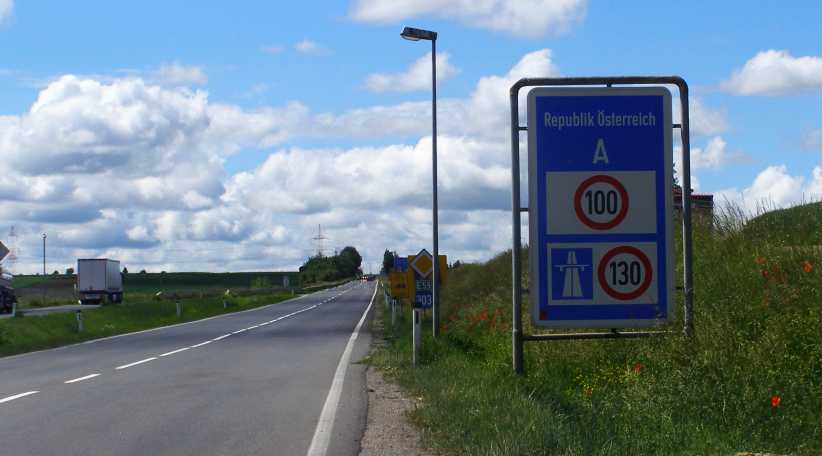
Austria. Another country, the twelfth of my European drive, and one of the prettiest.
It took a little while to get to the motorway, where I needed yet another ‘Vignetta’, this costing €11 and being valid for several days longer than I’d need to cross the country. Looking back at the photos I feel it’s a shame I didn’t take more time here…
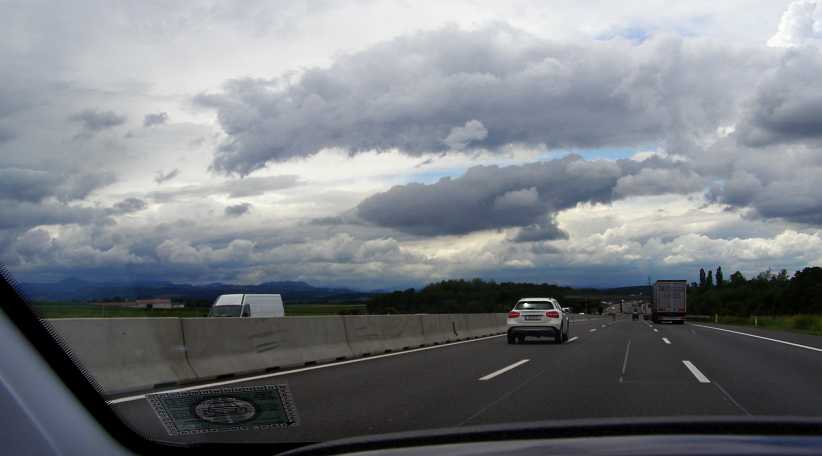
Motorway and clouds. The weather plays a part here in making this scene. Clouds of different densities, possibly a little rain off to the left, and fast-moving traffic on the motorway.
…with rolling hills and a backdrop of mountains and villages, it was certainly pleasant:
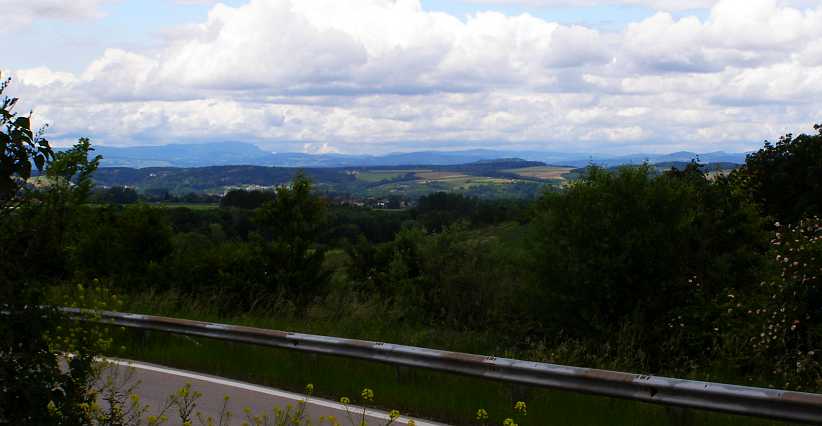
The countryside. The distant mountains, the clouds and the village tucked away in the valley set off this scene…
 [/url]
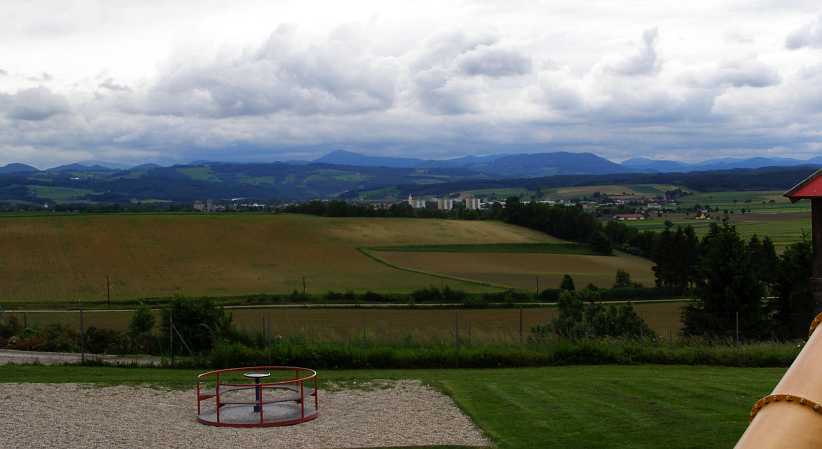
And more. …while it’s much the same here, though the agricultural aspect is highlighted in what is obviously fertile and well-developed country.
I was cruising well, thinking of other things to a large degree, and by the time I’d completed about 220kms out of Brno I couldn’t help notice this huge building down in one of the valleys:
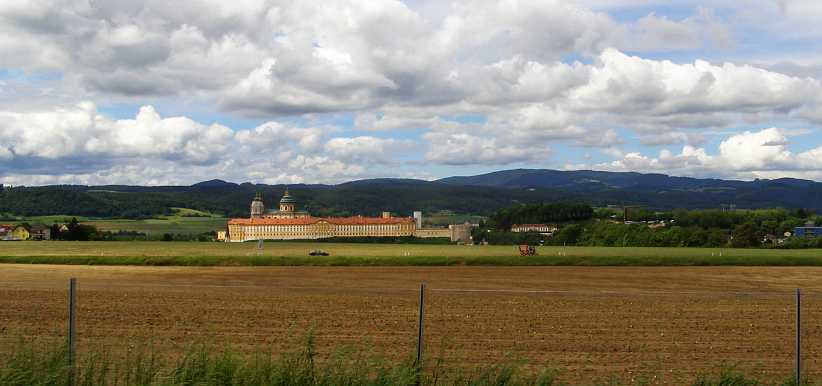
Melk Abbey. The Danube River is down in that valley too, with this huge abbey claiming great views of it.
It’s a Benedictine abbey which has obviously been around a very long time and had a lot of extensions made to it. It certainly dwarfs the town of just over 5,000 people.
Around this time I had a call from Sandra’s daughter. “Where are you? Mum doesn’t know where you are,” she said. It became clear that Sandra was disoriented and I had to explain things to her. It wasn’t yet a week since Sandra had flown home telling me to ‘enjoy myself’ as I carried on with the trip. I would learn later that she went to hospital due to her back pains and having picked up a bug on the flight from Rome.
Still the vistas rolled by, some lakes, some mountains were starting to appear as I got further to the West, and all the while villages were seen dotted out on the green carpet laid over Austria…
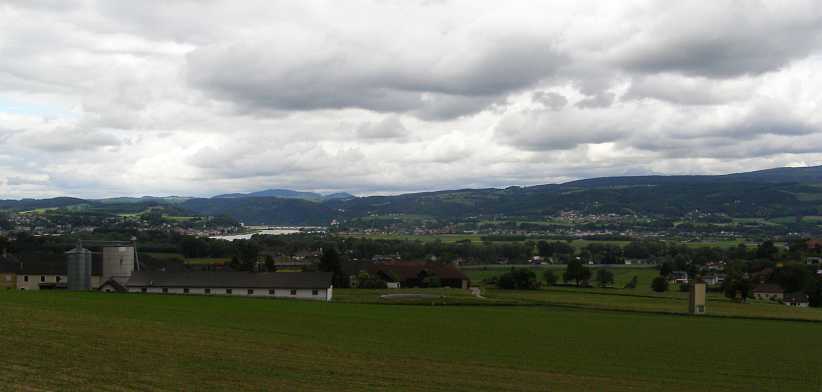
Farms and villages. There seemed to be no limit to the number of villages to be seen from the motorway, nor the farms.
…and the odd lake, backed by yet another mountain…
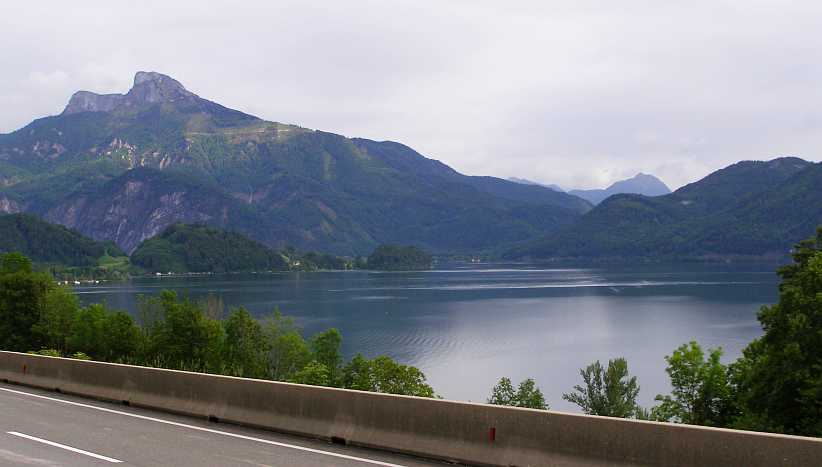
Lake and mountains. Almost spectacular, this sight with the lake and the emergent mountain could not be passed without taking a photo.
…and then the increasing number of mountains showed I was getting ever closer to the Austrian Alps. There was still snow about (this was the first of June) and with this view including a castle on a high point overlooking a village just begged to be captured too. Even if the sound-deadening fence is in the foreground:
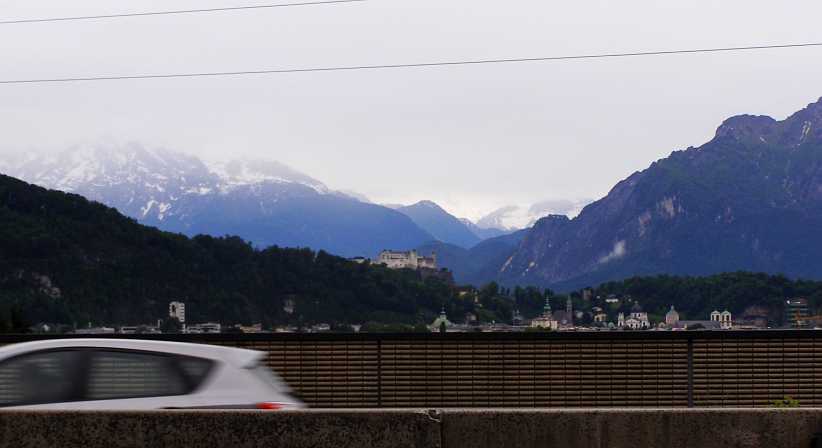
Snow in the heights. A promise of cooler conditions as I got closer to the Austrian Alps, while this sight of the castle and village in its shadow was worth seeing.
The kilometres were passing and somewhere near Salzburg the E60 motorway crossed the border into Germany. Not that I realised, there were no signs that I noticed at all. And a rest area alongside a lake cropped up and I took a break:
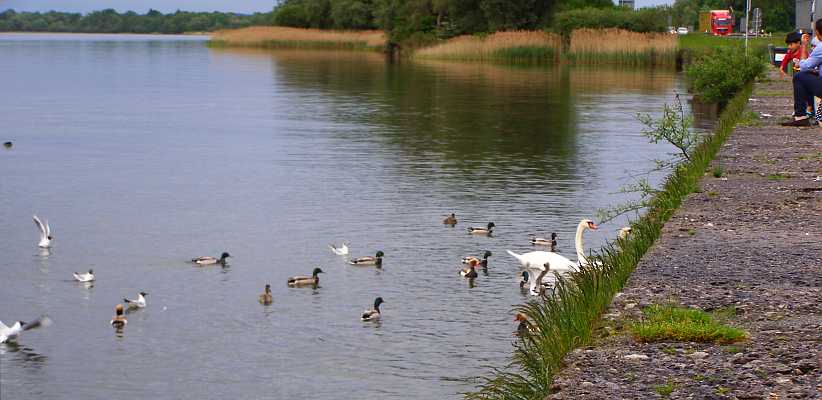
Chiemsee. I was surprised to learn this lake is in Germany. A number of people were here at the rest area enjoying the ducks and swans.
Now as I headed towards my goal, Lichtenstein, I was definitely going to see more of those mountains. They weren’t shy about coming forward at all, either. Nor was I alone on this busy road…
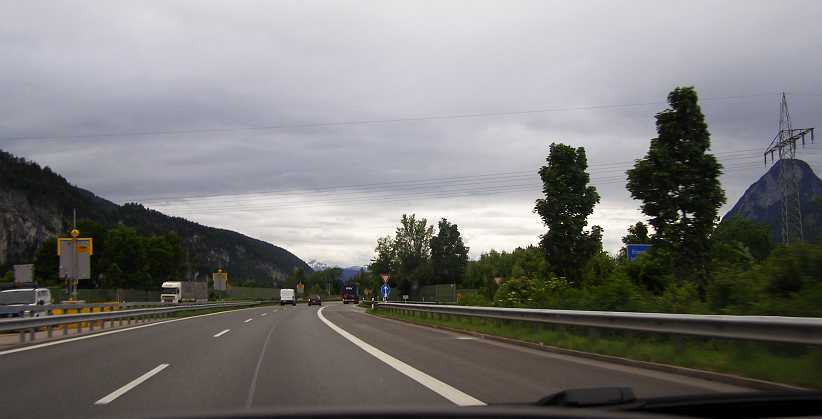
Mountains loom large. As I got ever closer to Lichtenstein the moutains started to close in.
…and even more so was the prospect of a cold night. Climbing higher, I was seeing more of the winter snow which hadn’t yet melted away:
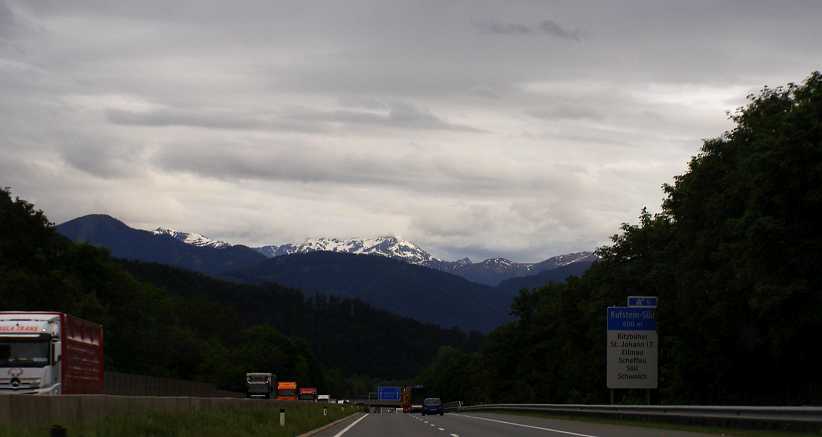
More snow on the mountain tops. As the day was nearing its end and I had reason not to go much further, I was looking forward to a very cool night in the car.
I knew the way through the mountains would entail going through a long tunnel. And I had agreed to take photos of the road into Lichtenstein for someone in England who was looking into a story about something that’s supposed to have happened along that road a long time ago. So I resolved to stay on the Austrian side of the tunnel overnight.
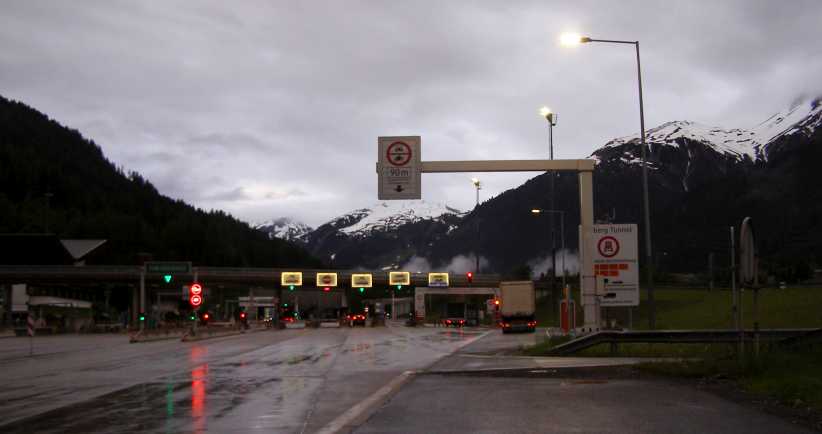
Toll gates. No, the vignetta wasn’t good enough to get me through the tunnel, another toll had to be paid here.
I hunted around and found somewhere to get something to eat and then parked in the carpark there to spend the night. Looking through my gear to find something to cover me up and keep me warm through it all. Outside it was drizzling and uncomfortable.
So ended a day I might not have had. Deciding to go to Brno was a last-minute inclusion in my itinerary and it was so worthwhile, crossing Austria was picturesque, hearing Sandra wasn’t doing the best was unhelpful. I had an uneasy sleep that night…
Plenty of traffic. Occasional bunches of traffic were encountered such as this lot, but the country was nice and open and green.
One thing I noticed as I got closer and closer to the Austrian border was the number of signs (billboards) advertising strip clubs, casinos and girls for hire. I came to the conclusion that Austria must have tighter controls on such things and that the Czechs have set things up close to the border to entice their Southern neighbours to come visit and spend their money on things deemed immoral in their own country.
Looser rules? Advertising for a strip club or two, for casinos and for ‘ladies of the night’ were a feature of the area near the Austrian border.
Then, right near the border, there was a cluster of ‘tourist trap’ places, headed by one called Excalibur City. It looked like there was a lot of shopping areas, and big signage for a theme park that was very colourful, and out the front was this colourful item too…
Low flying. This Iluyshin IL62 has become a restaurant, with dining both inside and outside on a balcony based on a wing.
…an Iluyshin jetliner converted into a restaurant.
Passing that by I drove into Austria. This was to be, essentially, a ‘transit’ day to get me to my next destinations. That didn’t stop me admiring the scenery, of course, but I wasn’t planning on any stops anywhere.
Austria. Another country, the twelfth of my European drive, and one of the prettiest.
It took a little while to get to the motorway, where I needed yet another ‘Vignetta’, this costing €11 and being valid for several days longer than I’d need to cross the country. Looking back at the photos I feel it’s a shame I didn’t take more time here…
Motorway and clouds. The weather plays a part here in making this scene. Clouds of different densities, possibly a little rain off to the left, and fast-moving traffic on the motorway.
…with rolling hills and a backdrop of mountains and villages, it was certainly pleasant:
The countryside. The distant mountains, the clouds and the village tucked away in the valley set off this scene…
[/url]And more. …while it’s much the same here, though the agricultural aspect is highlighted in what is obviously fertile and well-developed country.
I was cruising well, thinking of other things to a large degree, and by the time I’d completed about 220kms out of Brno I couldn’t help notice this huge building down in one of the valleys:
Melk Abbey. The Danube River is down in that valley too, with this huge abbey claiming great views of it.
It’s a Benedictine abbey which has obviously been around a very long time and had a lot of extensions made to it. It certainly dwarfs the town of just over 5,000 people.
Around this time I had a call from Sandra’s daughter. “Where are you? Mum doesn’t know where you are,” she said. It became clear that Sandra was disoriented and I had to explain things to her. It wasn’t yet a week since Sandra had flown home telling me to ‘enjoy myself’ as I carried on with the trip. I would learn later that she went to hospital due to her back pains and having picked up a bug on the flight from Rome.
Still the vistas rolled by, some lakes, some mountains were starting to appear as I got further to the West, and all the while villages were seen dotted out on the green carpet laid over Austria…
Farms and villages. There seemed to be no limit to the number of villages to be seen from the motorway, nor the farms.
…and the odd lake, backed by yet another mountain…
Lake and mountains. Almost spectacular, this sight with the lake and the emergent mountain could not be passed without taking a photo.
…and then the increasing number of mountains showed I was getting ever closer to the Austrian Alps. There was still snow about (this was the first of June) and with this view including a castle on a high point overlooking a village just begged to be captured too. Even if the sound-deadening fence is in the foreground:
Snow in the heights. A promise of cooler conditions as I got closer to the Austrian Alps, while this sight of the castle and village in its shadow was worth seeing.
The kilometres were passing and somewhere near Salzburg the E60 motorway crossed the border into Germany. Not that I realised, there were no signs that I noticed at all. And a rest area alongside a lake cropped up and I took a break:
Chiemsee. I was surprised to learn this lake is in Germany. A number of people were here at the rest area enjoying the ducks and swans.
Now as I headed towards my goal, Lichtenstein, I was definitely going to see more of those mountains. They weren’t shy about coming forward at all, either. Nor was I alone on this busy road…
Mountains loom large. As I got ever closer to Lichtenstein the moutains started to close in.
…and even more so was the prospect of a cold night. Climbing higher, I was seeing more of the winter snow which hadn’t yet melted away:
More snow on the mountain tops. As the day was nearing its end and I had reason not to go much further, I was looking forward to a very cool night in the car.
I knew the way through the mountains would entail going through a long tunnel. And I had agreed to take photos of the road into Lichtenstein for someone in England who was looking into a story about something that’s supposed to have happened along that road a long time ago. So I resolved to stay on the Austrian side of the tunnel overnight.
Toll gates. No, the vignetta wasn’t good enough to get me through the tunnel, another toll had to be paid here.
I hunted around and found somewhere to get something to eat and then parked in the carpark there to spend the night. Looking through my gear to find something to cover me up and keep me warm through it all. Outside it was drizzling and uncomfortable.
So ended a day I might not have had. Deciding to go to Brno was a last-minute inclusion in my itinerary and it was so worthwhile, crossing Austria was picturesque, hearing Sandra wasn’t doing the best was unhelpful. I had an uneasy sleep that night…
Thread Starter
|
Captain
Joined: Oct 2005
Posts: 568
Likes: 8
From: The Summit, Queensland, Australia
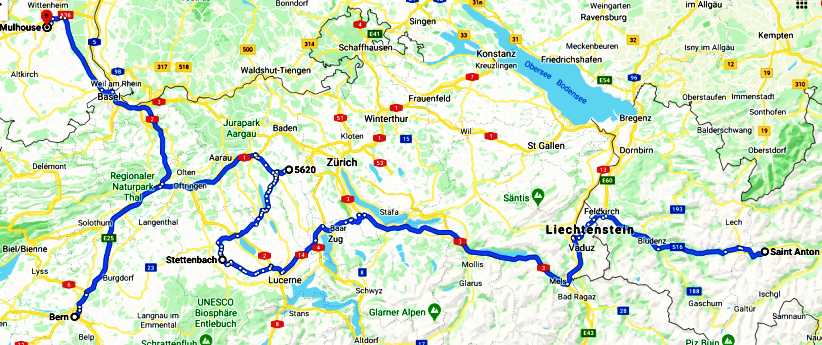
I naturally enough got underway early on Wednesday morning. Clearing the windscreen I could see not much had changed overnight. It was still cold, it was still drizzly, it was still up there in the mountains. After driving through Lichtenstein and into Switzerland I had two objectives; The first was to call in and visit, if possible, family of a friend back home; The second was to see what was left of the old road circuit at Bern, known as the Bremgarten circuit.
This was to be the day’s travel:
And you can see from this picture that it was cold, overcast and drizzling…
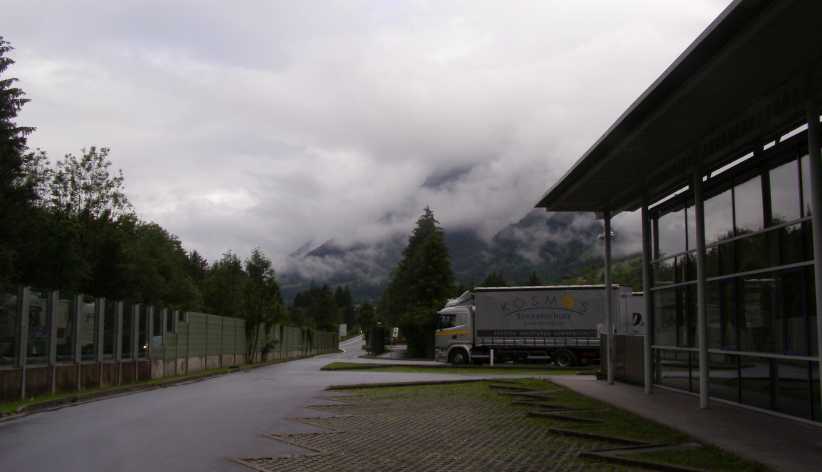
Morning in the Austrian Alps. The parking area here had been my camping spot for the night, an uncomfortably cold night without sufficient covering.
I went back to the tunnel entry, paid my toll and headed towards Lichtenstein. Clouds embraced the mountains on both sides as the headlights of oncoming cars reflected on the wet road surface. It was early and there wasn’t much traffic.
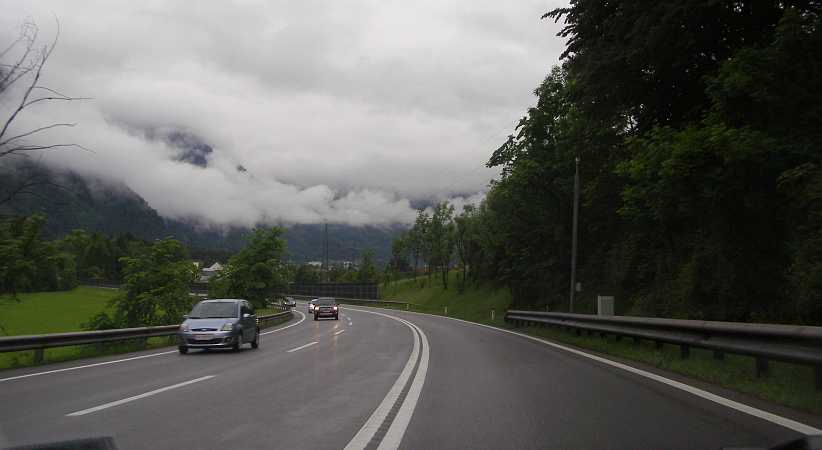
Wet and cold road. At least there was no snow or ice, but conditions were pretty bleak.
The setting was still another ‘adventure’ to me as we don’t have anywhere in Australia where these conditions prevail. Not with that kind of background, not with major roads traversing the mountains. I stopped at Bludenz to look around briefly, looking back on the highway produced this shot:
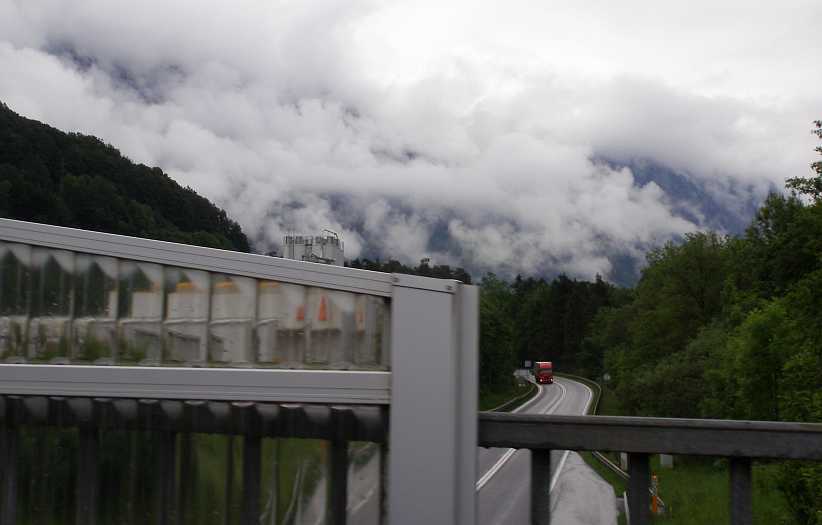
Looking back. Undoubtedly this road has improved enormously in the past fifty years, and so have the trucks, but the clouds and mists and the mountains would never change.
I had a brief look around there, with a bit of a surprise coming in seeing that it’s the headquarters of Sika, the people who make Sikaflex, so widely used in car building these days:
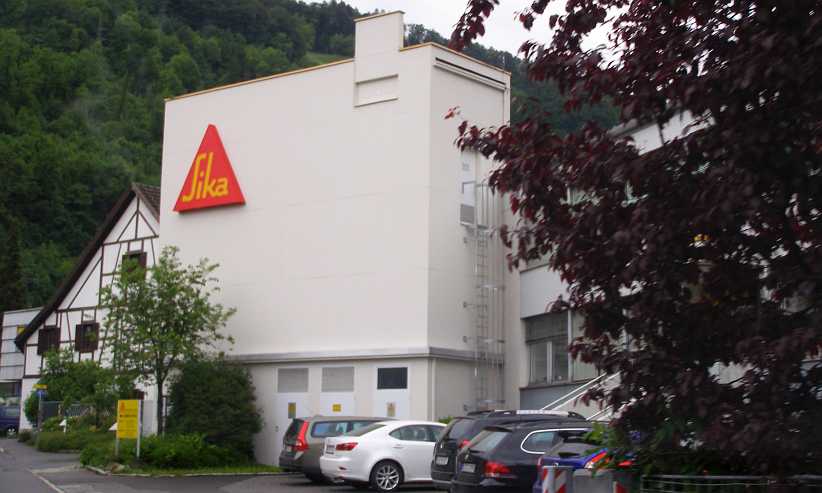
Sika. Bludenz houses a branch of the Sika brand, whose products have revolutionised car-building over the last thirty years or so.
And a little drive down into that part of the village didn’t find much else that I might be looking for, for instance somewhere to get breakfast.
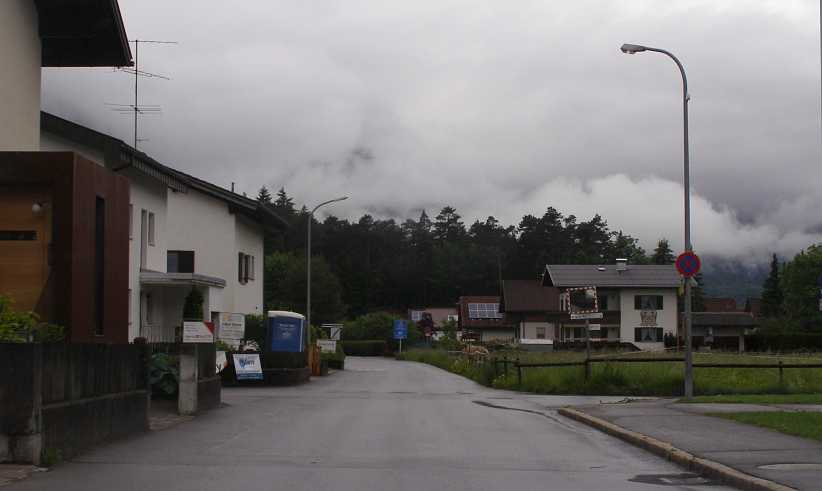
The village. Surrounded by those mountains and undoubtedly seeing many days each year like this, this corner of Bludenz was quiet at this time of morning. And probably the rest of the day.
As I mentioned, I’d been asked to take photos along this road by someone in England, and looking at these pics now it’s evident that a lot of electricity is transmitted via this path as well.
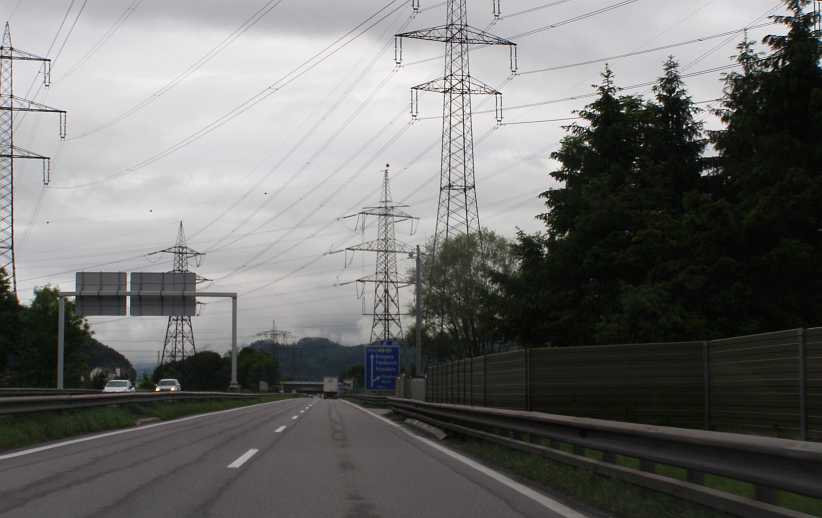
Power lines. A feature of the scenery along this road is the multiple powerlines which run parallel to the road.
Villages came and went as I drove on, always showing a solidarity gained from being very well-established. Like this one:
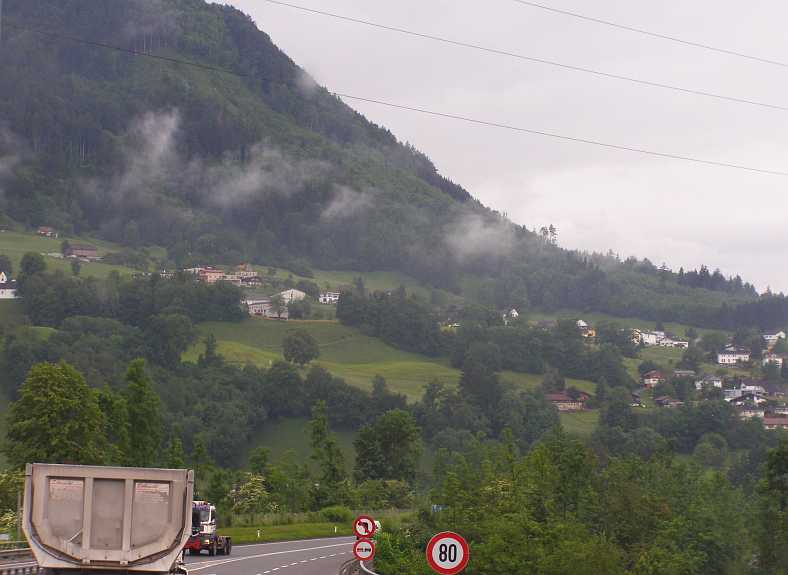
Hillside village. And then I was in Lichtenstein, this hillside village providing a pleasant scene nestling in the greenery.
One larger town put the traffic through a tunnel under a stately old building:
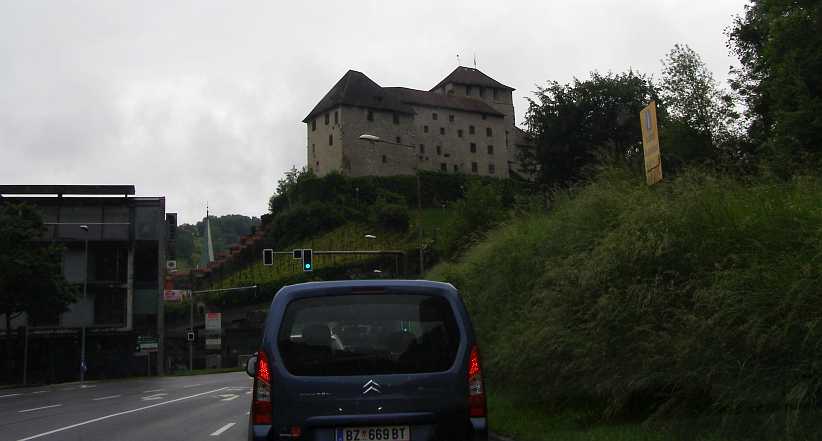
Tunnel. This place must have been important because a tunnel has been built to take traffic underneath the building.
Lichtenstein isn’t very large, so in short order I was at the Swiss border:
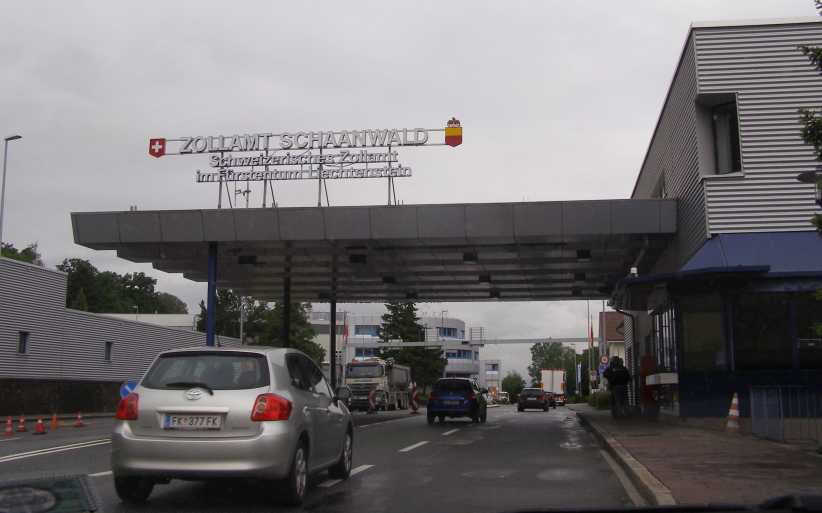
Swiss border. Getting through the border was no big deal, but I had to buy yet another ‘vignetta’. This one had a minimum period of a year and cost €36!
The cost of the vignetta did smart a little, so I got some breakfast and licked my wounds as I thought about a way to get some of that cost back. But this meant also that it was time to consider the inability to use my Load & Go Travel Visa. Oh, that’s right the one which stopped working in Serbia.
I tried it here and it still didn’t work, so I phoned the people in Australia. “There’s been a suspicious transaction on it, so we cancelled it.” I was told. I asked what that transaction was and it turned out that back in Italy, soon after leaving Rome, I bought fuel at a service station. Recall that I said I paid for the fuel and then decided to get something to eat as well?
So because of the second transaction straight after the other they thought they’d ‘protect’ me and cancel the card. Too bad if I had no other means of buying things, right? Anyway, they fixed it up right away for me and I was able to look forward to freedom to spend the money as I went along.
None of this, of course, spoiled the vistas I was enjoying as I motored further into this country, the sixteenth country of the trip so far.
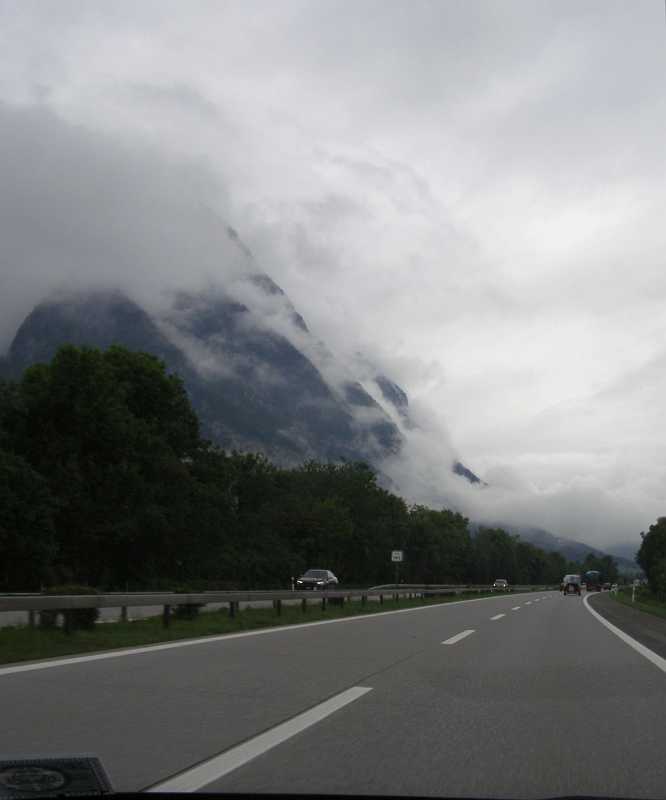
Swiss mountains and cloud. Even though it was now well into the morning, the mists and low clouds were hanging around the mountains making for great scenery.
And just when the pangs of hunger were getting to me I found somewhere to eat. This was at Sargans…
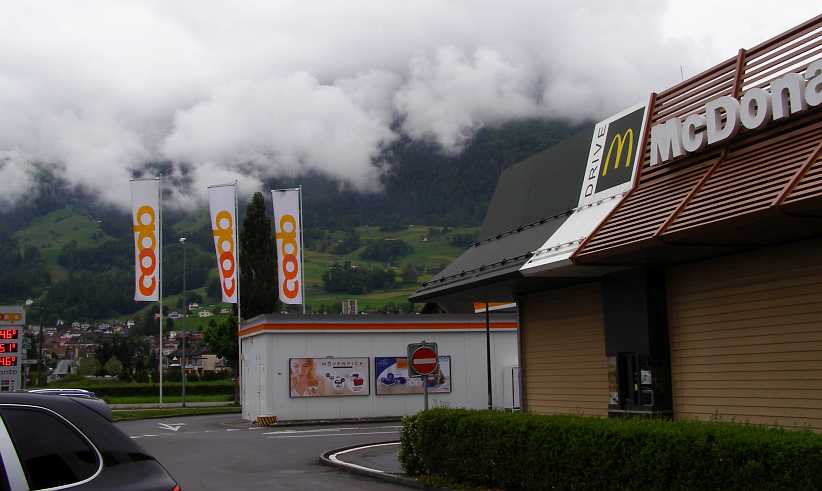
McDonalds Sargans. One reason I wanted to get this photo was because of the colour of the store, apparently a new colour scheme for the chain.
Going further as I followed the GPS set for Stettenbach, I decided to phone my friend at home and establish just where his sister lived in Stettenbach. I would be there before long and I had to be able to find the place. He didn’t get the call, but seeing the missed call he sent a text - ‘please text me.’ So I did.
Meanwhile I drove alongside the lake called Walensee…
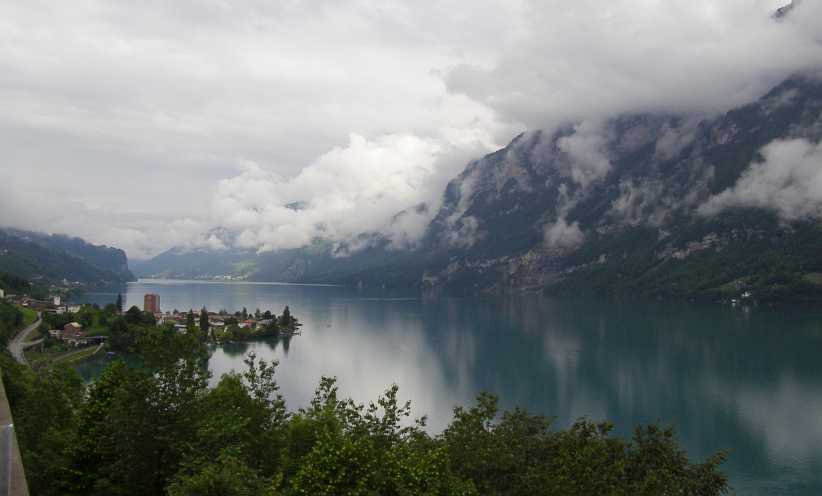
Walensee. The little town jutting out there is Murgon, the lake is called Walensee.
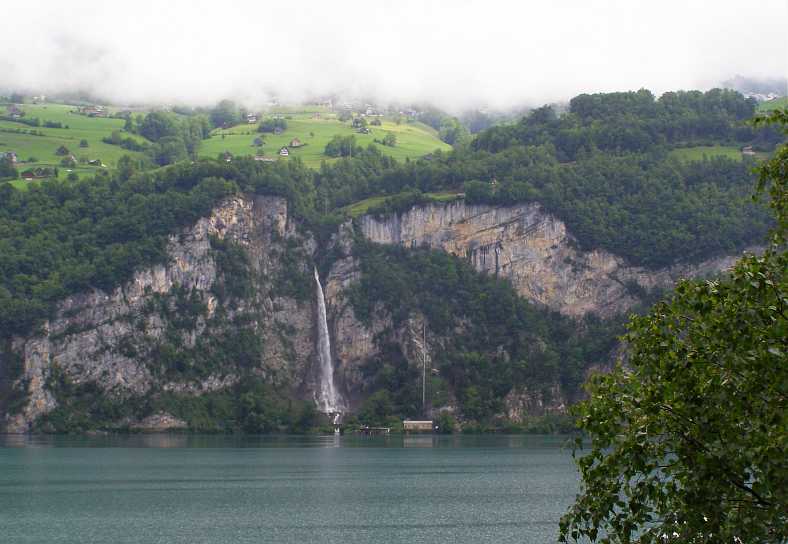
Waterfall. Along a bit further there was this waterfall, worth stopping to photograph.
Onward I went awaiting a response to my request. As I came upon this trailer-load I realised what it was and got the camera out. I turned it on and got this shot:
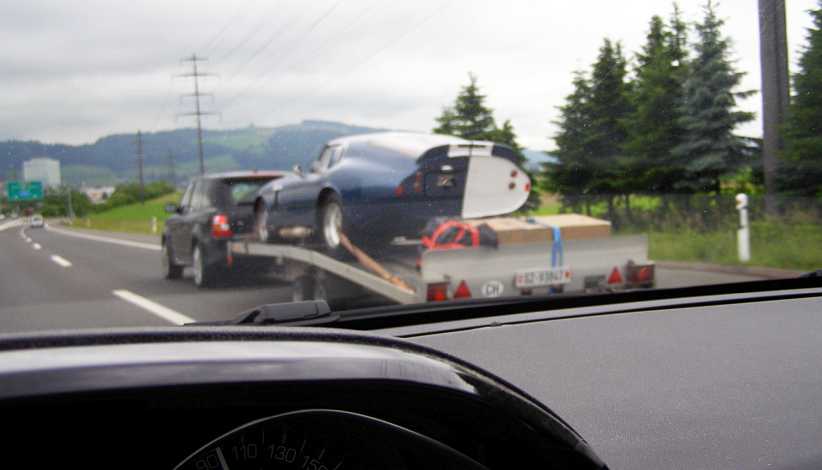
Cobra Daytona. What a surprise! Only six Cobra Daytona coupes were ever built, what were the chances I’d come upon one being trailered in Switzerland?
Unfortunately, I was going straight ahead at that junction just up the road and the trailer and Cobra Daytona were going to the right, but at least I had a shot of it despite it being somewhat out of focus. The scenery continued to unfold as I followed a less well-beaten path towards Stettenbach…
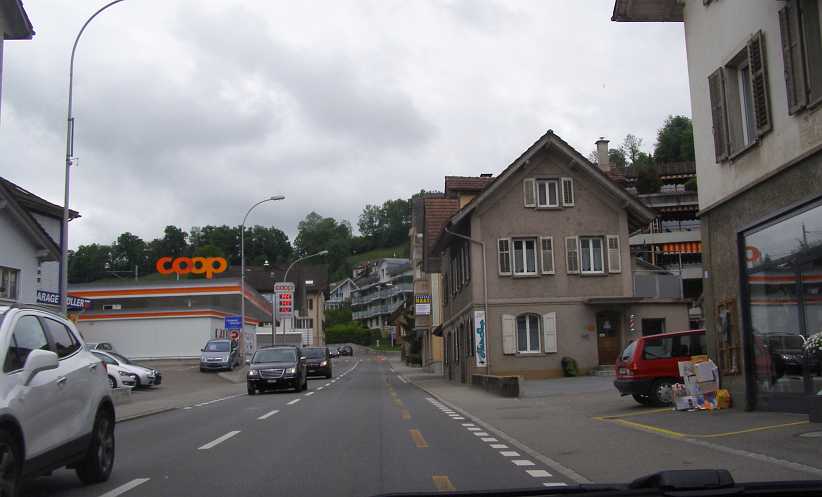
Through a Swiss town. Everyday Switzerland, a town somewhere in the countryside near Lucerne.
…and with a level crossing and a train to hold me up briefly…
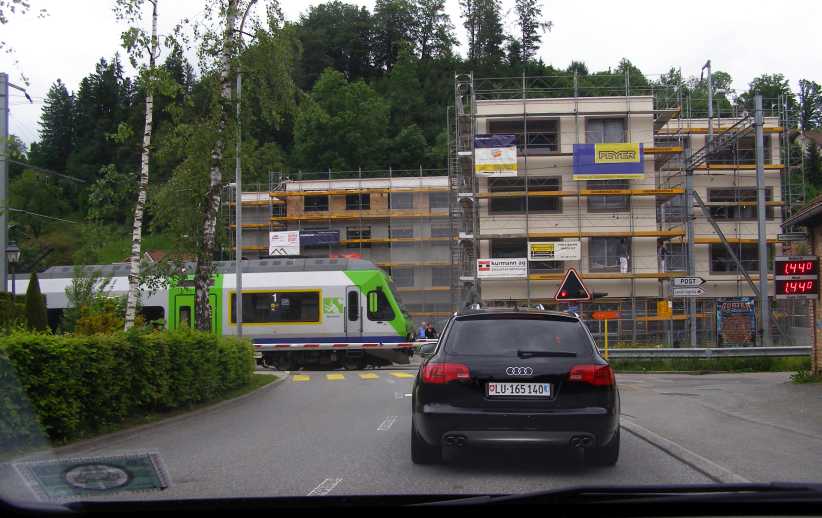
Level crossing. I didn’t have to wait very long for the train, and ahead of me was something I was to become quite used to seeing in this part of Europe – a black car!
…behind this black Audi. I was to see so many black cars in the next couple of days I couldn’t believe it. Mostly, it seemed, from VW, Audi, Seat and Skoda, which are all from the same source of course. Black was definitely the ‘in’ colour.
And on to Stettenbach…
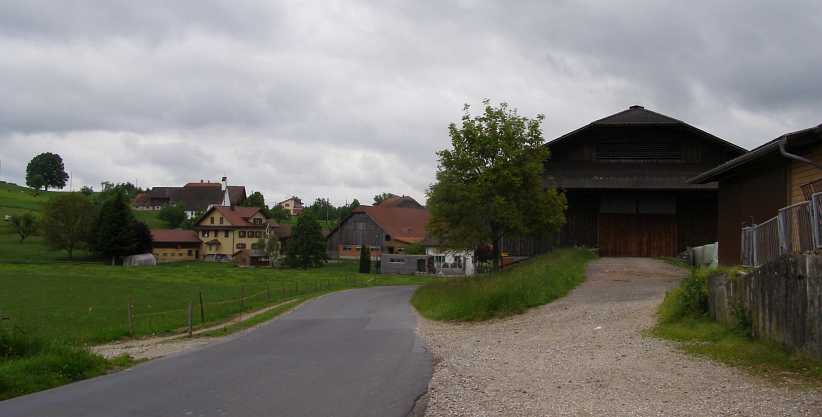
Entering Stettenbach. The barn on the right was the first building encountered as I entered the village area, what I didn’t know was that little house visible under the tree near the barn was the home of the people I was intent on visiting.
…with the problem that I hadn’t heard back. I spent some time driving around the village looking at the different houses and settings:
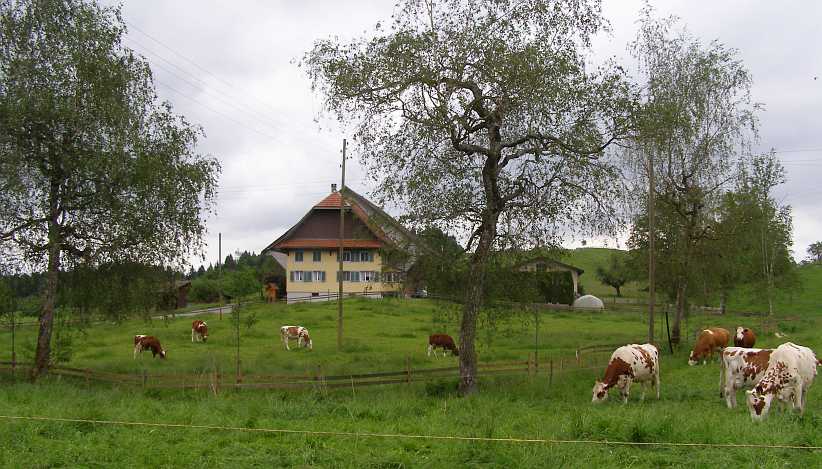
Stettenbach cows. A rural village is certainly the right place to graze a few cows. This house is backed up by a barn similar to the one seen in the last picture.
The distant hills make a good backdrop for this place:
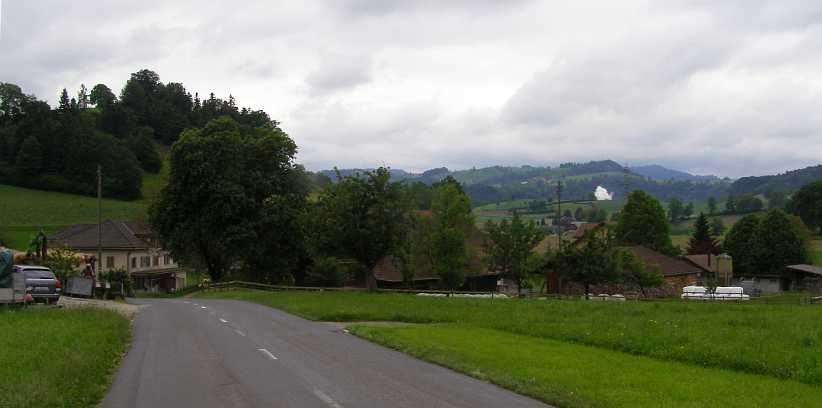
Distant hills. Still more places where agriculture is a part of village life, the white plastic covers hay for animals.
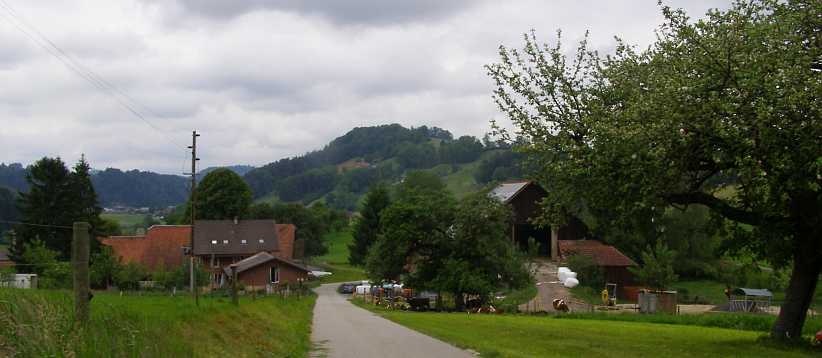
More barn, cows and mountains. Another barn right against the house, grazing cows and rooftops designed to allow snow to slide off in winter.
After waiting I gave up and set the GPS for Bremgarten. I got over the next range and was running down the other side, taking this shot as I went…
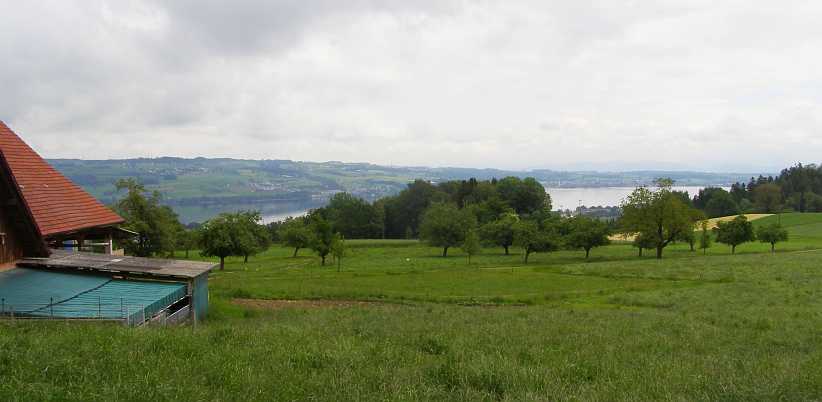
Lake and farms. Such a pretty place, the lake and the nice green farms, the rows of trees made this such a nice spot.
…and then I got a message back. I headed back to that little house seen in the pic of the first barn and knocked on the door. It was answered by his sister, who was at home with her son, I explained that I was a friend of her brother’s and we had a brief chat. And I took a picture of them:
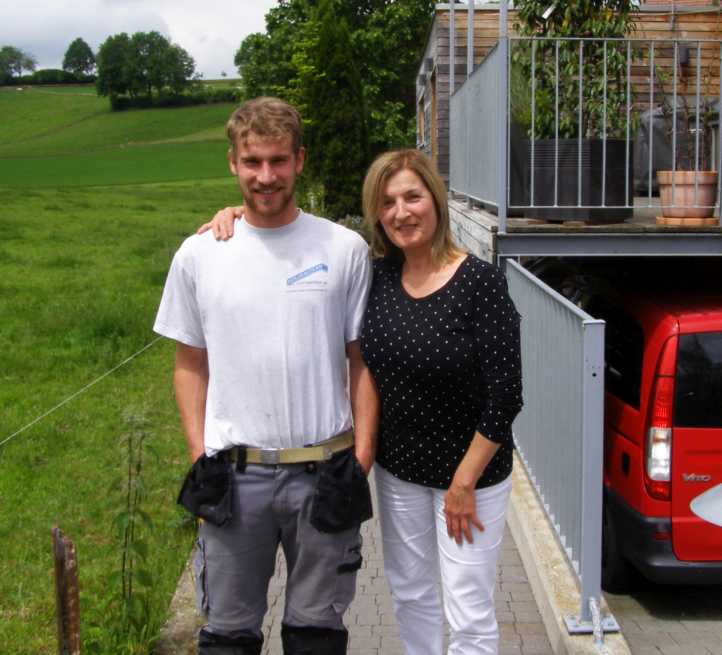
My friend’s sister and nephew. Little did they know they’d have a knock on the door by someone from Australia on this day!
And now I could go on the Bremgarten as planned. The drive was through some nice country, I was able to enjoy the scenery though I felt I was running a little behind schedule after having to double back ten or twelve kilometres.
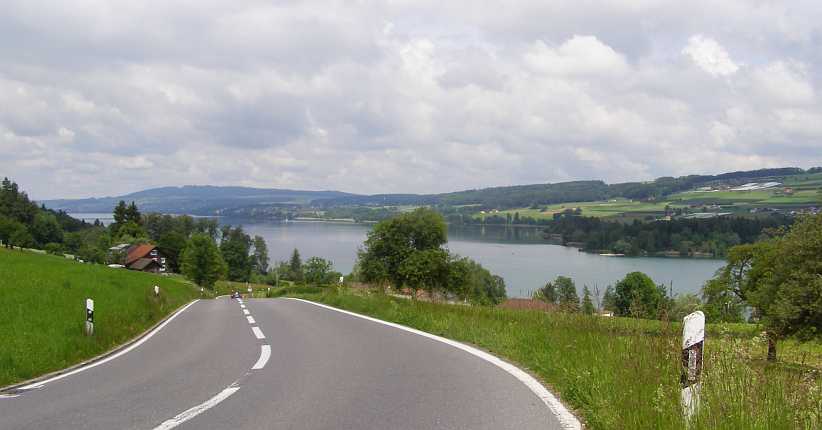
Lake view. Hallwilersee is the name of this lake, which I skirted along on the way to Bremgarten.
I was going down a hill at the beginning of the town when I saw a sign on a workshop, something like ‘Grand Prix Garage’ or some other motor sport oriented name. I pulled up and went inside. There I found Reudi Caprez:
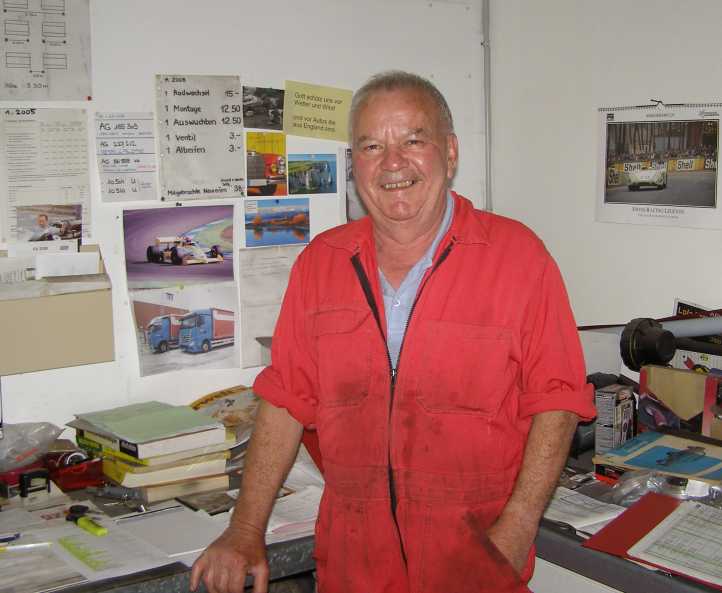
Reudi Caprez. The genial Reudi, his desk and pictures on the wall of cars he’s raced at some time.
I was in the thick of a little motor racing museum, though it was also an operating automotive workshop. And Reudi hardly spoke any English, though his wife was fluent in our language and held back her imminent departure to help me out.
Ultimately, Reudi showed me some of his treasures:
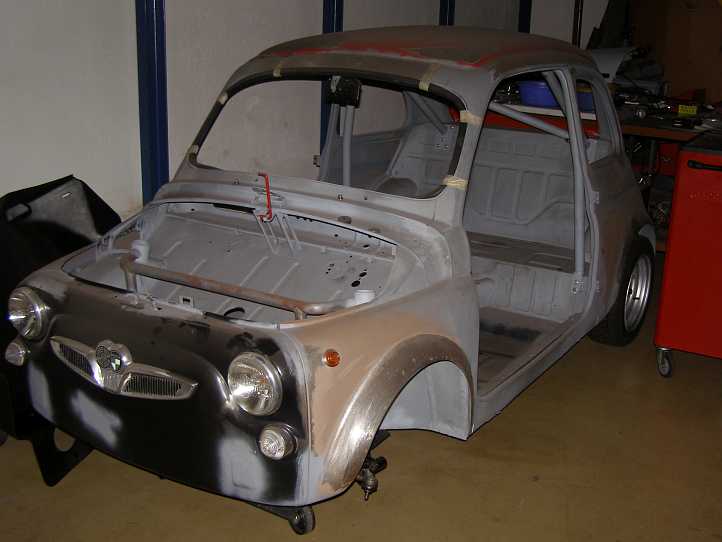
Steyr hillclimber. It’s natural for Swiss to go hillclimbing as racing was banned in Switzerland after the tragic 1955 Le Mans disaster. So Reudi started out with a Steyr like this one.
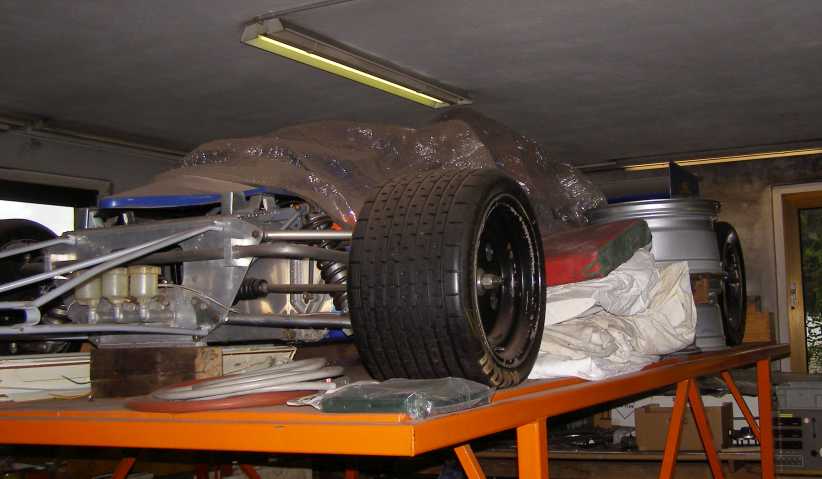
A bit faster. Though he spent time in sports cars, including competing in the Targa Florio, Reudi has this more modern open-wheeler stashed in his workshop.
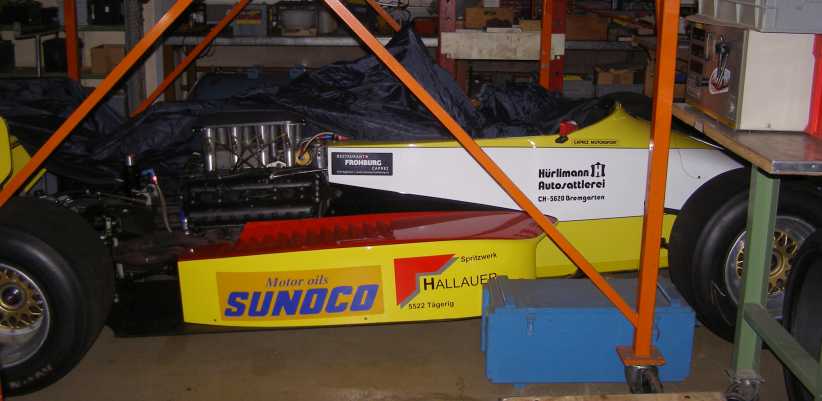
F3000. Also this one, a Lola 87/50 Formula 3000, which used the Cosworth DFV engine which had been dominant in Formula 1 from 1968 through the seventies and into the eighties.
But Reudi’s wife had explained to me before she left that I was at the wrong Bremgarten! I had about 100kms to go to get to the right one, which is a part of Bern. Along the way…
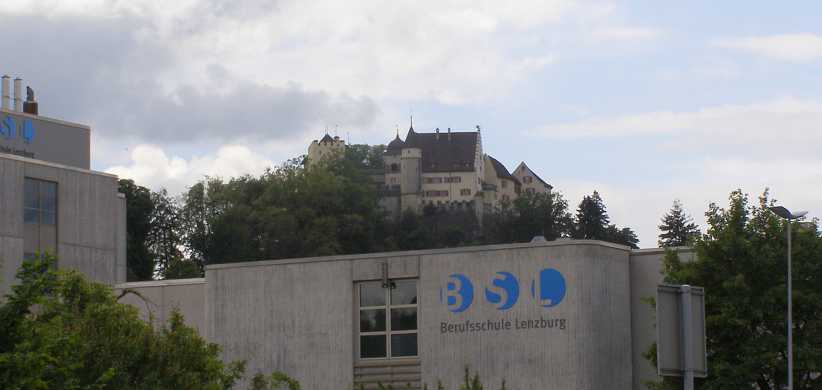
Lenzburg Castle. Overlooking the town of Lenzburg is this huge old castle. Of course I had no time to line up a better shot.
…there was still plenty to see. But then when I got to Bern I had to locate the circuit, and that wasn’t easy at all. I obtained a tourist map:
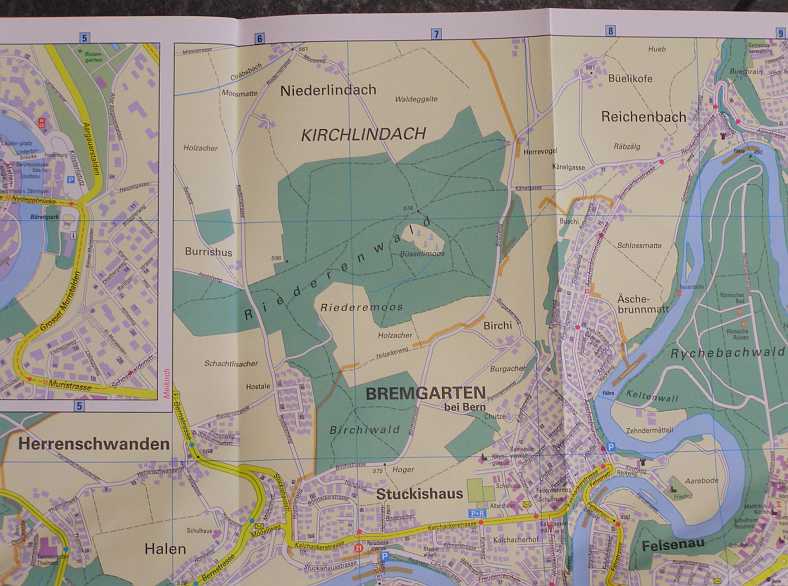
Bern map. The starting point in looking for the old Grand Prix circuit was this map…
And I asked at the tourist office about the circuit. Nobody there had ever heard of such a thing! I was show the way to the library and went there, learning after some delay that the circuit was in the Bremgarten forest. Or, at least, in the area where the forest was re-established over the last fifty years.
So, with that information, I headed off and started to look for the circuit. I knew, for instance, that there was a freeway went right over the area and that I wasn’t going to find a lot. But I’d come a long way and I don’t give up easily…
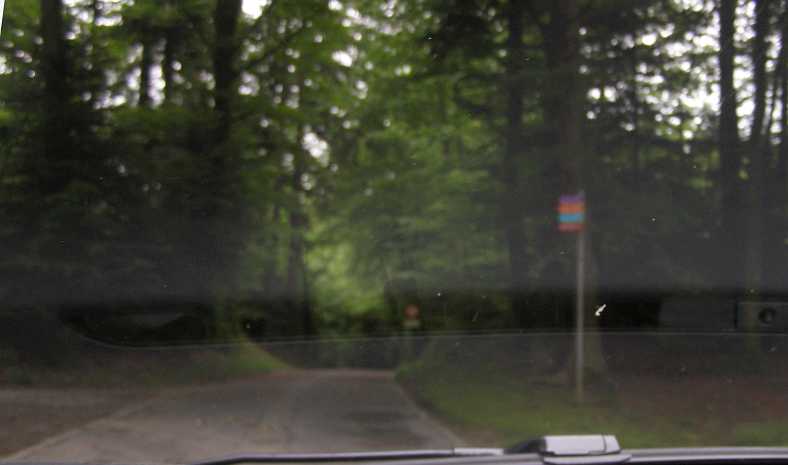
Unconvinced. This stretch of road looked likely enough, but didn’t seem to go anywhere.
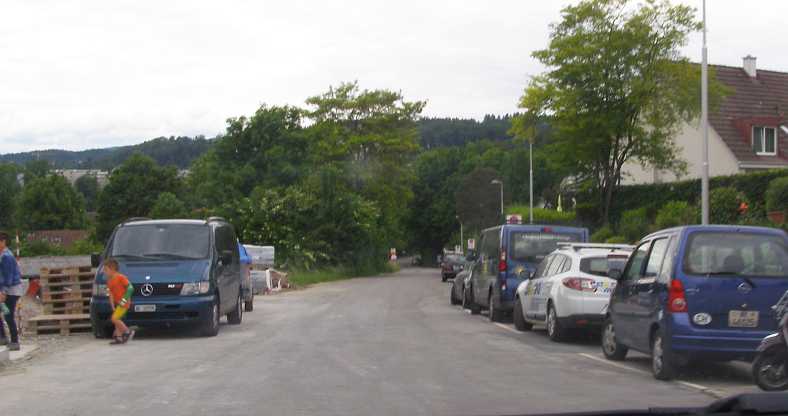
Part of circuit. This was definitely a part of the old circuit, though much changed over the years. A gate further down was a part of it too.After finding a few fractions that I could identify it didn’t seem worth pursuing it any further and I set the GPS for Mulhous in France. As I drove away from Bern I caught sight of this scene…
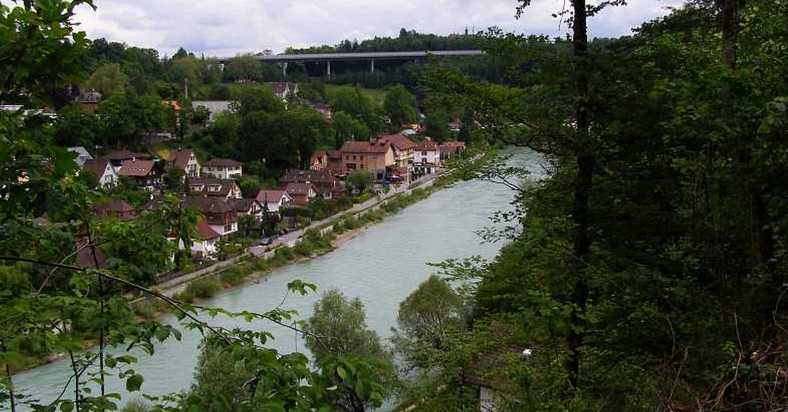
Felsenau and the Aare River. Felsenau is a part of Bern with the Aare River flowing by, I took this shot looking South from the bridge on the twisty yellow road towards the bottom of the map above.
…and reckoned it was worth a stop to get this shot. I still had quite a bit of Switzerland to cover, however, and there were still things to be seen. Among them the not-so-free toilets in service stations.
“User Pays” was to become something I’d become used to seeing and trying to avoid. And speaking of avoiding paying, they are free for children up to eight. A cutout next to the pay turnstile provides room for a child up to about that age to walk on through which was an interesting sight.
Not all of my photos worked out, of course, usually because of that old autofocus problem, like this one:
Another hillside castle. Spoiled totally by the camera’s inability to focus through the windscreen.
My curiosity towards the mundane or ordinarily different was satisfied when I took this picture of a crashed Renault postal van:
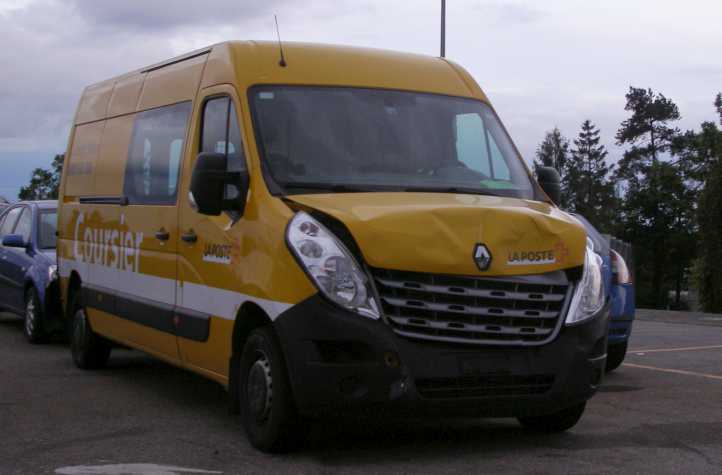
La Poste parked. A Renault postal van presented in a carpark with frontal damage that drew my attention.
It was raining again as the day’s end drew near. I still had a way to go to get to Mulhous, but I had no need to rush as the Schlumpf museum wouldn’t be open until business hours in the morning. I bought something to eat and drove on looking for somewhere to secrete myself and sleep out the night.
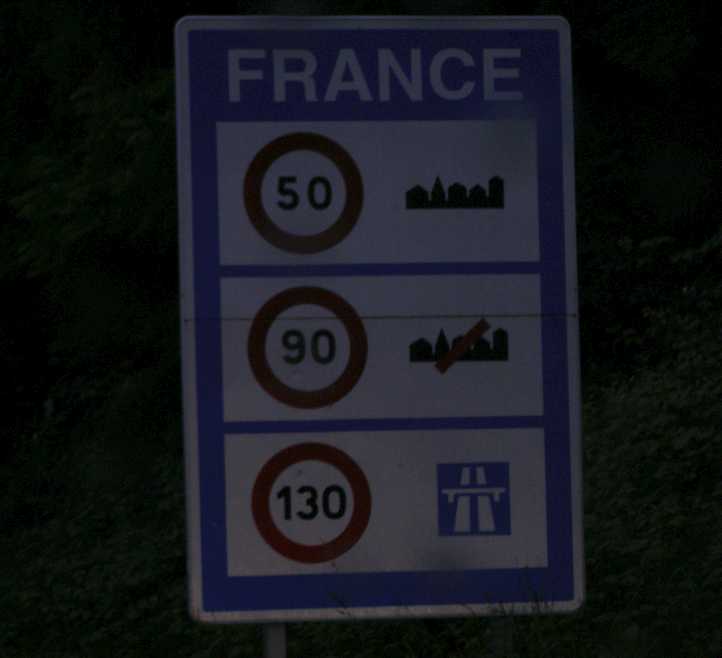
France. Back to France, my third entry into France for the trip and now I was right in the North-Eastern corner not too far from the famous town of Strasbourg. But it was Mulhous where I was going first.
An interesting day, I had seen a lot, met some people I’d never met before and got two motor sport-related surprises in seeing that Cobra Daytona and having a look at Reudi Caprez’ little personal collection.
And yet more cars, racing, rallying and just plain touring cars, would be a very large part of tomorrow. I looked forward to that as I nestled back into the seat and slept that night…
This was to be the day’s travel:
And you can see from this picture that it was cold, overcast and drizzling…
Morning in the Austrian Alps. The parking area here had been my camping spot for the night, an uncomfortably cold night without sufficient covering.
I went back to the tunnel entry, paid my toll and headed towards Lichtenstein. Clouds embraced the mountains on both sides as the headlights of oncoming cars reflected on the wet road surface. It was early and there wasn’t much traffic.
Wet and cold road. At least there was no snow or ice, but conditions were pretty bleak.
The setting was still another ‘adventure’ to me as we don’t have anywhere in Australia where these conditions prevail. Not with that kind of background, not with major roads traversing the mountains. I stopped at Bludenz to look around briefly, looking back on the highway produced this shot:
Looking back. Undoubtedly this road has improved enormously in the past fifty years, and so have the trucks, but the clouds and mists and the mountains would never change.
I had a brief look around there, with a bit of a surprise coming in seeing that it’s the headquarters of Sika, the people who make Sikaflex, so widely used in car building these days:
Sika. Bludenz houses a branch of the Sika brand, whose products have revolutionised car-building over the last thirty years or so.
And a little drive down into that part of the village didn’t find much else that I might be looking for, for instance somewhere to get breakfast.
The village. Surrounded by those mountains and undoubtedly seeing many days each year like this, this corner of Bludenz was quiet at this time of morning. And probably the rest of the day.
As I mentioned, I’d been asked to take photos along this road by someone in England, and looking at these pics now it’s evident that a lot of electricity is transmitted via this path as well.
Power lines. A feature of the scenery along this road is the multiple powerlines which run parallel to the road.
Villages came and went as I drove on, always showing a solidarity gained from being very well-established. Like this one:
Hillside village. And then I was in Lichtenstein, this hillside village providing a pleasant scene nestling in the greenery.
One larger town put the traffic through a tunnel under a stately old building:
Tunnel. This place must have been important because a tunnel has been built to take traffic underneath the building.
Lichtenstein isn’t very large, so in short order I was at the Swiss border:
Swiss border. Getting through the border was no big deal, but I had to buy yet another ‘vignetta’. This one had a minimum period of a year and cost €36!
The cost of the vignetta did smart a little, so I got some breakfast and licked my wounds as I thought about a way to get some of that cost back. But this meant also that it was time to consider the inability to use my Load & Go Travel Visa. Oh, that’s right the one which stopped working in Serbia.
I tried it here and it still didn’t work, so I phoned the people in Australia. “There’s been a suspicious transaction on it, so we cancelled it.” I was told. I asked what that transaction was and it turned out that back in Italy, soon after leaving Rome, I bought fuel at a service station. Recall that I said I paid for the fuel and then decided to get something to eat as well?
So because of the second transaction straight after the other they thought they’d ‘protect’ me and cancel the card. Too bad if I had no other means of buying things, right? Anyway, they fixed it up right away for me and I was able to look forward to freedom to spend the money as I went along.
None of this, of course, spoiled the vistas I was enjoying as I motored further into this country, the sixteenth country of the trip so far.
Swiss mountains and cloud. Even though it was now well into the morning, the mists and low clouds were hanging around the mountains making for great scenery.
And just when the pangs of hunger were getting to me I found somewhere to eat. This was at Sargans…
McDonalds Sargans. One reason I wanted to get this photo was because of the colour of the store, apparently a new colour scheme for the chain.
Going further as I followed the GPS set for Stettenbach, I decided to phone my friend at home and establish just where his sister lived in Stettenbach. I would be there before long and I had to be able to find the place. He didn’t get the call, but seeing the missed call he sent a text - ‘please text me.’ So I did.
Meanwhile I drove alongside the lake called Walensee…
Walensee. The little town jutting out there is Murgon, the lake is called Walensee.
Waterfall. Along a bit further there was this waterfall, worth stopping to photograph.
Onward I went awaiting a response to my request. As I came upon this trailer-load I realised what it was and got the camera out. I turned it on and got this shot:
Cobra Daytona. What a surprise! Only six Cobra Daytona coupes were ever built, what were the chances I’d come upon one being trailered in Switzerland?
Unfortunately, I was going straight ahead at that junction just up the road and the trailer and Cobra Daytona were going to the right, but at least I had a shot of it despite it being somewhat out of focus. The scenery continued to unfold as I followed a less well-beaten path towards Stettenbach…
Through a Swiss town. Everyday Switzerland, a town somewhere in the countryside near Lucerne.
…and with a level crossing and a train to hold me up briefly…
Level crossing. I didn’t have to wait very long for the train, and ahead of me was something I was to become quite used to seeing in this part of Europe – a black car!
…behind this black Audi. I was to see so many black cars in the next couple of days I couldn’t believe it. Mostly, it seemed, from VW, Audi, Seat and Skoda, which are all from the same source of course. Black was definitely the ‘in’ colour.
And on to Stettenbach…
Entering Stettenbach. The barn on the right was the first building encountered as I entered the village area, what I didn’t know was that little house visible under the tree near the barn was the home of the people I was intent on visiting.
…with the problem that I hadn’t heard back. I spent some time driving around the village looking at the different houses and settings:
Stettenbach cows. A rural village is certainly the right place to graze a few cows. This house is backed up by a barn similar to the one seen in the last picture.
The distant hills make a good backdrop for this place:
Distant hills. Still more places where agriculture is a part of village life, the white plastic covers hay for animals.
More barn, cows and mountains. Another barn right against the house, grazing cows and rooftops designed to allow snow to slide off in winter.
After waiting I gave up and set the GPS for Bremgarten. I got over the next range and was running down the other side, taking this shot as I went…
Lake and farms. Such a pretty place, the lake and the nice green farms, the rows of trees made this such a nice spot.
…and then I got a message back. I headed back to that little house seen in the pic of the first barn and knocked on the door. It was answered by his sister, who was at home with her son, I explained that I was a friend of her brother’s and we had a brief chat. And I took a picture of them:
My friend’s sister and nephew. Little did they know they’d have a knock on the door by someone from Australia on this day!
And now I could go on the Bremgarten as planned. The drive was through some nice country, I was able to enjoy the scenery though I felt I was running a little behind schedule after having to double back ten or twelve kilometres.
Lake view. Hallwilersee is the name of this lake, which I skirted along on the way to Bremgarten.
I was going down a hill at the beginning of the town when I saw a sign on a workshop, something like ‘Grand Prix Garage’ or some other motor sport oriented name. I pulled up and went inside. There I found Reudi Caprez:
Reudi Caprez. The genial Reudi, his desk and pictures on the wall of cars he’s raced at some time.
I was in the thick of a little motor racing museum, though it was also an operating automotive workshop. And Reudi hardly spoke any English, though his wife was fluent in our language and held back her imminent departure to help me out.
Ultimately, Reudi showed me some of his treasures:
Steyr hillclimber. It’s natural for Swiss to go hillclimbing as racing was banned in Switzerland after the tragic 1955 Le Mans disaster. So Reudi started out with a Steyr like this one.
A bit faster. Though he spent time in sports cars, including competing in the Targa Florio, Reudi has this more modern open-wheeler stashed in his workshop.
F3000. Also this one, a Lola 87/50 Formula 3000, which used the Cosworth DFV engine which had been dominant in Formula 1 from 1968 through the seventies and into the eighties.
But Reudi’s wife had explained to me before she left that I was at the wrong Bremgarten! I had about 100kms to go to get to the right one, which is a part of Bern. Along the way…
Lenzburg Castle. Overlooking the town of Lenzburg is this huge old castle. Of course I had no time to line up a better shot.
…there was still plenty to see. But then when I got to Bern I had to locate the circuit, and that wasn’t easy at all. I obtained a tourist map:
Bern map. The starting point in looking for the old Grand Prix circuit was this map…
And I asked at the tourist office about the circuit. Nobody there had ever heard of such a thing! I was show the way to the library and went there, learning after some delay that the circuit was in the Bremgarten forest. Or, at least, in the area where the forest was re-established over the last fifty years.
So, with that information, I headed off and started to look for the circuit. I knew, for instance, that there was a freeway went right over the area and that I wasn’t going to find a lot. But I’d come a long way and I don’t give up easily…
Unconvinced. This stretch of road looked likely enough, but didn’t seem to go anywhere.
Part of circuit. This was definitely a part of the old circuit, though much changed over the years. A gate further down was a part of it too.After finding a few fractions that I could identify it didn’t seem worth pursuing it any further and I set the GPS for Mulhous in France. As I drove away from Bern I caught sight of this scene…
Felsenau and the Aare River. Felsenau is a part of Bern with the Aare River flowing by, I took this shot looking South from the bridge on the twisty yellow road towards the bottom of the map above.
…and reckoned it was worth a stop to get this shot. I still had quite a bit of Switzerland to cover, however, and there were still things to be seen. Among them the not-so-free toilets in service stations.
“User Pays” was to become something I’d become used to seeing and trying to avoid. And speaking of avoiding paying, they are free for children up to eight. A cutout next to the pay turnstile provides room for a child up to about that age to walk on through which was an interesting sight.
Not all of my photos worked out, of course, usually because of that old autofocus problem, like this one:
Another hillside castle. Spoiled totally by the camera’s inability to focus through the windscreen.
My curiosity towards the mundane or ordinarily different was satisfied when I took this picture of a crashed Renault postal van:
La Poste parked. A Renault postal van presented in a carpark with frontal damage that drew my attention.
It was raining again as the day’s end drew near. I still had a way to go to get to Mulhous, but I had no need to rush as the Schlumpf museum wouldn’t be open until business hours in the morning. I bought something to eat and drove on looking for somewhere to secrete myself and sleep out the night.
France. Back to France, my third entry into France for the trip and now I was right in the North-Eastern corner not too far from the famous town of Strasbourg. But it was Mulhous where I was going first.
An interesting day, I had seen a lot, met some people I’d never met before and got two motor sport-related surprises in seeing that Cobra Daytona and having a look at Reudi Caprez’ little personal collection.
And yet more cars, racing, rallying and just plain touring cars, would be a very large part of tomorrow. I looked forward to that as I nestled back into the seat and slept that night…
Last edited by Ray Bell; Mar 27, 2023 at 06:30 AM.
Thread Starter
|
Captain
Joined: Oct 2005
Posts: 568
Likes: 8
From: The Summit, Queensland, Australia
Wet weather was still with me when I awoke on this Thursday morning and I strolled about the town to find a croissant for breakfast. But the filling in of the time until the museum might be open mattered little, this was a place I’d been wanting to see for over 35 years.
Mulhous in the rain. For the second day in a row I awoke to wet weather, though at the same time in Paris they’d had some torrential downpours and major flooding.
Killing some time I photographed these two vans…
‘Jumpy’ and ‘Expert’. Some amazing names the makers come up with. The Peugeot seems to be some kind of a security van.
…’badge engineered’ by Peugeot, though I’m a little surprised that nothing is different other than the badge from this angle. Surely they could have changed the headlights?
Old entry. There’s nothing flash about the entry from this street, nor is it in use any more. I had some more walking to do.
This is the old entry to the museum, I daresay from the time the Trade Union ran the museum. So I guess it’s time to fill in those who don’t know the history just how this all came about.
Following World War 2, during which the explosion in the use of synthetic materials took place with man-made thread taking the place of cotton and wool, the giant mills in this town were given government subsidies to help them keep their many workers in employment.
The owners were the Schlumpf brothers, Fritz and Hans. They were from a Swiss family who had established this business in 1908, but when the change of times came they saw an opportunity to live their own dream while syphoning off the cream of the money the government were providing to feed their employees.
They had an obsession with Bugatti, but they were keen on all sorts of cars and reached all around Europe to find examples to add to their collection. It seems obvious that they had a team of craftsmen restoring and maintaining them as well. The size of the collection was secret, but they gained audience in high places at times.
For instance, one of their acquisitions was a Mercedes race car from the twenties. When Daimler-Benz was working on their museum they decided that this particular car should be in their museum. The contacted the brothers and negotiated a deal, hence Fritz and Hans became the owners of one of the prized Sports Racing cars of the fifties, a Mercedes-Benz 300SLR. Straight eight, desmodromic valves, victor at the Targa Florio, the Tourist Trophy, and most famously, the Mille Miglia.
Their 300SLR, however, from that point on bore a specially-cast ‘F’ on its tail.
I parked in a side street a little distance from the museum, then I learned there was parking available near the entrance used today. It was a fair old walk, but I told my knee it would be worth the trouble and so came to the bridge that led to the new entry…
Today’s entry. Crossing the stream – it is mandatory for mills to be built next to streams, isn’t it? – this bridge leads to an impressive facade which adorns the entry at the other end of the building.
So how did this become a museum when the brothers had kept it all private and secret all those years?
Maybe one of the workers who maintained the collection let on to others what he knew? The result of the information getting to the workers in 1977 led to a revolt. Their trade unions were incensed that the government subsidies hadn’t been used as was intended and determined that the workers would get their money back. Taking over the mill and the collection they started planning to sell off the collection.
The reality soon hit them, however. Principally the vast collection of Bugattis, which numbered 146 in all and included two of the near-priceless Royales. If they put these cars on the market the prices would nosedive!
So they determined that it would become a museum and they’d collect admission moneys and distribute those funds to the workers. However, in time, it failed commercially and the French Government took over and it became a National museum.
Dressing up the entry was one of their achievements…
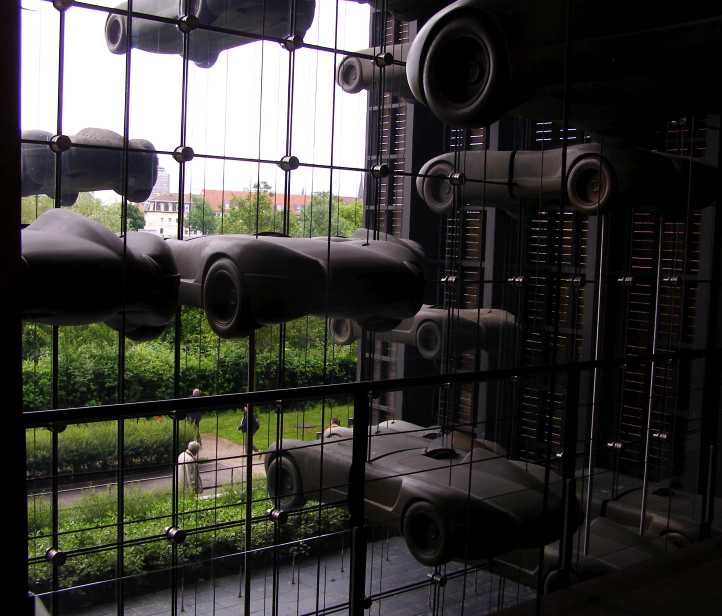
Arty entry. I guess it would be called ‘art’ and I agree that it looks good. The sports car mockups suspended on cables in front of the glass wall looked good from both outside and inside.
…in the 30+ years between that event and my arrival. I don’t know what these sports car bodies are made of, probably fibreglass, but they’re suspended out there in front of the huge glass facade and look quite spectacular. But it was what’s inside that I’d come to see, and I was never going to be disappointed.
Admission was €12 for a day and it was definitely well worth the price. Even if I had seen the Bugatti Royale in the Ford museum in Detroit, seeing another was always good. But this one they don’t even consider to be a ‘proper’ Bugatti Royale!
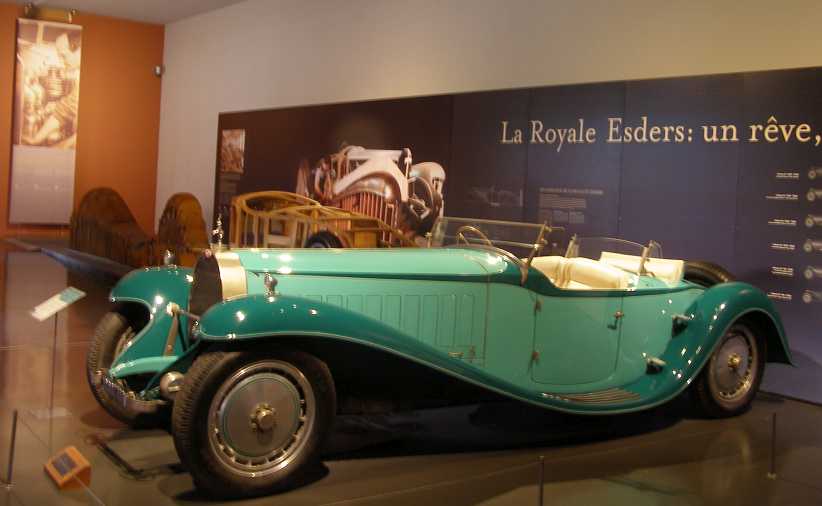
Esders’ Royale. Copy, replica, facsimile, reproduction, whatever you want to call it, this car is still imposing.
Armand Esders, it seemed, had one built, but this one is a replica which contains some parts from the original but it otherwise made up of spares with a specially-built body. The little display here also shows how the body was built.
The balance of this post will comprise mainly of rows and rows of displays of cars. They date from the earliest times, I’m sure there’s over a hundred cars there from before 1910, to cars of the sixties and seventies. I will put up two more posts with a closer look at specific cars and displays, and if anyone wants me to put up pics of any specific car I’m happy to do that.
Line one (my numbering by the way, not the museum’s) is the ‘oldies’, some of them from the 1890s…
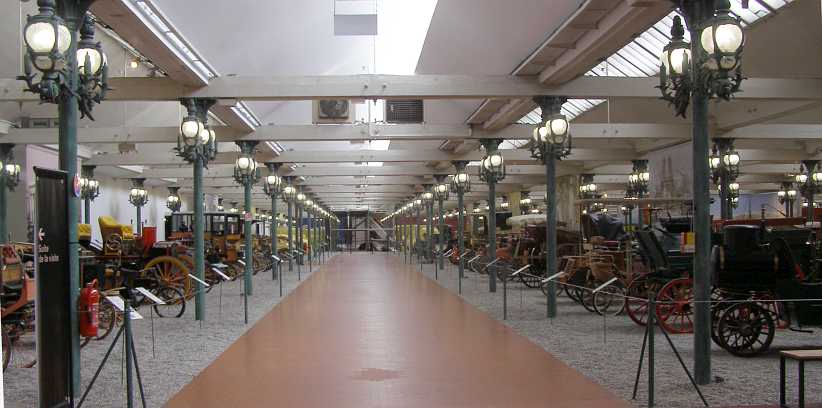
…and line two is of cars not much newer…
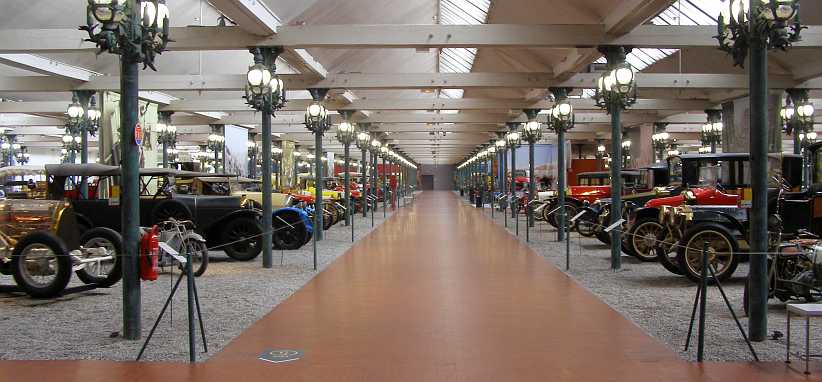
…as is also the case with line three…
…while line four sees some from the twenties and thirties…
…with more of these in line five…
… and line six takes in more of the thirties and some forties…
… with more of the same in line seven, but there are some long noses in there:
My closer interest, probably, was to begin with line eight. These are racing cars from the forties and fifties…
…and what I am calling line nine, with the backdrop of Le Mans grandstands, is sports racing cars from the same period:
What I have labelled as ‘line ten’ is even more interesting, more Formula One cars and in the next post I’ll have more on these…
…this eclectic mixture of F1 and even a sports racer is line 11…
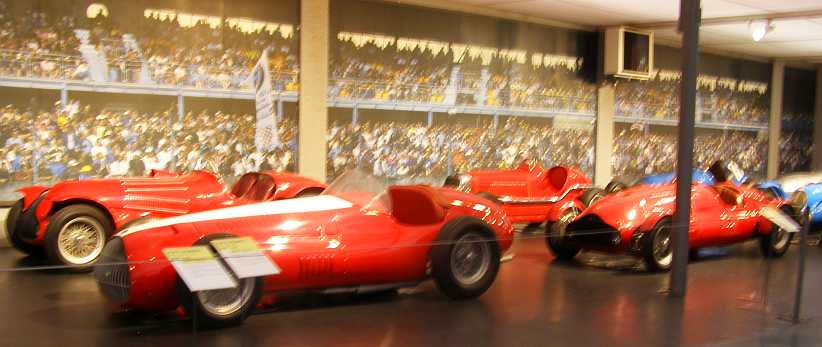
…and then, way down the other end (past the 1890s cars) is a hall which is dimly lit and therefore harder to capture as far as lines of cars go…
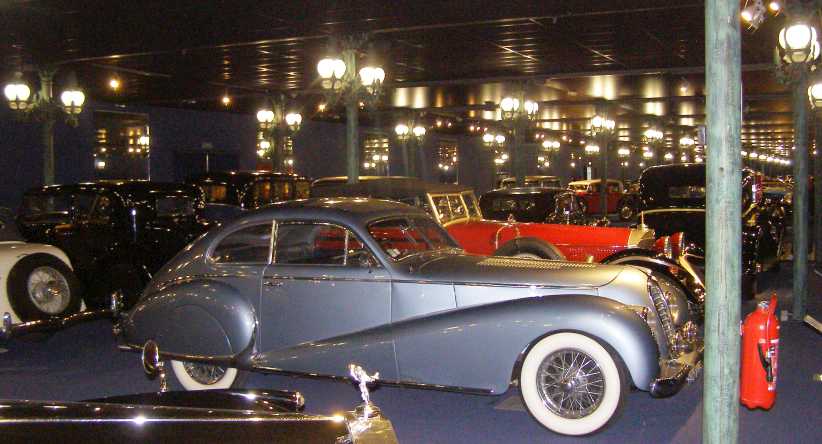
In this hall are the real prize cars of the collection. Just a sampling, as I’ll get back to these in the next couple of posts, beginning with a car I recall reading about over fifty years ago and never expected to see, the Mercedes-Benz ‘Grosser’ from the late thirties. This particular one was the private car of Herr Heinkel, who made aircraft in Germany in those years:
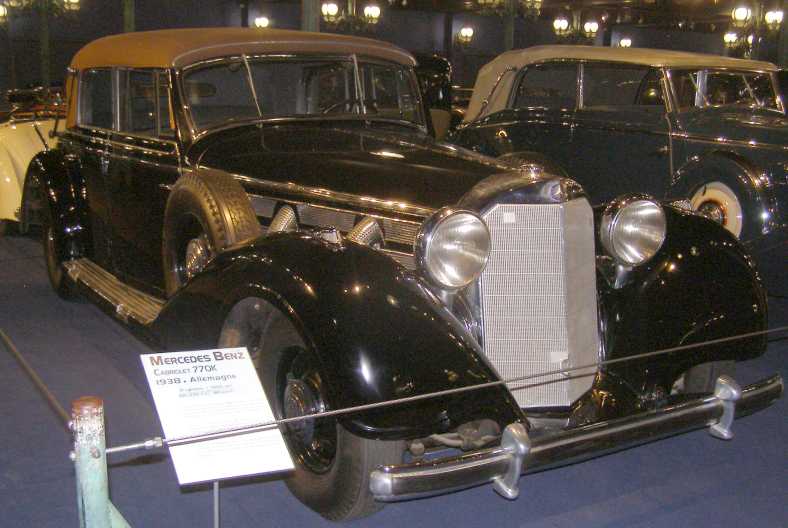
Heinkel’s Grosser. The Mercedes 770K, this one a cabriolet, was known as the ‘Grosser’ as it was such a big and luxurious car for its day. The engine was almost 7.7 litres, a straight 8 with a supercharger.
And, of course, this is where the ‘real’ Royales were housed. Bugatti’s famous Type 41:
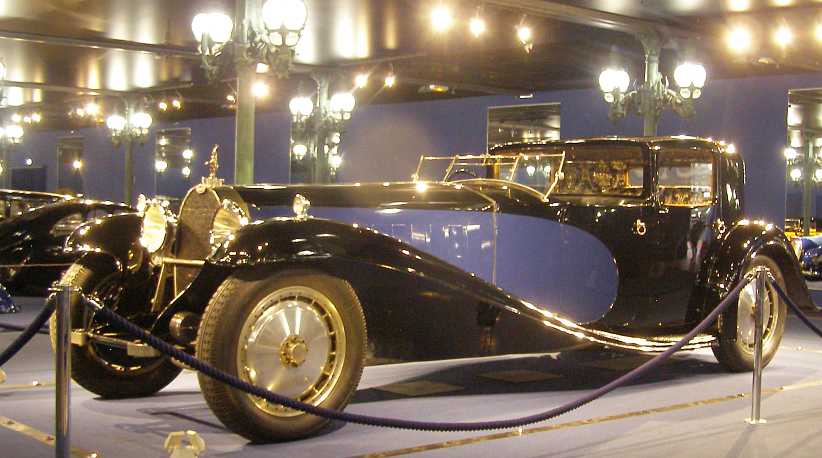
Bigatti Royale. I can’t imagine a more imposing car than the Royale, the first of which was built in 1926. Not many left the production line, but they shared their 12-litre straight 8 with rail cars.
There is way more to come of this fantastic place. Already before I took some of these photos I had returned to my car to get another set of batteries for my camera. And as I kept looking around I would forget I’d ever had that croissant that morning and start thinking about buying lunch at the cafeteria in the museum.
Another area sees displays of interesting engines, and while there are a couple of 1890s Benz engines there, I thought the most interesting of these was this little Bugatti engine and gearbox:
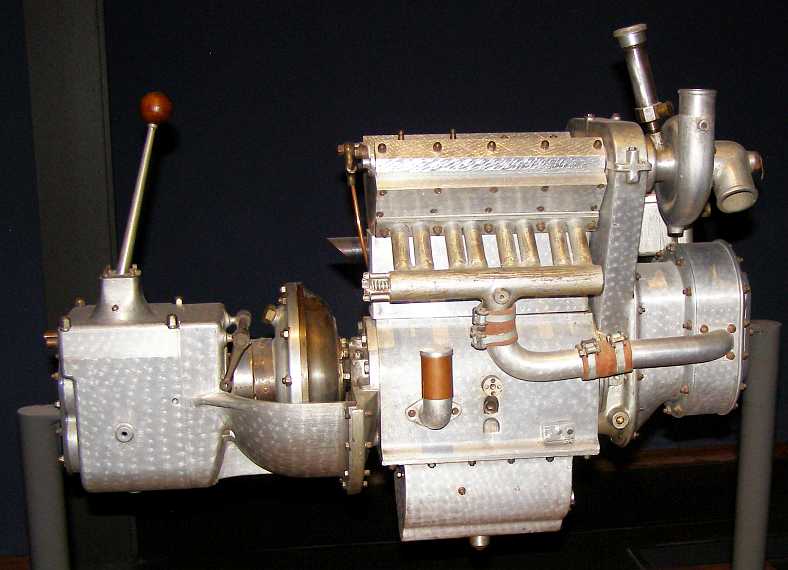
Mini power unit. This tiny engine still had all the regular features of the bigger engines Bugatti built, quite an incredible sight.
Built during the second World War, this is a 365cc 4-cylinder with twin overhead cams, four valves per cylinder and a four-speed gearbox. Like many other Bugatti engines, though far from all of them, it has a supercharger too.
Please don’t be afraid to ask if you want me to post up specific cars, I’ll do it if I have them. Or if anyone wants me to send them a specific picture, just e.mail me, raybell@dalveen.net
Mulhous in the rain. For the second day in a row I awoke to wet weather, though at the same time in Paris they’d had some torrential downpours and major flooding.
Killing some time I photographed these two vans…
‘Jumpy’ and ‘Expert’. Some amazing names the makers come up with. The Peugeot seems to be some kind of a security van.
…’badge engineered’ by Peugeot, though I’m a little surprised that nothing is different other than the badge from this angle. Surely they could have changed the headlights?
Old entry. There’s nothing flash about the entry from this street, nor is it in use any more. I had some more walking to do.
This is the old entry to the museum, I daresay from the time the Trade Union ran the museum. So I guess it’s time to fill in those who don’t know the history just how this all came about.
Following World War 2, during which the explosion in the use of synthetic materials took place with man-made thread taking the place of cotton and wool, the giant mills in this town were given government subsidies to help them keep their many workers in employment.
The owners were the Schlumpf brothers, Fritz and Hans. They were from a Swiss family who had established this business in 1908, but when the change of times came they saw an opportunity to live their own dream while syphoning off the cream of the money the government were providing to feed their employees.
They had an obsession with Bugatti, but they were keen on all sorts of cars and reached all around Europe to find examples to add to their collection. It seems obvious that they had a team of craftsmen restoring and maintaining them as well. The size of the collection was secret, but they gained audience in high places at times.
For instance, one of their acquisitions was a Mercedes race car from the twenties. When Daimler-Benz was working on their museum they decided that this particular car should be in their museum. The contacted the brothers and negotiated a deal, hence Fritz and Hans became the owners of one of the prized Sports Racing cars of the fifties, a Mercedes-Benz 300SLR. Straight eight, desmodromic valves, victor at the Targa Florio, the Tourist Trophy, and most famously, the Mille Miglia.
Their 300SLR, however, from that point on bore a specially-cast ‘F’ on its tail.
I parked in a side street a little distance from the museum, then I learned there was parking available near the entrance used today. It was a fair old walk, but I told my knee it would be worth the trouble and so came to the bridge that led to the new entry…
Today’s entry. Crossing the stream – it is mandatory for mills to be built next to streams, isn’t it? – this bridge leads to an impressive facade which adorns the entry at the other end of the building.
So how did this become a museum when the brothers had kept it all private and secret all those years?
Maybe one of the workers who maintained the collection let on to others what he knew? The result of the information getting to the workers in 1977 led to a revolt. Their trade unions were incensed that the government subsidies hadn’t been used as was intended and determined that the workers would get their money back. Taking over the mill and the collection they started planning to sell off the collection.
The reality soon hit them, however. Principally the vast collection of Bugattis, which numbered 146 in all and included two of the near-priceless Royales. If they put these cars on the market the prices would nosedive!
So they determined that it would become a museum and they’d collect admission moneys and distribute those funds to the workers. However, in time, it failed commercially and the French Government took over and it became a National museum.
Dressing up the entry was one of their achievements…
Arty entry. I guess it would be called ‘art’ and I agree that it looks good. The sports car mockups suspended on cables in front of the glass wall looked good from both outside and inside.
…in the 30+ years between that event and my arrival. I don’t know what these sports car bodies are made of, probably fibreglass, but they’re suspended out there in front of the huge glass facade and look quite spectacular. But it was what’s inside that I’d come to see, and I was never going to be disappointed.
Admission was €12 for a day and it was definitely well worth the price. Even if I had seen the Bugatti Royale in the Ford museum in Detroit, seeing another was always good. But this one they don’t even consider to be a ‘proper’ Bugatti Royale!
Esders’ Royale. Copy, replica, facsimile, reproduction, whatever you want to call it, this car is still imposing.
Armand Esders, it seemed, had one built, but this one is a replica which contains some parts from the original but it otherwise made up of spares with a specially-built body. The little display here also shows how the body was built.
The balance of this post will comprise mainly of rows and rows of displays of cars. They date from the earliest times, I’m sure there’s over a hundred cars there from before 1910, to cars of the sixties and seventies. I will put up two more posts with a closer look at specific cars and displays, and if anyone wants me to put up pics of any specific car I’m happy to do that.
Line one (my numbering by the way, not the museum’s) is the ‘oldies’, some of them from the 1890s…
…and line two is of cars not much newer…
…as is also the case with line three…
…while line four sees some from the twenties and thirties…
…with more of these in line five…
… and line six takes in more of the thirties and some forties…
… with more of the same in line seven, but there are some long noses in there:
My closer interest, probably, was to begin with line eight. These are racing cars from the forties and fifties…
…and what I am calling line nine, with the backdrop of Le Mans grandstands, is sports racing cars from the same period:
What I have labelled as ‘line ten’ is even more interesting, more Formula One cars and in the next post I’ll have more on these…
…this eclectic mixture of F1 and even a sports racer is line 11…
…and then, way down the other end (past the 1890s cars) is a hall which is dimly lit and therefore harder to capture as far as lines of cars go…
In this hall are the real prize cars of the collection. Just a sampling, as I’ll get back to these in the next couple of posts, beginning with a car I recall reading about over fifty years ago and never expected to see, the Mercedes-Benz ‘Grosser’ from the late thirties. This particular one was the private car of Herr Heinkel, who made aircraft in Germany in those years:
Heinkel’s Grosser. The Mercedes 770K, this one a cabriolet, was known as the ‘Grosser’ as it was such a big and luxurious car for its day. The engine was almost 7.7 litres, a straight 8 with a supercharger.
And, of course, this is where the ‘real’ Royales were housed. Bugatti’s famous Type 41:
Bigatti Royale. I can’t imagine a more imposing car than the Royale, the first of which was built in 1926. Not many left the production line, but they shared their 12-litre straight 8 with rail cars.
There is way more to come of this fantastic place. Already before I took some of these photos I had returned to my car to get another set of batteries for my camera. And as I kept looking around I would forget I’d ever had that croissant that morning and start thinking about buying lunch at the cafeteria in the museum.
Another area sees displays of interesting engines, and while there are a couple of 1890s Benz engines there, I thought the most interesting of these was this little Bugatti engine and gearbox:
Mini power unit. This tiny engine still had all the regular features of the bigger engines Bugatti built, quite an incredible sight.
Built during the second World War, this is a 365cc 4-cylinder with twin overhead cams, four valves per cylinder and a four-speed gearbox. Like many other Bugatti engines, though far from all of them, it has a supercharger too.
Please don’t be afraid to ask if you want me to post up specific cars, I’ll do it if I have them. Or if anyone wants me to send them a specific picture, just e.mail me, raybell@dalveen.net
Last edited by Ray Bell; May 6, 2020 at 12:57 AM.
Thread Starter
|
Captain
Joined: Oct 2005
Posts: 568
Likes: 8
From: The Summit, Queensland, Australia
One of the features of the Schlumpf collection I really liked was the way they had exhibits with technical side on exhibition too. This was done in a few different ways, this post is about those exhibits which caught my eye.
The first one here is something you might well expect – a ‘rolling chassis’ with the engine and all the mechanical components open to public gaze. You might not expect it of a Rolls Royce but at the Schlumpf museum that’s what you see…
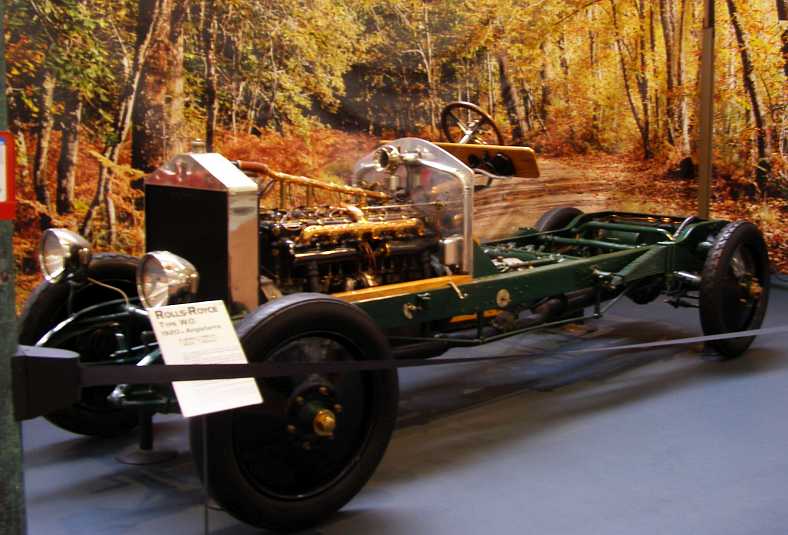
1920s Rolls Royce. The big 6-cylinder engine is all there to be seen as well as the workings of all the suspension, brakes and driveline. And look at all the brass and copper.
…but the ones with the power unit displayed alongside the complete car were the ones which really impressed me. This is a Mercedes, obviously, the engine adorned with the crankshaft-driven supercharger that cuts in when the throttle is wide open to send lots of hot gases down those external exhaust pipes:
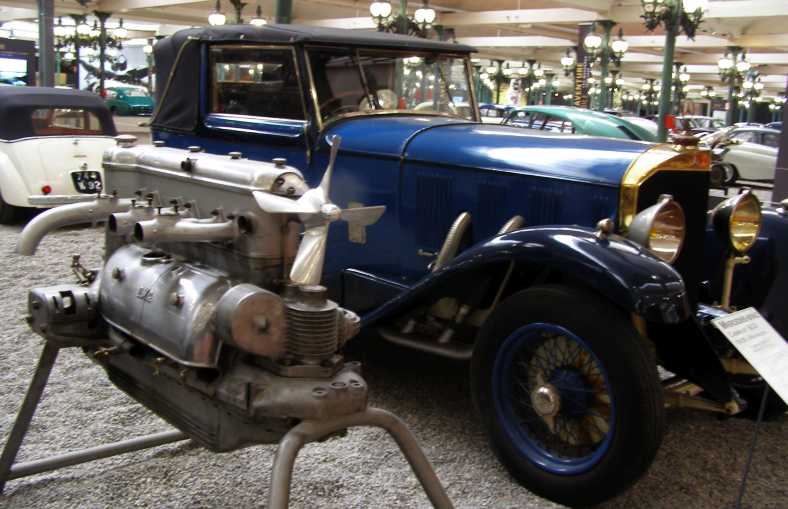
Pumped up. Mercedes made a practice of using the part-time blower in the inter-war years, this display shows how it was mounted on the front of the engine.
And the next one is pure treasure, motor racing history encapsulated in castings and forgings. Bugatti’s attempt to return to Grand Prix racing at the beginning of the 2.5-litre Formula One in the mid-fifties was a failure, but their car was certainly innovative and deserves recognition.
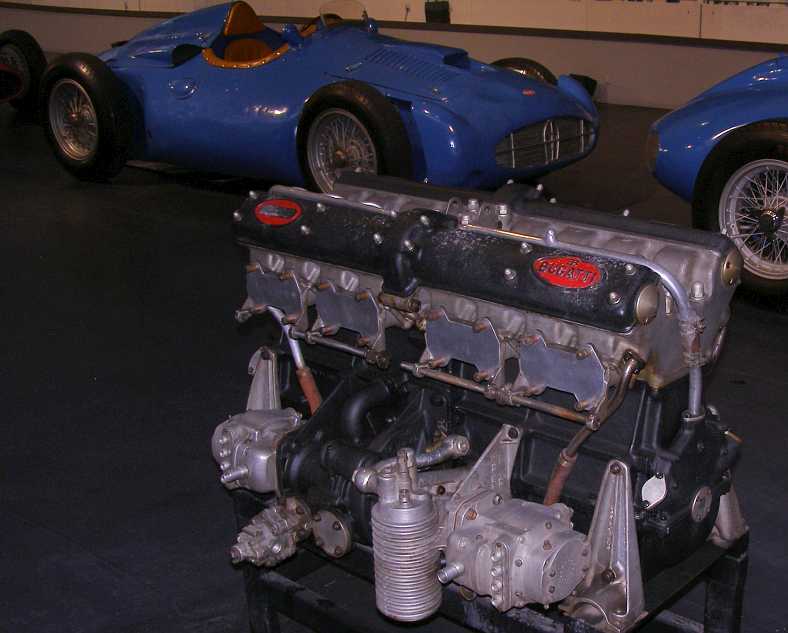
Bugatti 251. Designed by Gioacchino Colombo, this car had its straight 8 mounted transversally in the back and a variety of other innovative – or even backward – design features which added up to a poor performance at its single outing in the 1956 French GP.
Almost at the other end of the scale when it comes to successful development was the supercharged 1.5-litre Ferrari built for the earliest post-war Grand Prix races. Again the design work was by Gioacchino Colombo, but with more success this time. The little V12 looks plain alongside a lot of race engines, but it did the job until they realised that a 4.5-litre V12 without a blower would make defeating the Tipo 158/9 Alfa Romeos more of a reality.
Ferrari’s first F1. Compared to the Bugatti, this is a very ordinary car, but the tiny cylinders in that V12 had to work very hard. I’d love to have heard it scream. Here we see the back of the engine with its two magnetos standing up and the blower hanging out the front.
Hispano Suiza is a revered name in automotive circles. Financed by Swiss and built in Spain is my understanding of the name, one which is famous in luxury car circles as well as among piston-engined aircraft lovers. This engine belongs in a huge cabriolet which is not in frame, but is a V12 and gained a great reputation for the marque for quality and smoothness. Not to mention cost, these were the most expensive cars of their time.
Hispano Suiza V12. The V12 ranged from 9.4 litres to 11.3, production moved from Spain to France and was halted in 1938 to allow energies to be devoted to aircraft engine manufacture.
I’d never heard of a Farman before I saw this display. But the claim that it was the quietest car ever built was made for this one and the engine and the gearbox were displayed alongside the stately sedan to the right. Some great detail can be seen here:
Farman engine and gearbox. A masterpiece, well-built and very expensive, only 120 Farmans were ever sold. Note the dual ignition.
Another display showed a Bugatti Type 57S with the bodywork removed…
Chassis and body. Separated, but not by much. This 57S exposes the way Bugattis were made.
Rear end. Large alloy castings contain the final drive, all the rear suspension and brakes are there to be admired.
Bugatti gearbox. The gearbox seems a bit large, but it clearly had some work to do. The mount looks interesting, as do the magneto through the firewall and the fabric universal.
Once again in the hall devoted to engine displays the Royale is featured. As mentioned, these engines were also used in railway operations and so many more were made than were the Type 41 cars.
Wall hanging. Stripped down and ‘exploded’ in a wall display. This is the upper section...
Bottom end. …and this is the lower section, the 9-main bearing crankshaft and the con-rods with four bolts show the big engine was meant to deliver power, the pistons are shown fitted into the sleeves.
And there’s another one all assembled nearby:
Complete Royale engine. This is how it all looks bolted together, though from the other side in this case.
An example of a smaller straight eight mounted in its chassis was there, too. This is a Type 43 with the supercharger at the side of the engine.
Single camshaft. The SOHC Type 43 engine is 2261cc and produces 120bhp. Again the magneto is through the firewall, perhaps to keep it dry, while the supercharger drive is a shaft alongside the crankcase.
And an engine for which there was no car present. This is a 3-litre Peugeot V10 Formula 1 engine from a much later period. A couple of Grand Prix teams used them including McLaren and Jordan in the mid-nineties.
Peugeot in Formula 1. In the dying days of the 3-litre F1 Peugeot built a V10 which was competitive but not a consistent winner.
Not everything was under the roof, either. The prime mover for this semi-trailer came from Panhard et Levassor and didn’t get much attention from the museum visitors.
Pathe Marconi. There was little to be found about the usage of this vehicle, but the musical intonations on the side might indicate it was something to do with entertainment. Pathe, of course, produced newsreel movies.
An interesting section all on its own was devoted to the cars of Germain Lambert. Again, I’d never heard of them, but Lambert built cars for over twenty years and seems to have been a bit of an innovator. He used proprietary components like the Ruby engine and got caught up in the thirties fad of front wheel drive.
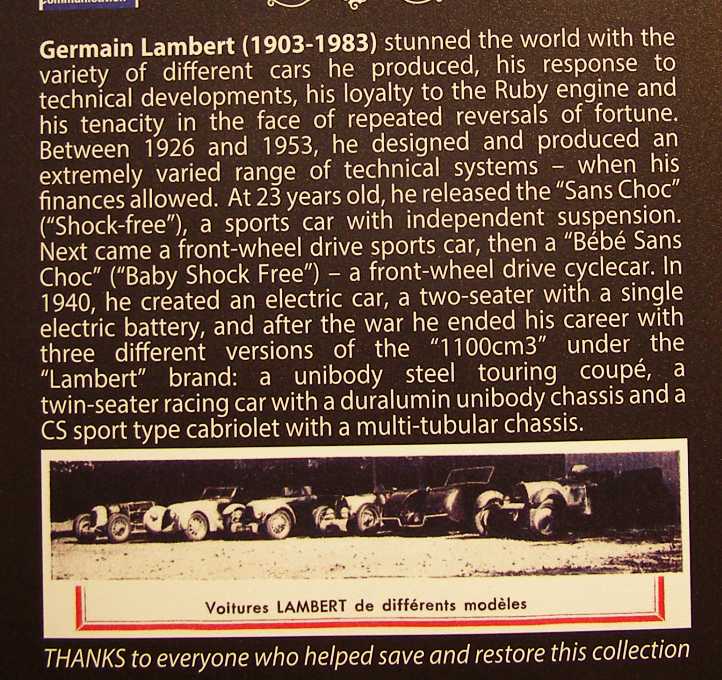
Lambert history. This tells the story of Lambert’s cars, another mentions that after it all came to an end he went into the restoration business.
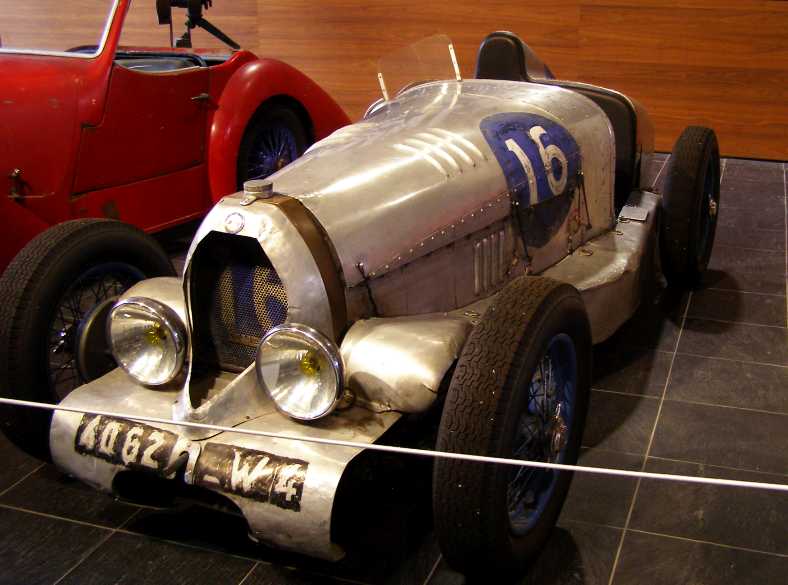
Lambert racer. Lambert raced this one over a long period, even winning one event at Montlhery.
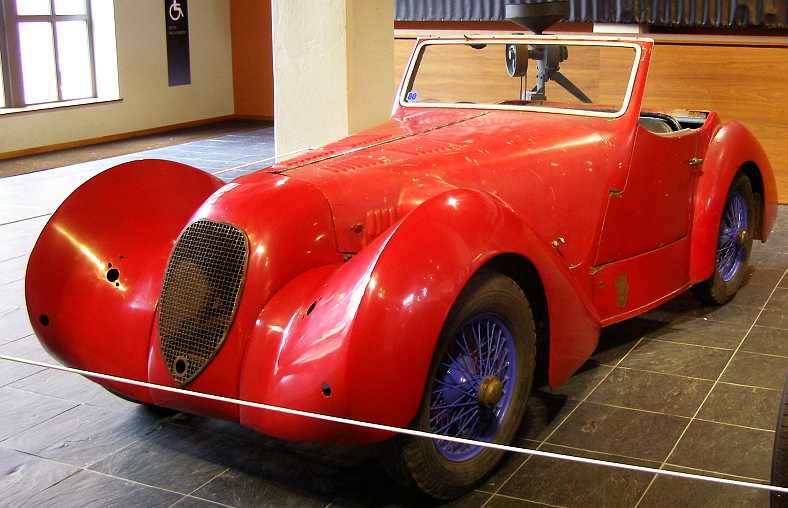
Sports model. Over a long period Lambert built several different models, one of which was a FWD sports car.
And in that engine display hall were a couple of really early engines:
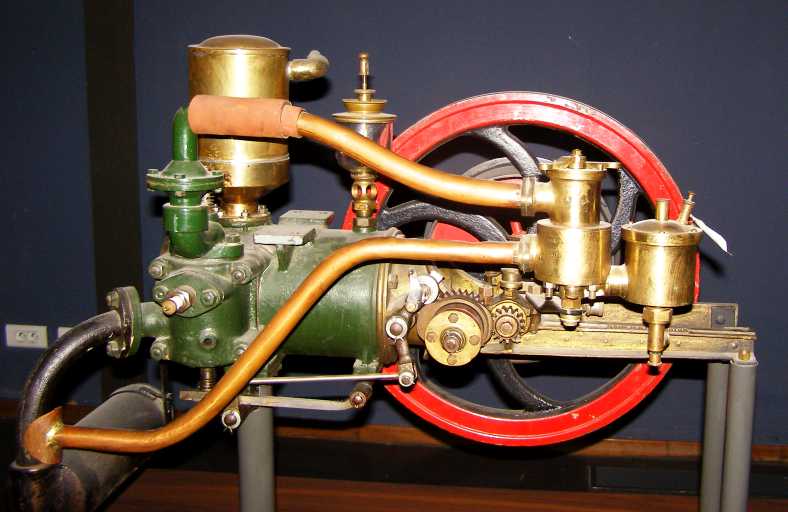
1895 Benz. Dominated by the big flywheel and the brasswork, this is a Benz engine from 1895. These were fitted to a wide range of ‘horseless carriages’ as entrepreneurs and ‘inventors’ tried to become manufacturers.
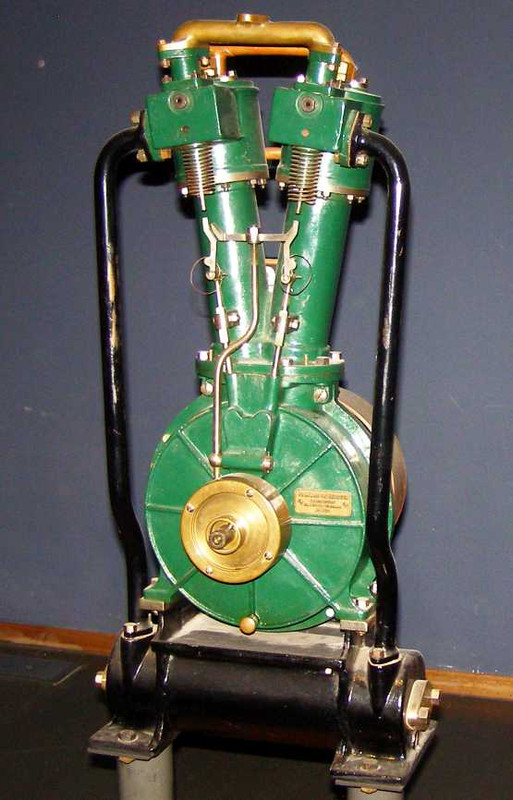
Daimler licence. Panhard et Levassor built this one under licence to Daimler, which was an
alternative to buying in engines. It’s a twin and under 600cc.
And for something really different, there’s a display of an automotive-oriented comic strip to be wondered at…
Comic development. Not just for a casual read, but for visitors to see how the drawings evolve into the pictures seen in the finished article.
Comic accuracy. Looking at the pages one sees that they’ve been drawn by someone with a full appreciation for cars. Attention to real detail is seen in the clarity of the drawings of the different makes and models, the Peugeot 403 and Jaguar on one page, for instance, the Mercedes 300SL Gullwing and Bugatti on the other. And even under the Peugeot bonnet the detail is correct, the exhaust, the intake, the windscreen washer bottle and the radiator support all being true to real life.
Next it will be time to look at the really old cars on display. None are older than this one, however:
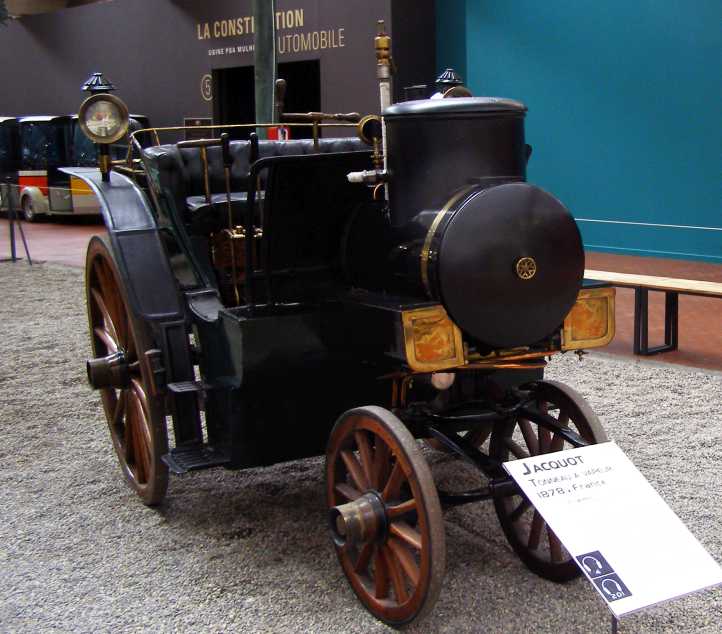
1878 Jacquot. Built by a blacksmith for a doctor, this marriage of carriage and steam power is the oldest display in the museum.
I think I said it before, the museum is well worth a visit and probably a longer one than I made. More in the next post…
The first one here is something you might well expect – a ‘rolling chassis’ with the engine and all the mechanical components open to public gaze. You might not expect it of a Rolls Royce but at the Schlumpf museum that’s what you see…
1920s Rolls Royce. The big 6-cylinder engine is all there to be seen as well as the workings of all the suspension, brakes and driveline. And look at all the brass and copper.
…but the ones with the power unit displayed alongside the complete car were the ones which really impressed me. This is a Mercedes, obviously, the engine adorned with the crankshaft-driven supercharger that cuts in when the throttle is wide open to send lots of hot gases down those external exhaust pipes:
Pumped up. Mercedes made a practice of using the part-time blower in the inter-war years, this display shows how it was mounted on the front of the engine.
And the next one is pure treasure, motor racing history encapsulated in castings and forgings. Bugatti’s attempt to return to Grand Prix racing at the beginning of the 2.5-litre Formula One in the mid-fifties was a failure, but their car was certainly innovative and deserves recognition.
Bugatti 251. Designed by Gioacchino Colombo, this car had its straight 8 mounted transversally in the back and a variety of other innovative – or even backward – design features which added up to a poor performance at its single outing in the 1956 French GP.
Almost at the other end of the scale when it comes to successful development was the supercharged 1.5-litre Ferrari built for the earliest post-war Grand Prix races. Again the design work was by Gioacchino Colombo, but with more success this time. The little V12 looks plain alongside a lot of race engines, but it did the job until they realised that a 4.5-litre V12 without a blower would make defeating the Tipo 158/9 Alfa Romeos more of a reality.
Ferrari’s first F1. Compared to the Bugatti, this is a very ordinary car, but the tiny cylinders in that V12 had to work very hard. I’d love to have heard it scream. Here we see the back of the engine with its two magnetos standing up and the blower hanging out the front.
Hispano Suiza is a revered name in automotive circles. Financed by Swiss and built in Spain is my understanding of the name, one which is famous in luxury car circles as well as among piston-engined aircraft lovers. This engine belongs in a huge cabriolet which is not in frame, but is a V12 and gained a great reputation for the marque for quality and smoothness. Not to mention cost, these were the most expensive cars of their time.
Hispano Suiza V12. The V12 ranged from 9.4 litres to 11.3, production moved from Spain to France and was halted in 1938 to allow energies to be devoted to aircraft engine manufacture.
I’d never heard of a Farman before I saw this display. But the claim that it was the quietest car ever built was made for this one and the engine and the gearbox were displayed alongside the stately sedan to the right. Some great detail can be seen here:
Farman engine and gearbox. A masterpiece, well-built and very expensive, only 120 Farmans were ever sold. Note the dual ignition.
Another display showed a Bugatti Type 57S with the bodywork removed…
Chassis and body. Separated, but not by much. This 57S exposes the way Bugattis were made.
Rear end. Large alloy castings contain the final drive, all the rear suspension and brakes are there to be admired.
Bugatti gearbox. The gearbox seems a bit large, but it clearly had some work to do. The mount looks interesting, as do the magneto through the firewall and the fabric universal.
Once again in the hall devoted to engine displays the Royale is featured. As mentioned, these engines were also used in railway operations and so many more were made than were the Type 41 cars.
Wall hanging. Stripped down and ‘exploded’ in a wall display. This is the upper section...
Bottom end. …and this is the lower section, the 9-main bearing crankshaft and the con-rods with four bolts show the big engine was meant to deliver power, the pistons are shown fitted into the sleeves.
And there’s another one all assembled nearby:
Complete Royale engine. This is how it all looks bolted together, though from the other side in this case.
An example of a smaller straight eight mounted in its chassis was there, too. This is a Type 43 with the supercharger at the side of the engine.
Single camshaft. The SOHC Type 43 engine is 2261cc and produces 120bhp. Again the magneto is through the firewall, perhaps to keep it dry, while the supercharger drive is a shaft alongside the crankcase.
And an engine for which there was no car present. This is a 3-litre Peugeot V10 Formula 1 engine from a much later period. A couple of Grand Prix teams used them including McLaren and Jordan in the mid-nineties.
Peugeot in Formula 1. In the dying days of the 3-litre F1 Peugeot built a V10 which was competitive but not a consistent winner.
Not everything was under the roof, either. The prime mover for this semi-trailer came from Panhard et Levassor and didn’t get much attention from the museum visitors.
Pathe Marconi. There was little to be found about the usage of this vehicle, but the musical intonations on the side might indicate it was something to do with entertainment. Pathe, of course, produced newsreel movies.
An interesting section all on its own was devoted to the cars of Germain Lambert. Again, I’d never heard of them, but Lambert built cars for over twenty years and seems to have been a bit of an innovator. He used proprietary components like the Ruby engine and got caught up in the thirties fad of front wheel drive.
Lambert history. This tells the story of Lambert’s cars, another mentions that after it all came to an end he went into the restoration business.
Lambert racer. Lambert raced this one over a long period, even winning one event at Montlhery.
Sports model. Over a long period Lambert built several different models, one of which was a FWD sports car.
And in that engine display hall were a couple of really early engines:
1895 Benz. Dominated by the big flywheel and the brasswork, this is a Benz engine from 1895. These were fitted to a wide range of ‘horseless carriages’ as entrepreneurs and ‘inventors’ tried to become manufacturers.
Daimler licence. Panhard et Levassor built this one under licence to Daimler, which was an
alternative to buying in engines. It’s a twin and under 600cc.
And for something really different, there’s a display of an automotive-oriented comic strip to be wondered at…
Comic development. Not just for a casual read, but for visitors to see how the drawings evolve into the pictures seen in the finished article.
Comic accuracy. Looking at the pages one sees that they’ve been drawn by someone with a full appreciation for cars. Attention to real detail is seen in the clarity of the drawings of the different makes and models, the Peugeot 403 and Jaguar on one page, for instance, the Mercedes 300SL Gullwing and Bugatti on the other. And even under the Peugeot bonnet the detail is correct, the exhaust, the intake, the windscreen washer bottle and the radiator support all being true to real life.
Next it will be time to look at the really old cars on display. None are older than this one, however:
1878 Jacquot. Built by a blacksmith for a doctor, this marriage of carriage and steam power is the oldest display in the museum.
I think I said it before, the museum is well worth a visit and probably a longer one than I made. More in the next post…
Last edited by Ray Bell; Jun 21, 2020 at 09:02 PM.
Thread Starter
|
Captain
Joined: Oct 2005
Posts: 568
Likes: 8
From: The Summit, Queensland, Australia
What surprises me now about the ‘oldies’ is that I photographed so few of them independently, because there is so many of them and so much diversity in that number. But they are the subject of this post…
The first looks very old, but it’s not really so, a little electric car which Ettore Bugatti built for personal transport around the factory…
Biplace Electric. Innovative and eccentric are probably adjectives which could be attributed to Ettore Bugatti, so it’s no surprise that he went to the trouble of building this device (actually a few were built) for transport around the factory. Electric power and tiller steering were throwbacks to much earlier times.
Forgive me, too, if there seems to be a leaning towards Bugatti and also Peugeot in all of this. Bugatti has to feature because this is the home of the biggest Bugatti collection in the world, while Peugeot is a marque with which I’ve had long time association. And in this instance, it was one of the very earliest manufacturers of automobiles.
And here they are blended:
Bugatti ‘Bebe’. A tiny car built by Bugatti, the Type 19, in 1911 set new standards so it’s no surprise that it was copied by…
Baby Peugeot. Peugeot’s baby of 1913. Not really copied, but built with the assistance of Bugatti.
Peugeot had other tiny cars in those early years, the name Quadrilette comes to mind. Sitting the passenger behind the drive allowed for a very narrow car.
Peugeot 161. Known as the ‘Quadrilette’, this model was to become successful in the era of ‘cyclecars.’
A bigger car hiding in the dark, older as a 1904 model, it was the first car built by the Swiss firm and entered for the Gordon Bennett race. It failed miserably, however, as a wheel broke prior to the start. Later it achieved success in a race in Paris.
1904 Dufaux racer. Sporting an eight-cylinder engine of over twelve litres, this was the first car built by Dufaux of Switzerland.
And I mentioned that Peugeot went back a very long way in the automotive field. They were there, in fact, making steam-powered cars for sale in 1889 and went into petrol engines with Daimler-designed engines built by Panhard the following year. So this is not their first model, but it’s older than almost every other car still surviving with any other nameplate.
1893 Peugeot. In 1890 Peugeot built 29 cars, in 1899 they built 300, so there won’t be too many of these early models. Featuring a variation on the steering wheel but very much modeled off horse-drawn carriage style, it’s the oldest Peugeot I saw in the museum.
Dating from the same year is this Menier. Not my photo, but I did take the second one because I was intrigued by the springs everywhere. The Menier was a one-off, built by chocolate manufacturer (etc…) Gaston Menier in collaboration with Panhard and Levassor.
Intriguing is the fact that it had two V-twin engines, while the special transmission required a different pedal to be depressed to operate each of the four forward speeds. Speeds? The poor thing only did about 10mph flat out!
Menier Double Phaeton. Though this twin-engined device was a one-off and ostensibly a dead-end in development, it no doubt proved or disproved theories for others of the time, particularly Panhard et Levassor.
As mentioned, the springs intrigued me:
Leaf springs everywhere. I still can’t work out how this suspension works, largely because I can’t determine what is axle and what is chassis, but I can certainly see four leaf springs attached to the front of the car.
Speaking of leaf spring arrangements, I have no idea what car this is as it’s only in the background of another photo I took of a more modern car. This is one of the great aspects of looking over old machines such as these, learning what weird and wonderful arrangements they tried as they sought a smooth ride or better roadholding or durability in those inventive times.
Strange spring arrangement. Yes, it’s got a transverse spring which is anchored in the middle, at the outer ends of that springs are the rear hangers of the semi-elliptic longitudinal springs. Progressive spring rate, perhaps?
Back in the racing sphere is yet another Bugatti, the Type 32 was an attempt to streamline a racing car which seems to have been regarded as a failure. An odd-looking car which has attracted the attention of racing enthusiasts in all the decades since, it was superseded soon after being built in 1923.
Bugatti ‘tank’. A 2-litre racing model fielded by Bugatti in 1923, four were built featuring a very short wheelbase, one of the most surprising features to anyone looking at one for the first time.
Scott built motorcycles in England for many years. I recall my grandfather had a 4-cylinder inline Scott when my mum was young, it was often spoken of in the family, particularly because it was water-cooled. In the museum there was this Scott from 1923, the sign clearly says it was built in ‘Angleterre’ and explains that it was used as a cannon carrier. I don’t know why, but a multitude of websites claim it was built in France.
Scott cannon carrier. A twin-cylinder 570cc motorcycle-based machine from the British firm of Scott.
By 1921 the ‘dawn of motoring’ maker, Turcat-Mery, was in financial trouble. During their reorganisation of the company they produced this ‘Torpedo’ model with a huge 9.5-litre 6-cylinder engine. The company was to fail, like so many others, as the twenties came to an end.
Turcat Mery Torpedo. This make came about when two cousins decided to enter the automotive business but struck the same problems as many minor makers, too much competition and probably too little capital. This model had a 3-litre 4-cylinder engine and this car was raced by Henry Rougier.
Ferdinand Porsche doesn’t feature much, it seems, in the Schlumpf museum. But this car is one of his designs, built by Mercedes in 1927 in the lead-up to the merger between Daimler and Benz.
1927 Mercedes Torpedo 400. Featuring a 4-litre engine with supercharger, there’s no doubt this Mercedes gave handsome performance on the faster roads of the late twenties and early thirties.
Back to Peugeot again, and back to a pre-WW1 car. The Peugeot 146 was much bigger than the Baby Peugeots, featuring a 4.5-litre V4 engine and a long 137” wheelbase. During WW1 it seems a lot of these (well, they only made 430 or so of them) were converted to armoured car use.
Peugeot 146. For a few years this was the top-of-the-line Peugeot, undoubtedly something for the impecunious owners of the familiar ‘Baby’ models to covet.
Maserati had a chequered history like other makers, ownership of the company changing periodically but always retaining a sporting character in their cars. This 2-litre 1930 model certainly looks advanced for those years.
Maserati Biplace Sport. You could certainly get the wind in your hair as the 8-cylinder engine stirred this smart-looking car along on roads both twisty and straight.
I mentioned the merger between Mercedes and Benz, this car came out of that merger to show that the two makers knew in which direction they wanted to head. Brazenly pushing those exhausts out the side and featuring the available-on-demand supercharger to give its seven-litre SOHC six enough urge to make it the fastest car of the day. It was a victorious race car too, with Rudi Caracciola famously winning the 1931 Mille Miglia in one.
It was the last car designed for Mercedes by Ferdinand Porsche.
Mercedes SSK. S for short – shorter than the S model – and K for light, but still 1,700kg, this is certainly a car that evokes grand thoughts. Only 40 were made over five years, but they made enough of an impact that they won a ‘car of the century’ award.
Like the Lambert cars of the previous post, this Sandford also used a Ruby engine. Ruby made cyclecars, but when that market dried up they kept on producing engines which were used by small volume makers like Lambert and Sandford.
1928 Sandford. A neat little car with an 1100cc engine to propel it. Built by Englishman Stuart Sandford, who took up residence in France and sold Morgan 3-wheelers there, many of his own cars were also 3-wheelers, but this one sports four wheels.
Little 1100cc cars were built in large numbers in the twenties in a number of countries, the French ones gaining a good foothold in a number of places around the world. Amilcar and Salmson were to become famous names out of this burst of productive energy. They don’t miss a place in the Schlumpf collection, of course.
Amilcar and Salmson. Both from the mid to late twenties, these 1100cc cars no doubt gave young owners some good times in their heyday. The Amilcar is a CGSS and the Salmson is a Val 3 Sport model, a year newer than the 1926 Amilcar and 3hp more powerful at 38hp.
Having looked at some of these beauties, I think the next page should concentrate on some faster models. One of the first cars I saw when I entered the museum was this Ferrari…
Ferrari 312 B2 Driven in 1970 by Jacky Ickx, Ignazio Giunti and Clay Regazzoni, this particular car hit its straps with two Grand Prix wins when driven by Mario Andretti in 1971. It’s been in the Schlumpf collection ever since its racing days ended.
Some of them are very interesting cars, well worth seeing…
The first looks very old, but it’s not really so, a little electric car which Ettore Bugatti built for personal transport around the factory…
Biplace Electric. Innovative and eccentric are probably adjectives which could be attributed to Ettore Bugatti, so it’s no surprise that he went to the trouble of building this device (actually a few were built) for transport around the factory. Electric power and tiller steering were throwbacks to much earlier times.
Forgive me, too, if there seems to be a leaning towards Bugatti and also Peugeot in all of this. Bugatti has to feature because this is the home of the biggest Bugatti collection in the world, while Peugeot is a marque with which I’ve had long time association. And in this instance, it was one of the very earliest manufacturers of automobiles.
And here they are blended:
Bugatti ‘Bebe’. A tiny car built by Bugatti, the Type 19, in 1911 set new standards so it’s no surprise that it was copied by…
Baby Peugeot. Peugeot’s baby of 1913. Not really copied, but built with the assistance of Bugatti.
Peugeot had other tiny cars in those early years, the name Quadrilette comes to mind. Sitting the passenger behind the drive allowed for a very narrow car.
Peugeot 161. Known as the ‘Quadrilette’, this model was to become successful in the era of ‘cyclecars.’
A bigger car hiding in the dark, older as a 1904 model, it was the first car built by the Swiss firm and entered for the Gordon Bennett race. It failed miserably, however, as a wheel broke prior to the start. Later it achieved success in a race in Paris.
1904 Dufaux racer. Sporting an eight-cylinder engine of over twelve litres, this was the first car built by Dufaux of Switzerland.
And I mentioned that Peugeot went back a very long way in the automotive field. They were there, in fact, making steam-powered cars for sale in 1889 and went into petrol engines with Daimler-designed engines built by Panhard the following year. So this is not their first model, but it’s older than almost every other car still surviving with any other nameplate.
1893 Peugeot. In 1890 Peugeot built 29 cars, in 1899 they built 300, so there won’t be too many of these early models. Featuring a variation on the steering wheel but very much modeled off horse-drawn carriage style, it’s the oldest Peugeot I saw in the museum.
Dating from the same year is this Menier. Not my photo, but I did take the second one because I was intrigued by the springs everywhere. The Menier was a one-off, built by chocolate manufacturer (etc…) Gaston Menier in collaboration with Panhard and Levassor.
Intriguing is the fact that it had two V-twin engines, while the special transmission required a different pedal to be depressed to operate each of the four forward speeds. Speeds? The poor thing only did about 10mph flat out!
Menier Double Phaeton. Though this twin-engined device was a one-off and ostensibly a dead-end in development, it no doubt proved or disproved theories for others of the time, particularly Panhard et Levassor.
As mentioned, the springs intrigued me:
Leaf springs everywhere. I still can’t work out how this suspension works, largely because I can’t determine what is axle and what is chassis, but I can certainly see four leaf springs attached to the front of the car.
Speaking of leaf spring arrangements, I have no idea what car this is as it’s only in the background of another photo I took of a more modern car. This is one of the great aspects of looking over old machines such as these, learning what weird and wonderful arrangements they tried as they sought a smooth ride or better roadholding or durability in those inventive times.
Strange spring arrangement. Yes, it’s got a transverse spring which is anchored in the middle, at the outer ends of that springs are the rear hangers of the semi-elliptic longitudinal springs. Progressive spring rate, perhaps?
Back in the racing sphere is yet another Bugatti, the Type 32 was an attempt to streamline a racing car which seems to have been regarded as a failure. An odd-looking car which has attracted the attention of racing enthusiasts in all the decades since, it was superseded soon after being built in 1923.
Bugatti ‘tank’. A 2-litre racing model fielded by Bugatti in 1923, four were built featuring a very short wheelbase, one of the most surprising features to anyone looking at one for the first time.
Scott built motorcycles in England for many years. I recall my grandfather had a 4-cylinder inline Scott when my mum was young, it was often spoken of in the family, particularly because it was water-cooled. In the museum there was this Scott from 1923, the sign clearly says it was built in ‘Angleterre’ and explains that it was used as a cannon carrier. I don’t know why, but a multitude of websites claim it was built in France.
Scott cannon carrier. A twin-cylinder 570cc motorcycle-based machine from the British firm of Scott.
By 1921 the ‘dawn of motoring’ maker, Turcat-Mery, was in financial trouble. During their reorganisation of the company they produced this ‘Torpedo’ model with a huge 9.5-litre 6-cylinder engine. The company was to fail, like so many others, as the twenties came to an end.
Turcat Mery Torpedo. This make came about when two cousins decided to enter the automotive business but struck the same problems as many minor makers, too much competition and probably too little capital. This model had a 3-litre 4-cylinder engine and this car was raced by Henry Rougier.
Ferdinand Porsche doesn’t feature much, it seems, in the Schlumpf museum. But this car is one of his designs, built by Mercedes in 1927 in the lead-up to the merger between Daimler and Benz.
1927 Mercedes Torpedo 400. Featuring a 4-litre engine with supercharger, there’s no doubt this Mercedes gave handsome performance on the faster roads of the late twenties and early thirties.
Back to Peugeot again, and back to a pre-WW1 car. The Peugeot 146 was much bigger than the Baby Peugeots, featuring a 4.5-litre V4 engine and a long 137” wheelbase. During WW1 it seems a lot of these (well, they only made 430 or so of them) were converted to armoured car use.
Peugeot 146. For a few years this was the top-of-the-line Peugeot, undoubtedly something for the impecunious owners of the familiar ‘Baby’ models to covet.
Maserati had a chequered history like other makers, ownership of the company changing periodically but always retaining a sporting character in their cars. This 2-litre 1930 model certainly looks advanced for those years.
Maserati Biplace Sport. You could certainly get the wind in your hair as the 8-cylinder engine stirred this smart-looking car along on roads both twisty and straight.
I mentioned the merger between Mercedes and Benz, this car came out of that merger to show that the two makers knew in which direction they wanted to head. Brazenly pushing those exhausts out the side and featuring the available-on-demand supercharger to give its seven-litre SOHC six enough urge to make it the fastest car of the day. It was a victorious race car too, with Rudi Caracciola famously winning the 1931 Mille Miglia in one.
It was the last car designed for Mercedes by Ferdinand Porsche.
Mercedes SSK. S for short – shorter than the S model – and K for light, but still 1,700kg, this is certainly a car that evokes grand thoughts. Only 40 were made over five years, but they made enough of an impact that they won a ‘car of the century’ award.
Like the Lambert cars of the previous post, this Sandford also used a Ruby engine. Ruby made cyclecars, but when that market dried up they kept on producing engines which were used by small volume makers like Lambert and Sandford.
1928 Sandford. A neat little car with an 1100cc engine to propel it. Built by Englishman Stuart Sandford, who took up residence in France and sold Morgan 3-wheelers there, many of his own cars were also 3-wheelers, but this one sports four wheels.
Little 1100cc cars were built in large numbers in the twenties in a number of countries, the French ones gaining a good foothold in a number of places around the world. Amilcar and Salmson were to become famous names out of this burst of productive energy. They don’t miss a place in the Schlumpf collection, of course.
Amilcar and Salmson. Both from the mid to late twenties, these 1100cc cars no doubt gave young owners some good times in their heyday. The Amilcar is a CGSS and the Salmson is a Val 3 Sport model, a year newer than the 1926 Amilcar and 3hp more powerful at 38hp.
Having looked at some of these beauties, I think the next page should concentrate on some faster models. One of the first cars I saw when I entered the museum was this Ferrari…
Ferrari 312 B2 Driven in 1970 by Jacky Ickx, Ignazio Giunti and Clay Regazzoni, this particular car hit its straps with two Grand Prix wins when driven by Mario Andretti in 1971. It’s been in the Schlumpf collection ever since its racing days ended.
Some of them are very interesting cars, well worth seeing…
Last edited by Ray Bell; May 8, 2020 at 09:35 AM.
Thread Starter
|
Captain
Joined: Oct 2005
Posts: 568
Likes: 8
From: The Summit, Queensland, Australia
This post will be relatively short. Some of the cars to be featured have already been seen in previous posts, some I’ve photographed as a part of a line (see my first post on the museum), while others are shown here in pairs as they were exhibited tightly grouped. And I don’t believe believe racing cars is what the Schlumpf collection was really all about. It’s just that it would not be complete without some.
And the ‘some’ is a grand little listing, too. The Car in which Mario Andretti won two Grands Prix we’ve seen already, so let’s see what else we can pick out.
First to come under the scrutiny of my lens was was one which was an absolute natural to be in a French automotive museum. In the late forties and very early fifties the Lago Talbot was never going to keep up with the Alfa Romeos and Ferraris, but it wasn’t so far behind that it couldn’t be discounted.
One fantastic story is about Raymond Sommer, who planned out a strategy to win the Belgian Grand Prix by stealth, using the fuel consumption advantage of the 4.5-litre 6-cylinder engine to avoid time-consuming pit stops as Louis Rosier had done in winning that race in 1949 ahead of the Alfa Romeo 4CLT driving one of these models. Sommer did spend some laps in the lead, but the car failed him in the end.
Lago Talbot. Reputed not to have ever raced, this Lago Talbot dates back to 1948.
And what a lot of F1 cars of so many different types are in this next photo!
In the foreground is the V12 Matra from 1968, Engins Matra being an aerospace firm which wanted to publicise its engineering expertise to back up its sales of military hardware. Alongside is a Renault RE40, which used a different approach to that same formula which allowed unsupercharged engines up to 3-litres and supercharged (or turbocharged in this case) engines up to 1.5-litres. Alain Prost’s name is on this one, the engine in this case is a V6.
Behind the Prost car is a red Lotus 21, this one being fitted with a 1.5-litre (unsupercharged) Coventry Climax FPF engine. This was one of a number of cars sold to the Schlumpfs by Swiss driver and garage owner, Jo Siffert, and he used it in 1962. There was no supercharging option for the 1961-65 formula and one of the quickest cars in that era was the Lotus 25 and its derivative, the Lotus 33. The 25/33 is barely visible here, but it features a Coventry Climax FWMV V8 engine and would undoubtedly have been driven at some time by Jim Clark. It was in Siffert’s hands later and part of the same sale as the 21.
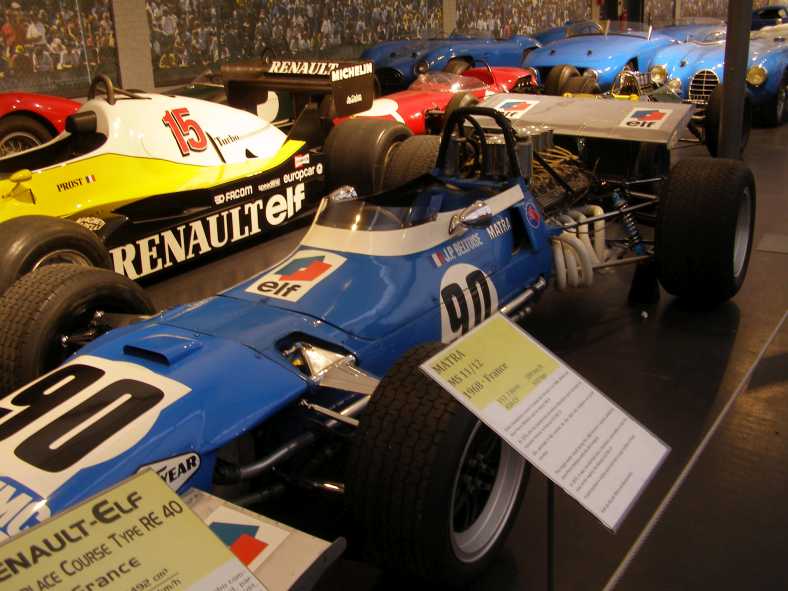
Matra, Renault, Lotus. These cars typify the competitive cars of the 1961 to 1983 period, a period of great change in tyres and aerodynamics in particular. Power levels rose enormously too, about 175hp for Siffert’s 21 to about 650hp for the Renault.
French racing blue struggled to reach the front after Bugatti was eclipsed by the Italian and German teams of the early thirties. But it wasn’t for the want of trying and one of the most persistent triers was Amidee Gordini.
The Gordini 32 was an ambitious project with a straight eight engine of 2473cc. It raced up to the 1957 season but made little impact against the Maseratis, Ferraris and Vanwalls of the era. Behind it is the failed Bugatti 251 described earlier with the photo of the engine in frame as well.
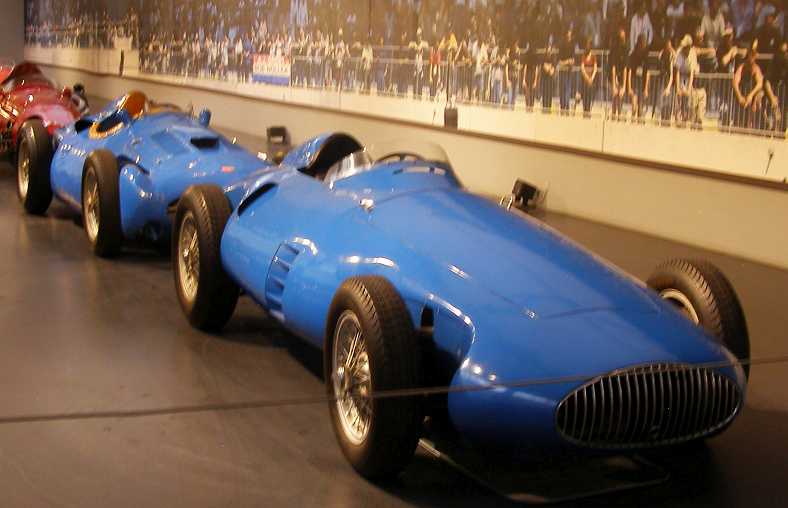
French Racing Blue. Holding up the French colours in the fifties’ GP racing was Gordini, with the Bugatti 251 also a hopeful design. Entering the 1957 Pau Grand Prix, this Gordini became the last Formula 1 car to use a straight eight engine.
Mercedes Benz was tremendously successful in Grand Prix racing from 1934 to 1939, during which time two different formulae were in use. First came the 750kg formula, which stipulated that cars could weigh no less than that weight – but the rest of the design was up to the maker – and then a 3-litre formula which allowed supercharging on engines up to that size.
The W125 was a major revision of the W25 introduced in 1934. By 1937 it was obvious that more was required and the straight eight engine of 1937 was a dramatic 5.6-litres. Rising speeds led the controlling body of the sport to introduce the 3-litre formula for 1939, but further improvements to the cars meant lap times kept tumbling. The W154 had a V12 engine and pumped out over 450hp.
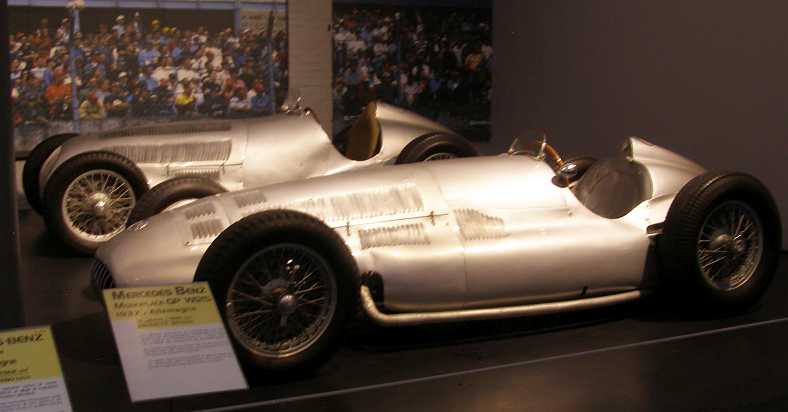
Mercedes W154. Using the M163 engine, this 1939 Grand Prix car brought lap times down at many circuits to levels which would take some beating in post-war days.
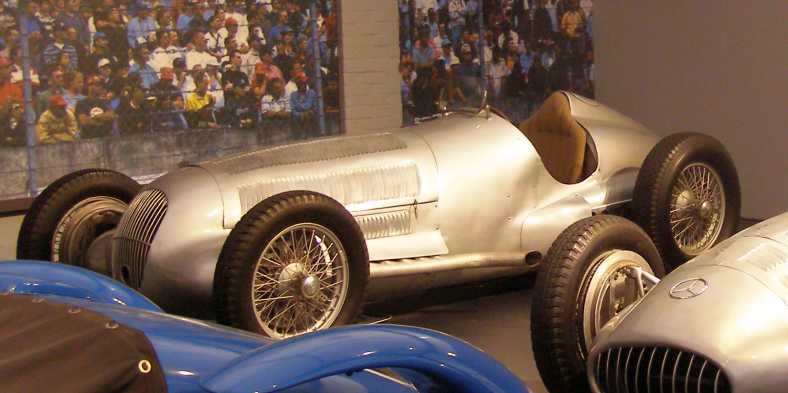
W125. A better angle of the W125, which was rather more vertical than the W154, though still a little lower than the earlier W25. It had 600hp for the drivers to enjoy.
Not all racing cars suffered from such a surfeit of horsepower. During the 1920s Bugattis were very successful with their Type 35, 1.5-litre cars. The 1926 Amilcar to the right was for the ‘voiturette’ races and was only 1100cc. French blue was to the fore in this era.
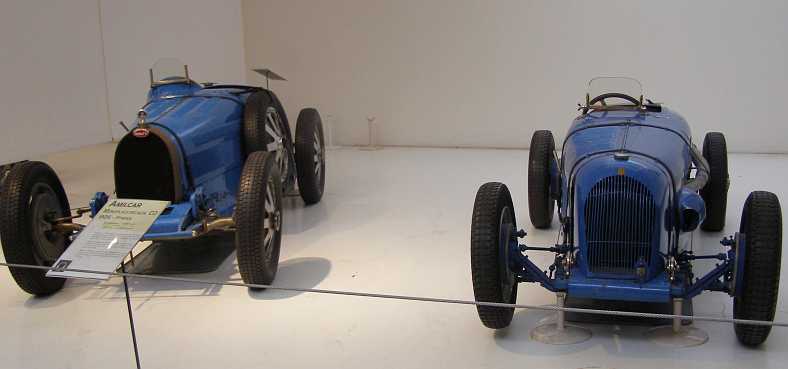
Bugatti 35 and Amilcar Decalee. While the Bugatti Type 35 was tremendously successful in the twenties, the Amilcar was not so potent with its smaller engine and competed in lesser races.
Many people cannot imagine Formula One without Ferrari and here are two early examples. The lead car is a 375, the car which replaced the supercharged car in 1950 with a Lampredi-designed SOHC V12 which grew to the 4.5-litres necessary to challenge the Alfa Romeos with their 2-stage supercharged straight eight engines.
Behind it is, I understand, a 500/625, essentially the Formula 2 type which took Alberto Ascari to two World Championships. Limited to 2-litres, these had 4-cylinder engines and the ‘625’ part of the name refers to the enlarged cylinders which gave them 2.5-litres when the 1954 formula change came.
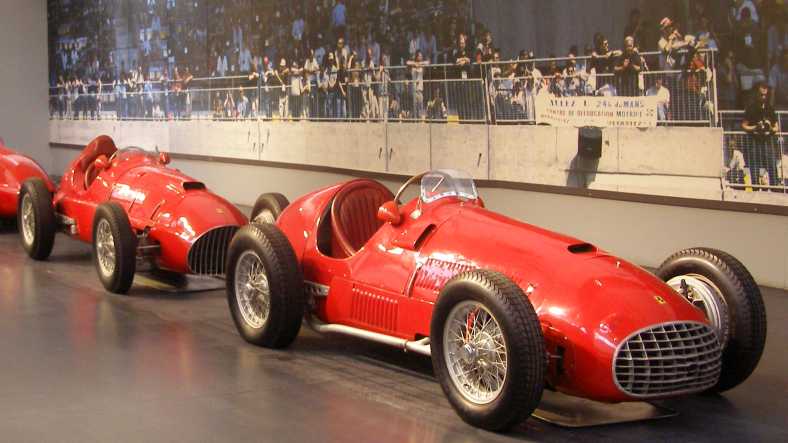
Ferraris. Ferrari came into being during the second World War and was ready to go racing after the war. V12 engines were Enzo Ferrari’s favourite and he oversaw the building of many of these, the 4.5-litre Lampredi version of which gave him his first Grand Prix victory with Alberto Ascari at the wheel. The first car here is one of that model.
Rounding out the types of cars in the collection, there are two more types to go. The ones I would call the ‘Grand Routiers’ – cars built for grand touring – and the luxury models, the cars of the rich, famous and powerful. Here’s one of the latter type:
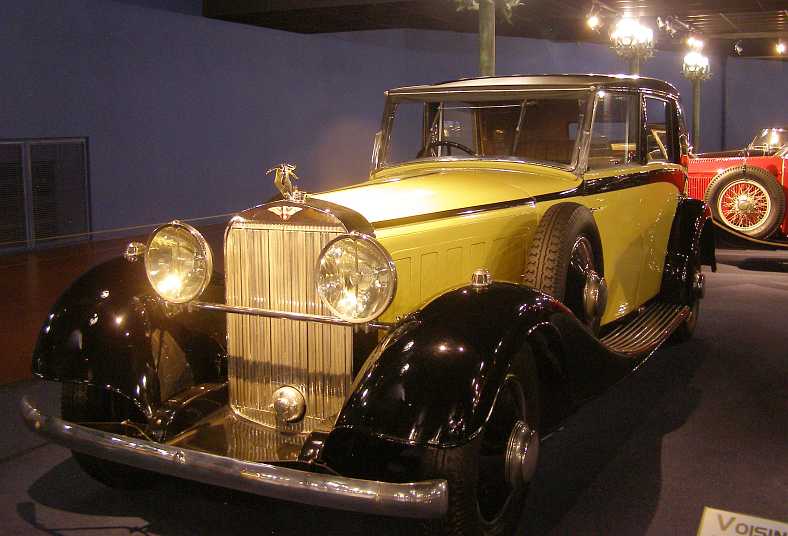
Opulence and luxury. Particularly between the wars there was a class of people who could afford very expensive cars and did so. This Hispano Suiza is one of the cars which would never have been able to have been built had those people not patronised makers of such cars.
There are many such in the collection, some of them will be in the next post…
And the ‘some’ is a grand little listing, too. The Car in which Mario Andretti won two Grands Prix we’ve seen already, so let’s see what else we can pick out.
First to come under the scrutiny of my lens was was one which was an absolute natural to be in a French automotive museum. In the late forties and very early fifties the Lago Talbot was never going to keep up with the Alfa Romeos and Ferraris, but it wasn’t so far behind that it couldn’t be discounted.
One fantastic story is about Raymond Sommer, who planned out a strategy to win the Belgian Grand Prix by stealth, using the fuel consumption advantage of the 4.5-litre 6-cylinder engine to avoid time-consuming pit stops as Louis Rosier had done in winning that race in 1949 ahead of the Alfa Romeo 4CLT driving one of these models. Sommer did spend some laps in the lead, but the car failed him in the end.
Lago Talbot. Reputed not to have ever raced, this Lago Talbot dates back to 1948.
And what a lot of F1 cars of so many different types are in this next photo!
In the foreground is the V12 Matra from 1968, Engins Matra being an aerospace firm which wanted to publicise its engineering expertise to back up its sales of military hardware. Alongside is a Renault RE40, which used a different approach to that same formula which allowed unsupercharged engines up to 3-litres and supercharged (or turbocharged in this case) engines up to 1.5-litres. Alain Prost’s name is on this one, the engine in this case is a V6.
Behind the Prost car is a red Lotus 21, this one being fitted with a 1.5-litre (unsupercharged) Coventry Climax FPF engine. This was one of a number of cars sold to the Schlumpfs by Swiss driver and garage owner, Jo Siffert, and he used it in 1962. There was no supercharging option for the 1961-65 formula and one of the quickest cars in that era was the Lotus 25 and its derivative, the Lotus 33. The 25/33 is barely visible here, but it features a Coventry Climax FWMV V8 engine and would undoubtedly have been driven at some time by Jim Clark. It was in Siffert’s hands later and part of the same sale as the 21.
Matra, Renault, Lotus. These cars typify the competitive cars of the 1961 to 1983 period, a period of great change in tyres and aerodynamics in particular. Power levels rose enormously too, about 175hp for Siffert’s 21 to about 650hp for the Renault.
French racing blue struggled to reach the front after Bugatti was eclipsed by the Italian and German teams of the early thirties. But it wasn’t for the want of trying and one of the most persistent triers was Amidee Gordini.
The Gordini 32 was an ambitious project with a straight eight engine of 2473cc. It raced up to the 1957 season but made little impact against the Maseratis, Ferraris and Vanwalls of the era. Behind it is the failed Bugatti 251 described earlier with the photo of the engine in frame as well.
French Racing Blue. Holding up the French colours in the fifties’ GP racing was Gordini, with the Bugatti 251 also a hopeful design. Entering the 1957 Pau Grand Prix, this Gordini became the last Formula 1 car to use a straight eight engine.
Mercedes Benz was tremendously successful in Grand Prix racing from 1934 to 1939, during which time two different formulae were in use. First came the 750kg formula, which stipulated that cars could weigh no less than that weight – but the rest of the design was up to the maker – and then a 3-litre formula which allowed supercharging on engines up to that size.
The W125 was a major revision of the W25 introduced in 1934. By 1937 it was obvious that more was required and the straight eight engine of 1937 was a dramatic 5.6-litres. Rising speeds led the controlling body of the sport to introduce the 3-litre formula for 1939, but further improvements to the cars meant lap times kept tumbling. The W154 had a V12 engine and pumped out over 450hp.
Mercedes W154. Using the M163 engine, this 1939 Grand Prix car brought lap times down at many circuits to levels which would take some beating in post-war days.
W125. A better angle of the W125, which was rather more vertical than the W154, though still a little lower than the earlier W25. It had 600hp for the drivers to enjoy.
Not all racing cars suffered from such a surfeit of horsepower. During the 1920s Bugattis were very successful with their Type 35, 1.5-litre cars. The 1926 Amilcar to the right was for the ‘voiturette’ races and was only 1100cc. French blue was to the fore in this era.
Bugatti 35 and Amilcar Decalee. While the Bugatti Type 35 was tremendously successful in the twenties, the Amilcar was not so potent with its smaller engine and competed in lesser races.
Many people cannot imagine Formula One without Ferrari and here are two early examples. The lead car is a 375, the car which replaced the supercharged car in 1950 with a Lampredi-designed SOHC V12 which grew to the 4.5-litres necessary to challenge the Alfa Romeos with their 2-stage supercharged straight eight engines.
Behind it is, I understand, a 500/625, essentially the Formula 2 type which took Alberto Ascari to two World Championships. Limited to 2-litres, these had 4-cylinder engines and the ‘625’ part of the name refers to the enlarged cylinders which gave them 2.5-litres when the 1954 formula change came.
Ferraris. Ferrari came into being during the second World War and was ready to go racing after the war. V12 engines were Enzo Ferrari’s favourite and he oversaw the building of many of these, the 4.5-litre Lampredi version of which gave him his first Grand Prix victory with Alberto Ascari at the wheel. The first car here is one of that model.
Rounding out the types of cars in the collection, there are two more types to go. The ones I would call the ‘Grand Routiers’ – cars built for grand touring – and the luxury models, the cars of the rich, famous and powerful. Here’s one of the latter type:
Opulence and luxury. Particularly between the wars there was a class of people who could afford very expensive cars and did so. This Hispano Suiza is one of the cars which would never have been able to have been built had those people not patronised makers of such cars.
There are many such in the collection, some of them will be in the next post…
Last edited by Ray Bell; May 8, 2020 at 11:14 AM.