


Ride along with me...


Thread Starter
|
Captain

Joined: Oct 2005
Posts: 568
Likes: 8
From: The Summit, Queensland, Australia

Again, with our ‘Opulence and Luxury’ category, a number of the cars have been seen already for one reason or another. But there’s still some interesting ones among my pics and I now realise I could easily have taken two or three times as many pics!
But I didn’t, so I can’t bore my readers with too much of this stuff. Can I?
We can’t start in this section without showing the other Royale, the one which stands abreast of Ettore Bugatti’s own one shown in an earlier post:
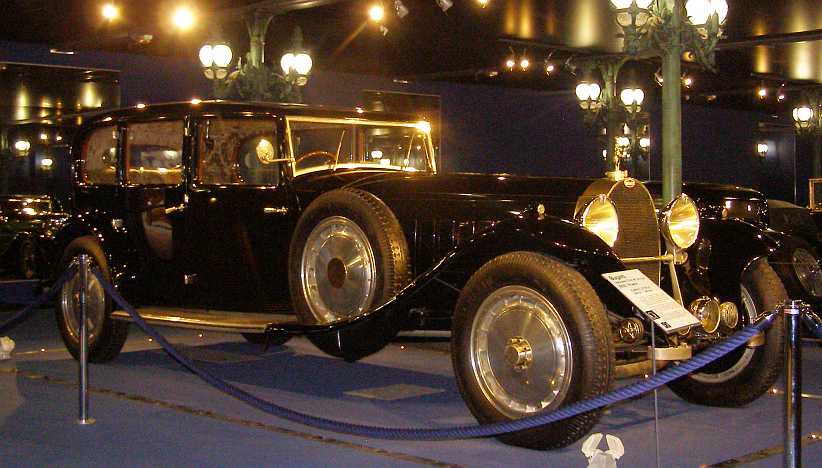
Bugatti Royale. Originally built in 1933 for an English client, this car has a body by the British coachbuilder, Park Ward. It later went to America and was acquired by the Schlumpf brothers as one of a 30 Bugatti job-lot purchase.
Due to the darkness of this hall some pics are pretty poor. Such is the case of this picture of an Isotta Fraschini built in 1928, the imposing front describing it’s engine – a straight eight – and simply reeking of power and authority on the road.
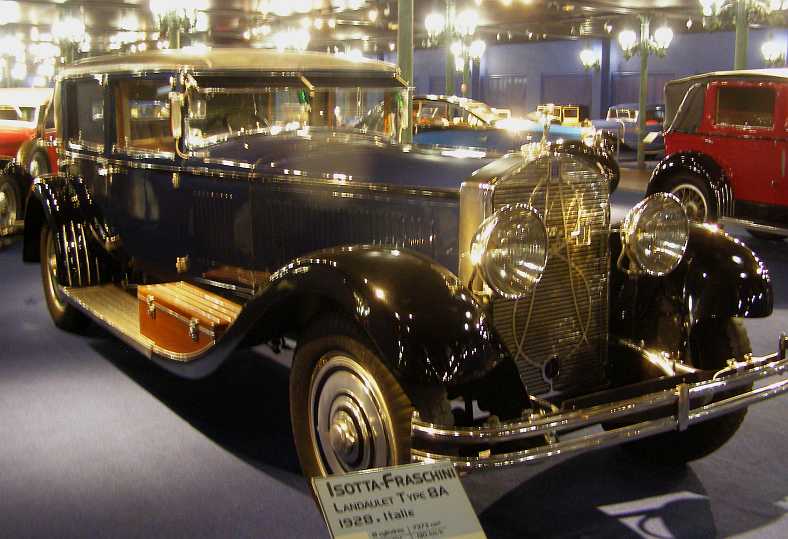
Isotta Fraschini. The imposing front of this Isotta Fraschini is justified by the encasement of a powerful 7.4-litre engine. Its wheels would turn up to 130kmh on the crude highways of its time.
I’m not sure how many Hispano Suizas are in the collection, but I seem to recall seeing about six or seven. This has the wider grille, establishing that it’s carrying a V12 engine and, being a 2-door, I probably should have included in the ‘Grand Routiers’ group.
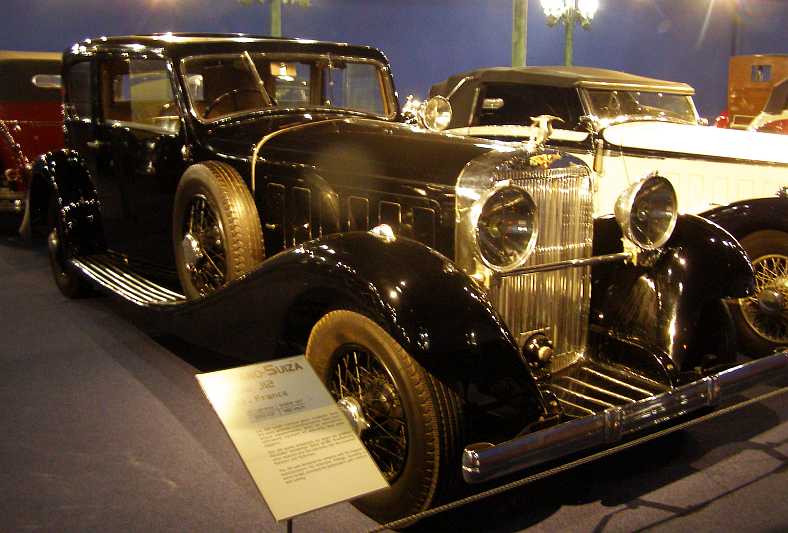
V12 Hispano Suiza. Noted for their build quality and engineering excellence, Hispano Suiza’s ultimate models were the V12s of the thirties.
We looked at the Farman earlier, but only the engine and gearbox were shown in the picture. Again, poorly photographed because of the darkness of the hall, but this is the car:
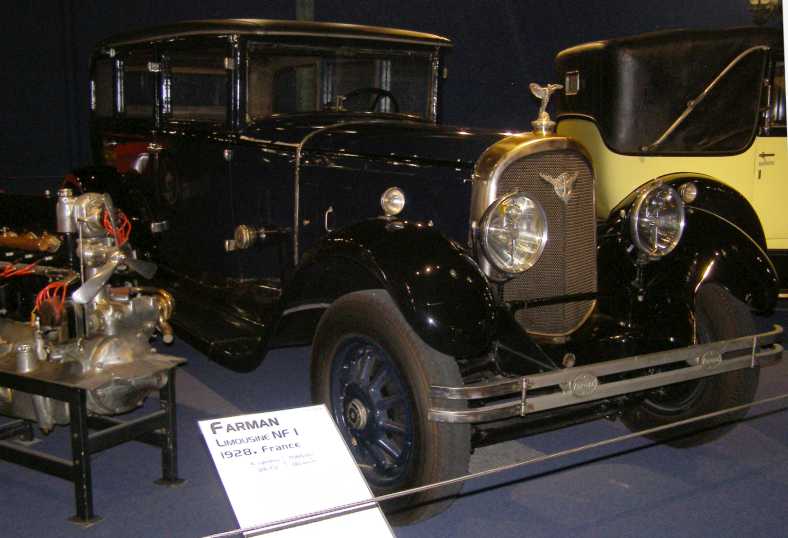
1928 Farman. With a 7-litre six the Farman had adequate power to move its plush bodywork around for some wealthy owner.
Often I’ve read the name ‘Horch’ in books about German racing or motoring in the thirties. But I’ve never seen one, so this had to be the first. Very neatly presented, I’ve no doubt it was the pride and joy of someone who could afford the luxury of a 6-litre V12 in the days of the Great Depression.
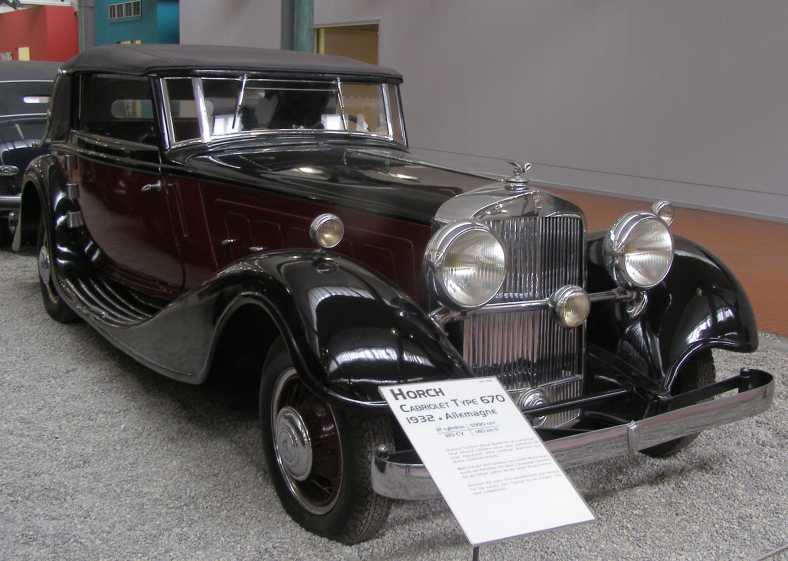
1932 Horch. An impressive sight even today, this drophead could only have been afforded by a very wealthy person at the time it was built.
And to return to Bugatti (if it’s not too boring…) we have a post-war car from the Roland Bugatti era. This Type 101 had a 3.2-litre straight eight and is described here as a cabriolet. By 1952 it was becoming difficult to have a modern tilt in the styling and still be able to retain the traditional Bugatti radiator and surround.
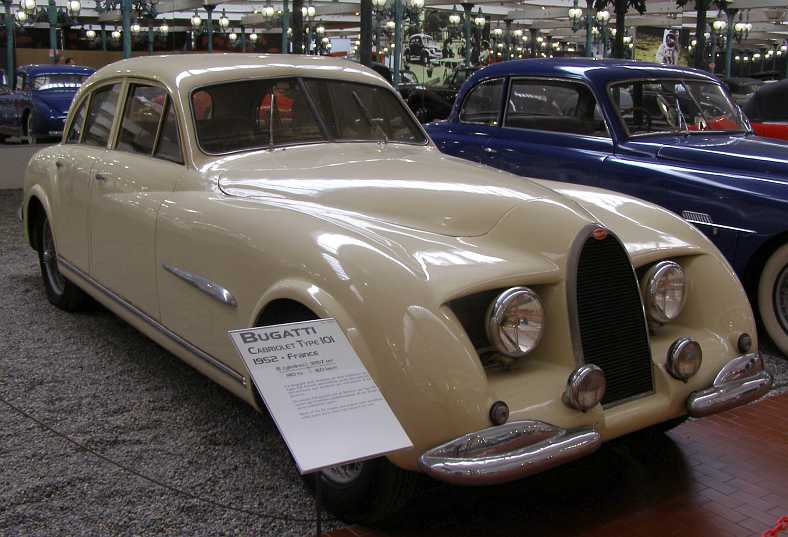
Bugatti Type 101 Cabriolet. Claimed to be a hundred miles an hour car, it’s a 4-door and should have whisked people from Paris to Le Mans at a respectable speed and in reasonable comfort.
More to come…
But I didn’t, so I can’t bore my readers with too much of this stuff. Can I?
We can’t start in this section without showing the other Royale, the one which stands abreast of Ettore Bugatti’s own one shown in an earlier post:
Bugatti Royale. Originally built in 1933 for an English client, this car has a body by the British coachbuilder, Park Ward. It later went to America and was acquired by the Schlumpf brothers as one of a 30 Bugatti job-lot purchase.
Due to the darkness of this hall some pics are pretty poor. Such is the case of this picture of an Isotta Fraschini built in 1928, the imposing front describing it’s engine – a straight eight – and simply reeking of power and authority on the road.
Isotta Fraschini. The imposing front of this Isotta Fraschini is justified by the encasement of a powerful 7.4-litre engine. Its wheels would turn up to 130kmh on the crude highways of its time.
I’m not sure how many Hispano Suizas are in the collection, but I seem to recall seeing about six or seven. This has the wider grille, establishing that it’s carrying a V12 engine and, being a 2-door, I probably should have included in the ‘Grand Routiers’ group.
V12 Hispano Suiza. Noted for their build quality and engineering excellence, Hispano Suiza’s ultimate models were the V12s of the thirties.
We looked at the Farman earlier, but only the engine and gearbox were shown in the picture. Again, poorly photographed because of the darkness of the hall, but this is the car:
1928 Farman. With a 7-litre six the Farman had adequate power to move its plush bodywork around for some wealthy owner.
Often I’ve read the name ‘Horch’ in books about German racing or motoring in the thirties. But I’ve never seen one, so this had to be the first. Very neatly presented, I’ve no doubt it was the pride and joy of someone who could afford the luxury of a 6-litre V12 in the days of the Great Depression.
1932 Horch. An impressive sight even today, this drophead could only have been afforded by a very wealthy person at the time it was built.
And to return to Bugatti (if it’s not too boring…) we have a post-war car from the Roland Bugatti era. This Type 101 had a 3.2-litre straight eight and is described here as a cabriolet. By 1952 it was becoming difficult to have a modern tilt in the styling and still be able to retain the traditional Bugatti radiator and surround.
Bugatti Type 101 Cabriolet. Claimed to be a hundred miles an hour car, it’s a 4-door and should have whisked people from Paris to Le Mans at a respectable speed and in reasonable comfort.
More to come…
Thread Starter
|
Captain
Joined: Oct 2005
Posts: 568
Likes: 8
From: The Summit, Queensland, Australia
Lots of cars in the Schlumpf collection are less outstanding in one way or another, but are preserved and displayed. This includes regular production cars, some sporting models, cars which have changed identity over the decades and so on. Not all are cars you’d really car to highlight in just the same way as I haven’t photographed every car, even some others wouldn’t miss out on.
I mentioned I’ve had a long association with Peugeot, starting with a 403 I owned in 1965, so it’s not surprising that I photographed this classy sedan from the early twenties:
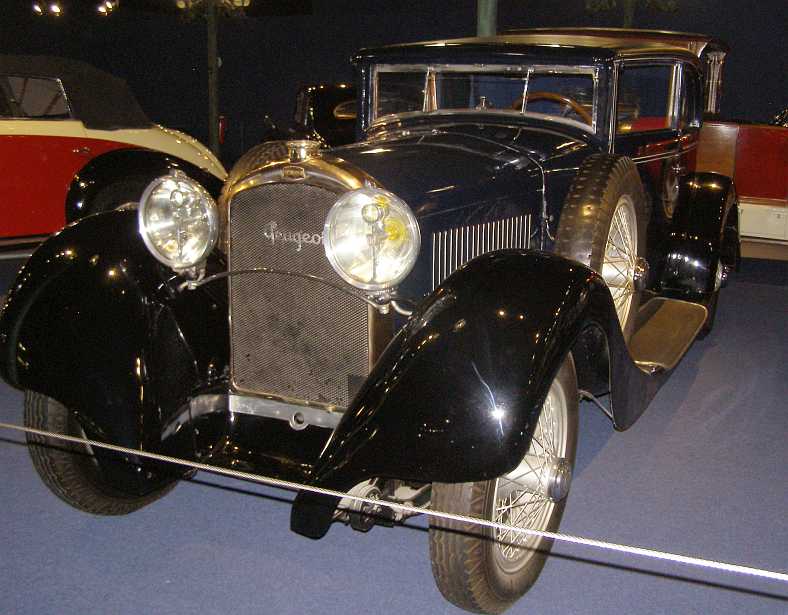
Peugeot 174. Better known as the ‘18 horsepower’ apparently, this had a 4-cylinder engine of almost four litres and 85bhp, there was also a sports model - or maybe this is the sports model.
Peugeot also features in the small display of rally cars. This one is from the era when rallying got a bit out of control and cars like this had 4WD, this one has its engine mounted in the back and is so far from a standard road car that virtually nothing other than the profile bears a resemblance. If you’d like to know more, google ‘Peugeot 205 Turbo 16.’
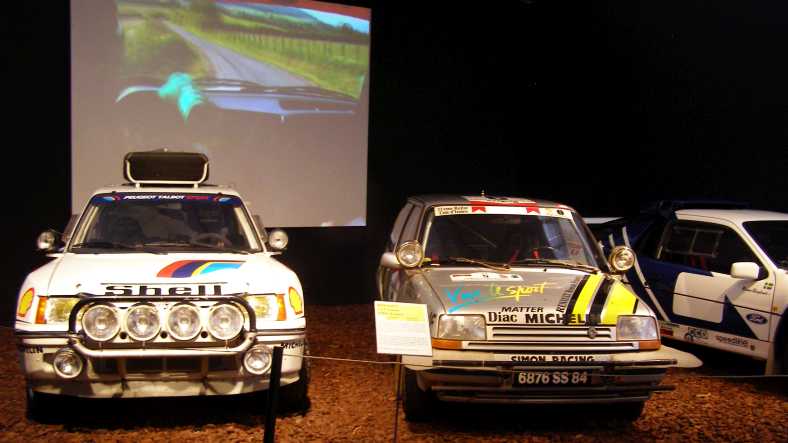
Rallying. A small display of rally cars has a non-stop screen of rally action behind it. A diversion from the main event at the Schlumpf.
This isn’t included in the racing car posting because it’s not a real one. An Alfa Romeo V12, it was a Tipo 412 built as a GT car but was rebodied in this form after Michelotti did a rough design for the body on a for owner ***** Daetwyler on a tablecloth. It has ‘road equipment’ (lights, cycle guards) too and sometimes is displayed with them in place.
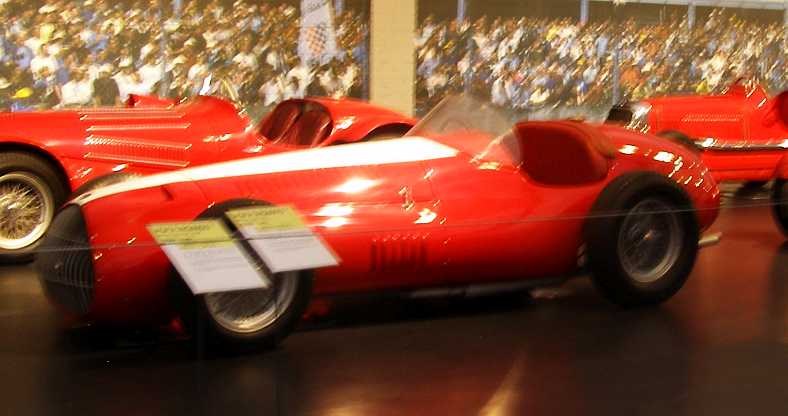
Alfa Romeo V12. Looking for all the world like a Tipo 158, this would be a great car to put on the street with its guards and lights.
I mentioned earlier that the Schlumpf brothers traded an old competition Mercedes Benz with the official M-B museum for a very real 300SLR, and here it is. I’ve chosen the rear view because it shows the ‘F’ badge they’ve had cast, chromed and attached.
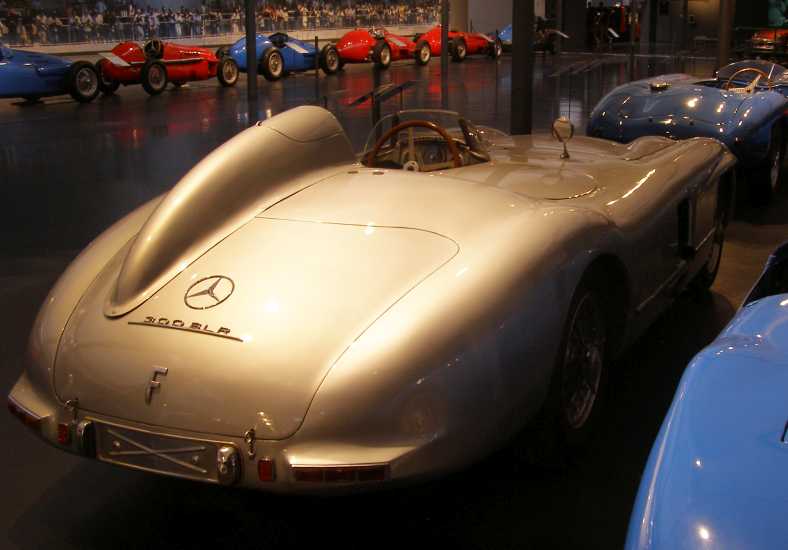
Mercedes Benz 300SLR. This model won the cream of the Sports Car races of the 1955 season, save for Le Mans in which one crashed into the crowd and led to the others being withdrawn mid-race even though Fangio and Moss were driving one in the lead of the event. A car I’ve always liked.
There’s rarely a French movie which doesn’t show at least one of these Citroen ‘Traction Avant’ models at some time. Introduced in 1934, they were made until the mid-fifties and one of these covered an incredible 400,000+kms in the hands of a Paris restaurant proprietor, Francois Lecot, in 12 months of (audited and controlled) day and night driving.
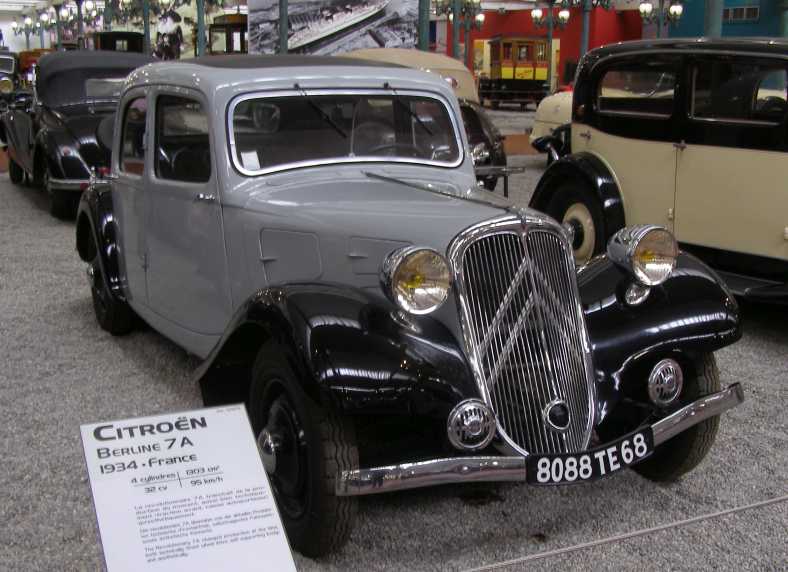
Citroen ‘Traction.’ Citroen swung production of his cars over to front wheel drive and produced this model in droves. A bigger 6-cylinder version was also produced. They were highly advanced cars for their era.
Peugeot again! The 203 model is well-remembered by people whose interests go back to the fifties, but in the thirties and forties the forerunners to the 203 were the 201 and 202. Basic cars built to put middle-class Frenchmen behind the wheel.
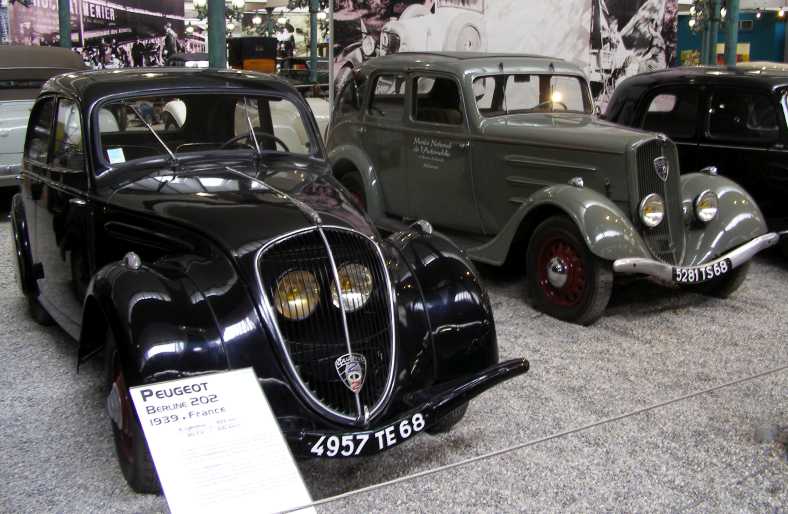
Peugeot 201 and 202. Small 4-cylinder sedans which helped mobilise France in the thirties, the 202 continuing briefly after the war until the much more modern 203 was ready for production.
From Czechoslovakia came the Tatra. A rear-mounted air-cooled V8 engine powered this car and it endured many years in production with some minor changes.
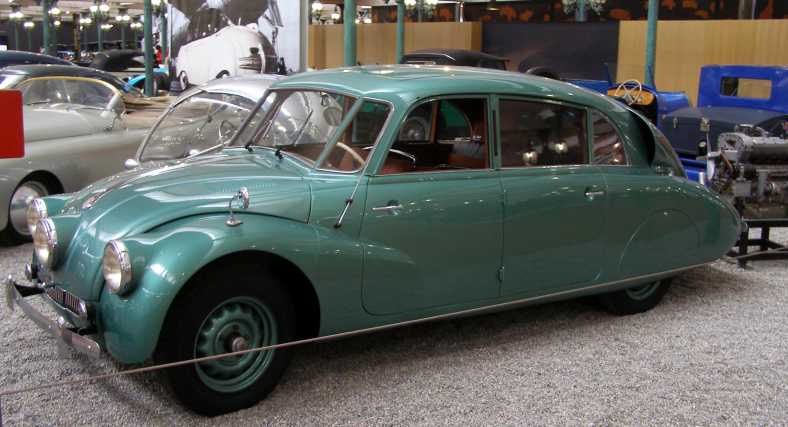
Tatra V8. This one dates from 1937 and its engine is 3-litres in capacity, a very smooth-looking variant of the Tatra models.
An interesting one next, the Panhard Dyna from 1945 on the left and the 1941 AFG prototype on the right. The Dyna came from the prototype but obviously much changed along the way. Styling house Gregoire is the ‘G’ in ‘AFG’ – Aluminium Francaise Gregoire’ – and turned out this to offer to various manufacturers. While there are conflicting stories that the chassis, firewall and windscreen surround was made as one piece in aluminium or if it was partially steel, it was certainly light.
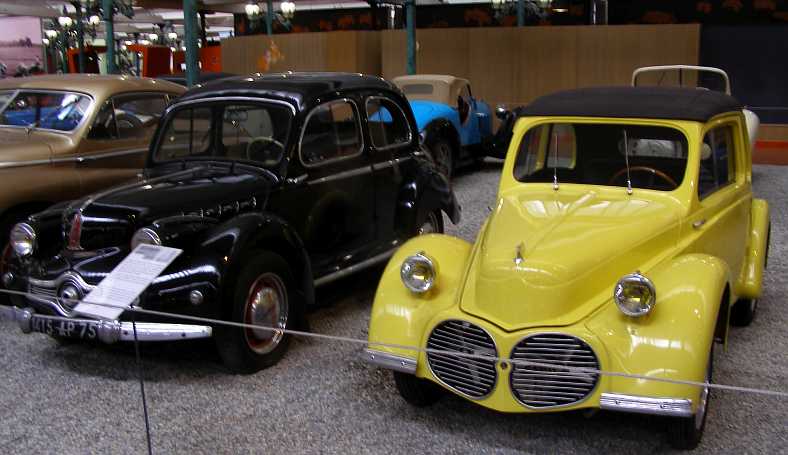
Small French. We’re all very familiar with the 4CV Renault – the 750 – but on the roads of France in the fifties the Dyna Panhard was very familiar too. A flat-twin engine of 610, 745 or 851cc capacity hung out the front and drove the front wheels, the car weighed little over half a ton and 45,000 were built.
A styling exercise or a joke? This Renault 4 with a large section missing looks very strange:
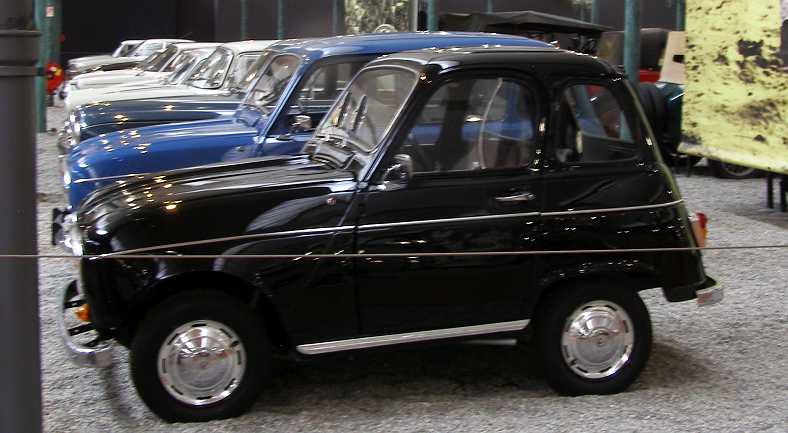
Renault ‘Shorty’. The Renault 4 became a very common sight on the roads of France from its introduction in the mid-sixties. It remained in production for a long time, so it’s no surprise that someone had to play with it somehow. It was the model which marked the changeover from rear engine to front wheel drive for Renault.
A private effort next, based on Simca mechanicals and some structure, this 1100cc coupe was built by Marcel Alart and looks like it belongs.
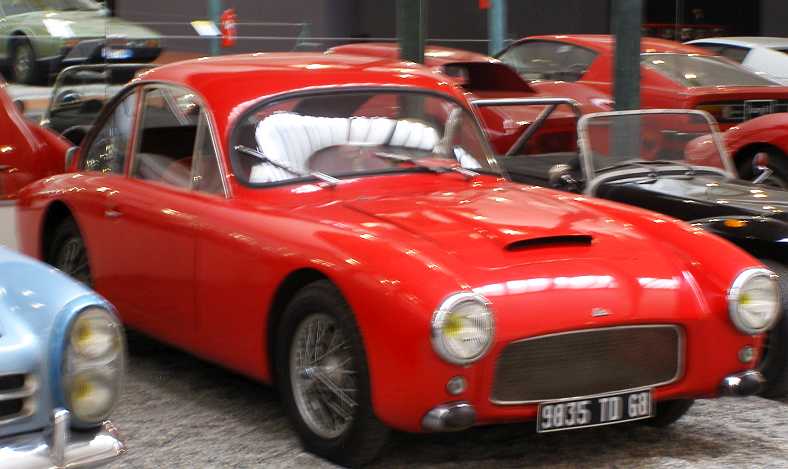
Alart Simca. A private design and build, the Alart coupe belies the fact that it was a home-made car by its professional finish. It took three years to build before emerging in 1959.
One car which really surprised me for its styling was this Bugatti Type 46. Said to have been built in 1931, it really looks like it could have emerged in the forties or fifties with those lines. One source says that some of the bodywork came from Cadillac, which clearly identifies it as later in the thirties.
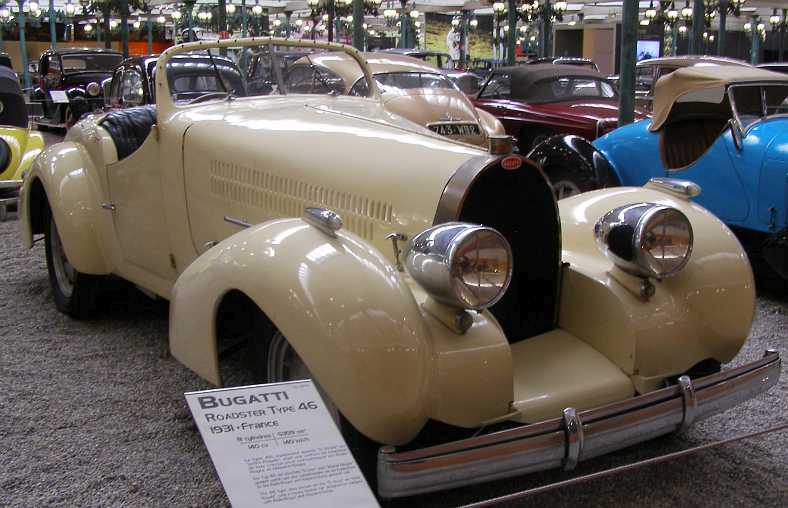
Bugatti T46. Styled by Ettore’s son, Jean Bugatti, this 5.4-litre straight eight powered car is an awkward blend of the later streamlining with the traditional nose. This model, along with the T50, has some different features, one being the gearbox mounting along with the final drive in the solid rear axle. Unsprung weight? Jolting and jerking? It wasn’t all that unusual a concept in the years prior to WW1 but hard to understand in the thirties.
Does this belong with the racing sports cars or even the ‘Grand Routiers’? Not quite with either, it was a production model from Alfa Romeo in the early thirties and had close links with the Alfa Romeo 2300 Monza, a very rapid racing model.
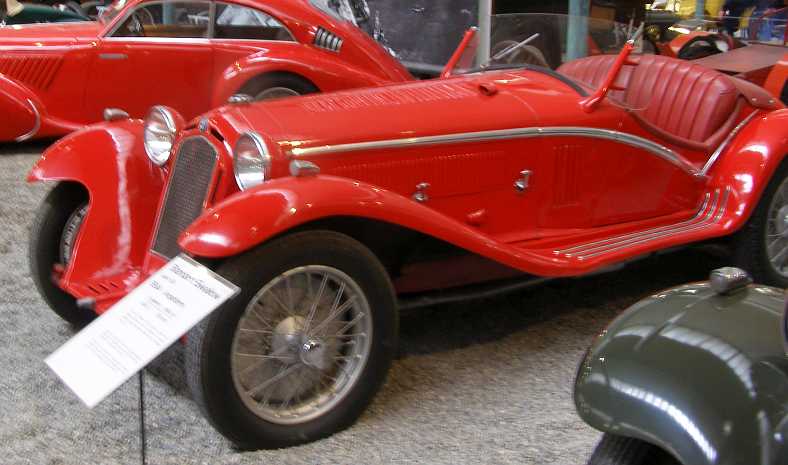
Alfa Romeo 8C 2300. Another good one to get the wind in your hair, this classic Alfa would have had superb performance for a car of the thirties.
This is one for the Grand Routiers, however. I lusted over gullwings for many years, in Australia there was only one or two ever (privately) imported though there are more now. I even indulged in buying lottery tickets in the hope I’d be able to get one in the mid-sixties era in which they regularly sold as used cars – complete with Blaupunkt radios – in the USA for around $6,000.
I saw more of this model in the Mercedes-Benz museum the following day, so I’ll be giving more detail then, but to preview the ‘Grand Routiers’ of the next post…
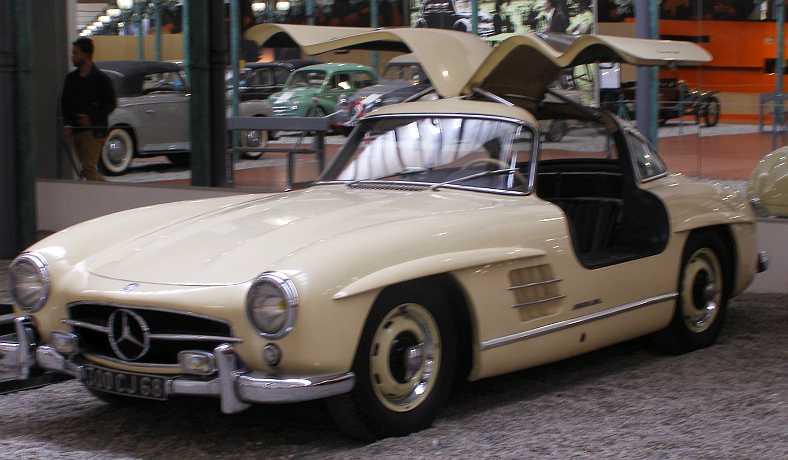
Mercedes Benz 300SL. A blend of a large sedan engine with added performance and a spaceframe chassis which precluded the fitment of normal doors, the ‘Gullwing’ Mercedes set a high standard for many years after its introduction in the early fifties.
Yes, that’s right, it’s the ‘Grand Routiers’ next…
I mentioned I’ve had a long association with Peugeot, starting with a 403 I owned in 1965, so it’s not surprising that I photographed this classy sedan from the early twenties:
Peugeot 174. Better known as the ‘18 horsepower’ apparently, this had a 4-cylinder engine of almost four litres and 85bhp, there was also a sports model - or maybe this is the sports model.
Peugeot also features in the small display of rally cars. This one is from the era when rallying got a bit out of control and cars like this had 4WD, this one has its engine mounted in the back and is so far from a standard road car that virtually nothing other than the profile bears a resemblance. If you’d like to know more, google ‘Peugeot 205 Turbo 16.’
Rallying. A small display of rally cars has a non-stop screen of rally action behind it. A diversion from the main event at the Schlumpf.
This isn’t included in the racing car posting because it’s not a real one. An Alfa Romeo V12, it was a Tipo 412 built as a GT car but was rebodied in this form after Michelotti did a rough design for the body on a for owner ***** Daetwyler on a tablecloth. It has ‘road equipment’ (lights, cycle guards) too and sometimes is displayed with them in place.
Alfa Romeo V12. Looking for all the world like a Tipo 158, this would be a great car to put on the street with its guards and lights.
I mentioned earlier that the Schlumpf brothers traded an old competition Mercedes Benz with the official M-B museum for a very real 300SLR, and here it is. I’ve chosen the rear view because it shows the ‘F’ badge they’ve had cast, chromed and attached.
Mercedes Benz 300SLR. This model won the cream of the Sports Car races of the 1955 season, save for Le Mans in which one crashed into the crowd and led to the others being withdrawn mid-race even though Fangio and Moss were driving one in the lead of the event. A car I’ve always liked.
There’s rarely a French movie which doesn’t show at least one of these Citroen ‘Traction Avant’ models at some time. Introduced in 1934, they were made until the mid-fifties and one of these covered an incredible 400,000+kms in the hands of a Paris restaurant proprietor, Francois Lecot, in 12 months of (audited and controlled) day and night driving.
Citroen ‘Traction.’ Citroen swung production of his cars over to front wheel drive and produced this model in droves. A bigger 6-cylinder version was also produced. They were highly advanced cars for their era.
Peugeot again! The 203 model is well-remembered by people whose interests go back to the fifties, but in the thirties and forties the forerunners to the 203 were the 201 and 202. Basic cars built to put middle-class Frenchmen behind the wheel.
Peugeot 201 and 202. Small 4-cylinder sedans which helped mobilise France in the thirties, the 202 continuing briefly after the war until the much more modern 203 was ready for production.
From Czechoslovakia came the Tatra. A rear-mounted air-cooled V8 engine powered this car and it endured many years in production with some minor changes.
Tatra V8. This one dates from 1937 and its engine is 3-litres in capacity, a very smooth-looking variant of the Tatra models.
An interesting one next, the Panhard Dyna from 1945 on the left and the 1941 AFG prototype on the right. The Dyna came from the prototype but obviously much changed along the way. Styling house Gregoire is the ‘G’ in ‘AFG’ – Aluminium Francaise Gregoire’ – and turned out this to offer to various manufacturers. While there are conflicting stories that the chassis, firewall and windscreen surround was made as one piece in aluminium or if it was partially steel, it was certainly light.
Small French. We’re all very familiar with the 4CV Renault – the 750 – but on the roads of France in the fifties the Dyna Panhard was very familiar too. A flat-twin engine of 610, 745 or 851cc capacity hung out the front and drove the front wheels, the car weighed little over half a ton and 45,000 were built.
A styling exercise or a joke? This Renault 4 with a large section missing looks very strange:
Renault ‘Shorty’. The Renault 4 became a very common sight on the roads of France from its introduction in the mid-sixties. It remained in production for a long time, so it’s no surprise that someone had to play with it somehow. It was the model which marked the changeover from rear engine to front wheel drive for Renault.
A private effort next, based on Simca mechanicals and some structure, this 1100cc coupe was built by Marcel Alart and looks like it belongs.
Alart Simca. A private design and build, the Alart coupe belies the fact that it was a home-made car by its professional finish. It took three years to build before emerging in 1959.
One car which really surprised me for its styling was this Bugatti Type 46. Said to have been built in 1931, it really looks like it could have emerged in the forties or fifties with those lines. One source says that some of the bodywork came from Cadillac, which clearly identifies it as later in the thirties.
Bugatti T46. Styled by Ettore’s son, Jean Bugatti, this 5.4-litre straight eight powered car is an awkward blend of the later streamlining with the traditional nose. This model, along with the T50, has some different features, one being the gearbox mounting along with the final drive in the solid rear axle. Unsprung weight? Jolting and jerking? It wasn’t all that unusual a concept in the years prior to WW1 but hard to understand in the thirties.
Does this belong with the racing sports cars or even the ‘Grand Routiers’? Not quite with either, it was a production model from Alfa Romeo in the early thirties and had close links with the Alfa Romeo 2300 Monza, a very rapid racing model.
Alfa Romeo 8C 2300. Another good one to get the wind in your hair, this classic Alfa would have had superb performance for a car of the thirties.
This is one for the Grand Routiers, however. I lusted over gullwings for many years, in Australia there was only one or two ever (privately) imported though there are more now. I even indulged in buying lottery tickets in the hope I’d be able to get one in the mid-sixties era in which they regularly sold as used cars – complete with Blaupunkt radios – in the USA for around $6,000.
I saw more of this model in the Mercedes-Benz museum the following day, so I’ll be giving more detail then, but to preview the ‘Grand Routiers’ of the next post…
Mercedes Benz 300SL. A blend of a large sedan engine with added performance and a spaceframe chassis which precluded the fitment of normal doors, the ‘Gullwing’ Mercedes set a high standard for many years after its introduction in the early fifties.
Yes, that’s right, it’s the ‘Grand Routiers’ next…
Last edited by Ray Bell; May 13, 2020 at 08:00 AM.
Thread Starter
|
Captain
Joined: Oct 2005
Posts: 568
Likes: 8
From: The Summit, Queensland, Australia
During the 1930s there were some great roads opening up in Europe. France was recognised as always having had long straight highways, but Germany’s growing network of Autobahns was coming along and generally it was becoming a world where high speed travel in comfort moved from the railways to the roads.
The ‘upper class’ makers were happy to supply the means by which their clientele could join the select group of people who made these journeys. These are some of the cars…
The first of these had me wondering. Is it a racing sports car (the next category to cover) or a ‘Grand Routier’? Spurred on by the appearance of the car, and ignoring that it might have lacked some of those creature comforts this category should embrace, I took the decision to include it.
This particular car won the Mille Miglia in 1936, it’s an Alfa Romeo with the 2.9-litre twin-cam engine derived from the Grand Prix cars of the early thirties, the Tipo B. It truly has a heritage.
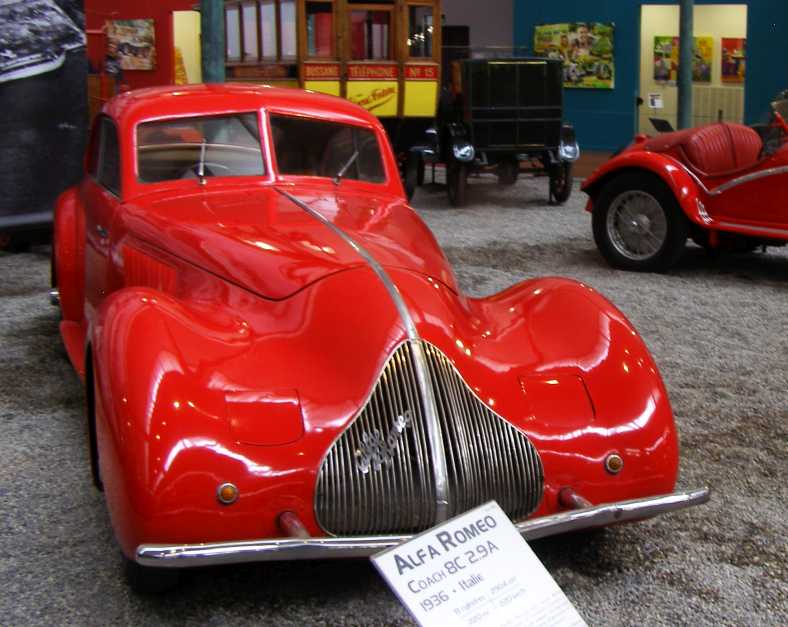
Alfa Romeo 2900 coupe. A very long car, a very slippery shape and all muscle under the skin, I’d love to take this for a drive some time.
This one looked very exciting, though the big surprise was to learn what’s under that huge and shapely bodywork. Based on a 1928 Buick chassis, Paul Arzens created a slippery shape with lots of overhang to take the overall length out to over seven metres. As he was a busy man who designed lots of things and worked with railway locomotives and electrical things and he apparently carried a lot of gear with him. He had room to stash it in this car.
He also built the ‘egg’ behind it in the picture. This is a little electric vehicle with a largely perspex body, but it gets worse. A copy of the original car was also built to run on batteries, of which it carried over a ton and from full charge they took it about 200kms.
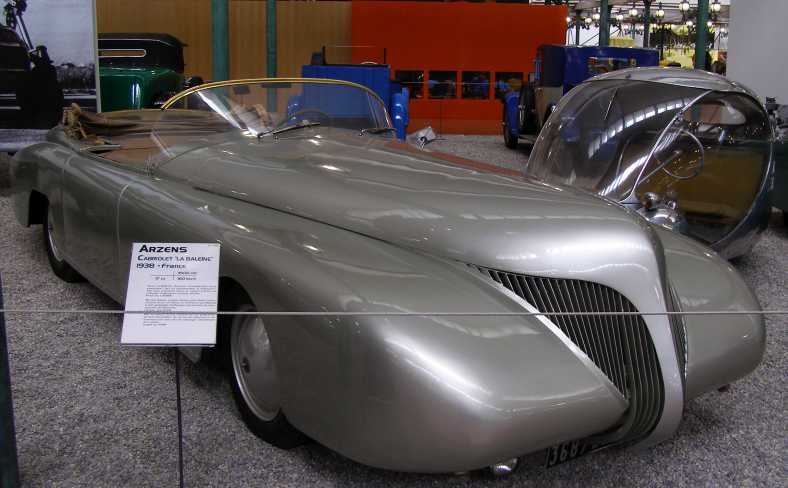
Arzens “La Baliene.” A one-off car that’s beautifully finished, the Arzens has a 3.5-litre six which gave it good speed for the time. The headlights are hidden behind the grille of the car, 'La Baliene' means 'The Whale’.
Incredibly, it seems that the running gear was all from a 1928 Buick 'Standard Six', possibly bored out from the original 207 cubic inches to reach the 214 cubic inches mentioned on some websites.

Inside. From another website I've copied this picture which shows the original gearlever, bent to suit, and the handbrake lever, also bent to suit. Tortured would be a better description, I'd say. And the instrument cluster is original 1928 Buick too, very old-fashioned even ten years later when this car was built, though the steering wheel looks a bit more modern, probably fifties.
Well, in this place there had to be yet another Bugatti, didn’t there? In 1939 this Type 64 was created with a 4.4-litre straight eight delivering 185bhp and capable of running it up to 115mph. Built in right hand drive, it has some design features that indicate that Jean Bugatti had been at work again, he being the main stylist in the firm.
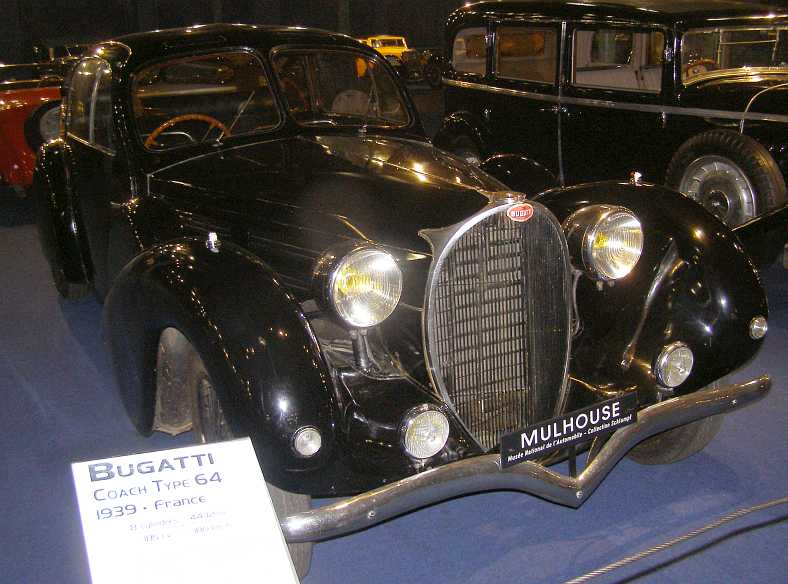
1939 Bugatti Type 64. The stylist has taken away some of the ‘older’ elements of the aesthetics and introduced some new and novel ones. Like the doors curving over into the roof and the thick central pillar in the windscreen.
Top down motoring for the owners of this Hispano Suiza. The paintwork might need to be changed for me to fully appreciate its style, but there’s no doubt this V12-powered car’s size would have given it a good ride at the speeds the V12 could help it achieve.
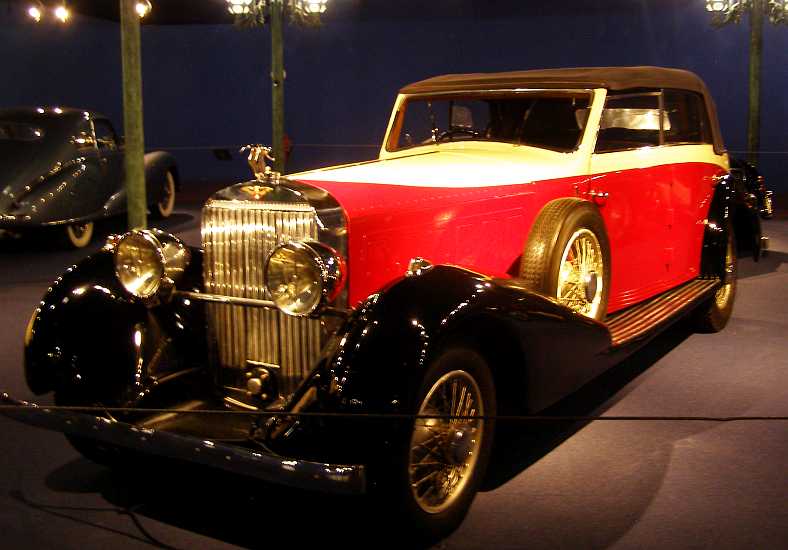
Hispano Suiza V12 Another right hand drive car, displayed here with the top up and, realistically, probably normally driven with it up, would have turned heads when it was new. And even more so now.
This is another one for open-air motoring, and it really does impress me with its lines. The Mercedes-Benz 540K has another driver-command supercharger attached to its 5.4-litre straight eight engine. Imposing yet clearly designed to be a good-looking car, another I’d happily drive any day.
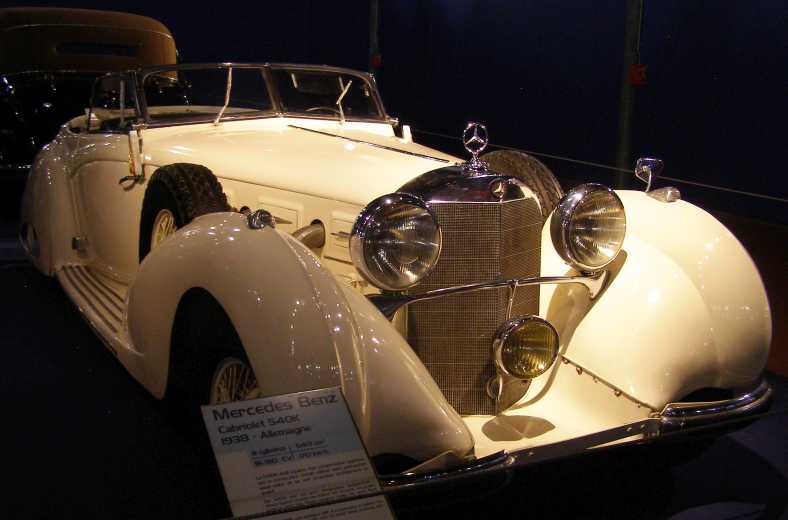
1938 Mercedes-Benz 540K. 115 horsepower under the hood, rising to 185 when the supercharger is engaged, this one is good for a bit over the ‘ton’ and looks like it would ride out any small blemishes in the autobahns easily.
Several cars like this one line the aisles at the museum. I would present more but the repetition wouldn’t be useful and some of the photos (from that dark hall) are badly blurred. This one, however, was in better light and I was able to get a good shot of it.
The style was called ‘Atlantic Coupe’ by Bugatti, or at least a French name similar to that. This particular one (one of three built) is a Type 57S which has a 3.3-litre straight eight which is good for 5,500rpm and delivers 190 horsepower.
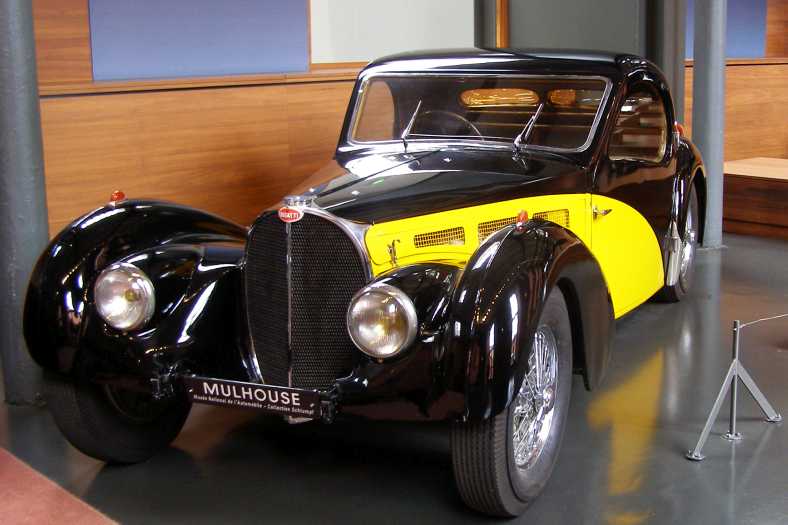
Bugatti ‘Atlantic’. A type styled by Jean Bugatti and of which many were built, this Type 57S is fairly light at just under a ton and no doubt had good performance. A car to be seen in as you rushed from Paris to Nice for the weekend? Or Molsheim to Paris to be with the dancing girls, as Jean is said to have been fond of doing?
Once again, I am so sorry I didn’t shoot more photos, I’m sure there were more cars there as interesting as those shown in this post. And there’s also the fact that about 150 cars are not on display at any given time, being rotated for maintenance etc.
Sports racing cars are next…
The ‘upper class’ makers were happy to supply the means by which their clientele could join the select group of people who made these journeys. These are some of the cars…
The first of these had me wondering. Is it a racing sports car (the next category to cover) or a ‘Grand Routier’? Spurred on by the appearance of the car, and ignoring that it might have lacked some of those creature comforts this category should embrace, I took the decision to include it.
This particular car won the Mille Miglia in 1936, it’s an Alfa Romeo with the 2.9-litre twin-cam engine derived from the Grand Prix cars of the early thirties, the Tipo B. It truly has a heritage.
Alfa Romeo 2900 coupe. A very long car, a very slippery shape and all muscle under the skin, I’d love to take this for a drive some time.
This one looked very exciting, though the big surprise was to learn what’s under that huge and shapely bodywork. Based on a 1928 Buick chassis, Paul Arzens created a slippery shape with lots of overhang to take the overall length out to over seven metres. As he was a busy man who designed lots of things and worked with railway locomotives and electrical things and he apparently carried a lot of gear with him. He had room to stash it in this car.
He also built the ‘egg’ behind it in the picture. This is a little electric vehicle with a largely perspex body, but it gets worse. A copy of the original car was also built to run on batteries, of which it carried over a ton and from full charge they took it about 200kms.
Arzens “La Baliene.” A one-off car that’s beautifully finished, the Arzens has a 3.5-litre six which gave it good speed for the time. The headlights are hidden behind the grille of the car, 'La Baliene' means 'The Whale’.
Incredibly, it seems that the running gear was all from a 1928 Buick 'Standard Six', possibly bored out from the original 207 cubic inches to reach the 214 cubic inches mentioned on some websites.
Inside. From another website I've copied this picture which shows the original gearlever, bent to suit, and the handbrake lever, also bent to suit. Tortured would be a better description, I'd say. And the instrument cluster is original 1928 Buick too, very old-fashioned even ten years later when this car was built, though the steering wheel looks a bit more modern, probably fifties.
Well, in this place there had to be yet another Bugatti, didn’t there? In 1939 this Type 64 was created with a 4.4-litre straight eight delivering 185bhp and capable of running it up to 115mph. Built in right hand drive, it has some design features that indicate that Jean Bugatti had been at work again, he being the main stylist in the firm.
1939 Bugatti Type 64. The stylist has taken away some of the ‘older’ elements of the aesthetics and introduced some new and novel ones. Like the doors curving over into the roof and the thick central pillar in the windscreen.
Top down motoring for the owners of this Hispano Suiza. The paintwork might need to be changed for me to fully appreciate its style, but there’s no doubt this V12-powered car’s size would have given it a good ride at the speeds the V12 could help it achieve.
Hispano Suiza V12 Another right hand drive car, displayed here with the top up and, realistically, probably normally driven with it up, would have turned heads when it was new. And even more so now.
This is another one for open-air motoring, and it really does impress me with its lines. The Mercedes-Benz 540K has another driver-command supercharger attached to its 5.4-litre straight eight engine. Imposing yet clearly designed to be a good-looking car, another I’d happily drive any day.
1938 Mercedes-Benz 540K. 115 horsepower under the hood, rising to 185 when the supercharger is engaged, this one is good for a bit over the ‘ton’ and looks like it would ride out any small blemishes in the autobahns easily.
Several cars like this one line the aisles at the museum. I would present more but the repetition wouldn’t be useful and some of the photos (from that dark hall) are badly blurred. This one, however, was in better light and I was able to get a good shot of it.
The style was called ‘Atlantic Coupe’ by Bugatti, or at least a French name similar to that. This particular one (one of three built) is a Type 57S which has a 3.3-litre straight eight which is good for 5,500rpm and delivers 190 horsepower.
Bugatti ‘Atlantic’. A type styled by Jean Bugatti and of which many were built, this Type 57S is fairly light at just under a ton and no doubt had good performance. A car to be seen in as you rushed from Paris to Nice for the weekend? Or Molsheim to Paris to be with the dancing girls, as Jean is said to have been fond of doing?
Once again, I am so sorry I didn’t shoot more photos, I’m sure there were more cars there as interesting as those shown in this post. And there’s also the fact that about 150 cars are not on display at any given time, being rotated for maintenance etc.
Sports racing cars are next…
Last edited by Ray Bell; May 30, 2020 at 06:24 AM.
Thread Starter
|
Captain
Joined: Oct 2005
Posts: 568
Likes: 8
From: The Summit, Queensland, Australia
‘Sports Racing’ is a term not often used today, but in the fifties and sixties it was the common description for sports cars built to race and, therefore, fitting in with the regulations of the time. And, of course, there was always capacity classes.
One thing about this group is that it shows up the bulk buy the Schlumpf brothers made from Gordini, ten or more cars all at once, both racing and sports racing. But the first one of this batch was not a Gordini.
This is the offering from Bollack, Netter & Co, who in 1926 swung over to OHC engines. But which engines? They bought engines from a number of makers during their time in manufacturing and even the 1100cc cars like this one had a choice of two different makes.
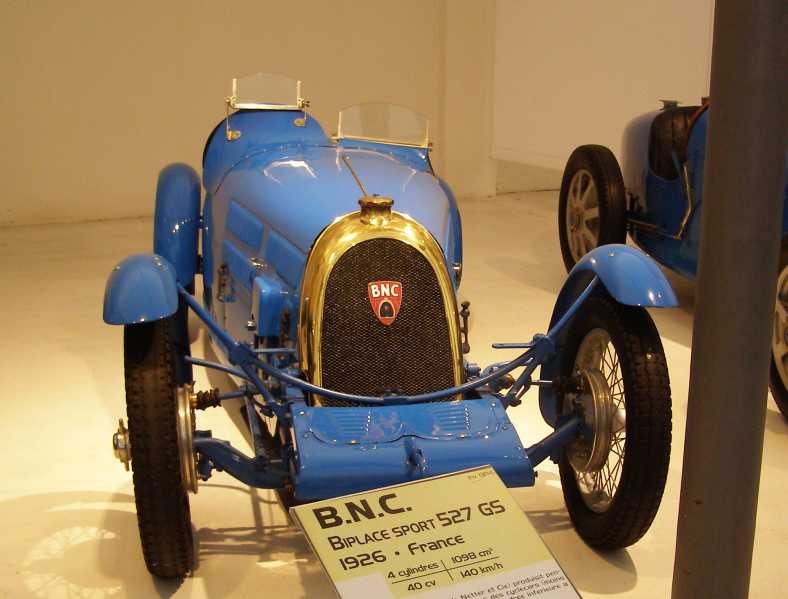
1926 BNC 527GS. Sold with both SCAP and Ruby OHC engines, this little car looks very neat.
The next car was one of the very last racing Bugattis built before World War 2. The model was the Type 59 and it used an enlarge 50B engine, giving it a straight eight of 3.3-litres and supercharged to produce an impressive 400+BHP. This car is a sports, the one behind it is, I gather, the racing car version of the same model, it’s the car in which Jean-Pierre Wimille won the first GP race after the war, the Coupes de Prisonniers in September, 1945.
Developed in 1934 and raced for just a couple of years, these cars were highly regarded as Bugatti’s finest racing machines. The piano-wire wheels also drew attention to Bugatti’s quest for artistic perfection in creating his cars. Wimille had success in this one too, finishing second in the Comminges Grand Prix.
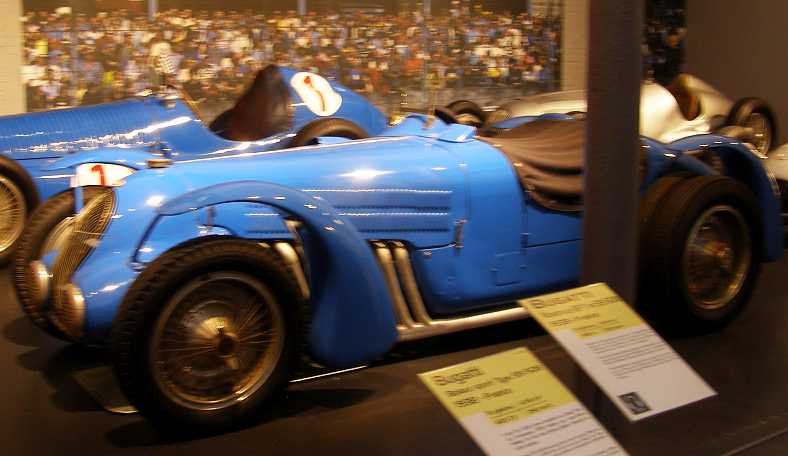
Bugatti 59/50B. Those eight exhaust pipes out the side would have been very hot as this racer developed full power. Dual rear wheels are for hillclimbing as it appeared in those events as well.
A trio of Gordinis from the Simca-Gordini years of the early fifties. Amadee Gordini was known as ‘The Sorcerer’, undoubtedly because of what he could do on small budgets. The lead car here is a 24S from 1953, the second is a car which was a bit of a sensation at the Paris Show of 1952
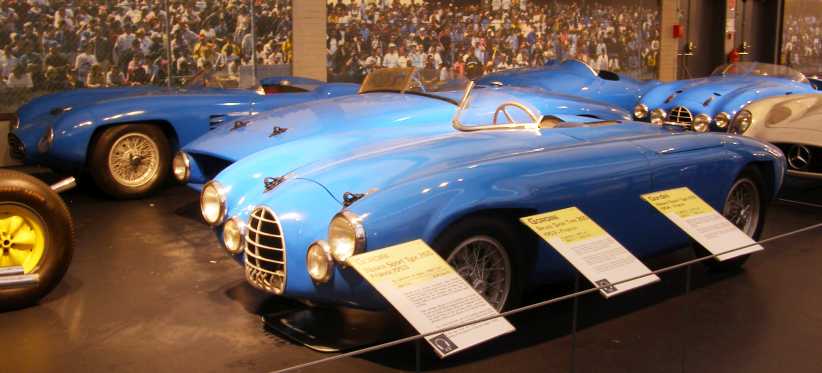
Gordinis lined up. The 24S Gordini heads this line-up, these being cars which held the French flag high in the racing world of the forties and fifties.
And other trio of Gordinis…
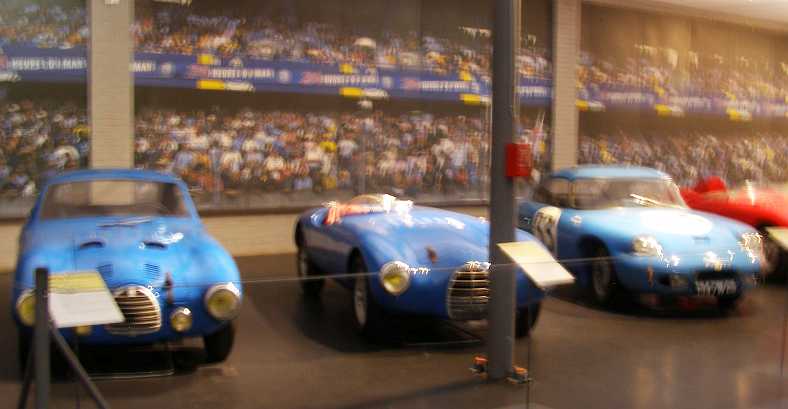
French blue. Another bunch of the cars Gordini put on the track in those early years. After his time with Simca he formed an alliance with Renault which led to many better-than-stock road cars being produced with his name on their rumps.
One of my favourite cars, the Maserati 300S. In the mid-fifties these were driven by some of the top drivers and won many important races. They had a 6-cylinder engine of 3-litres and were designed by someone who really knew how to make a car look great, two of them raced in Australia for a number of years.
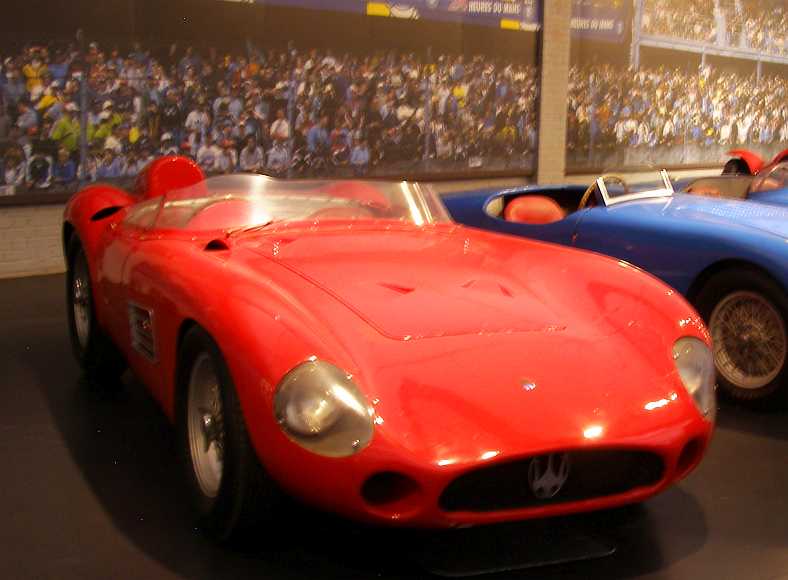
Maserati 300S. Style and race-winning performance in the one package, the 300S won many races for Maserati.
A further three Gordinis to add to the blue. The car on the left is the Type 23, the one in the middle is the 17S and the little one third in this line is the Type 5, a tiny car which in 1937 averaged 103kmh for 48 hours. Its engine was just 570cc.
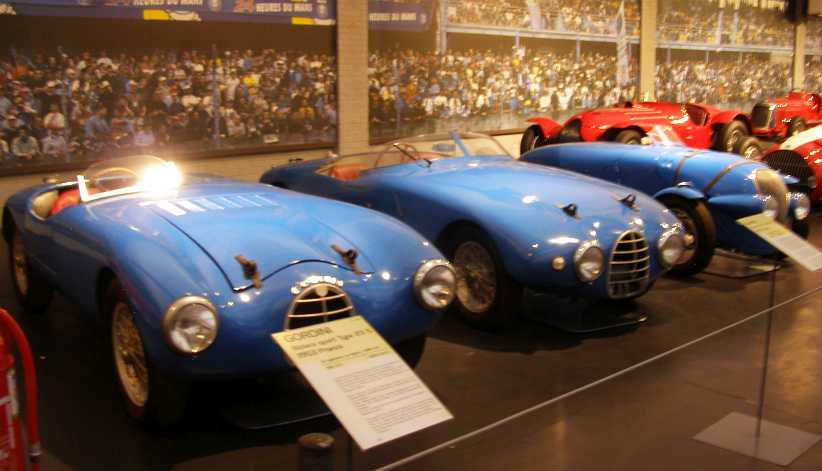
Gordinis aplenty! The Type 23S, the much-raced 17S and the Type 5 line up with the Le Mans crowd backdrop. Gordini turned out an incredible array of cars during his time in racing.
There’s another of them here, another 24S, but it’s hidden behind the 300SLR which the Schlumpfs traded out of Mercedes-Benz. With so many different designations and models, I’m having a hard time getting to grips with the different Gordini designations, but one website tells me that a 24S has a similar engine to the 300SLR, a straight eight of 3-litres, and that it has 4-wheel disc brakes.
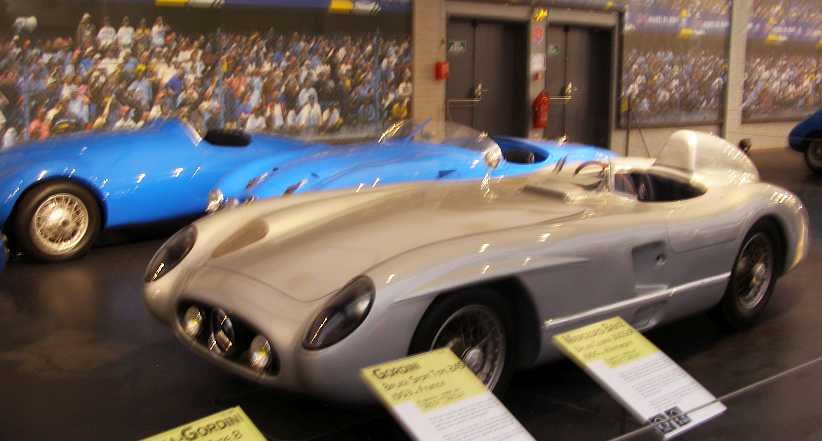
Two straight eights? We know the 300SLR is, and that it has fuel injection and desmodromic valves, but who would have thought that the enterprising Gordini could conjure up a 3-litre straight eight as well?
More modern now, the Lotus 7 alongside the Ferrari 250LM. Both long-lived in competition, the Lotus 7 being produced in huge numbers (mostly in kit form) over more than a decade (with copyists keeping it going much longer) and the 250LM winning Le Mans in 1965 when either Ford or one of the Ferrari prototypes were supposed to win.
In Australia, the 250LM kept on winning the Surfers Paradise 12-hour year after year.
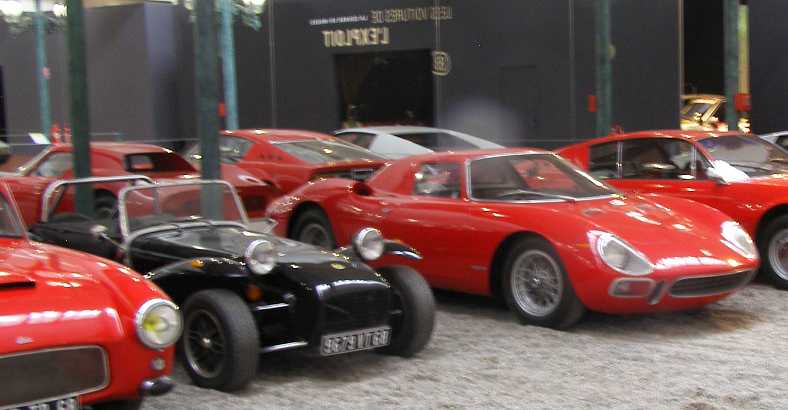
Racing staples. Around the world the Lotus 7 raced for over two decades, filling grids in Clubman racing, while the 250LM with its 3.3-litre V12 survived endurance races which killed faster cars.
And something a bit different… Panhard et Levassor built this skinny car (the bodywork is no wider than the radiator for its whole length) with a large engine for George Eyston to attack records. He estimated he’d achieve 125 miles in an hour, but he was wrong.
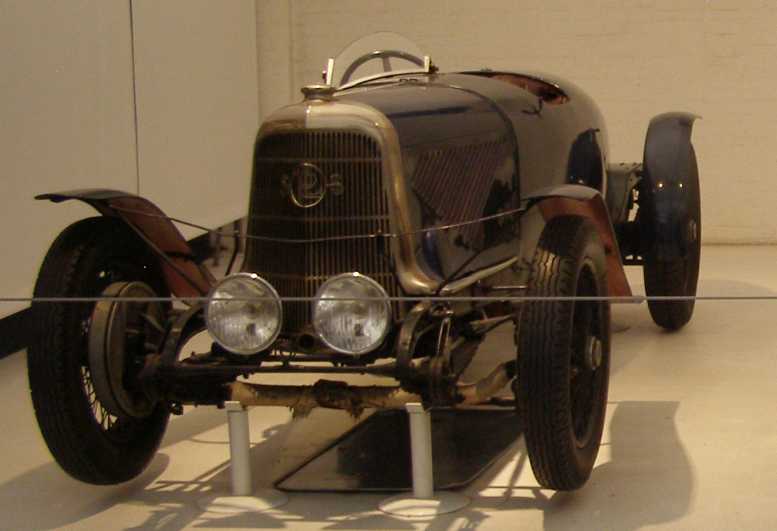
Eyston’s Panhard. At Montlhery in 1934 this car covered 133.37 miles in just one hour to put its name in the record books.
Finally, I reneged on the Alfa Romeo 2900 coupe which won the 1936 Mille Miglia. Yes, it’s in the other category, but I came across this photo from a day when the museum took it out to a public display and it’s better than I could get where it was located in the museum.
Glamour and speed come together, but I have to wonder about how much of a handful it might have been on the twistier sections of the Mille Miglia. Today another one of these cars runs regularly in the Historic Le Mans events and has to have its harmonic balancer rebuilt each time because it runs right on the critical harmonic period all the way down the long straights.
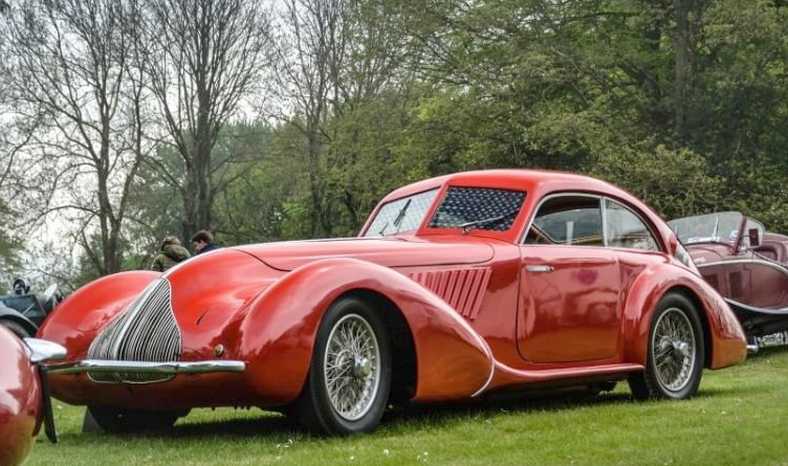
Alfa’s finest? What a car! As mentioned, virtually a Grand Prix engine and anything else required to gain speed with reliability. That long wheelbase, while likely to be difficult in the tight sections, was no doubt a comfort on the long, long straights towards the end of the Mille Miglia.
So that’s a whole host of my Schlumpf photos covered. I will add a few more of some odd cars before I carry on with the balance of that wonderful day, heading off to Strasbourg.
One thing about this group is that it shows up the bulk buy the Schlumpf brothers made from Gordini, ten or more cars all at once, both racing and sports racing. But the first one of this batch was not a Gordini.
This is the offering from Bollack, Netter & Co, who in 1926 swung over to OHC engines. But which engines? They bought engines from a number of makers during their time in manufacturing and even the 1100cc cars like this one had a choice of two different makes.
1926 BNC 527GS. Sold with both SCAP and Ruby OHC engines, this little car looks very neat.
The next car was one of the very last racing Bugattis built before World War 2. The model was the Type 59 and it used an enlarge 50B engine, giving it a straight eight of 3.3-litres and supercharged to produce an impressive 400+BHP. This car is a sports, the one behind it is, I gather, the racing car version of the same model, it’s the car in which Jean-Pierre Wimille won the first GP race after the war, the Coupes de Prisonniers in September, 1945.
Developed in 1934 and raced for just a couple of years, these cars were highly regarded as Bugatti’s finest racing machines. The piano-wire wheels also drew attention to Bugatti’s quest for artistic perfection in creating his cars. Wimille had success in this one too, finishing second in the Comminges Grand Prix.
Bugatti 59/50B. Those eight exhaust pipes out the side would have been very hot as this racer developed full power. Dual rear wheels are for hillclimbing as it appeared in those events as well.
A trio of Gordinis from the Simca-Gordini years of the early fifties. Amadee Gordini was known as ‘The Sorcerer’, undoubtedly because of what he could do on small budgets. The lead car here is a 24S from 1953, the second is a car which was a bit of a sensation at the Paris Show of 1952
Gordinis lined up. The 24S Gordini heads this line-up, these being cars which held the French flag high in the racing world of the forties and fifties.
And other trio of Gordinis…
French blue. Another bunch of the cars Gordini put on the track in those early years. After his time with Simca he formed an alliance with Renault which led to many better-than-stock road cars being produced with his name on their rumps.
One of my favourite cars, the Maserati 300S. In the mid-fifties these were driven by some of the top drivers and won many important races. They had a 6-cylinder engine of 3-litres and were designed by someone who really knew how to make a car look great, two of them raced in Australia for a number of years.
Maserati 300S. Style and race-winning performance in the one package, the 300S won many races for Maserati.
A further three Gordinis to add to the blue. The car on the left is the Type 23, the one in the middle is the 17S and the little one third in this line is the Type 5, a tiny car which in 1937 averaged 103kmh for 48 hours. Its engine was just 570cc.
Gordinis aplenty! The Type 23S, the much-raced 17S and the Type 5 line up with the Le Mans crowd backdrop. Gordini turned out an incredible array of cars during his time in racing.
There’s another of them here, another 24S, but it’s hidden behind the 300SLR which the Schlumpfs traded out of Mercedes-Benz. With so many different designations and models, I’m having a hard time getting to grips with the different Gordini designations, but one website tells me that a 24S has a similar engine to the 300SLR, a straight eight of 3-litres, and that it has 4-wheel disc brakes.
Two straight eights? We know the 300SLR is, and that it has fuel injection and desmodromic valves, but who would have thought that the enterprising Gordini could conjure up a 3-litre straight eight as well?
More modern now, the Lotus 7 alongside the Ferrari 250LM. Both long-lived in competition, the Lotus 7 being produced in huge numbers (mostly in kit form) over more than a decade (with copyists keeping it going much longer) and the 250LM winning Le Mans in 1965 when either Ford or one of the Ferrari prototypes were supposed to win.
In Australia, the 250LM kept on winning the Surfers Paradise 12-hour year after year.
Racing staples. Around the world the Lotus 7 raced for over two decades, filling grids in Clubman racing, while the 250LM with its 3.3-litre V12 survived endurance races which killed faster cars.
And something a bit different… Panhard et Levassor built this skinny car (the bodywork is no wider than the radiator for its whole length) with a large engine for George Eyston to attack records. He estimated he’d achieve 125 miles in an hour, but he was wrong.
Eyston’s Panhard. At Montlhery in 1934 this car covered 133.37 miles in just one hour to put its name in the record books.
Finally, I reneged on the Alfa Romeo 2900 coupe which won the 1936 Mille Miglia. Yes, it’s in the other category, but I came across this photo from a day when the museum took it out to a public display and it’s better than I could get where it was located in the museum.
Glamour and speed come together, but I have to wonder about how much of a handful it might have been on the twistier sections of the Mille Miglia. Today another one of these cars runs regularly in the Historic Le Mans events and has to have its harmonic balancer rebuilt each time because it runs right on the critical harmonic period all the way down the long straights.
Alfa’s finest? What a car! As mentioned, virtually a Grand Prix engine and anything else required to gain speed with reliability. That long wheelbase, while likely to be difficult in the tight sections, was no doubt a comfort on the long, long straights towards the end of the Mille Miglia.
So that’s a whole host of my Schlumpf photos covered. I will add a few more of some odd cars before I carry on with the balance of that wonderful day, heading off to Strasbourg.
Last edited by Ray Bell; May 13, 2020 at 08:05 AM.
Thread Starter
|
Captain
Joined: Oct 2005
Posts: 568
Likes: 8
From: The Summit, Queensland, Australia
Now we come to the last of the Schlumpf collection photos I’m going to post. It’s been even more interesting to me posting these because I’ve had to learn more about the cars to make the posts more complete.
Looking at some other pics I took, pics which many would not have taken, they meant at least a little to me personally. One of the early cars in my life was a Peugeot 203, so I got shots of this one:
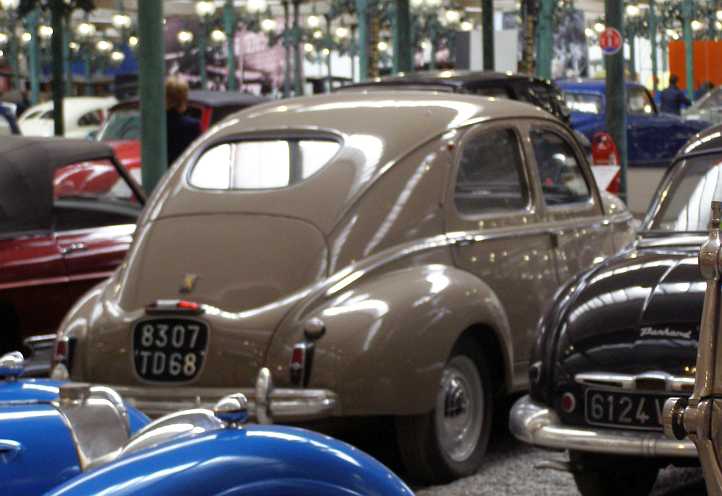
Rear shot. And why this photo? Because it shows the additional tail lights down low on the rear flanks where they were never located on this model at all. These lights were introduced with the 203C model about 1954.
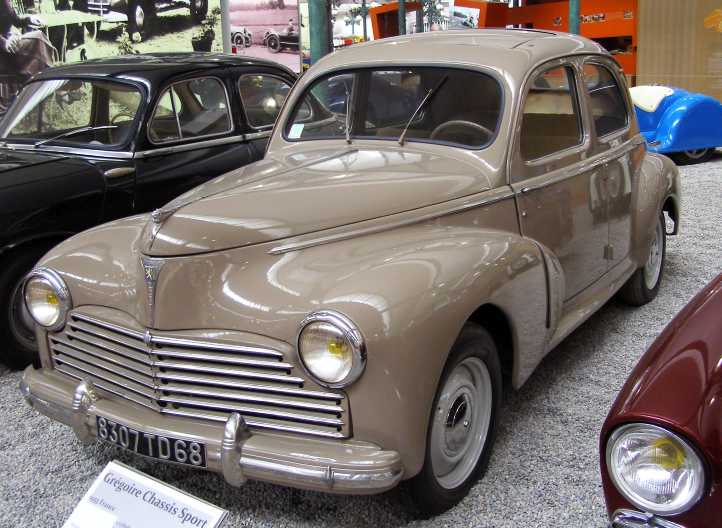
Front view. They weren’t a bad looking car, they rode and handled very well and got along all right despite their 1290cc engine. Improvements kept on coming over the life of the model.
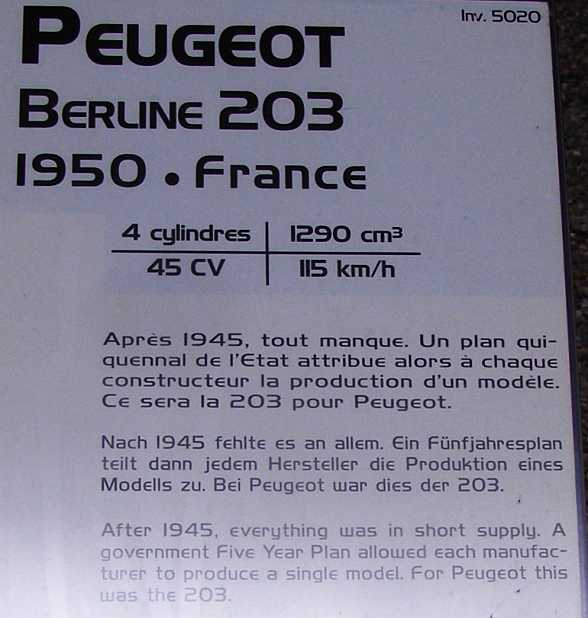
Government restrictions. So that’s why they didn’t have more models! Little bits of information like this explain things over time, I’d never heard of it before.
The first Peugeot I ever had, actually, was a 403, but after the 203 (and several Simcas) I went back to a 403, then I had a string of 404s…
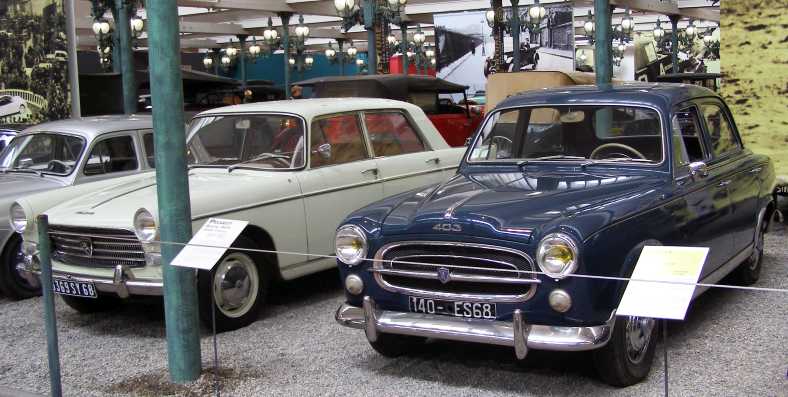
Peugeot 403 and 404. This meant that there were three cars in the museum similar to ones I’ve owned over the years. But they’re pretty mundane alongside some of the classy models. I still have a 404, I love driving them, I must get mine on the road some time.
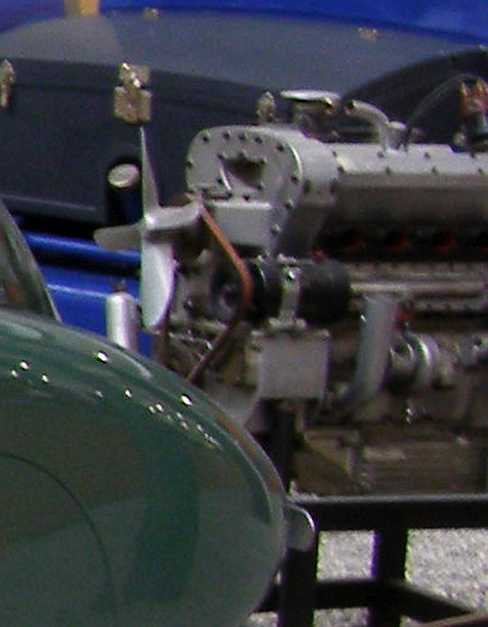
Unknown twin-cam engine. I missed getting this shot with the car to which it belonged, so I don’t know what it was. It doesn’t look Bugatti at all and it goes to show that I really didn’t take enough photos!
Maurice Trintignant won his first race in this 1926 Amilcar Decalee. The car had a 6-cylinder engine of just 1097cc – which must have sounded terrific! – and Trintignant used it to win the 1947 Avignon Grand Prix. He went on to race a number of different cars in World Championship events and was the victor in the 1955 Monaco Grand Prix in a Ferrari and at the 1958 Monaco Grand Prix in a Cooper Climax.
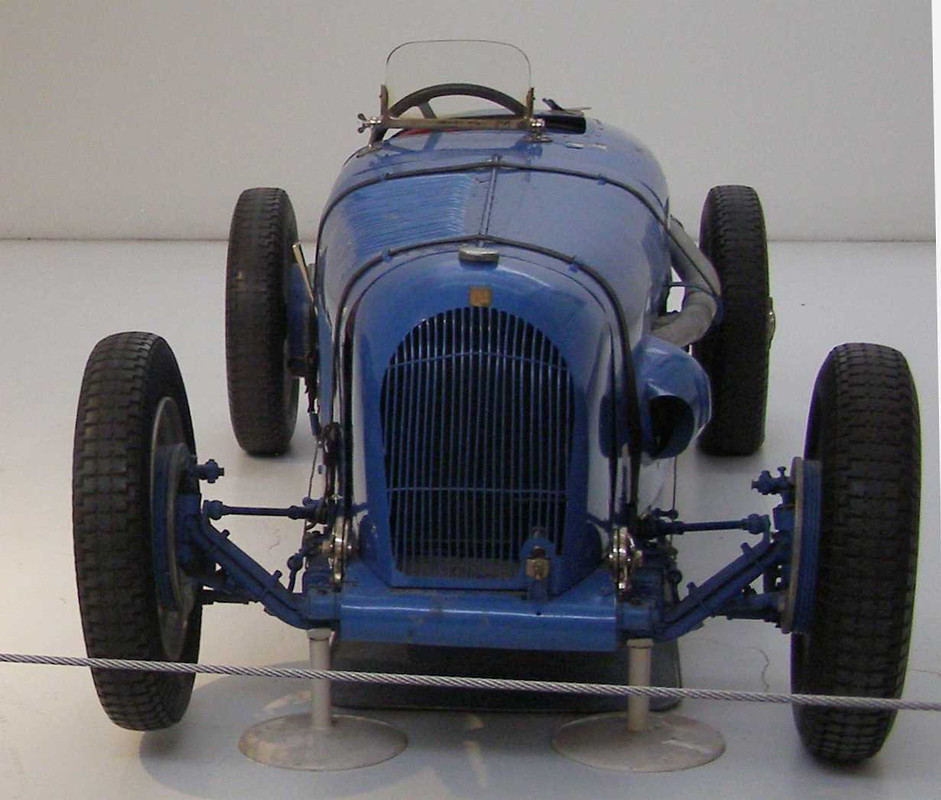
Smart little six. This little open-wheeler from the twenties really looks more modern than that. It obviously was a good thing in its class to succeed in 1947.
On a board near the Esders Royale was this layout showing which types of bodies each of the Royale chassis had. Some, of course, had two and that’s shown too.
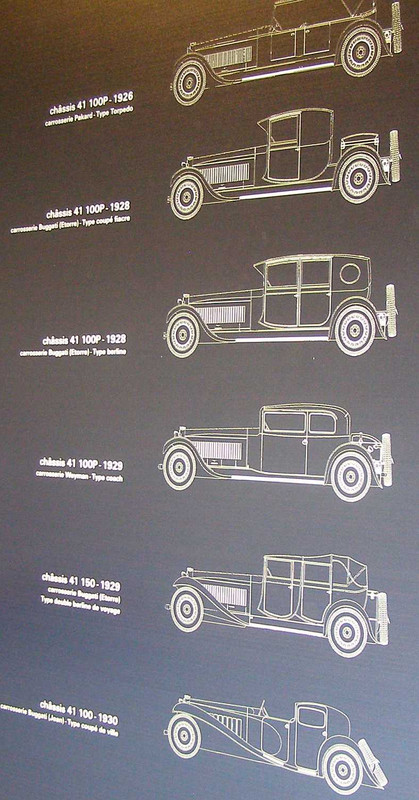
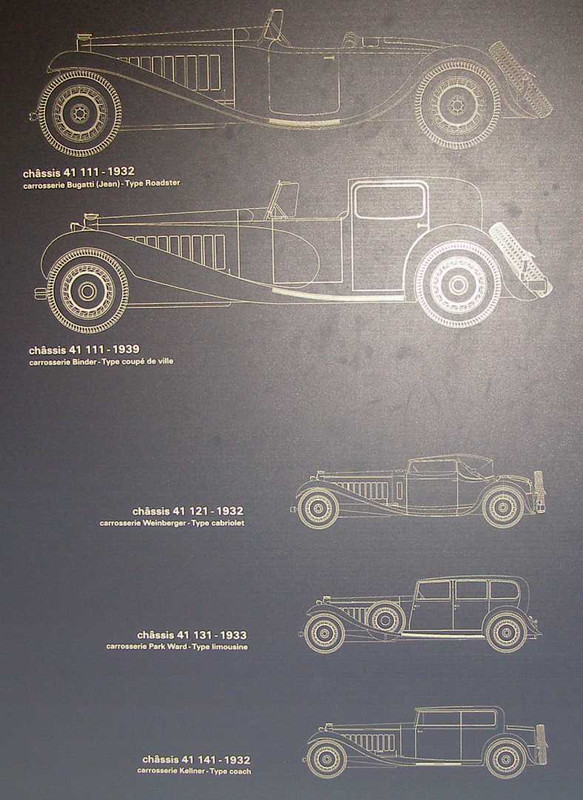
If you’re not sick of more and more Bugatti information, from the boards above we learn that there was only one cabriolet made, chassis 41 121. It was sold to a doctor in Germany and bodied by a German body builder. As tensions increased in Germany in the mid-thirties he moved to Switzerland, then China and finally New York.
After the war a General Motors Vice President, Charles Chayne, is said to have located the car in a scrap yard in New York and bought it for $75. He is said to have then spent $10,000 on upgrading and restoring the car, one of the upgrades being the fitment of four carburettors in his quest to make it more driveable. After using it for ten years he donated it to the Ford Museum, where it became the first Royale I ever saw in 2014:
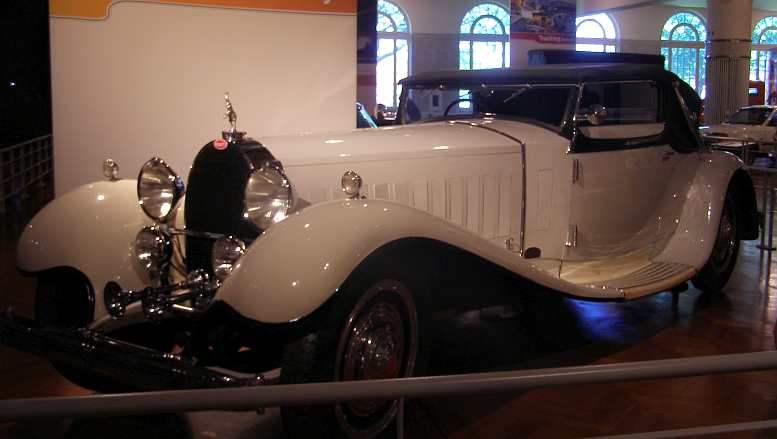
In the Ford Museum, Dearborn. Still with its original body, but all restored and a feature of the Ford Museum is this Royal originally sold to a German doctor.
Having seen my fill – even if I hadn’t photographed enough of them – I walked back out across that bridge to resume my trip…
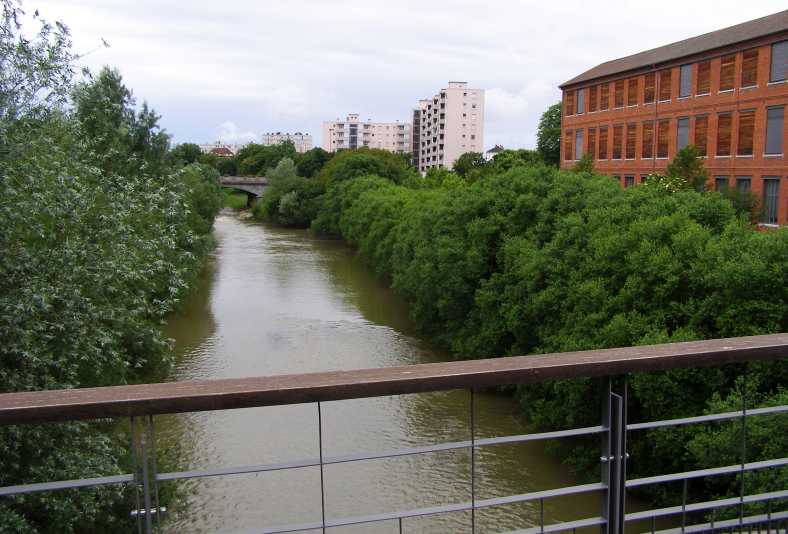
The stream at Mulhous. As I mentioned, mills were always built along side running water. Now I would go in search of other waters, other towns…
And the first stage of the trip from there to Germany took me to Strasbourg.
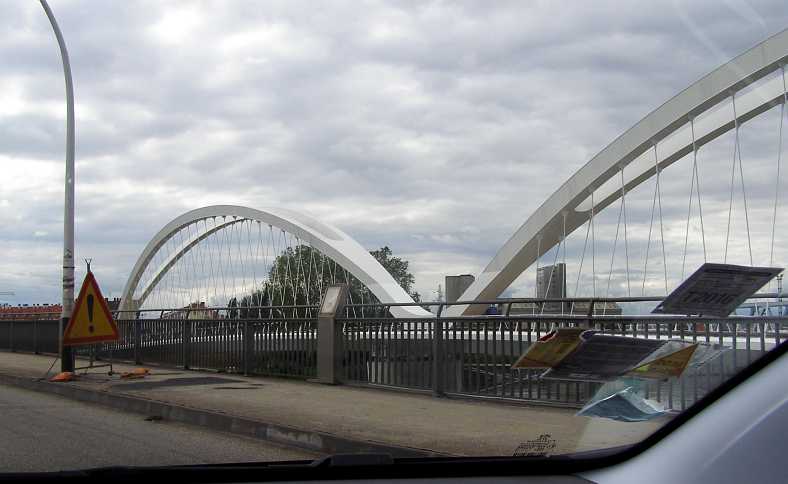
Bridges in Strasbourg. An impressive new bridge alongside the road bridge at Strasbourg, I was entering a town I first heard mentioned at school. Something to do with a clock. I didn’t see it when I was there and I couldn’t make myself understood asking about it so I gave up.
I would have given up if I’d looked closely at these signs at the time rather than later in the photo…
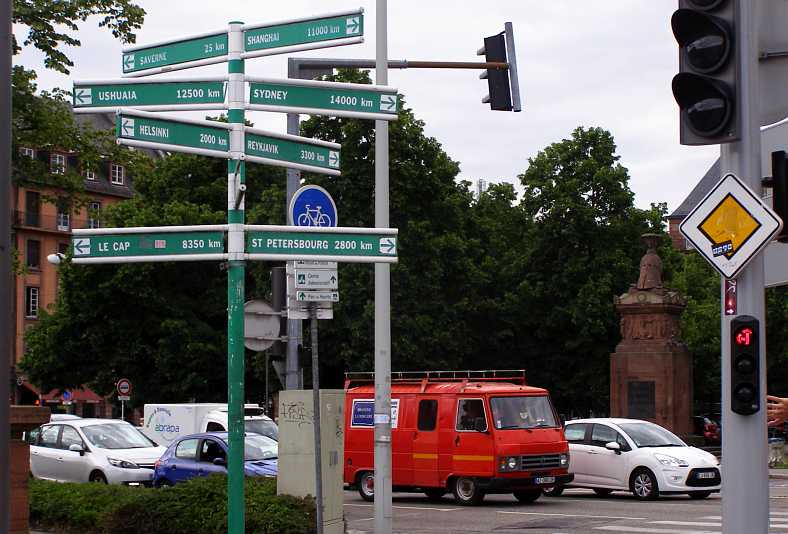
Strange directions. No, Sydney is not in the same direction as St Petersbourg at all! And another Peugeot here, that red van is one of those incredibly practical FWD vans built in France.
I got a few shots as I drove around, the modern appearance of the light rail trains was impressive:
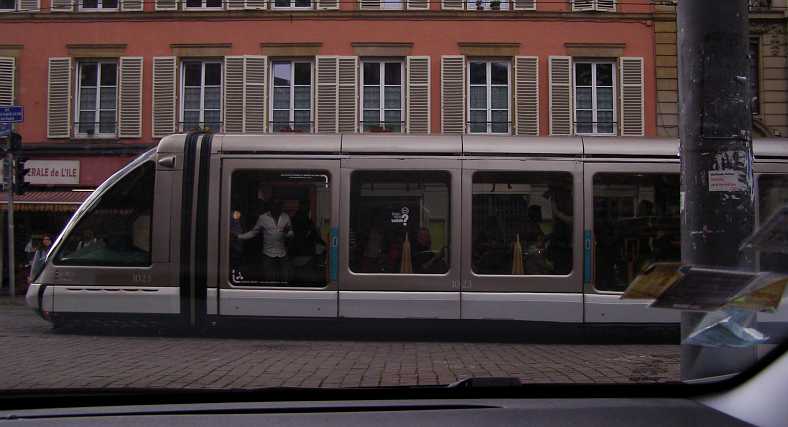
Modern trains. Or are they trams? Anyway, their streamlined appearance, large windows and clean lines looked good to me.
Gardens are evident here…
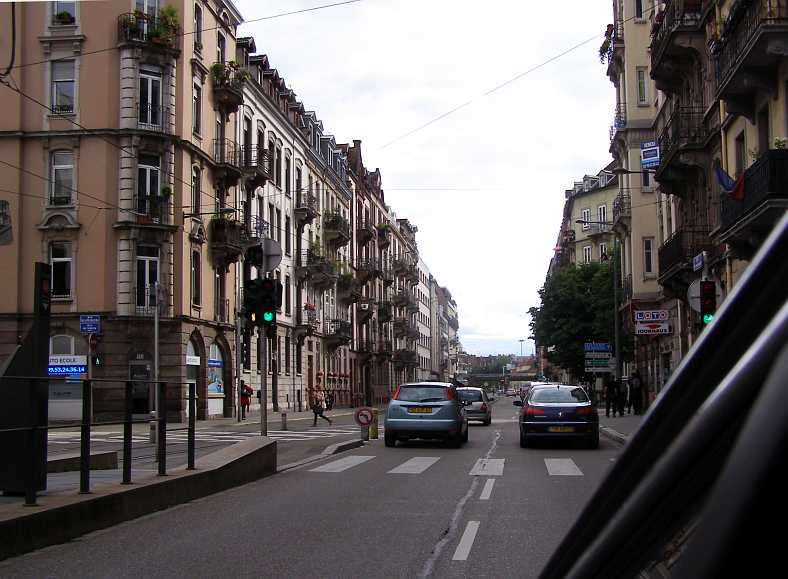
Gardens growing. Little balconies built out from buildings here show that the Strasbourg people like to have a bit of greenery despite the multi-storey buildings that abound.
And I saw another train flashing across this bridge as I headed out of town:
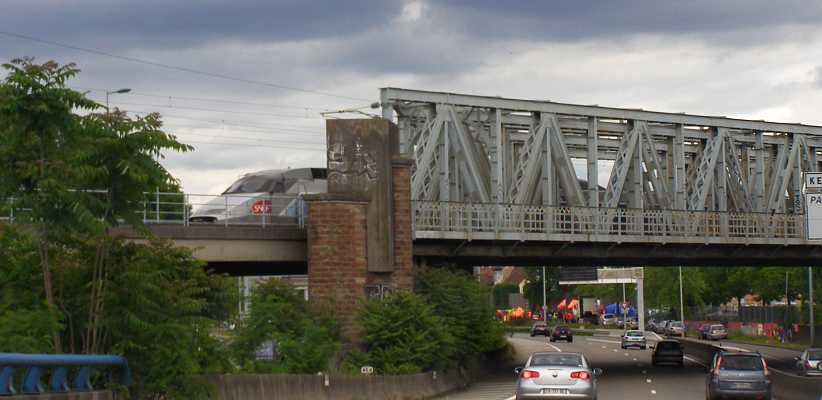
Train flashes by. Another picture of a train. This time it’s moving quickly across this bridge.
…and so I hit the road in the general direction of Stuttgart…
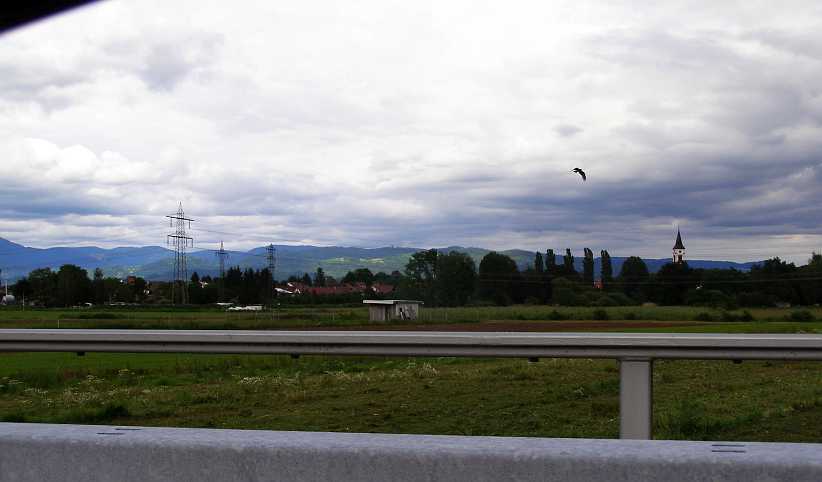
Stuttgart bound. Not a long drive, but the day was well along. The scenery rushed by as I opened up the little diesel Peugeot to get to my next destination.
…with a stop along the way at a McDonalds for something to eat. It was at this store that I learned I was already in Germany, so easy it is to cross borders in modern Europe.
And so I looked for somewhere to park for the night and got some sleep once again in the car. I had plans to fulfil the next day and a lot to remember from my hours soaking up the automotive history of the Schlumpf collection.
I also had thoughts for Sandra. I’d had a message from her daughter asking me where I was. “Mum doesn’t know where you are,” she said. I didn’t know how bad her condition was. She’d spent a few days with her sister in Brisbane after the long flight home and had caught some kind of bug on the trip.
And I simply didn’t know, but I realised she must have been seriously disoriented…
Looking at some other pics I took, pics which many would not have taken, they meant at least a little to me personally. One of the early cars in my life was a Peugeot 203, so I got shots of this one:
Rear shot. And why this photo? Because it shows the additional tail lights down low on the rear flanks where they were never located on this model at all. These lights were introduced with the 203C model about 1954.
Front view. They weren’t a bad looking car, they rode and handled very well and got along all right despite their 1290cc engine. Improvements kept on coming over the life of the model.
Government restrictions. So that’s why they didn’t have more models! Little bits of information like this explain things over time, I’d never heard of it before.
The first Peugeot I ever had, actually, was a 403, but after the 203 (and several Simcas) I went back to a 403, then I had a string of 404s…
Peugeot 403 and 404. This meant that there were three cars in the museum similar to ones I’ve owned over the years. But they’re pretty mundane alongside some of the classy models. I still have a 404, I love driving them, I must get mine on the road some time.
Unknown twin-cam engine. I missed getting this shot with the car to which it belonged, so I don’t know what it was. It doesn’t look Bugatti at all and it goes to show that I really didn’t take enough photos!
Maurice Trintignant won his first race in this 1926 Amilcar Decalee. The car had a 6-cylinder engine of just 1097cc – which must have sounded terrific! – and Trintignant used it to win the 1947 Avignon Grand Prix. He went on to race a number of different cars in World Championship events and was the victor in the 1955 Monaco Grand Prix in a Ferrari and at the 1958 Monaco Grand Prix in a Cooper Climax.
Smart little six. This little open-wheeler from the twenties really looks more modern than that. It obviously was a good thing in its class to succeed in 1947.
On a board near the Esders Royale was this layout showing which types of bodies each of the Royale chassis had. Some, of course, had two and that’s shown too.
If you’re not sick of more and more Bugatti information, from the boards above we learn that there was only one cabriolet made, chassis 41 121. It was sold to a doctor in Germany and bodied by a German body builder. As tensions increased in Germany in the mid-thirties he moved to Switzerland, then China and finally New York.
After the war a General Motors Vice President, Charles Chayne, is said to have located the car in a scrap yard in New York and bought it for $75. He is said to have then spent $10,000 on upgrading and restoring the car, one of the upgrades being the fitment of four carburettors in his quest to make it more driveable. After using it for ten years he donated it to the Ford Museum, where it became the first Royale I ever saw in 2014:
In the Ford Museum, Dearborn. Still with its original body, but all restored and a feature of the Ford Museum is this Royal originally sold to a German doctor.
Having seen my fill – even if I hadn’t photographed enough of them – I walked back out across that bridge to resume my trip…
The stream at Mulhous. As I mentioned, mills were always built along side running water. Now I would go in search of other waters, other towns…
And the first stage of the trip from there to Germany took me to Strasbourg.
Bridges in Strasbourg. An impressive new bridge alongside the road bridge at Strasbourg, I was entering a town I first heard mentioned at school. Something to do with a clock. I didn’t see it when I was there and I couldn’t make myself understood asking about it so I gave up.
I would have given up if I’d looked closely at these signs at the time rather than later in the photo…
Strange directions. No, Sydney is not in the same direction as St Petersbourg at all! And another Peugeot here, that red van is one of those incredibly practical FWD vans built in France.
I got a few shots as I drove around, the modern appearance of the light rail trains was impressive:
Modern trains. Or are they trams? Anyway, their streamlined appearance, large windows and clean lines looked good to me.
Gardens are evident here…
Gardens growing. Little balconies built out from buildings here show that the Strasbourg people like to have a bit of greenery despite the multi-storey buildings that abound.
And I saw another train flashing across this bridge as I headed out of town:
Train flashes by. Another picture of a train. This time it’s moving quickly across this bridge.
…and so I hit the road in the general direction of Stuttgart…
Stuttgart bound. Not a long drive, but the day was well along. The scenery rushed by as I opened up the little diesel Peugeot to get to my next destination.
…with a stop along the way at a McDonalds for something to eat. It was at this store that I learned I was already in Germany, so easy it is to cross borders in modern Europe.
And so I looked for somewhere to park for the night and got some sleep once again in the car. I had plans to fulfil the next day and a lot to remember from my hours soaking up the automotive history of the Schlumpf collection.
I also had thoughts for Sandra. I’d had a message from her daughter asking me where I was. “Mum doesn’t know where you are,” she said. I didn’t know how bad her condition was. She’d spent a few days with her sister in Brisbane after the long flight home and had caught some kind of bug on the trip.
And I simply didn’t know, but I realised she must have been seriously disoriented…
Last edited by Ray Bell; May 12, 2020 at 11:25 PM.
Thread Starter
|
Captain
Joined: Oct 2005
Posts: 568
Likes: 8
From: The Summit, Queensland, Australia
With morning I started to seek out the Solitudering. This was a circuit used in the early to mid-sixties for the Solitude Grand Prix, another public road circuit and a very interesting one. One thing I learned as I checked internet sources to help me find it was that motorised competition here began as a hillclimb as long ago as 1903 with a hill climb to the Schloss Solitude, just to the North of what would become the circuit.
That ceased in 1905, but later another hill climb was established on a part of what was to become the circuit I wanted to see. This progressed in 1925 to racing on a 22.3km circuit, shortened a little in 1929 and finally the circuit I wanted to drive in 1930…
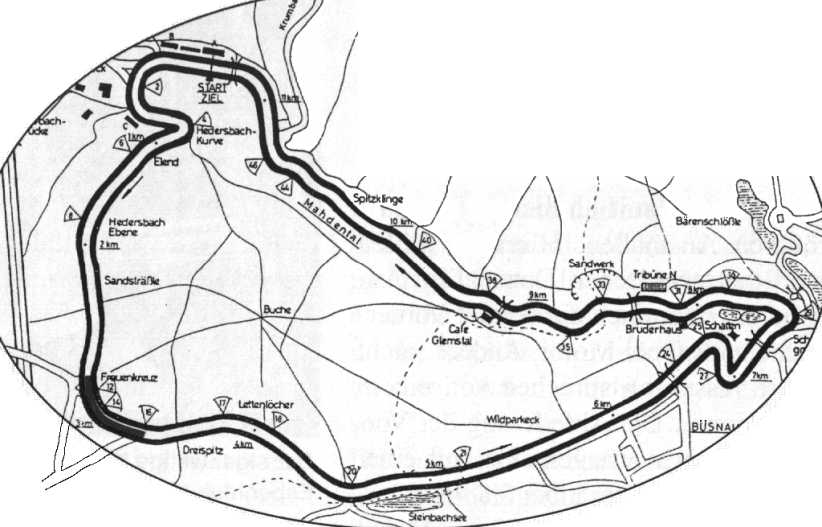
The circuit, 11.5kms of beautifully-maintained roads near the Solitude castle just outside of Stuttgart. Map from www.silhouet.com
All of those roads are still there save for one sweeping bend where some road was allowed to return to nature in exchange for some land authorities wanted to take out of nature for a restaurant area along a nearby autobahn. This part is shown in grey. And the first corner after the start is now a squared-off junction rather than a curve.
I joined the circuit coming through a roundabout that now exists at the far right corner of the map…
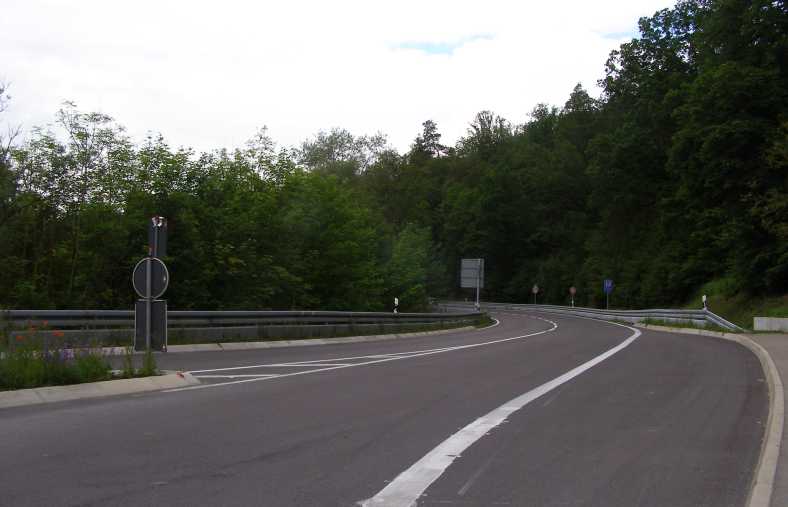
…and then headed along that section which is called ‘Shadowland’ because of the overhanging trees…
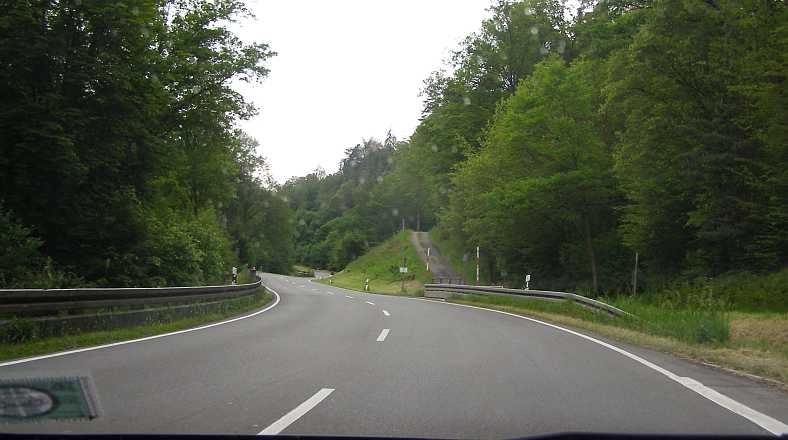
…which cause it to be slippery in the wet, I’ve no doubt…
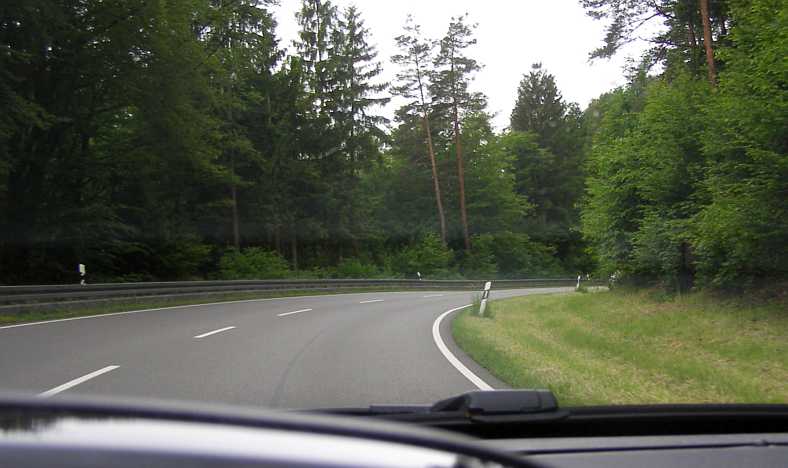
…while the road turns left and then right and then left and right again. There is negligible change in altitude, the road essentially following the contour line. Some traffic lights are at the point where the map shows a cafe (just after the 9km mark)…
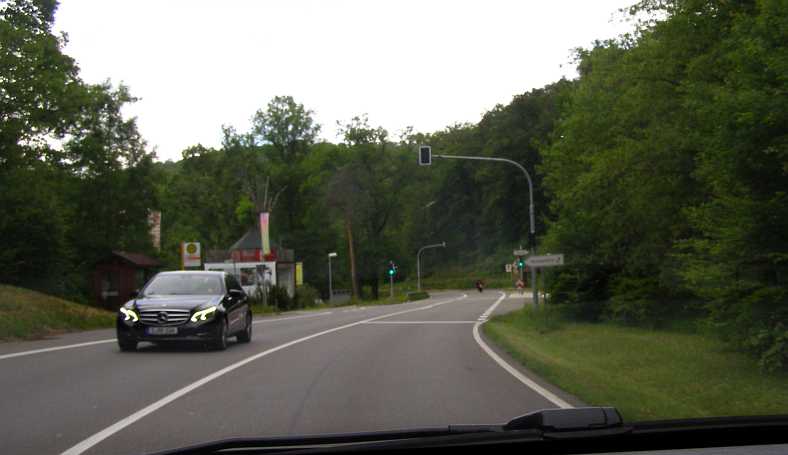
…but that’s not the end of the winding back and forth. So much of this happens (in truth only 18 bends) that 1961 World Champion Phil Hill is said to have remarked that it was, “more difficult to learn and memorise than the whole Nürburgring.” And the nature of the road and its potential for being slippery led to one of the classic Denis Jenkinson descriptions in his report on the very wet 1964 race as Jim Clark and John Surtees duelled for the win.
Something close to, “These two drivers with their fingertip control would have made a cat walking on a shelf of Dresden China look clumsy.” Such was the care they were taking in the slippery conditions while driving as fast as they dared.
Ultimately the road led to the pits…
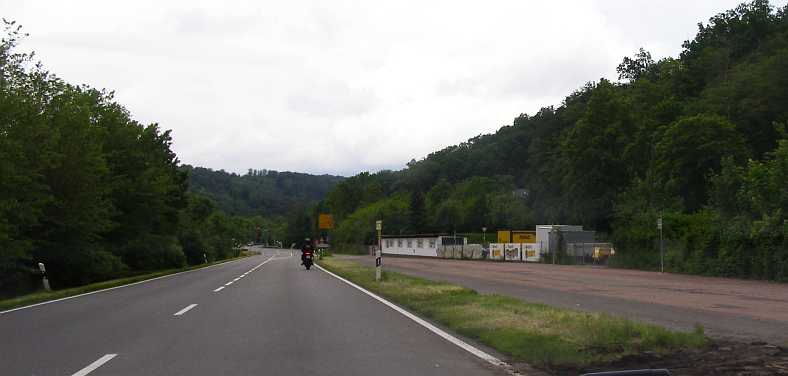
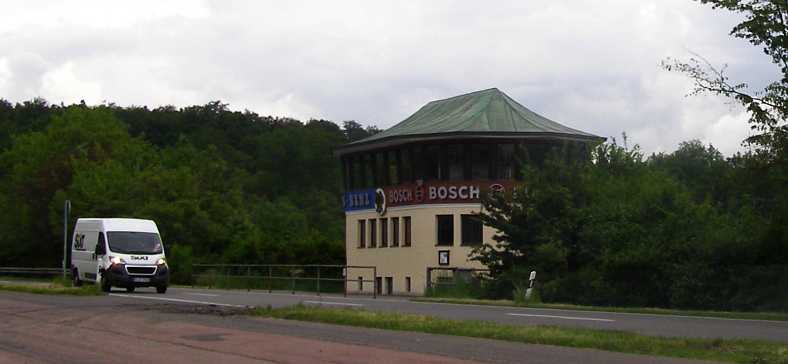
…followed shortly afterwards by the control tower. All of these amenities are still there and look complete despite the passage of time. In fact, some of them appear to still be in use.
So this was the start and finish area. The first corner came up quickly…
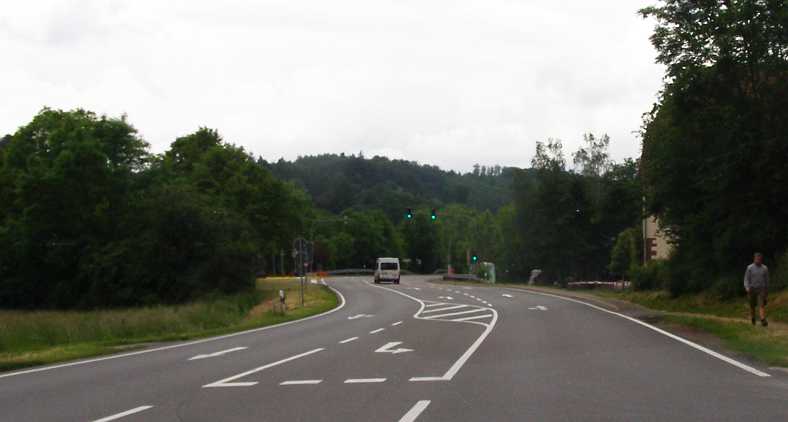
…but as I mentioned, it was a curve to the left following closely those trees and before the traffic lights where the new road goes off…
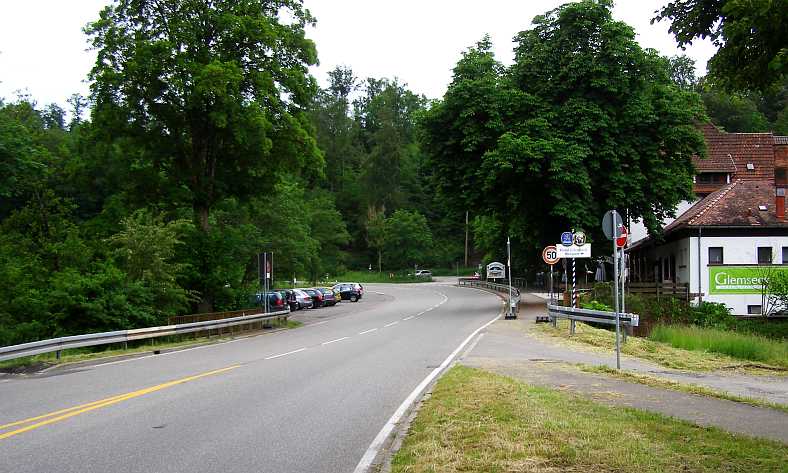
…and then past this pub to turn left at the point where there’s a carpark on the right. I’m sure this pub did a roaring trade on race weekends, and it still does today as many enthusiasts come to have a look at the circuit. We’ll come back to that, in the meantime, around that left-hander…
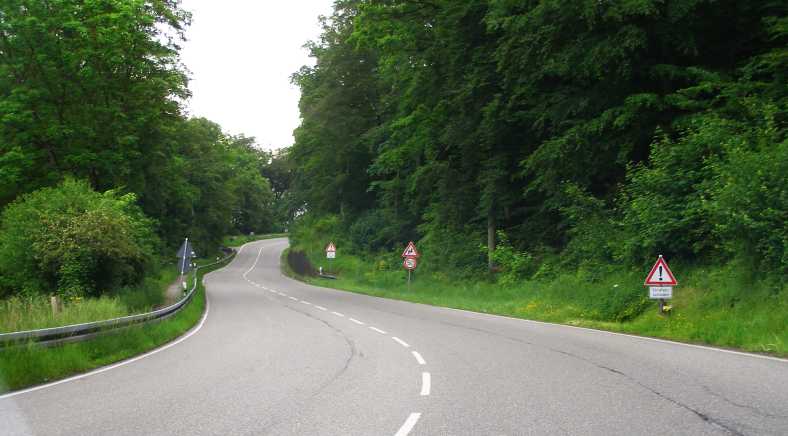
…the road starts to ascend. In the distance here where it goes right there’s a very tight corner, this being part of the hillclimb I mentioned earlier. Out of that tight corner…
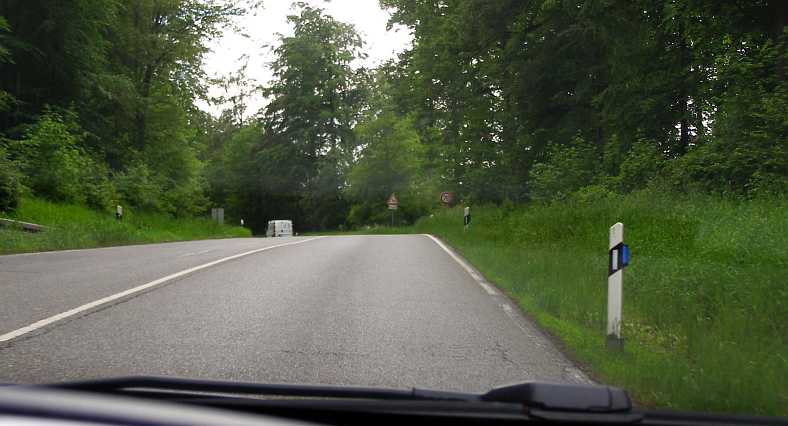
…is a steeper climb with the road then swinging left as it continues to ascend, some more sweeps follow…
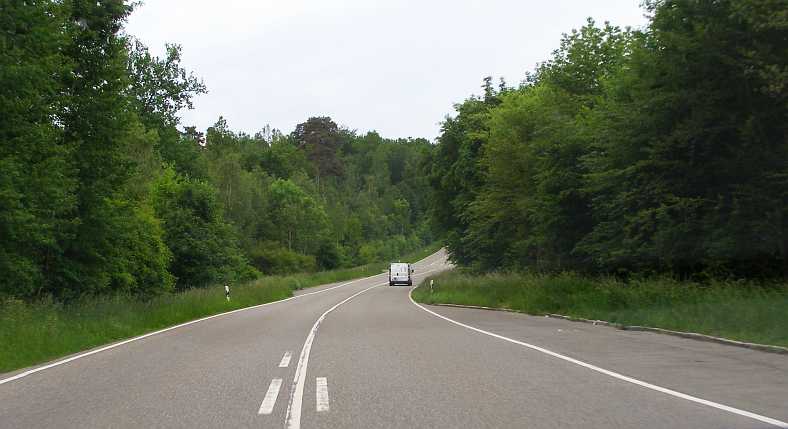
…past the point on the map noted as ‘Sandstrasse’…
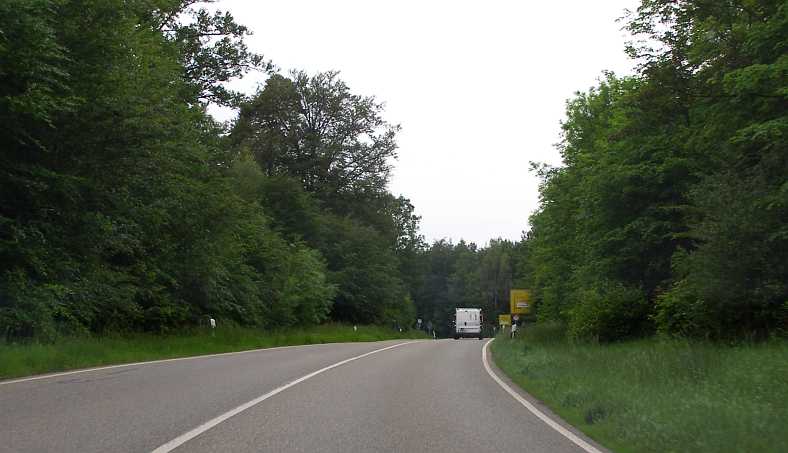
…then we come to the crossroad, formerly the point where the bit which has been obliterated swung to the left…
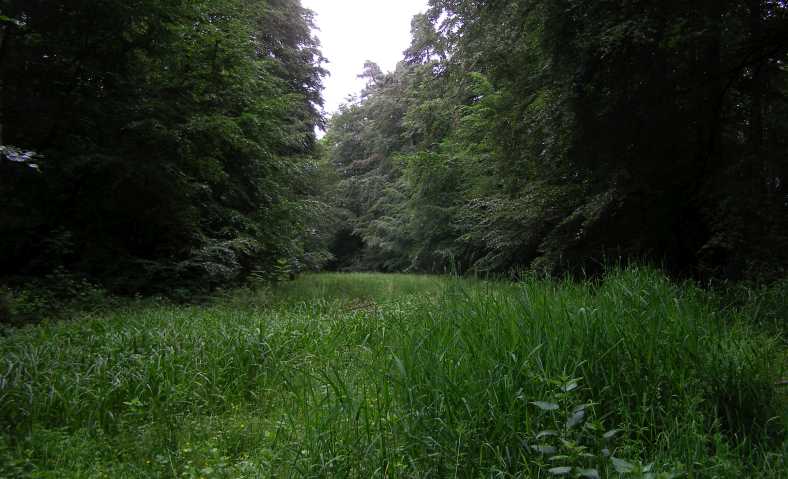
…and where today the line of the curve is hiding in the woods. It’s not visible from the road, but if you go walking it’s there and ultimately it leads through to…
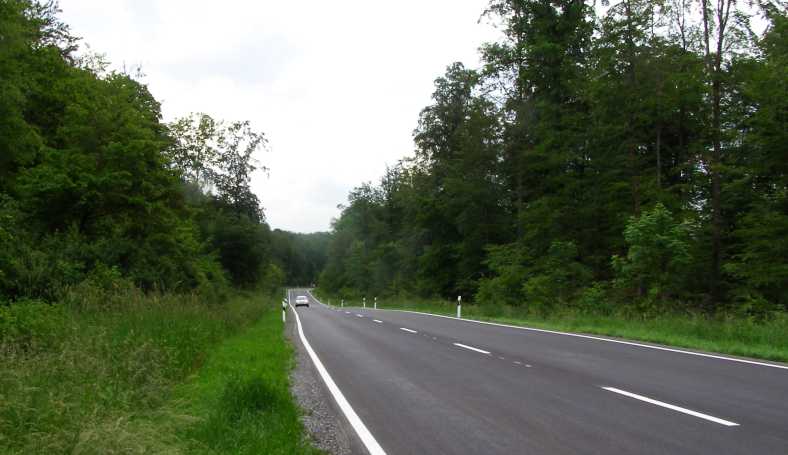
…a very, very quick downhill section with long straights and fast curves…
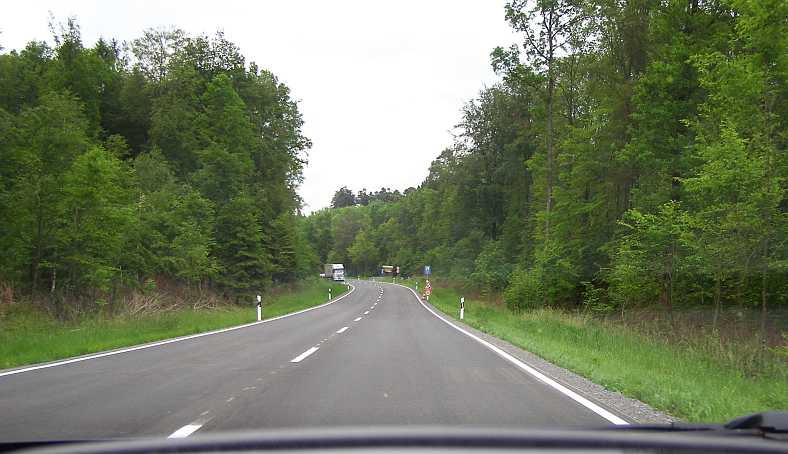
…a fast and open stretch, another straight…
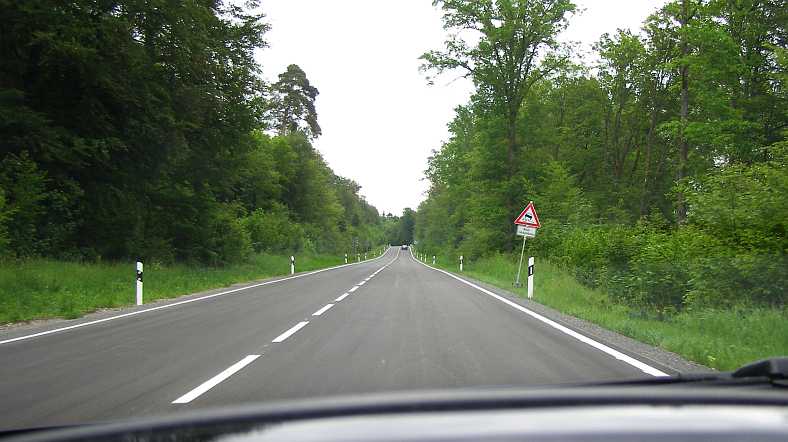
…another sweep, another straight, I can just imagine those little 1.5-litre Formula One engines of the period screaming their heads off and straining all their components at maximum revs…
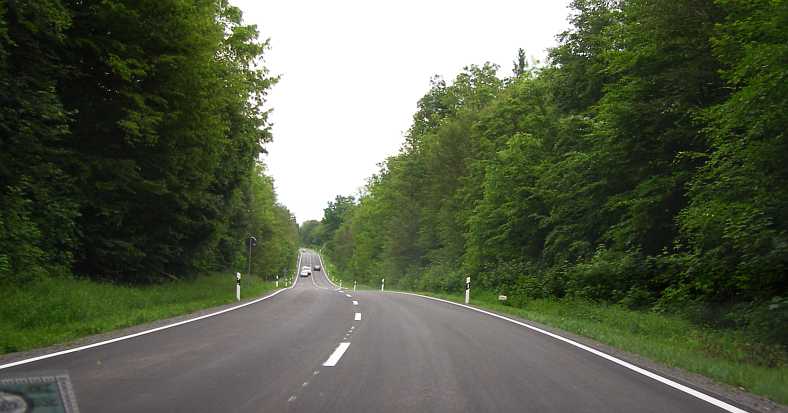
…as the fast bit doesn’t seem to end, until we reach the point on the map after the 6km notation…
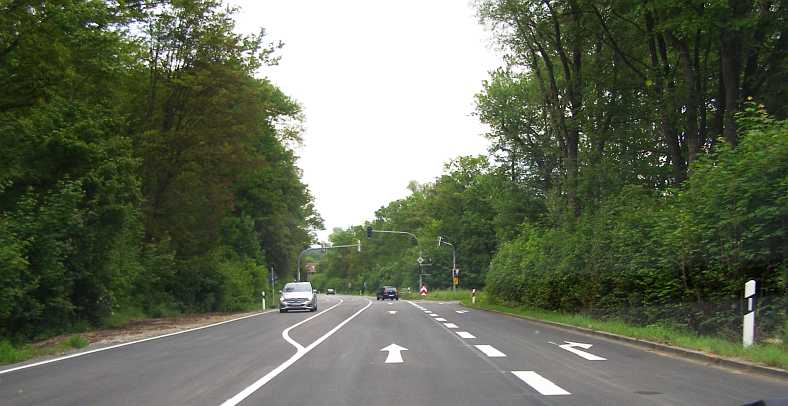
…where modern needs have seen yet another set of traffic lights installed. But still, the power was on until…
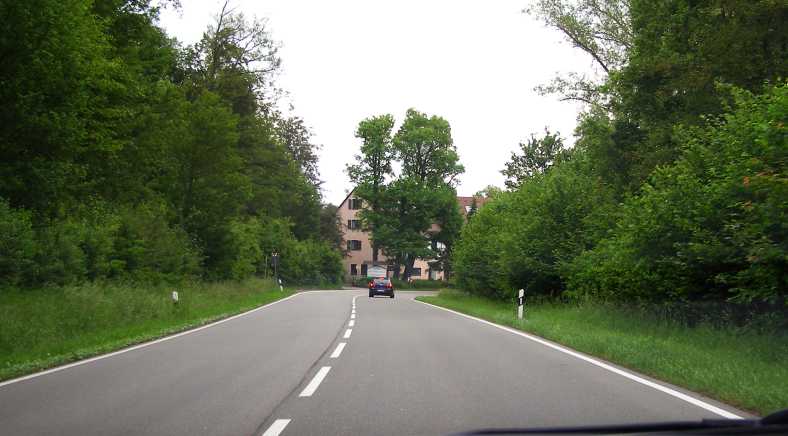
…the tight 180° right hander, which falls away to…
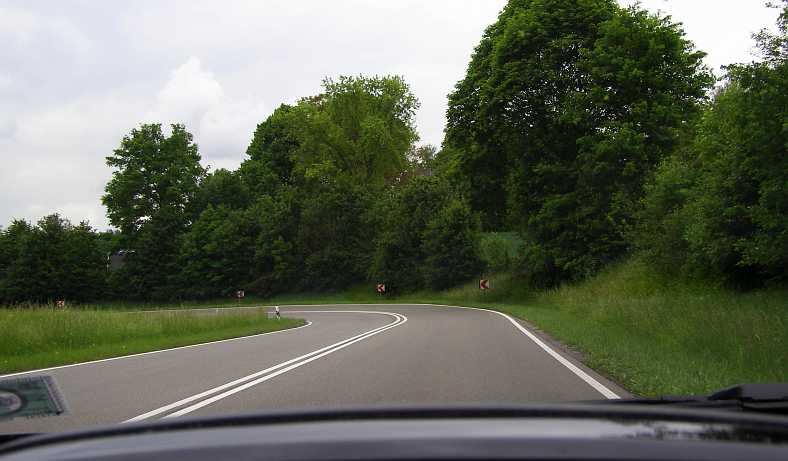
… a tight 180° left hander, still falling away and heading for the lowest point on the circuit…
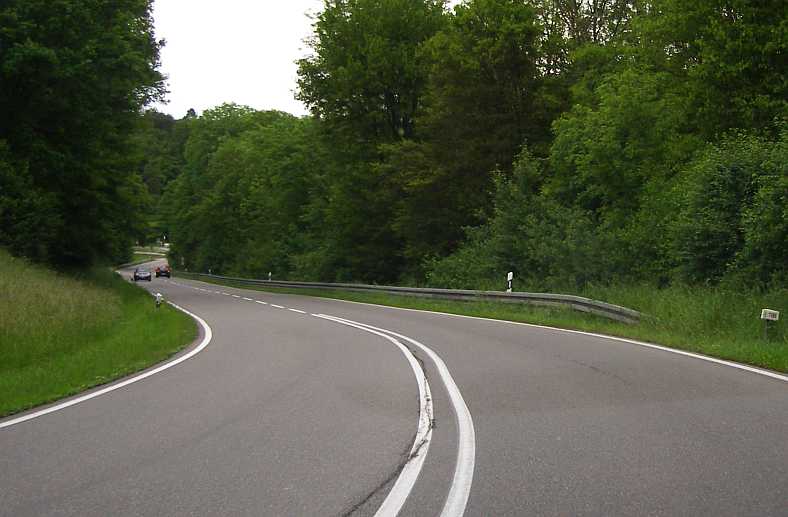
…with the roundabout where we initially joined the circuit being visible in the distance.
A great circuit, different to so many others and very challenging. It’s fitted right into the topography and feels very natural as you drive around it. Which I did again, as I went back to have another look at a couple of points, visiting the pub as I did.
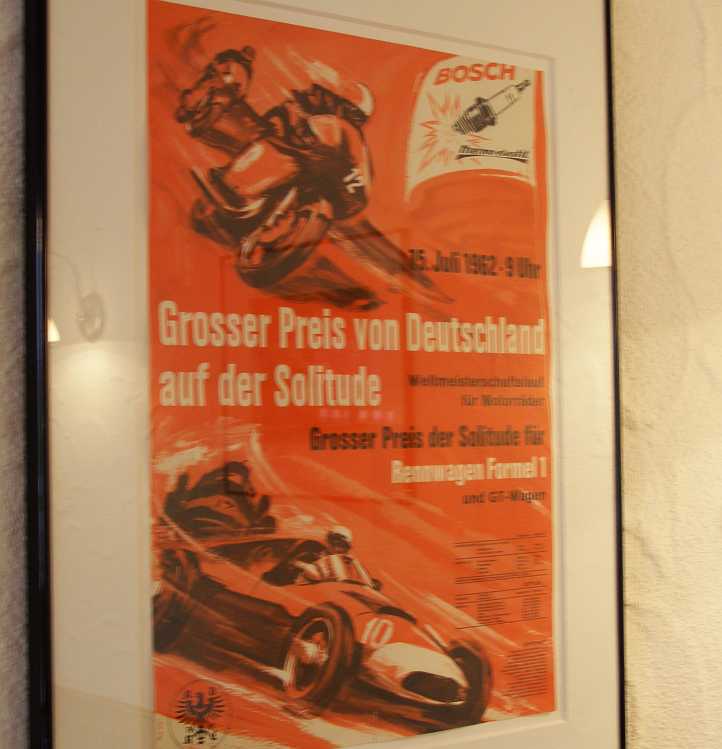
1962 Grand Prix poster. 1962 was a good year for the German enthusiasts who flocked to the Solitudering in their tens of thousands. Dan Gurney won in a Porsche, with Jo Bonnier second in another Porsche, a great result for the German carmaker right on the doorstep of their home base. They pulled out of Formula One at the end of that year.
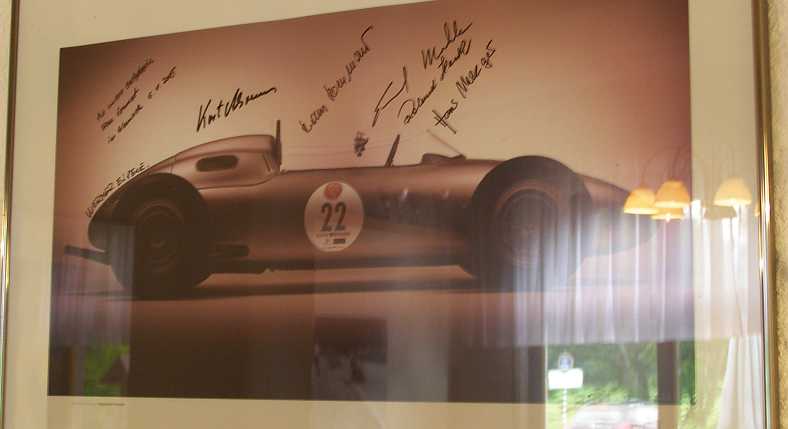
Autographed Porsche. I’m guessing that the autographs on this picture of the Porsche 718 are those of Porsche drivers and mechanics. The only one I can identify is Kurt Ahrens.
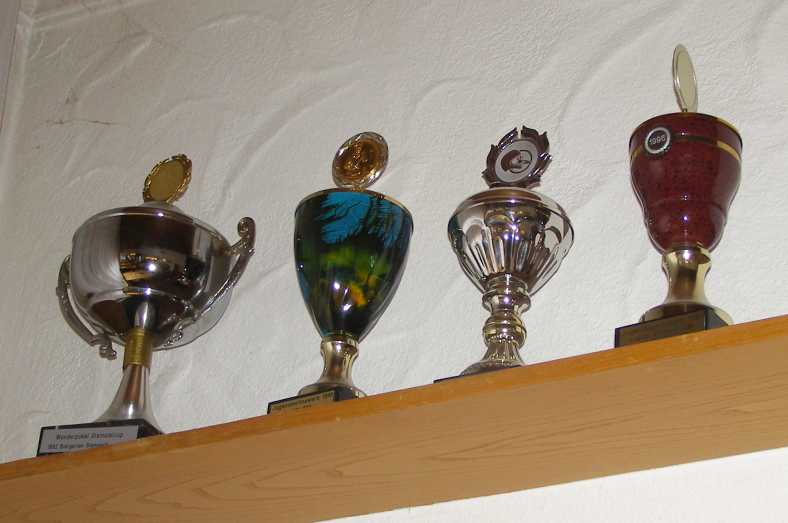
Trophies. I have no idea what the trophies were for, but they are part of a wider display of racing-oriented artifacts in the hotel’s bar area.
The place is full of atmosphere and I don’t for one moment regret the early part of this day being consumed by my visit to Solitude. From there I went back into Stuttgart and to the Mercedes-Benz museum…
That ceased in 1905, but later another hill climb was established on a part of what was to become the circuit I wanted to see. This progressed in 1925 to racing on a 22.3km circuit, shortened a little in 1929 and finally the circuit I wanted to drive in 1930…
The circuit, 11.5kms of beautifully-maintained roads near the Solitude castle just outside of Stuttgart. Map from www.silhouet.com
All of those roads are still there save for one sweeping bend where some road was allowed to return to nature in exchange for some land authorities wanted to take out of nature for a restaurant area along a nearby autobahn. This part is shown in grey. And the first corner after the start is now a squared-off junction rather than a curve.
I joined the circuit coming through a roundabout that now exists at the far right corner of the map…
…and then headed along that section which is called ‘Shadowland’ because of the overhanging trees…
…which cause it to be slippery in the wet, I’ve no doubt…
…while the road turns left and then right and then left and right again. There is negligible change in altitude, the road essentially following the contour line. Some traffic lights are at the point where the map shows a cafe (just after the 9km mark)…
…but that’s not the end of the winding back and forth. So much of this happens (in truth only 18 bends) that 1961 World Champion Phil Hill is said to have remarked that it was, “more difficult to learn and memorise than the whole Nürburgring.” And the nature of the road and its potential for being slippery led to one of the classic Denis Jenkinson descriptions in his report on the very wet 1964 race as Jim Clark and John Surtees duelled for the win.
Something close to, “These two drivers with their fingertip control would have made a cat walking on a shelf of Dresden China look clumsy.” Such was the care they were taking in the slippery conditions while driving as fast as they dared.
Ultimately the road led to the pits…
…followed shortly afterwards by the control tower. All of these amenities are still there and look complete despite the passage of time. In fact, some of them appear to still be in use.
So this was the start and finish area. The first corner came up quickly…
…but as I mentioned, it was a curve to the left following closely those trees and before the traffic lights where the new road goes off…
…and then past this pub to turn left at the point where there’s a carpark on the right. I’m sure this pub did a roaring trade on race weekends, and it still does today as many enthusiasts come to have a look at the circuit. We’ll come back to that, in the meantime, around that left-hander…
…the road starts to ascend. In the distance here where it goes right there’s a very tight corner, this being part of the hillclimb I mentioned earlier. Out of that tight corner…
…is a steeper climb with the road then swinging left as it continues to ascend, some more sweeps follow…
…past the point on the map noted as ‘Sandstrasse’…
…then we come to the crossroad, formerly the point where the bit which has been obliterated swung to the left…
…and where today the line of the curve is hiding in the woods. It’s not visible from the road, but if you go walking it’s there and ultimately it leads through to…
…a very, very quick downhill section with long straights and fast curves…
…a fast and open stretch, another straight…
…another sweep, another straight, I can just imagine those little 1.5-litre Formula One engines of the period screaming their heads off and straining all their components at maximum revs…
…as the fast bit doesn’t seem to end, until we reach the point on the map after the 6km notation…
…where modern needs have seen yet another set of traffic lights installed. But still, the power was on until…
…the tight 180° right hander, which falls away to…
… a tight 180° left hander, still falling away and heading for the lowest point on the circuit…
…with the roundabout where we initially joined the circuit being visible in the distance.
A great circuit, different to so many others and very challenging. It’s fitted right into the topography and feels very natural as you drive around it. Which I did again, as I went back to have another look at a couple of points, visiting the pub as I did.
1962 Grand Prix poster. 1962 was a good year for the German enthusiasts who flocked to the Solitudering in their tens of thousands. Dan Gurney won in a Porsche, with Jo Bonnier second in another Porsche, a great result for the German carmaker right on the doorstep of their home base. They pulled out of Formula One at the end of that year.
Autographed Porsche. I’m guessing that the autographs on this picture of the Porsche 718 are those of Porsche drivers and mechanics. The only one I can identify is Kurt Ahrens.
Trophies. I have no idea what the trophies were for, but they are part of a wider display of racing-oriented artifacts in the hotel’s bar area.
The place is full of atmosphere and I don’t for one moment regret the early part of this day being consumed by my visit to Solitude. From there I went back into Stuttgart and to the Mercedes-Benz museum…
Thread Starter
|
Captain
Joined: Oct 2005
Posts: 568
Likes: 8
From: The Summit, Queensland, Australia
It wasn’t far back to the Mercedes-Benz museum, though at one point there was a ‘speed camera ahead’ sign as the road dived under a bridge. I saw it, I slowed, but maybe not enough as there was a bright flash and when I pulled up at the next lights the driver next to me made signs that he’d also seen me flashed. I don’t know any more than that, I’ve not heard another word.
When I got there I had to find somewhere to park, which wasn’t easy. And, after a bit of a walk I arrived and found they were unloading the latest Formula One car from a transporter to go on display. This enabled me to get a close up shot or two…
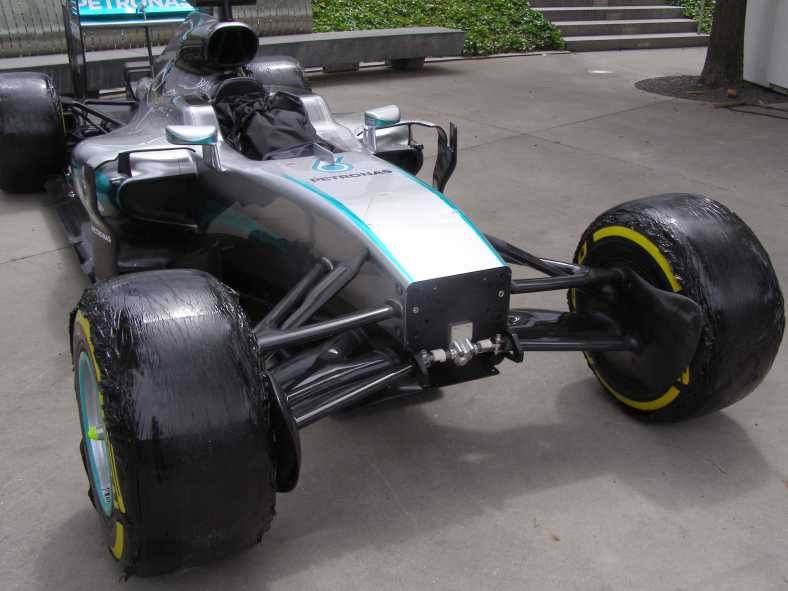
Museum piece? With its tyres wrapped up to prevent getting unwanted material on them, the then-current Mercedes F1 car. These cars had filled second and third placings at Monaco the weekend before.
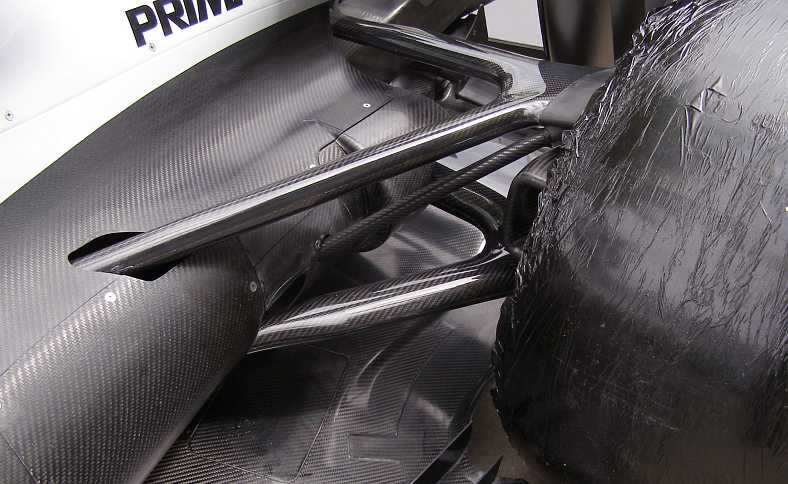
Carbon fibre. A close up of the intricate work in carbon-fibre around the front suspension.
And then I went into the museum and was greeted by a nice young lady who made me almost feel good about paying my admission.
The museum is arranged as a spiralling 3-storey building (or is it 4-storey?) and an elevator takes new arrivals to the top and their progress through the museum takes them round and round the downward spiral as they go from section to section. And there’s some very old stuff there, as you’d expect of Daimler-Benz.
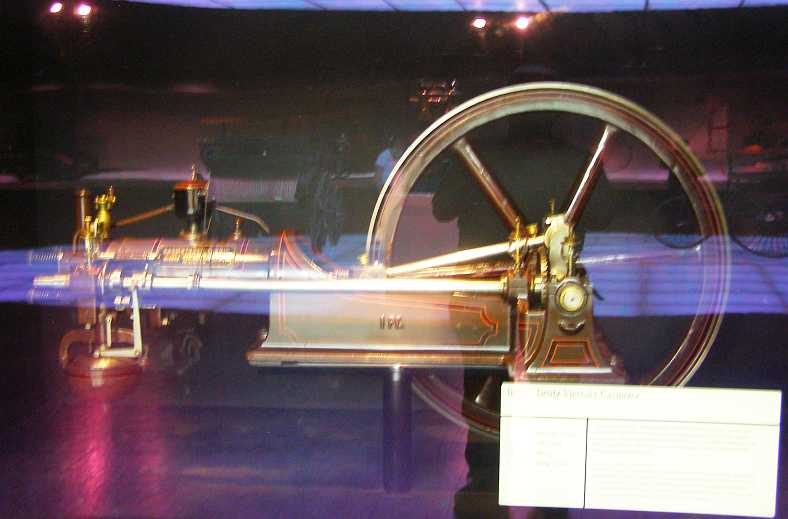
1880 Deutz ‘gasmotor’. Gottlieb Daimler and Wilhelm Maybach formed a company in the 1870s to build engines on the Otto principle, ultimately licensing manufacture of similar engines all around the world – as seen at the Schlumpf museum with the Panhard et Levassor-made versions. This one is a stationary engine from 1880.
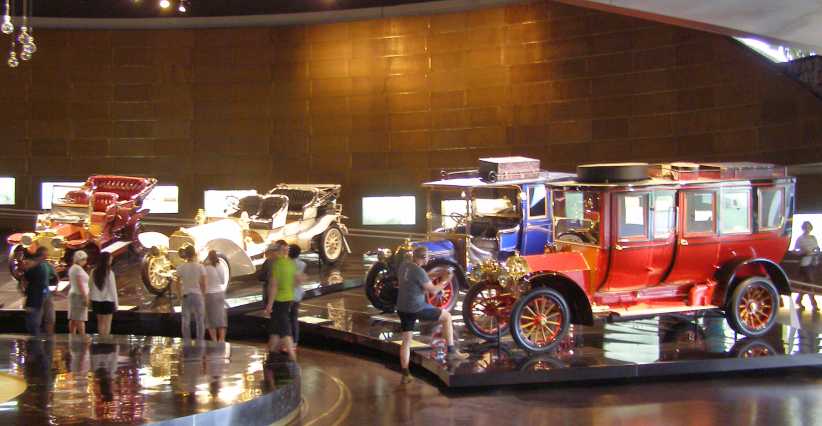
Real oldies. Well, not so. These cars are the first I’ve photographed, but Benz made tiller-steered buggies way back before 1890. Here we have a selection from the 1900s and up to the first world war, it includes some very stately vehicles.
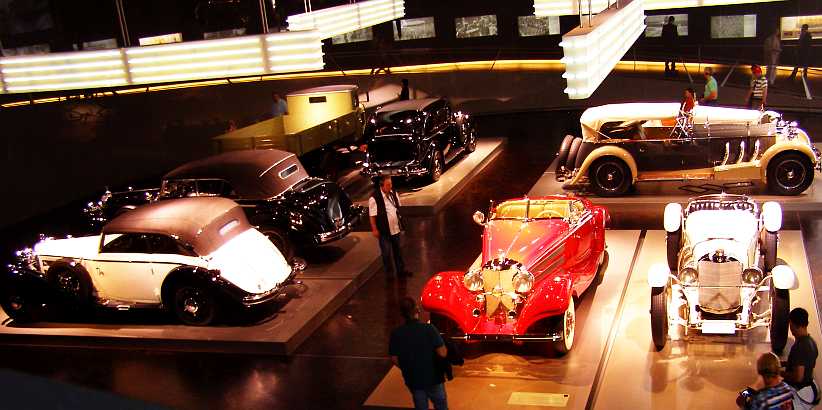
Moving into the twenties. Some very classy cars here, from both the twenties and the thirties, not to mention a typical truck. Commercial vehicles were always a big part of the Mercedes-Benz business. Mercedes and Benz, by the way, merged in the late twenties. The outstanding red car is a 540K.
As patrons descend the spiralling outer walk there are pictures on the wall to view, exhibits hanging from the ceiling, and the view outside passes by.
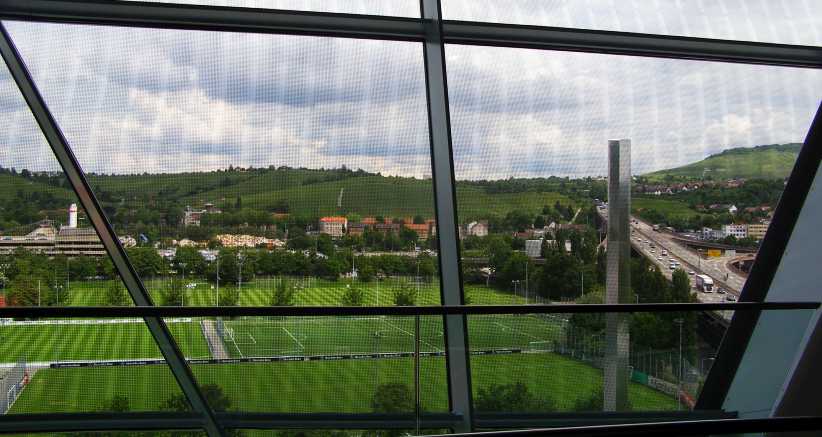
View of Stuttgart. Looking from the window as I walked down the spiral I snapped this shot showing sporting grounds and highway in everyday Stuttgart.
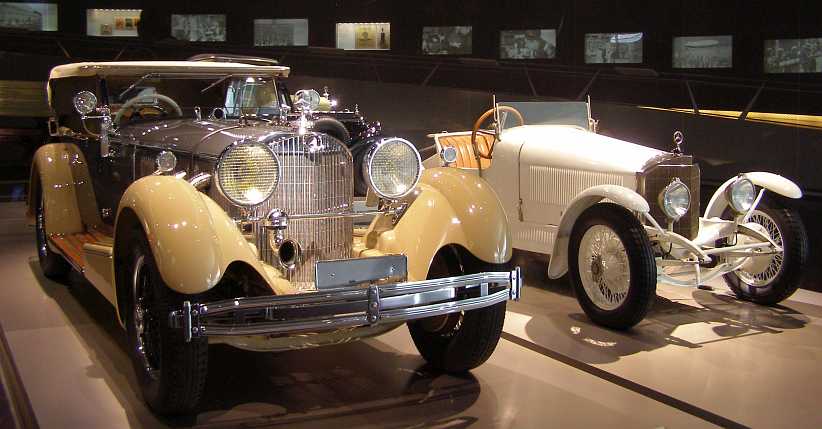
Big and small. Classical lines show in both these cars, the bigger one being a 1930 SS which was so famous as the progenitor of the SSK and SSKL cars.
As we descend the years pass and soon enough we arrive at the post-WW2 era. The 300D arrived and gave the company prestige again, and linking Conrad Adenauer with these cars (he had six of them) by giving one model his name was another step. But there were more steps for the 3-litre engine it introduced to the world.
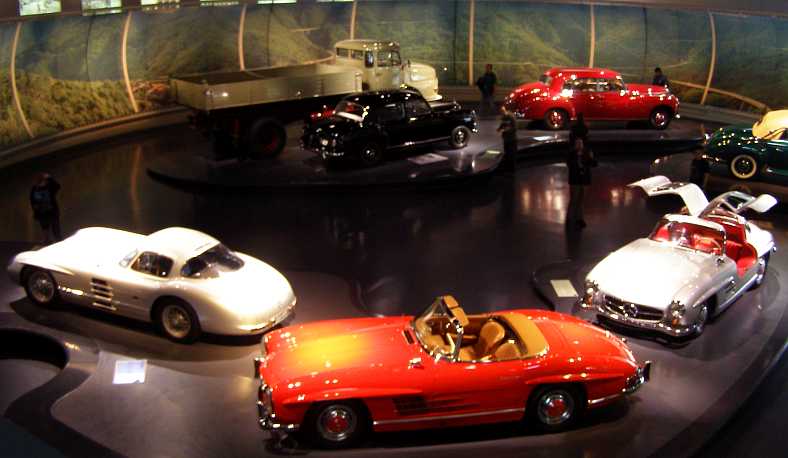
300s and post-war revival. While cars like the 170 and 180 were bread and butter as the fifties rolled around, it was the 300 which revived the classical image of Mercedes-Benz with their arrival in 1951. And soon after came the 300SL models. Note once again there’s a truck in the display.
That engine, and other elements of the big sedan, provided elements for the introduction of the sporting 300SL. This was initially only available in ‘Gullwing’ coupe form, but ultimately a roadster was released to join it later in the fifties.
One story I’ve read is that people, looking at the Gullwing at shows or dealers, would be asked if they were interested in the car. Typically a reply would be along the lines of, “Oh, I’d prefer an open car.” And Mercedes listened and produced an open car, which sold no better. “Tyre kickers!” might be the appropriate response.
After the war there were limitations put on German entries in competition and they weren’t allowed into Grand Prix racing for several years. Mercedes, once the green light was given, saw it as futile to build a new car for the dying 4.5-litre Formula One and started preparing for the new 2.5-litre formula coming in 1954. In the meantime the factory went sports car racing with 300SLs, in 1952 winning the Le Mans 24-hours and the Carrera Panamerica.
The ultimate version of the 300SL was, of course, the 300SLR which appeared in the racing world in 1955 using a 3-litre version of the Grand Prix engine and won the Mille Miglia, the Targa Florio and the Tourist Trophy as well as some less notable races. They were leading the Le Mans 24-hour race in the hours following the huge crash which killed over 80 people (and involved one of their cars) when they withdrew from the race on instructions from the Board of Directors.
For 1956 they were being further developed and were going to race as coupes. One improvement to the 3-litre straight eight engine was an inlet manifold featuring variable trumpet lengths. This cleaned up a bit of a ‘flat spot’ in the rev range and actually gave them an extra 20bhp in that part of the rev range.
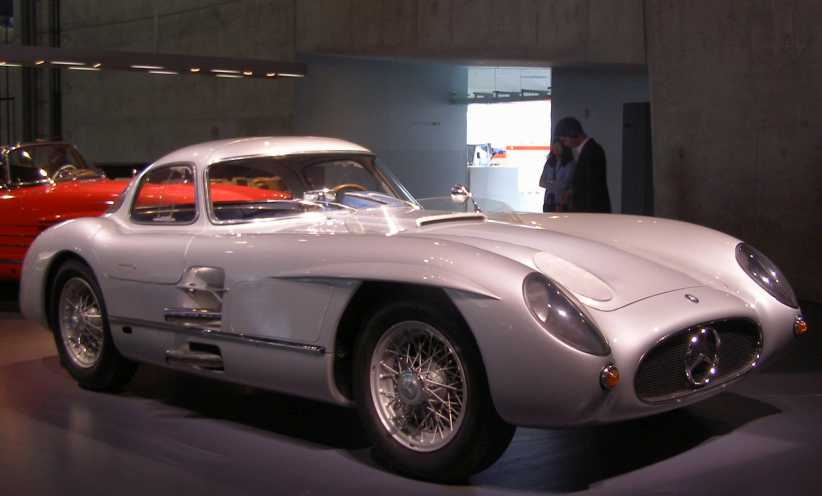
Racing version. Based on the chassis of the 300SL, but with the 8-cylinder racing engine, was the 300SLR. This coupe is one of two cars prepared for the 1956 season, but never raced as the company pulled out of competition to rest on their laurels for a few decades.
But the car was used, and probably well-used. No doubt developments were carried out on it as it became Rudi Uhlenhaut’s personal carriage. Uhlenhaut had been on the racing car design team, ultimately to head it, since the thirties. He also drove the cars and was almost as quick as the top team drivers, but was considered to valuable in the engineering team to be risked in racing.
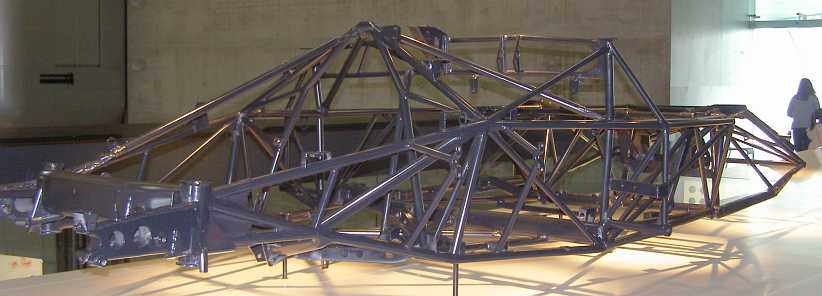
Spaceframe. This is the chassis of the 300SL. It was the need for chassis depth at the door-opening section which led to the cars becoming ‘gull-winged’. The front of the chassis is to the left.
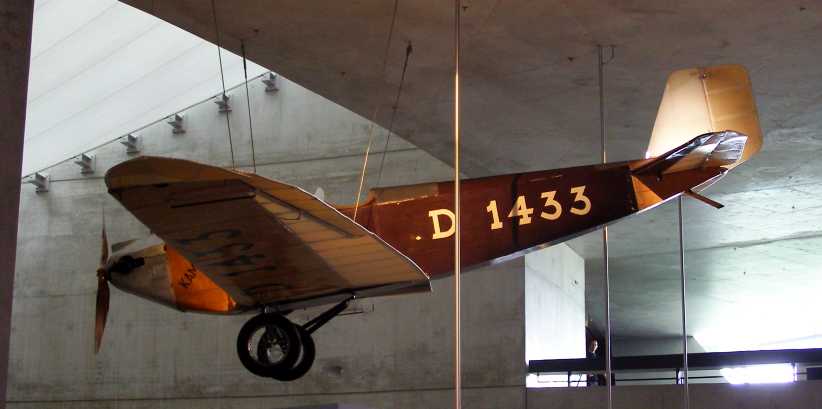
Aircraft too. Powered by a Benz 20hp engine, this Klemm aircraft carried Friedrich Karl von Koenig-Warthausen on a record-setting flight around the world in 1928.
With anything likely to happen in the Grand Prix season it might be necessary to rapidly ferry another car to the circuit when something’s gone wrong on practice day. Or, as in the case of the 1955 Italian Grand Prix, when Stirling Moss decided he’d prefer a streamlined W196 instead of the regular car after trying the one Juan Manuel Fangio was running.
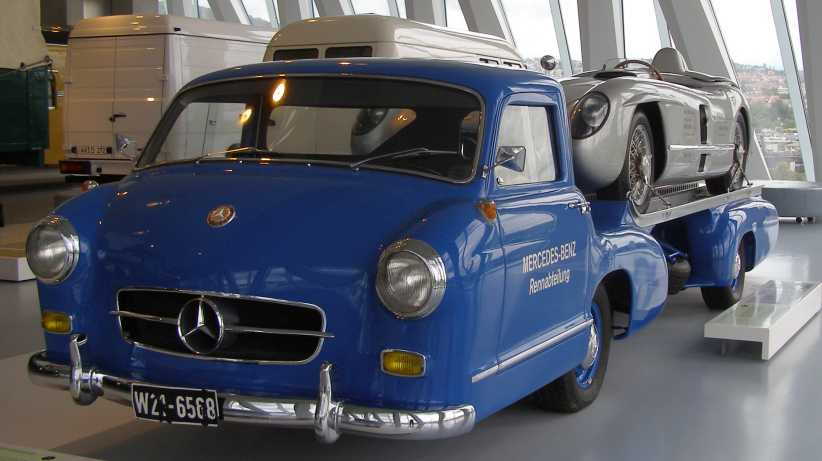
High speed transporter. Built specifically to transport the Grand Prix or Sports Racing cars around Europe, Mercedes created this transporter. The one on display is a replica, however, built as a project by their engineering apprentices.
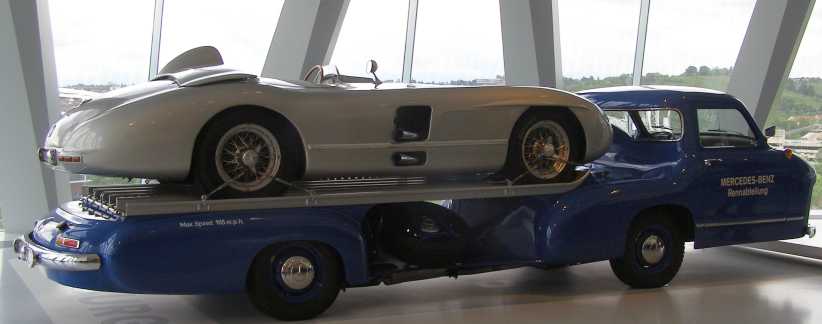
Air brake. The car on the transporter is set up as they were for Le Mans in 1955, with an air brake…
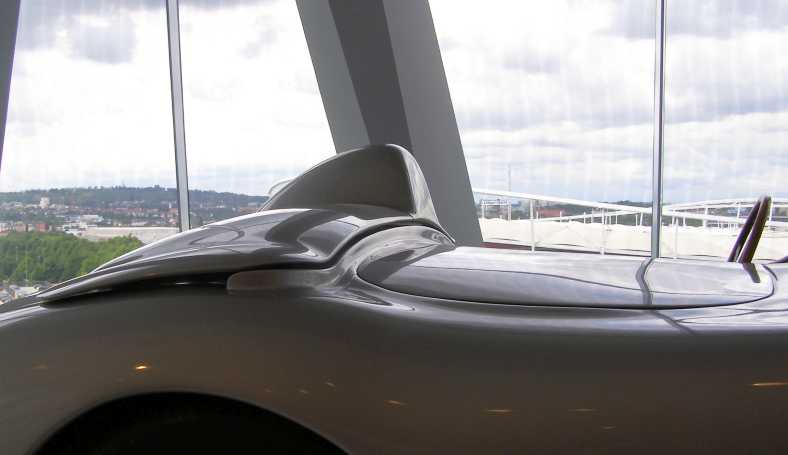
Close up. …which came up when the driver needed to slow from the high speeds of Le Mans, saving the drum brakes to a small extent.
Another sphere operations of the Daimler-Benz organisation is the aircraft engine division. In the piston-engined era they built a number of different engines powering all manner of aircraft. Including, of course, the bombers and fighters of the World Wars.
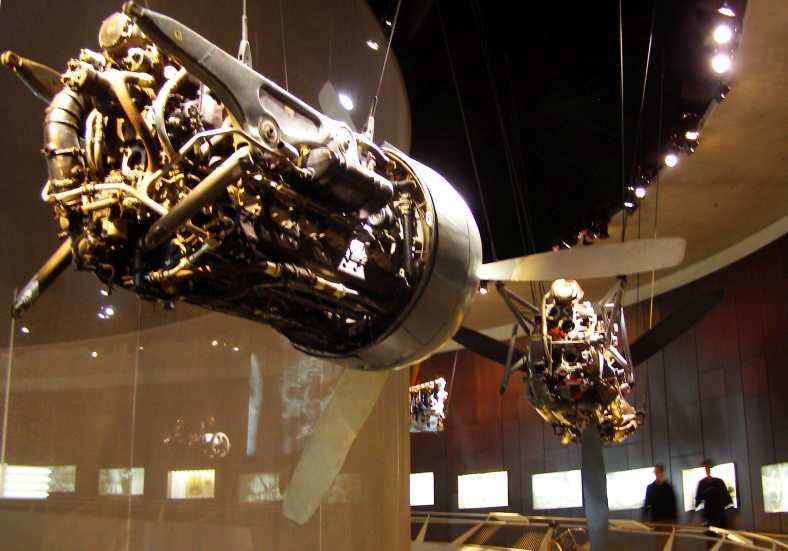
Aircraft engines. Big aircraft engines hang from the ceiling alongside the spiral walkway.
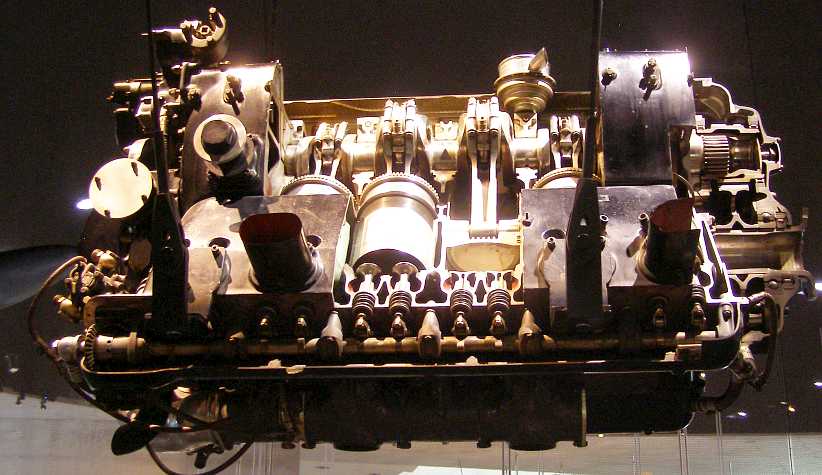
V12 cutaway. The exposed internals of this V12 are interesting. The ‘vee’, by the way, is usually inverted (as are inline engines) in aircraft. Visible here are the overhead cams, 4-valve arrangement and the fork-and-blade connnecting rods.
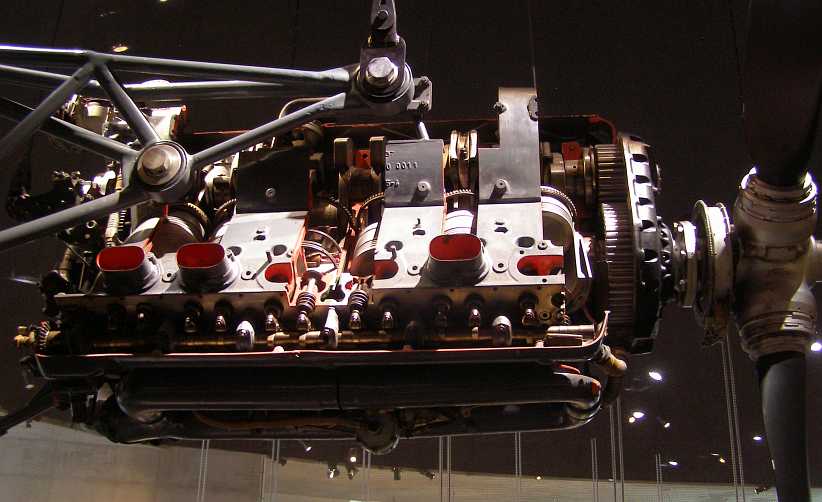
In the airframe. This exhibit shows how the engine is attached in the airframe, the cutaway engine in this case showing the reduction gearing for the propellor drive as well.
Another engine displayed is this straight-eight from the W25 race cars of the first years of the 750kg maximum weight formula. The finning seen between the supercharger and the inlet ports is there to act as an intercooler.
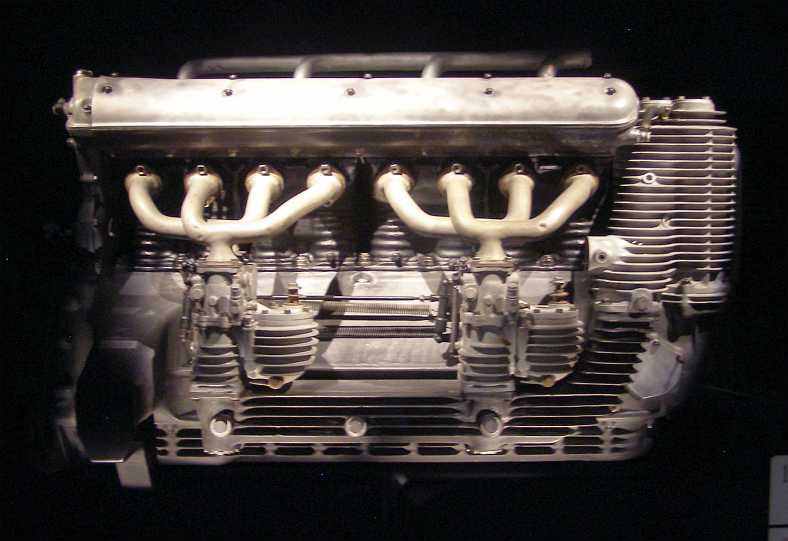
M25 engine. The stuff legends are made of, this engine started life as a 3.3-litre and grew to 4.7-litres, with its best results at the 4.4-litre level. Other details changed as the capacity grew, so we know this is the early version.
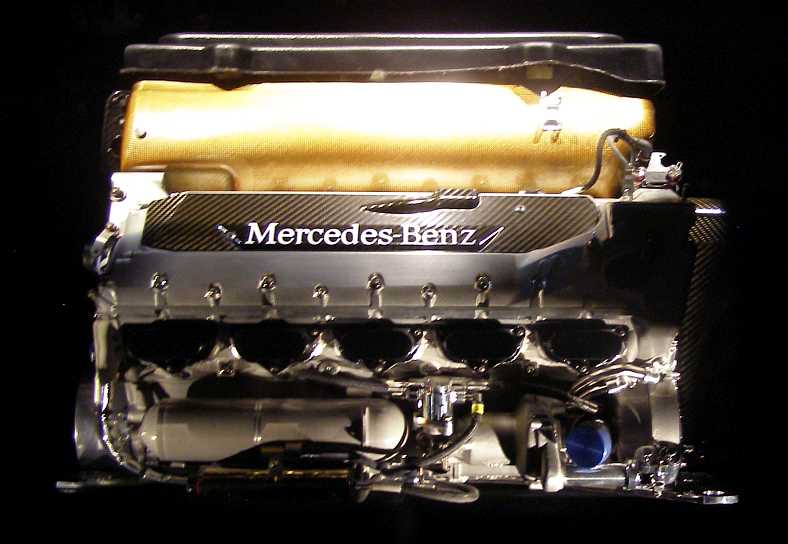
Modern engine. How different the modern Formula One engine is. Computer designing makes so many things possible, from having a V10 cylinder arrangement to the extremes of power obtained. This engine was used by McLaren.
And so to the racing cars. These are arranged as on a long curve with the newest at the front. The company has gone to great lengths over the years to preserve the cars and used them to promote the image of Mercedes-Benz, therefore the cars are seen to be of great value to the company.
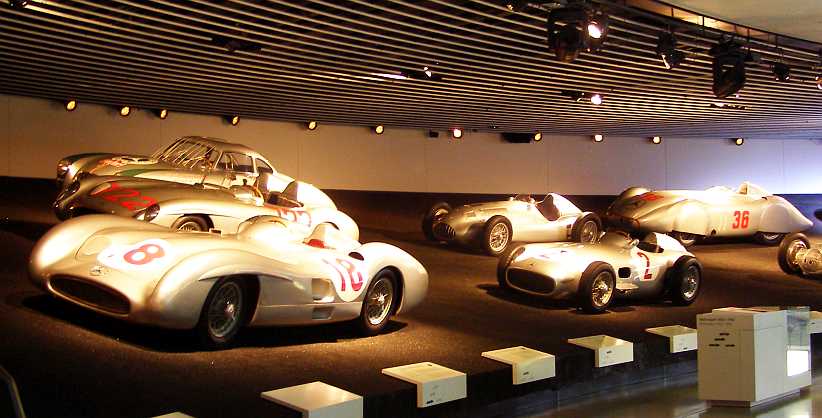
First of the racers. The streamlined W196 of 1954-55 heads the line here. Alongside is the 300SLR in which Moss won the Mille Miglia with the Le Mans and Carrerra Panamerica-winning early 300SL at the rear. Behind them come the regular W196 and the W165 built specifically to win the Tripoli Grand Prix.
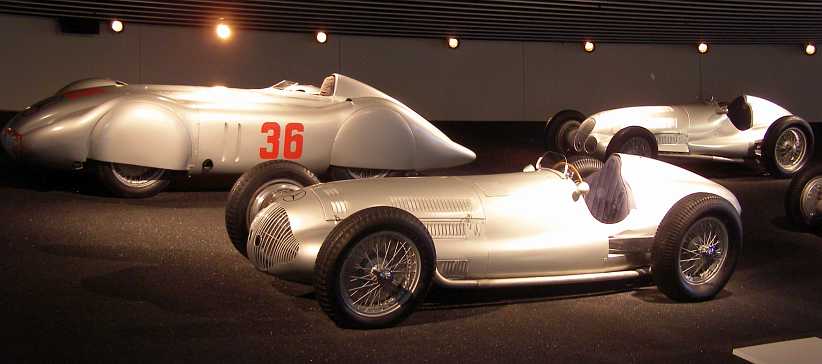
‘Silver Arrows’. The 154, with its supercharged 3-litre V12 sits alongside the streamlined W25 record car of 1934, the W125 Grand Prix car comes next.
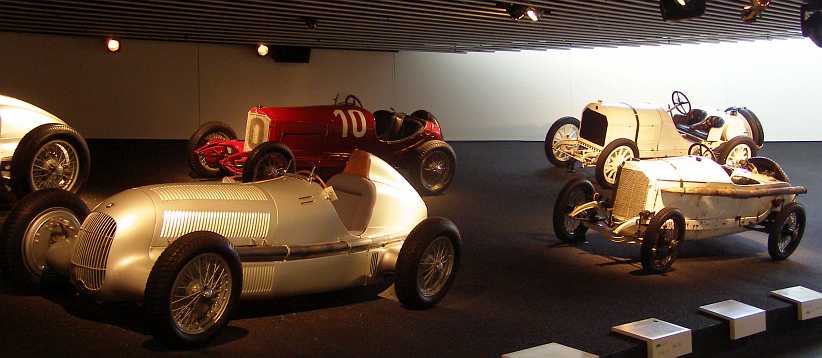
Older racers. A contrast is obvious here between the 1934 W25 and the next cars, the red one being the car in which Christian Wagner won the 1924 Targa Florio.
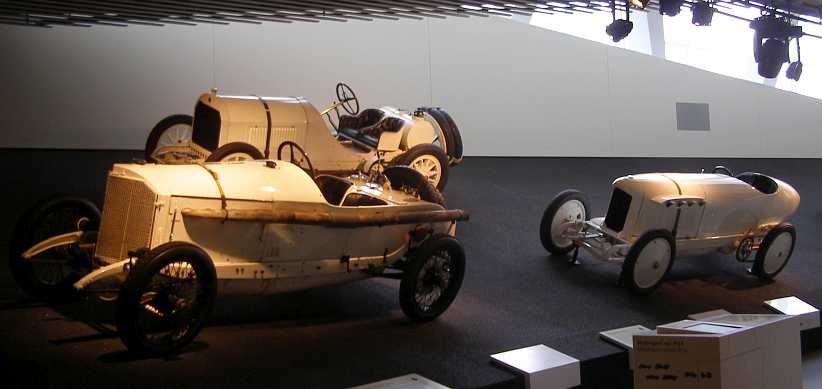
Early Grand Prix racers. Chain drive is evident on the 1908 Benz Grand Prix car on the outside while nearest camera is the 1914 car used to dominate the French Grand Prix at Lyon. The third of these cars is the ‘Lightning Benz’ or ‘Blitzen Benz’ which used its 21.5-litre engine to set many records.
Also lined up here are some pure record cars. During the twenties and thirties the World Land Speed Record attracted a lot of attention and some very quick cars were built to attack the record. Over time the settings for these records moved from beaches (like Daytona Beach in Florida, or Ninety Mile Beach in New Zealand) to the salt flats at Bonneville, Utah.
Mercedes-Benz decided they could build a car to beat the speeds of the late thirties on an Autobahn in Germany, but it never got a chance to prove itself. Assisting in the design was Ferdinand Porsche.
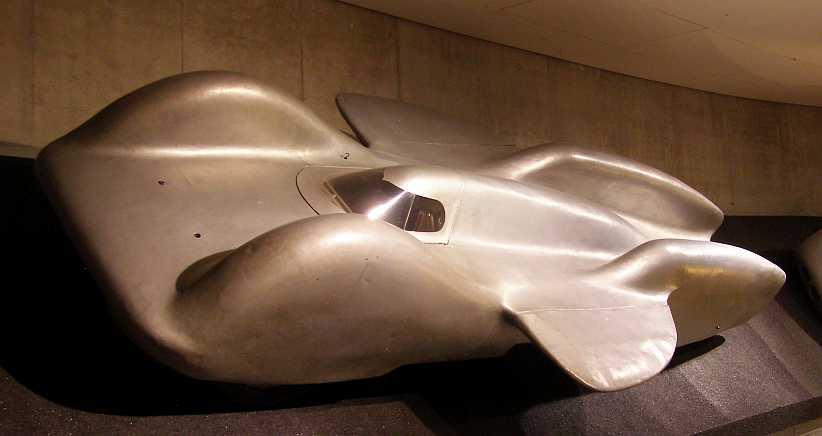
T80 record car. This car bristled with features necessary to enable the record to get as high as, perhaps, 400mph on an Autobahn. It had traction control to assist with both acceleration and braking and those wings to keep it stable and again assist with traction, while over 3,000 horsepower came from a M-B aircraft engine of 44.5-litres.
They had already achieve some high speeds in the annual record attempts on the Frankfurt-Darmstadt autobahn, but these came to an end after the death of Auto Union’s lead driver, Bernd Rosemeyer.
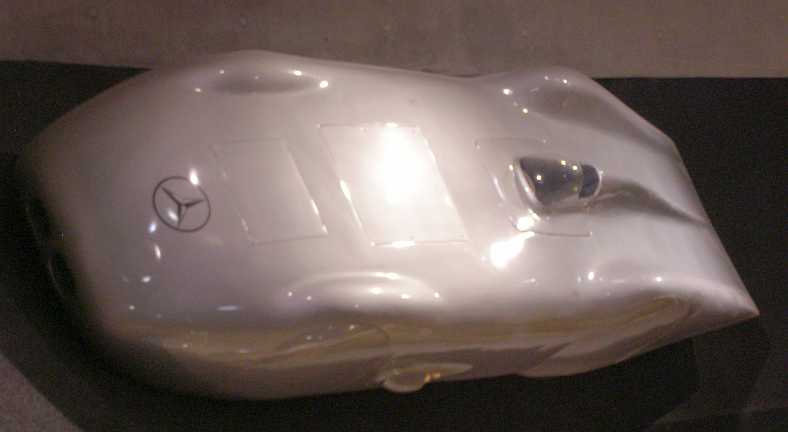
Successful. The day before Rosemeyer died, Rudi Caracciola used this car (based on the W154 GP car) to set a record of 432.7kmh.
And there’s one more car that grabbed my attention, a car which combines ugly with spectacular, though the rear of the car is quite good looking:
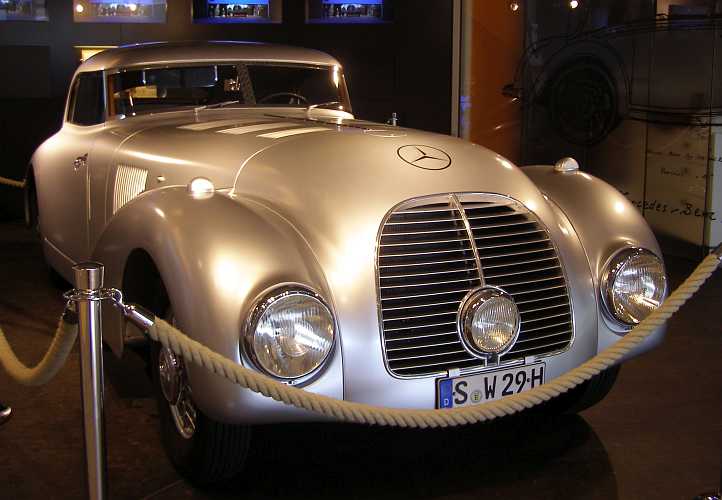
540K Streamliner. A huge car, built on the 540K chassis and using that supercharged engine, it was built to run in an event between Berlin and Rome which was ultimately cancelled in the pre-WW2 turmoil. Dunlop bought it to test tyres, reckoning it’s 2.4-ton weight and available high power and speed made it ideal to help with their tyre designs, then it was lost, dismembered and cast aside. When the chassis was finally identified it was rebuilt for exhibition.
I left the museum and headed off down the road, which took me right past the Porsche Museum…
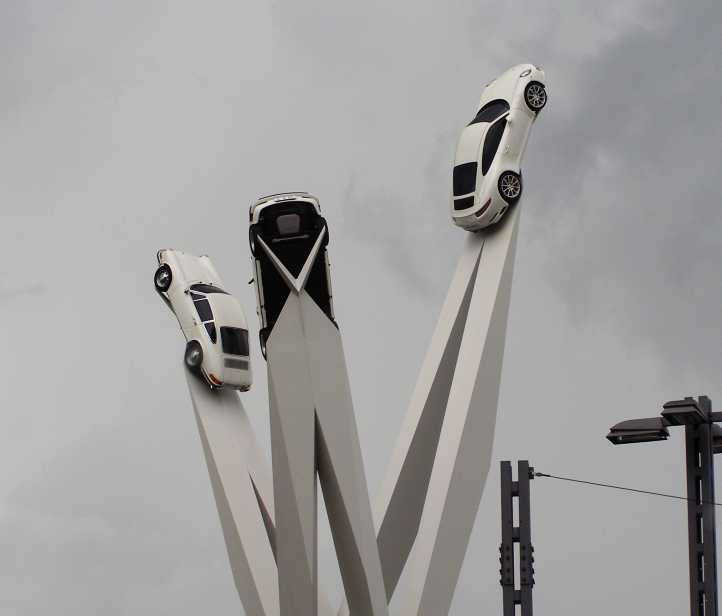
Porsches in the air. I didn’t bother with the Porsche museum as I’m not a fan. Something I’d later regret. This display is in a roundabout as you drive by.
So I started off towards the Nurburgring, the next planned stop.
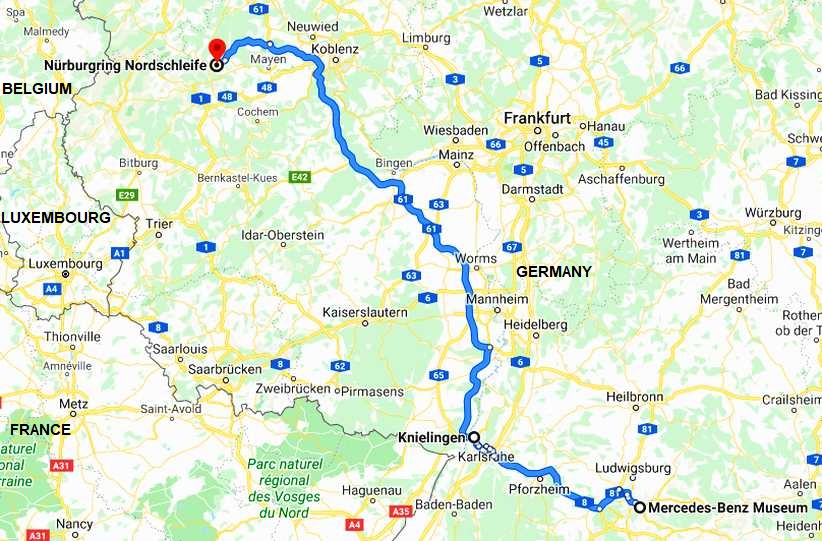
I set the GPS and commenced that journey, about 320kms, an autobahn took me over the Rhine near Knielingen…
Into the Rhineland. This bridge over the Rhine took me right away from the industrial centres around Stuttgart as I commenced my drive to the Nurburgring.
…and into a world of strange things. Traffic jams on the autobahns, which led me to notice just how many Audis there are, and how many new cars are black. Skodas, Seats, Volkswagens, BMWs had all adopted shiny black paint as their normal coating. And there was more.
I also learned all about toilets. I’d struck it in Switzerland where they are big on a ‘user pays’ system and they have cutouts of approximately the size of a seven or eight-year-old beside the pay turnstile and if a child can go through there they use the toilet for free. Along the autobahns, however, there are free toilets. Which are filthy.
Generally around service stations on the autobahn there are bushy areas where people, principally truck drivers, duck out of sight for their personal relief. At the one where I refuelled this afternoon I followed that same example with very sad results.
Some of those using these bushy areas do their ‘number twos’ there too, so when I walked up over a bank I trod in something nasty and slipped. I got all kinds of muck over my clothing as I went down, so I had to spend a lot of time before I could move on giving my clothes a bit of a wash. Of course the windscreen cleaning bucket was useful for this, being refilled several times before I got things clean.
Fortunately the worst of the traffic jams was on the opposite side of the autobahn and I made some progress, but it wasn’t long before I started looking for a likely place to park for the night and get some sleep. During the course of the day I'd gone online and booked my tickets for the return trip on the ferry between Dunkirk and Dover.
And the thought of the Nurburgring had me excited…
When I got there I had to find somewhere to park, which wasn’t easy. And, after a bit of a walk I arrived and found they were unloading the latest Formula One car from a transporter to go on display. This enabled me to get a close up shot or two…
Museum piece? With its tyres wrapped up to prevent getting unwanted material on them, the then-current Mercedes F1 car. These cars had filled second and third placings at Monaco the weekend before.
Carbon fibre. A close up of the intricate work in carbon-fibre around the front suspension.
And then I went into the museum and was greeted by a nice young lady who made me almost feel good about paying my admission.
The museum is arranged as a spiralling 3-storey building (or is it 4-storey?) and an elevator takes new arrivals to the top and their progress through the museum takes them round and round the downward spiral as they go from section to section. And there’s some very old stuff there, as you’d expect of Daimler-Benz.
1880 Deutz ‘gasmotor’. Gottlieb Daimler and Wilhelm Maybach formed a company in the 1870s to build engines on the Otto principle, ultimately licensing manufacture of similar engines all around the world – as seen at the Schlumpf museum with the Panhard et Levassor-made versions. This one is a stationary engine from 1880.
Real oldies. Well, not so. These cars are the first I’ve photographed, but Benz made tiller-steered buggies way back before 1890. Here we have a selection from the 1900s and up to the first world war, it includes some very stately vehicles.
Moving into the twenties. Some very classy cars here, from both the twenties and the thirties, not to mention a typical truck. Commercial vehicles were always a big part of the Mercedes-Benz business. Mercedes and Benz, by the way, merged in the late twenties. The outstanding red car is a 540K.
As patrons descend the spiralling outer walk there are pictures on the wall to view, exhibits hanging from the ceiling, and the view outside passes by.
View of Stuttgart. Looking from the window as I walked down the spiral I snapped this shot showing sporting grounds and highway in everyday Stuttgart.
Big and small. Classical lines show in both these cars, the bigger one being a 1930 SS which was so famous as the progenitor of the SSK and SSKL cars.
As we descend the years pass and soon enough we arrive at the post-WW2 era. The 300D arrived and gave the company prestige again, and linking Conrad Adenauer with these cars (he had six of them) by giving one model his name was another step. But there were more steps for the 3-litre engine it introduced to the world.
300s and post-war revival. While cars like the 170 and 180 were bread and butter as the fifties rolled around, it was the 300 which revived the classical image of Mercedes-Benz with their arrival in 1951. And soon after came the 300SL models. Note once again there’s a truck in the display.
That engine, and other elements of the big sedan, provided elements for the introduction of the sporting 300SL. This was initially only available in ‘Gullwing’ coupe form, but ultimately a roadster was released to join it later in the fifties.
One story I’ve read is that people, looking at the Gullwing at shows or dealers, would be asked if they were interested in the car. Typically a reply would be along the lines of, “Oh, I’d prefer an open car.” And Mercedes listened and produced an open car, which sold no better. “Tyre kickers!” might be the appropriate response.
After the war there were limitations put on German entries in competition and they weren’t allowed into Grand Prix racing for several years. Mercedes, once the green light was given, saw it as futile to build a new car for the dying 4.5-litre Formula One and started preparing for the new 2.5-litre formula coming in 1954. In the meantime the factory went sports car racing with 300SLs, in 1952 winning the Le Mans 24-hours and the Carrera Panamerica.
The ultimate version of the 300SL was, of course, the 300SLR which appeared in the racing world in 1955 using a 3-litre version of the Grand Prix engine and won the Mille Miglia, the Targa Florio and the Tourist Trophy as well as some less notable races. They were leading the Le Mans 24-hour race in the hours following the huge crash which killed over 80 people (and involved one of their cars) when they withdrew from the race on instructions from the Board of Directors.
For 1956 they were being further developed and were going to race as coupes. One improvement to the 3-litre straight eight engine was an inlet manifold featuring variable trumpet lengths. This cleaned up a bit of a ‘flat spot’ in the rev range and actually gave them an extra 20bhp in that part of the rev range.
Racing version. Based on the chassis of the 300SL, but with the 8-cylinder racing engine, was the 300SLR. This coupe is one of two cars prepared for the 1956 season, but never raced as the company pulled out of competition to rest on their laurels for a few decades.
But the car was used, and probably well-used. No doubt developments were carried out on it as it became Rudi Uhlenhaut’s personal carriage. Uhlenhaut had been on the racing car design team, ultimately to head it, since the thirties. He also drove the cars and was almost as quick as the top team drivers, but was considered to valuable in the engineering team to be risked in racing.
Spaceframe. This is the chassis of the 300SL. It was the need for chassis depth at the door-opening section which led to the cars becoming ‘gull-winged’. The front of the chassis is to the left.
Aircraft too. Powered by a Benz 20hp engine, this Klemm aircraft carried Friedrich Karl von Koenig-Warthausen on a record-setting flight around the world in 1928.
With anything likely to happen in the Grand Prix season it might be necessary to rapidly ferry another car to the circuit when something’s gone wrong on practice day. Or, as in the case of the 1955 Italian Grand Prix, when Stirling Moss decided he’d prefer a streamlined W196 instead of the regular car after trying the one Juan Manuel Fangio was running.
High speed transporter. Built specifically to transport the Grand Prix or Sports Racing cars around Europe, Mercedes created this transporter. The one on display is a replica, however, built as a project by their engineering apprentices.
Air brake. The car on the transporter is set up as they were for Le Mans in 1955, with an air brake…
Close up. …which came up when the driver needed to slow from the high speeds of Le Mans, saving the drum brakes to a small extent.
Another sphere operations of the Daimler-Benz organisation is the aircraft engine division. In the piston-engined era they built a number of different engines powering all manner of aircraft. Including, of course, the bombers and fighters of the World Wars.
Aircraft engines. Big aircraft engines hang from the ceiling alongside the spiral walkway.
V12 cutaway. The exposed internals of this V12 are interesting. The ‘vee’, by the way, is usually inverted (as are inline engines) in aircraft. Visible here are the overhead cams, 4-valve arrangement and the fork-and-blade connnecting rods.
In the airframe. This exhibit shows how the engine is attached in the airframe, the cutaway engine in this case showing the reduction gearing for the propellor drive as well.
Another engine displayed is this straight-eight from the W25 race cars of the first years of the 750kg maximum weight formula. The finning seen between the supercharger and the inlet ports is there to act as an intercooler.
M25 engine. The stuff legends are made of, this engine started life as a 3.3-litre and grew to 4.7-litres, with its best results at the 4.4-litre level. Other details changed as the capacity grew, so we know this is the early version.
Modern engine. How different the modern Formula One engine is. Computer designing makes so many things possible, from having a V10 cylinder arrangement to the extremes of power obtained. This engine was used by McLaren.
And so to the racing cars. These are arranged as on a long curve with the newest at the front. The company has gone to great lengths over the years to preserve the cars and used them to promote the image of Mercedes-Benz, therefore the cars are seen to be of great value to the company.
First of the racers. The streamlined W196 of 1954-55 heads the line here. Alongside is the 300SLR in which Moss won the Mille Miglia with the Le Mans and Carrerra Panamerica-winning early 300SL at the rear. Behind them come the regular W196 and the W165 built specifically to win the Tripoli Grand Prix.
‘Silver Arrows’. The 154, with its supercharged 3-litre V12 sits alongside the streamlined W25 record car of 1934, the W125 Grand Prix car comes next.
Older racers. A contrast is obvious here between the 1934 W25 and the next cars, the red one being the car in which Christian Wagner won the 1924 Targa Florio.
Early Grand Prix racers. Chain drive is evident on the 1908 Benz Grand Prix car on the outside while nearest camera is the 1914 car used to dominate the French Grand Prix at Lyon. The third of these cars is the ‘Lightning Benz’ or ‘Blitzen Benz’ which used its 21.5-litre engine to set many records.
Also lined up here are some pure record cars. During the twenties and thirties the World Land Speed Record attracted a lot of attention and some very quick cars were built to attack the record. Over time the settings for these records moved from beaches (like Daytona Beach in Florida, or Ninety Mile Beach in New Zealand) to the salt flats at Bonneville, Utah.
Mercedes-Benz decided they could build a car to beat the speeds of the late thirties on an Autobahn in Germany, but it never got a chance to prove itself. Assisting in the design was Ferdinand Porsche.
T80 record car. This car bristled with features necessary to enable the record to get as high as, perhaps, 400mph on an Autobahn. It had traction control to assist with both acceleration and braking and those wings to keep it stable and again assist with traction, while over 3,000 horsepower came from a M-B aircraft engine of 44.5-litres.
They had already achieve some high speeds in the annual record attempts on the Frankfurt-Darmstadt autobahn, but these came to an end after the death of Auto Union’s lead driver, Bernd Rosemeyer.
Successful. The day before Rosemeyer died, Rudi Caracciola used this car (based on the W154 GP car) to set a record of 432.7kmh.
And there’s one more car that grabbed my attention, a car which combines ugly with spectacular, though the rear of the car is quite good looking:
540K Streamliner. A huge car, built on the 540K chassis and using that supercharged engine, it was built to run in an event between Berlin and Rome which was ultimately cancelled in the pre-WW2 turmoil. Dunlop bought it to test tyres, reckoning it’s 2.4-ton weight and available high power and speed made it ideal to help with their tyre designs, then it was lost, dismembered and cast aside. When the chassis was finally identified it was rebuilt for exhibition.
I left the museum and headed off down the road, which took me right past the Porsche Museum…
Porsches in the air. I didn’t bother with the Porsche museum as I’m not a fan. Something I’d later regret. This display is in a roundabout as you drive by.
So I started off towards the Nurburgring, the next planned stop.
I set the GPS and commenced that journey, about 320kms, an autobahn took me over the Rhine near Knielingen…
Into the Rhineland. This bridge over the Rhine took me right away from the industrial centres around Stuttgart as I commenced my drive to the Nurburgring.
…and into a world of strange things. Traffic jams on the autobahns, which led me to notice just how many Audis there are, and how many new cars are black. Skodas, Seats, Volkswagens, BMWs had all adopted shiny black paint as their normal coating. And there was more.
I also learned all about toilets. I’d struck it in Switzerland where they are big on a ‘user pays’ system and they have cutouts of approximately the size of a seven or eight-year-old beside the pay turnstile and if a child can go through there they use the toilet for free. Along the autobahns, however, there are free toilets. Which are filthy.
Generally around service stations on the autobahn there are bushy areas where people, principally truck drivers, duck out of sight for their personal relief. At the one where I refuelled this afternoon I followed that same example with very sad results.
Some of those using these bushy areas do their ‘number twos’ there too, so when I walked up over a bank I trod in something nasty and slipped. I got all kinds of muck over my clothing as I went down, so I had to spend a lot of time before I could move on giving my clothes a bit of a wash. Of course the windscreen cleaning bucket was useful for this, being refilled several times before I got things clean.
Fortunately the worst of the traffic jams was on the opposite side of the autobahn and I made some progress, but it wasn’t long before I started looking for a likely place to park for the night and get some sleep. During the course of the day I'd gone online and booked my tickets for the return trip on the ferry between Dunkirk and Dover.
And the thought of the Nurburgring had me excited…
Last edited by Ray Bell; May 17, 2020 at 05:21 PM.
Thread Starter
|
Captain
Joined: Oct 2005
Posts: 568
Likes: 8
From: The Summit, Queensland, Australia
In 1962 I read of the Nurburgring for the first time. It was a report on the German Grand Prix, won that year by Graham Hill in very wet conditions ahead of Dan Gurney and John Surtees. The description of the circuit told of 172 bends in over 14 miles of the circuit. It was in the Eiffel Mountains and therefore had many climbs and drops, and some places where the cars become airborne.
Over the years it’s become something of a strong desire to see the circuit, and now I was headed in that direction. The running was certainly easier than it had been the previous afternoon and evening, traffic light.
I don’t know where I took this photo. In fact, because the photos I took after I left the Mercedes Museum were on a fresh memory card, and that card corrupted. I had to recover it and when it was recovered it’s very clear some photos are out of order. This, indeed, might be one of them, but if it isn’t it fits into the morning I was driving towards the Nurburgring:
This photo, certainly, was taken along that road. I remember seeing this Mercedes 300 Cabriolet and recalling that the one in the museum had a note that very few were built. I don’t recall the numbers, but it was very low, total production of the 300 models, sedans, coupes and all, was between 12,000 and 13,000 over about ten years.
Rarety. Like the Cobra Daytona, I guess you’d have to say it was only by remote chance that I saw this rare Mercedes on the tilt tray truck.
And this was getting close to the Nurburgring, too…
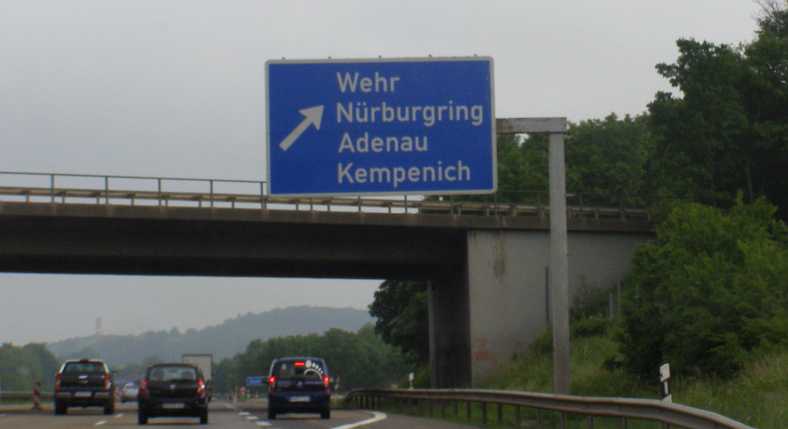
Nuirburgring sign. With my camera still switched on I snapped this sign, the first that indicated the way specifically to the Nurburgring.
The Nurburgring is famous for misty days. That 1962 Grand Prix report made that clear, so being in the Eiffel Mountains on this morning exposed me to the mists of the area. Not heavy mists, but still evident.
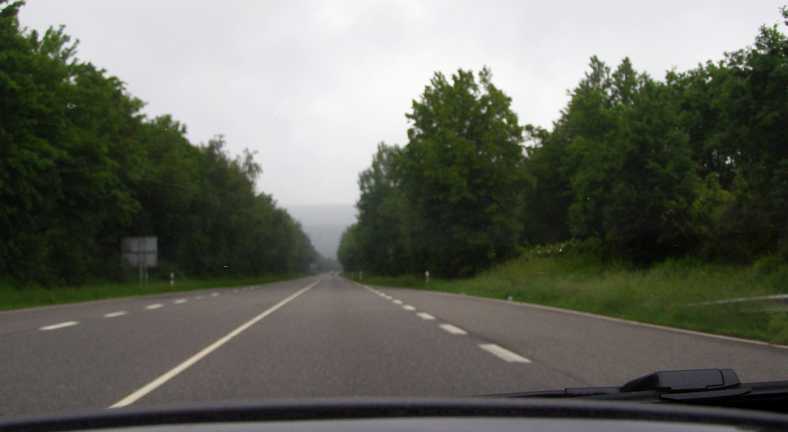
Misty road. Mist and also the heavily-treed surroundings made me feel like I was getting close.
The scenery was passing by as I drove along, with a couple of villages coming into view:
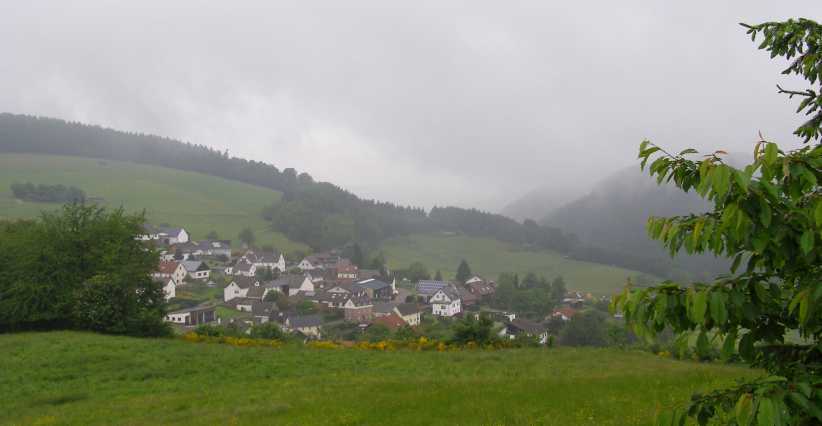
Village in the mist. This is one of the villages I saw off this road, one thing of particular note was the house with the entire roof covered in solar panels, it’s the house near the centre of the pic just left of and partially behind the very obvious white house.
You never know what you’ll find in these places…
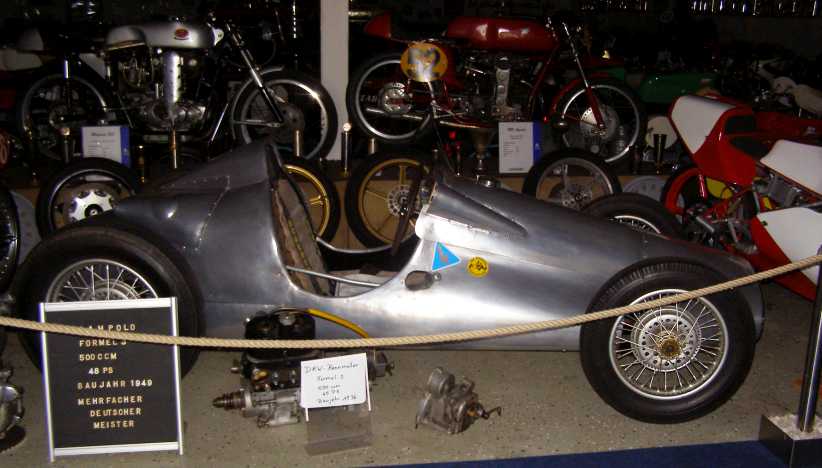
F3 in museum. One of the villages had a tiny racing museum, virtually a big room under a house. I went to have a look, but as it was almost all motorcycles the only thing of interest was this Formula 3 car which I gather won the German F3 championship in 1949.
…but the main target of the day was getting near. As I drove along I saw entrances to the carparks where hundreds of thousands of cars have gathered over the decades to watch some classic races. I soon came to a stop in one of them, thinking I’d take a quick look and then go to the main area near the pits.
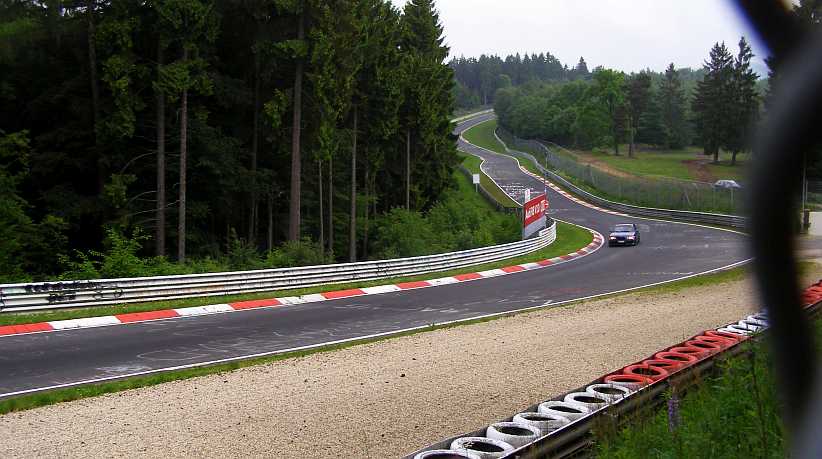
First sight. A quick corner lined with Armco, some gravel trap and lots of chainwire fence, this is Pflanzgarten.
But then I decided to watch for a while, and then to gradually move back along the circuit, stop at various spots and join with others watching people haring around the circuit in all sorts of cars. And on motorcycles…
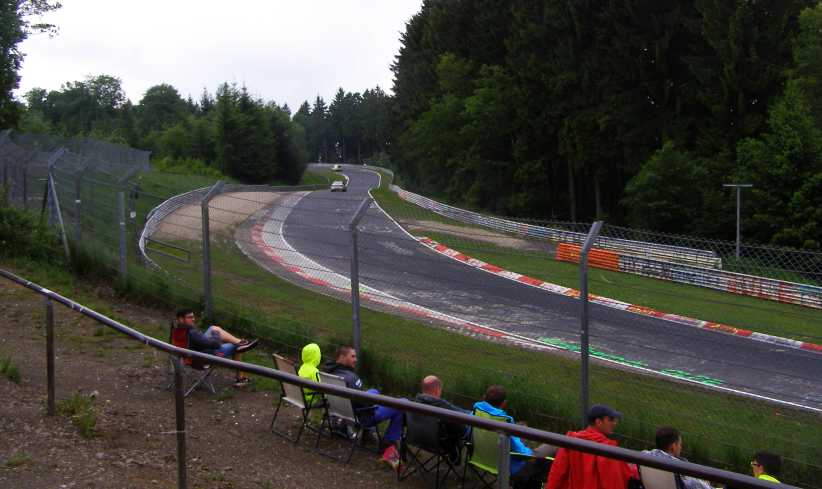
Exiting Pflanzgarten. After Pflanzgarten there’s a quick left-hander as they disappear from sight.
I struck up conversation with some of the people, who came ready to just watch individuals driving around and I tried to learn what might be the cost of doing a lap myself. It wasn’t cheap, but as I watched I kept wondering if I should do that.
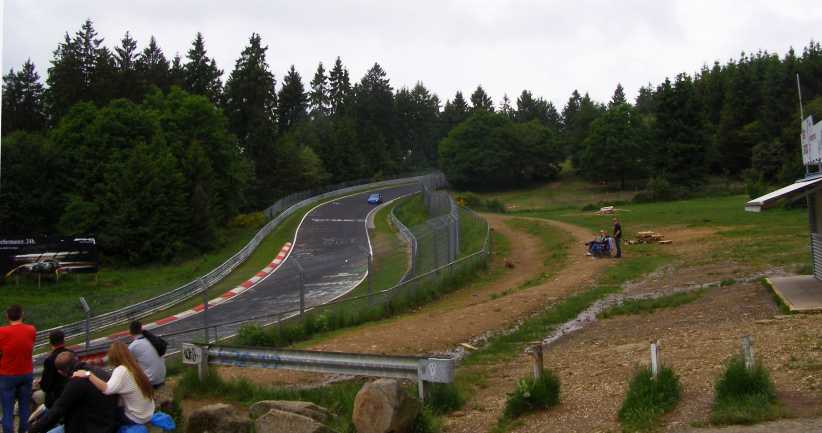
Brunnchen. Note all the painting on the surface? I wonder what’s behind that? I kept moving on.
Not far along I noted one of those things which can make circuits like this so interesting, a crest between corners which can upset visibility not to mention ‘lighten’ a car so turning the corner is more difficult.
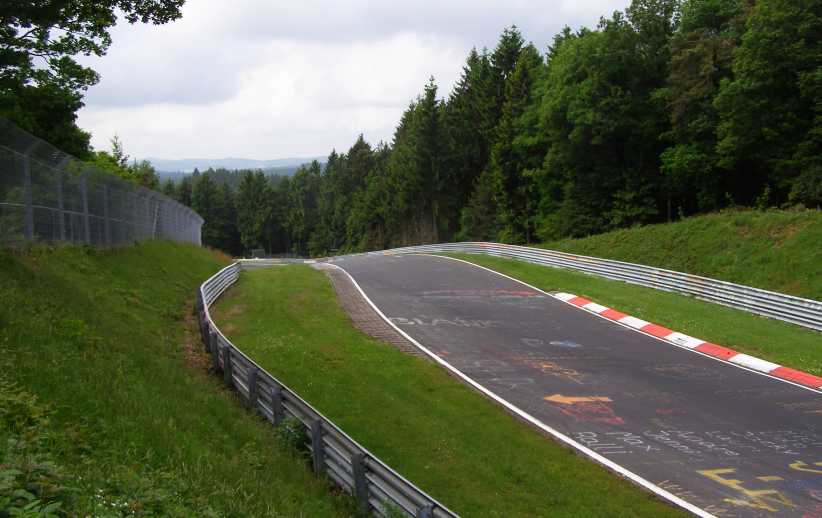
Wippermann. The tricks of the Nurburgring beginning to show with this crest.
The twists and turns continued…
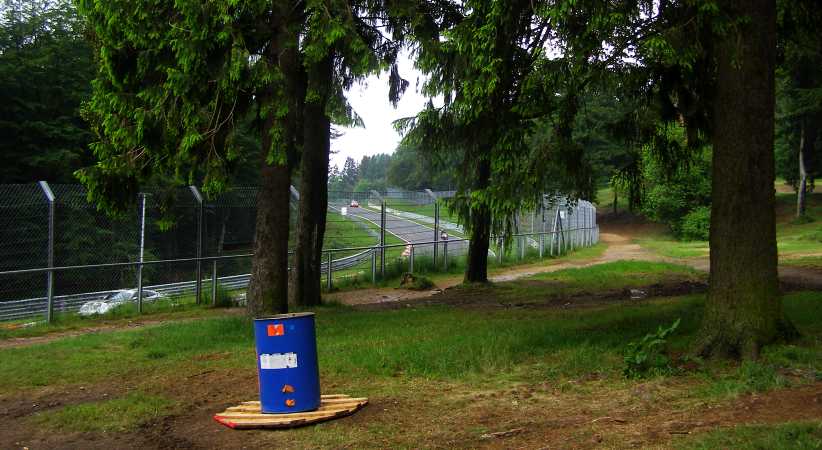
Hedwigshohe. A nice lightly-treed spectator area here looks like it would be a popular place on race days.
… so, too, did the rises and falls…
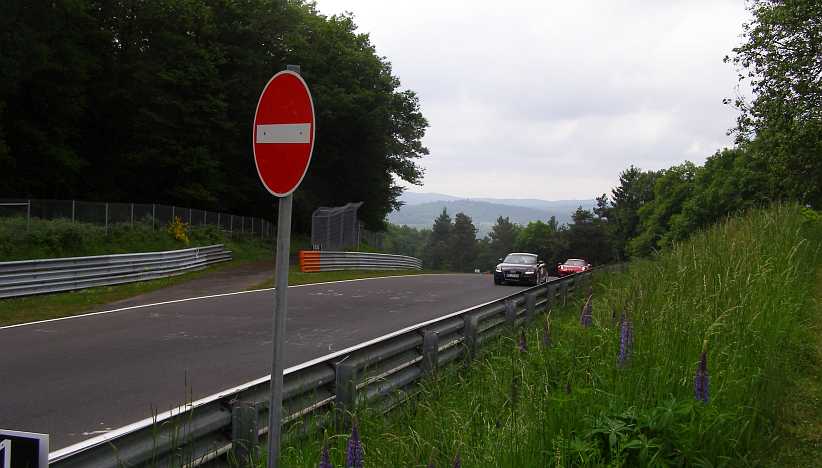
Hohe Acht. Top of the climb up from the Karussell, these cars have to turn right here while the quickest ones will probably becoming a bit ‘light’.
By this time I’d experienced a few silent minutes. The steady string of cars (and a few bikes) would be interrupted and then a tilt tray would come around. Sometimes an ambulance. All of which made me a but more cautious about driving the circuit.
I had no hesitation in believing that I’d be okay out there, even driving quickly, but I didn’t know if the ‘full insurance’ on the little Peugeot would apply here at the Nurburgring, and there was always the concern that one of those BMWs and Porsches which were being driven so close to the limit of adhesion in front of me might get out of control and wrap me up with it.
When I reached the Karussell it was silent, a long break in the traffic. I took note of a team there who were out to use a drone to film a car as it came around this famous bend. As things were very quiet I took time to find out about this and also to find out more about what it might cost. I’ve forgotten the actual prices now, but it wasn’t cheap, and you could pay for either two laps or five laps or something like that. One lap would be all I’d want, really, under these circumstances.
Then a car arrived and drove through the Karussell…
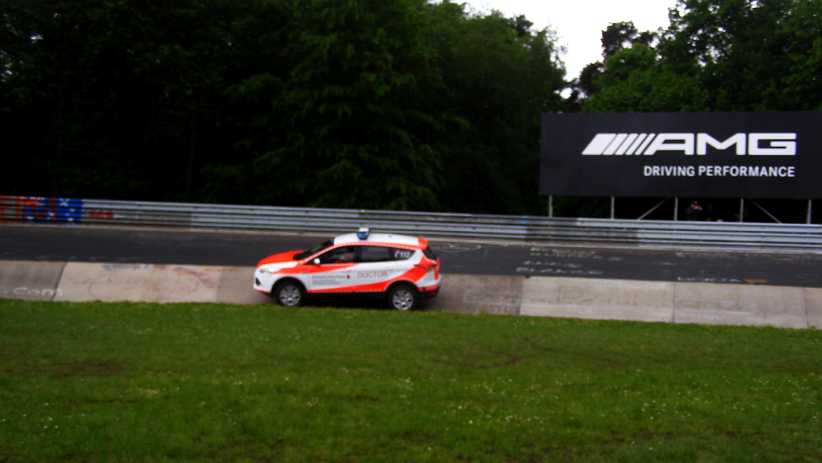
Herr Doctor. There was a reason, it seems, for this long gap in the traffic. Someone was in trouble.
That was the moment when I made up my mind to stay off the circuit, but I continued looking around. This is the run up to the Karussell…
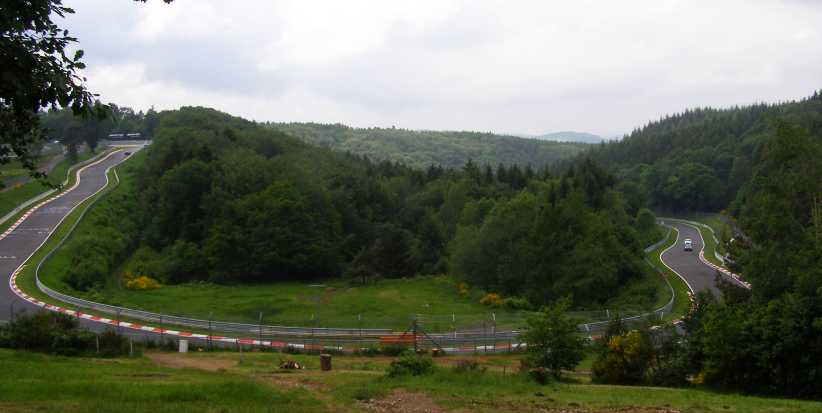
Long run to Karussell. Climbing and curving, this road has seen some famous names since the circuit opened in the early thirties.
…is a great place to imagine the battled between the greats of pre-war times. Included in those stories of long ago is one involving this track…
Connecting track. Between the bend in the picture above and Hohe Acht is a track, it’s now paved nicely, but in times past it probably wasn’t.
…which shows on the map like this:
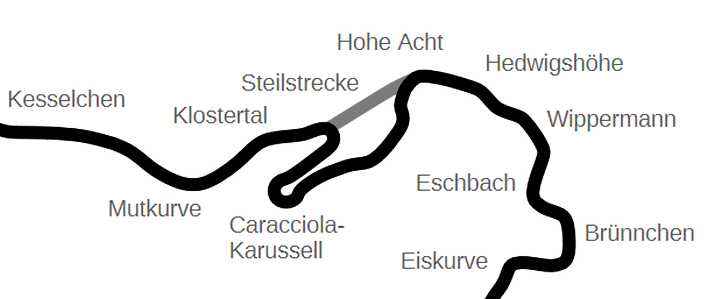
Map. So if this track was in reasonable shape one could save perhaps a full kilometre and also cut out the tight corner at the Karussell.
…where it is said Tazio Nuvolari took the short cut in practice in 1935 to turn in a super-fast lap to demoralise his opposition.
From this point it wasn’t possible to get near the circuit for some distance, so I followed the closest road and got the glimpses I could…
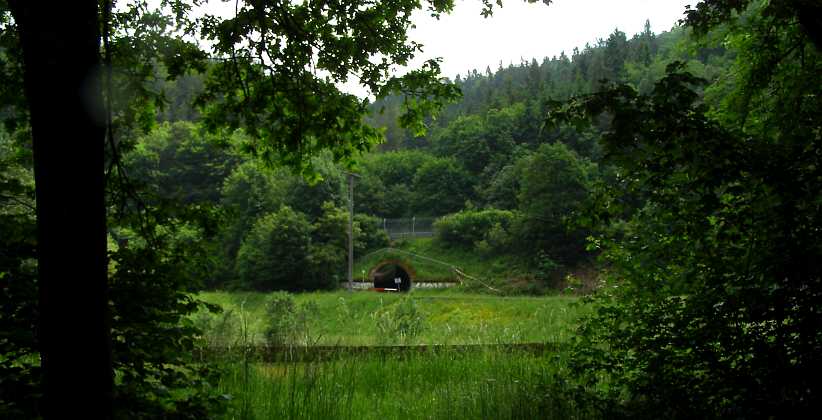
Tunnel. On a circuit this long there are many internal tracks and roads, so access has to be provided. And the chainwire fence lines the lot.
…until I reached the village of Adenau. This place is now seemingly totally dedicated to serving the needs of those people rushing around the circuit on days like this.
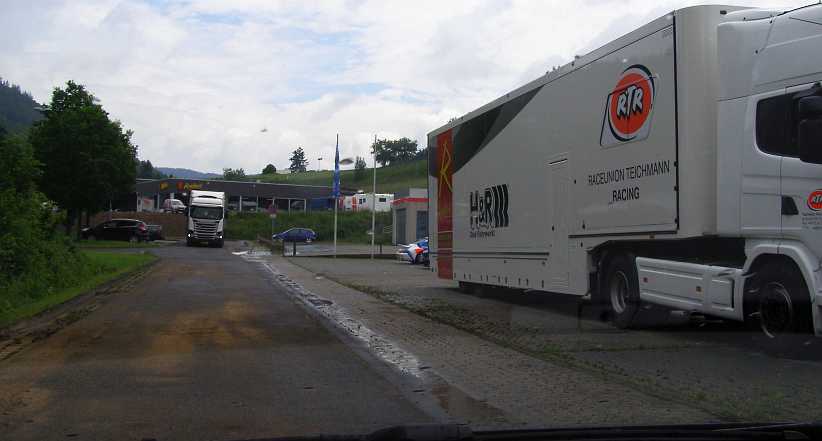
Transporter and garages. At Adenau there were signs that people put a lot of money and effort into doing their laps of the circuit.
Among the garages was one where there are Radicals, lightweight cars powered by engines like those from the Hyabusa motorcycles, very quick cars.
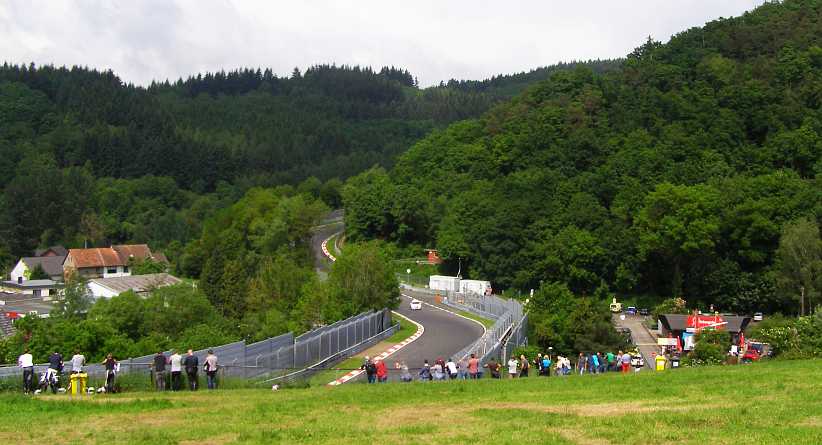
Adenau view. The circuit cuts through the village, though mostly the residential area is on one side of the circuit and the services are on the other. And that car is, indeed, going the wrong way. This was another of those ‘quiet times’ when no cars were going by.
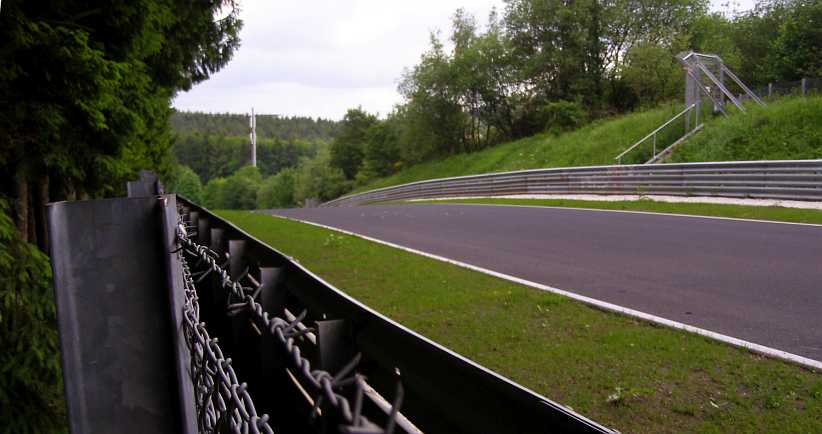
Crest. It’s easy to picture a very fast car getting daylight under its wheels here.
So I continued further along the circuit…
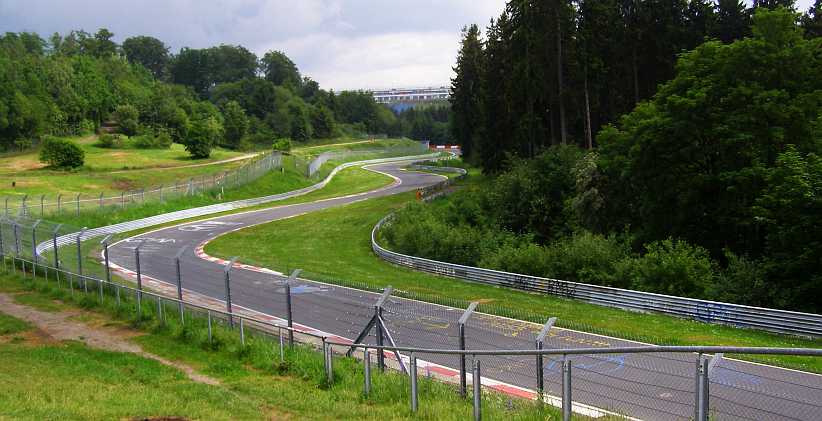
More curves. A nice spectator area here for these curves…
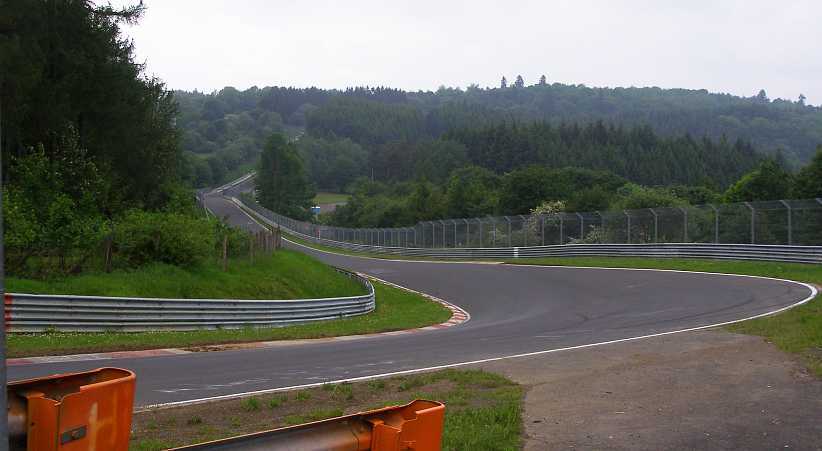
And more. …including some fast ones. No wonder crowds exceeding 300,000 have been able to fit around this circuit on big race days.
Skipping around to the start area I got this shot of the long straight where the cars are sent on their way for their quick laps:
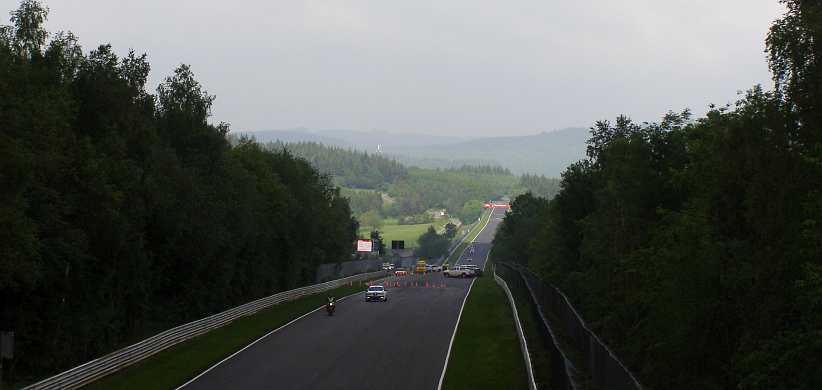
Start. Cars were being sent on their way from this start area, near the end of the long straight which leads to the pit area.
Back at Adenau the ambulance returns to its base after duty…
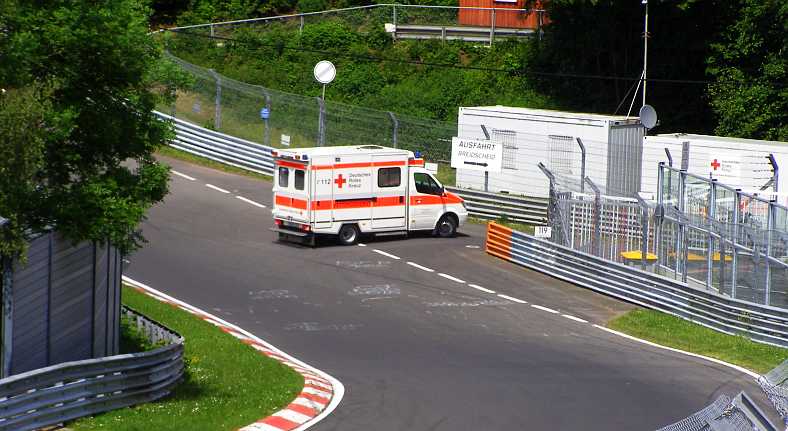
Ambulance. Such things are said to be a regular sight here, one of the reasons for my reticence.
…and soon afterwards this BMW arrived too:
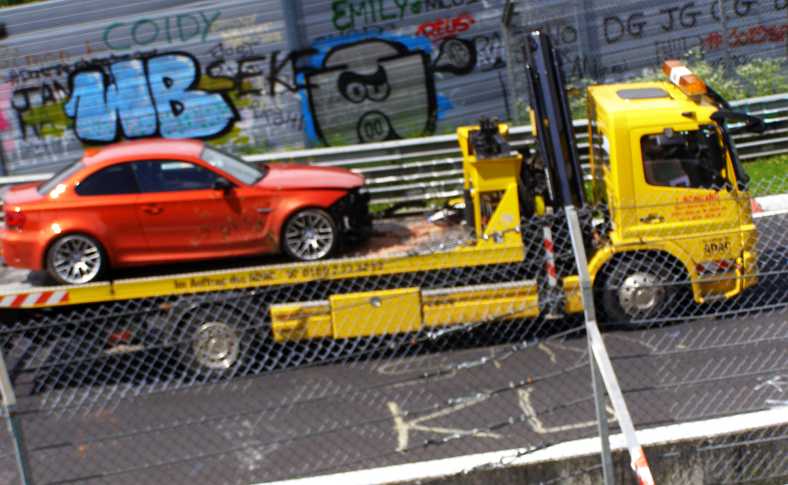
Tilt tray arrival. Probably seen even more often are cars with damage like this. Some, of course, would be much worse.
There are lots of You Tube clips showing crashes from the use of the circuit on non-race days.
The famous Nurburg Castle looks over things…
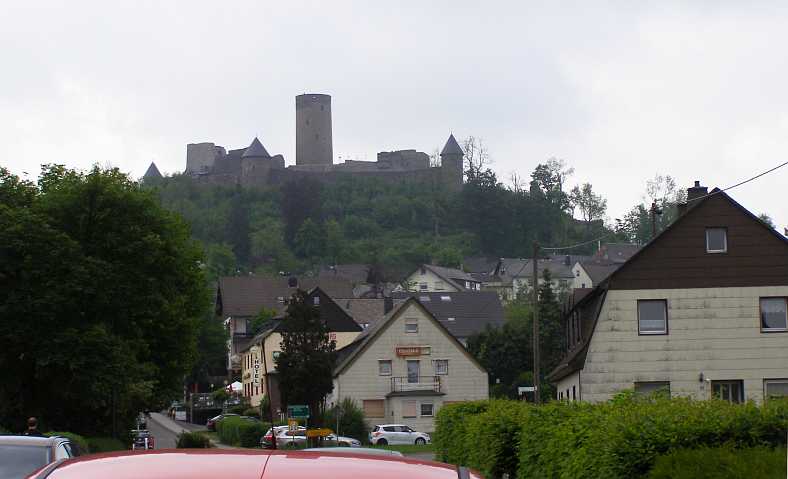
Nurburg Castle. A part of the tradition of the ’ring, the castle at Nurburg has seen many decades of classical racing.
…while the management has built some huge buildings…
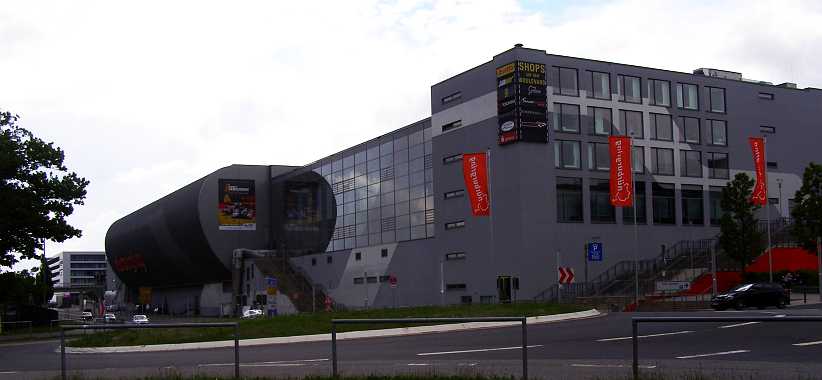
Huge offices. Also ‘technical centres’ the infrastructure is as big as the circuit would appear to demand.
Finally, I departed back along the road on which I arrived, stopping off for one last sighting…
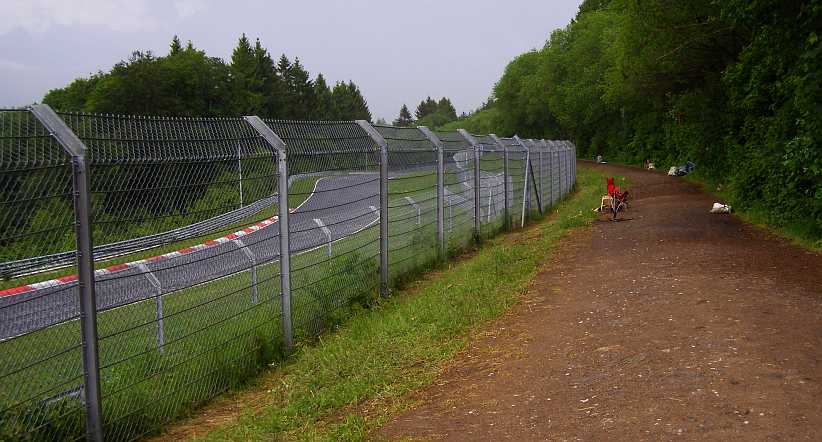
More bends. Yet another spot where people sit to watch the goings-on, not far from the Pflanzgarten. The weather was also closing in.
…before setting the GPS for Spa-Francorchamps. Before long I was onto the Autobahn…
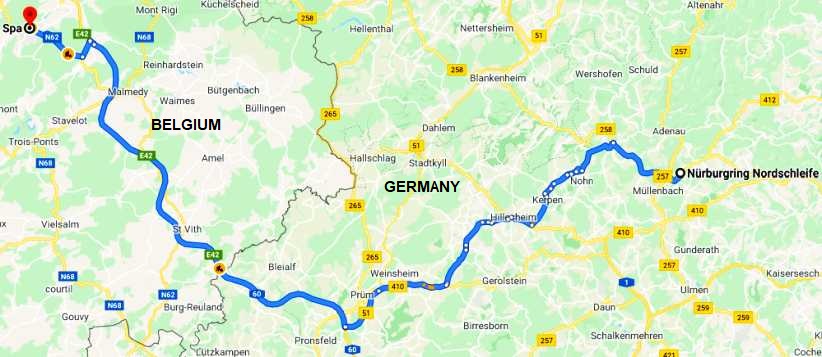
…and it was a quick run to the Belgian border. This sign indicated I had passed that:
Belgium. As I entered Belgium I was going into the sixteenth country of my European drive. It was to prove to be a very pretty place.
Late afternoon and the long shadows probably added to the beauty I was seeing as I drove into the Ardennes…
Belgian beauty. I was struck by the scenery as I drove along the Belgian E42 Motorway.
Villages and farms came into view, along with the long shadows.
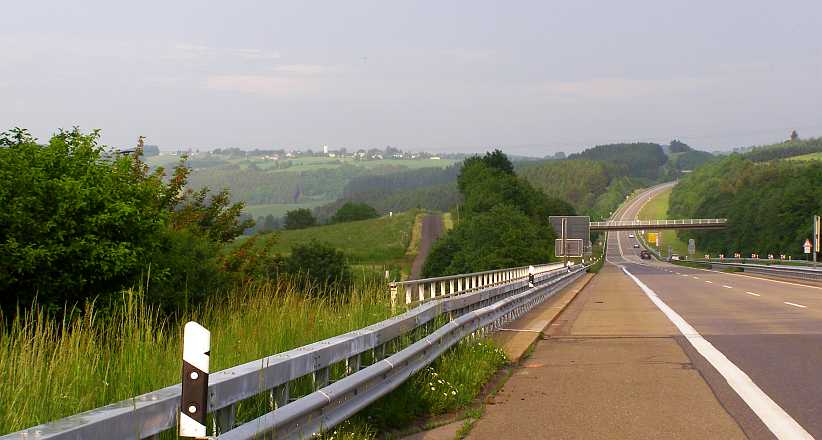
Village, overpass and underpass. Minor roads lead off to farms and villages in the Ardennes countryside.
Not all bridges are equal, however, one was a very tall bridge and it simply forced me to stop and take photos of the farms beneath it:
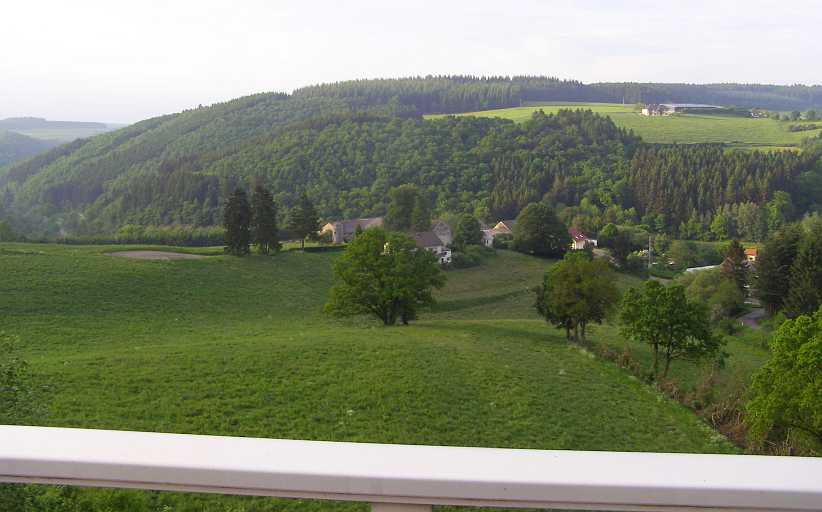
Under the bridge. Some farms and homes nestling in the trees beneath the motorway bridge, with a valley stretch off into the distance. A part of the Ardennes beauty that made me comment later it was the prettiest part of Europe I saw.
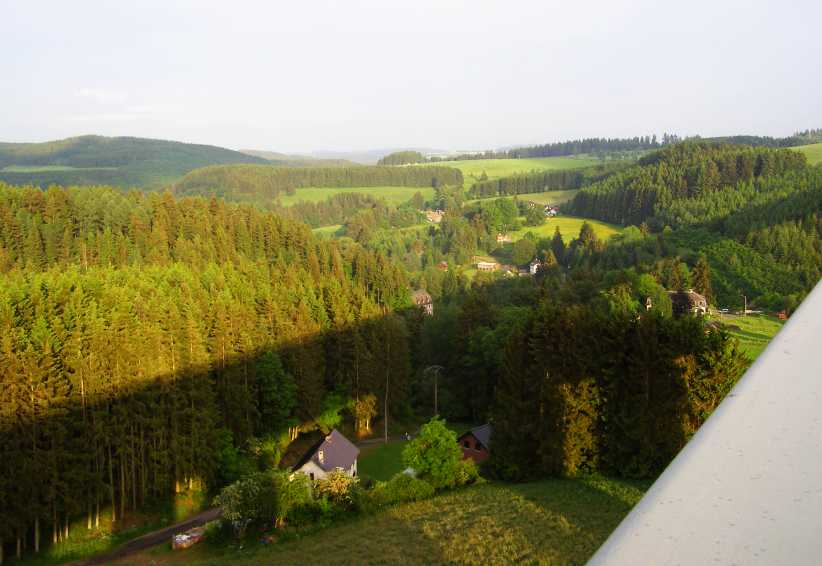
More spectacular. With the strong light of the setting sun throwing shadows over this area, it was truly spectacular to see.
I stopped briefly at a rest area along this way, then proceeded to find the Spa-Francorchamps circuit which had long been another circuit I’d desired to visit.
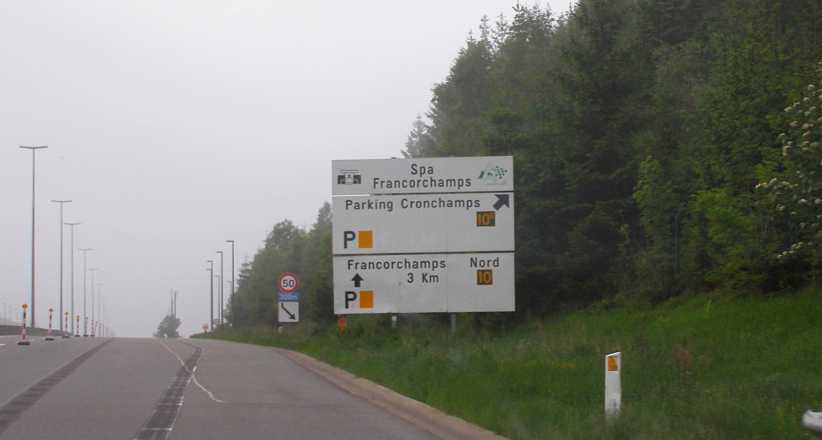
Spa sign. This sign was the indication I was almost there. It was most welcome on this late Saturday afternoon.
The circuit I wanted to see, however, was not the one used today. In times past the Spa circuit was over eight and a half miles long and reached out via everyday roads to run through three villages, Burnenville, Masta and Stavelot.
I reached it and identified the roads I needed to follow, but it was getting too late to take photos. What I was able to do next was quite a surprise to me as I realised I was going to have to await the morning to get those photos.
The next post will cover that surprise as well as the circuit…
Over the years it’s become something of a strong desire to see the circuit, and now I was headed in that direction. The running was certainly easier than it had been the previous afternoon and evening, traffic light.
I don’t know where I took this photo. In fact, because the photos I took after I left the Mercedes Museum were on a fresh memory card, and that card corrupted. I had to recover it and when it was recovered it’s very clear some photos are out of order. This, indeed, might be one of them, but if it isn’t it fits into the morning I was driving towards the Nurburgring:
This photo, certainly, was taken along that road. I remember seeing this Mercedes 300 Cabriolet and recalling that the one in the museum had a note that very few were built. I don’t recall the numbers, but it was very low, total production of the 300 models, sedans, coupes and all, was between 12,000 and 13,000 over about ten years.
Rarety. Like the Cobra Daytona, I guess you’d have to say it was only by remote chance that I saw this rare Mercedes on the tilt tray truck.
And this was getting close to the Nurburgring, too…
Nuirburgring sign. With my camera still switched on I snapped this sign, the first that indicated the way specifically to the Nurburgring.
The Nurburgring is famous for misty days. That 1962 Grand Prix report made that clear, so being in the Eiffel Mountains on this morning exposed me to the mists of the area. Not heavy mists, but still evident.
Misty road. Mist and also the heavily-treed surroundings made me feel like I was getting close.
The scenery was passing by as I drove along, with a couple of villages coming into view:
Village in the mist. This is one of the villages I saw off this road, one thing of particular note was the house with the entire roof covered in solar panels, it’s the house near the centre of the pic just left of and partially behind the very obvious white house.
You never know what you’ll find in these places…
F3 in museum. One of the villages had a tiny racing museum, virtually a big room under a house. I went to have a look, but as it was almost all motorcycles the only thing of interest was this Formula 3 car which I gather won the German F3 championship in 1949.
…but the main target of the day was getting near. As I drove along I saw entrances to the carparks where hundreds of thousands of cars have gathered over the decades to watch some classic races. I soon came to a stop in one of them, thinking I’d take a quick look and then go to the main area near the pits.
First sight. A quick corner lined with Armco, some gravel trap and lots of chainwire fence, this is Pflanzgarten.
But then I decided to watch for a while, and then to gradually move back along the circuit, stop at various spots and join with others watching people haring around the circuit in all sorts of cars. And on motorcycles…
Exiting Pflanzgarten. After Pflanzgarten there’s a quick left-hander as they disappear from sight.
I struck up conversation with some of the people, who came ready to just watch individuals driving around and I tried to learn what might be the cost of doing a lap myself. It wasn’t cheap, but as I watched I kept wondering if I should do that.
Brunnchen. Note all the painting on the surface? I wonder what’s behind that? I kept moving on.
Not far along I noted one of those things which can make circuits like this so interesting, a crest between corners which can upset visibility not to mention ‘lighten’ a car so turning the corner is more difficult.
Wippermann. The tricks of the Nurburgring beginning to show with this crest.
The twists and turns continued…
Hedwigshohe. A nice lightly-treed spectator area here looks like it would be a popular place on race days.
… so, too, did the rises and falls…
Hohe Acht. Top of the climb up from the Karussell, these cars have to turn right here while the quickest ones will probably becoming a bit ‘light’.
By this time I’d experienced a few silent minutes. The steady string of cars (and a few bikes) would be interrupted and then a tilt tray would come around. Sometimes an ambulance. All of which made me a but more cautious about driving the circuit.
I had no hesitation in believing that I’d be okay out there, even driving quickly, but I didn’t know if the ‘full insurance’ on the little Peugeot would apply here at the Nurburgring, and there was always the concern that one of those BMWs and Porsches which were being driven so close to the limit of adhesion in front of me might get out of control and wrap me up with it.
When I reached the Karussell it was silent, a long break in the traffic. I took note of a team there who were out to use a drone to film a car as it came around this famous bend. As things were very quiet I took time to find out about this and also to find out more about what it might cost. I’ve forgotten the actual prices now, but it wasn’t cheap, and you could pay for either two laps or five laps or something like that. One lap would be all I’d want, really, under these circumstances.
Then a car arrived and drove through the Karussell…
Herr Doctor. There was a reason, it seems, for this long gap in the traffic. Someone was in trouble.
That was the moment when I made up my mind to stay off the circuit, but I continued looking around. This is the run up to the Karussell…
Long run to Karussell. Climbing and curving, this road has seen some famous names since the circuit opened in the early thirties.
…is a great place to imagine the battled between the greats of pre-war times. Included in those stories of long ago is one involving this track…
Connecting track. Between the bend in the picture above and Hohe Acht is a track, it’s now paved nicely, but in times past it probably wasn’t.
…which shows on the map like this:
Map. So if this track was in reasonable shape one could save perhaps a full kilometre and also cut out the tight corner at the Karussell.
…where it is said Tazio Nuvolari took the short cut in practice in 1935 to turn in a super-fast lap to demoralise his opposition.
From this point it wasn’t possible to get near the circuit for some distance, so I followed the closest road and got the glimpses I could…
Tunnel. On a circuit this long there are many internal tracks and roads, so access has to be provided. And the chainwire fence lines the lot.
…until I reached the village of Adenau. This place is now seemingly totally dedicated to serving the needs of those people rushing around the circuit on days like this.
Transporter and garages. At Adenau there were signs that people put a lot of money and effort into doing their laps of the circuit.
Among the garages was one where there are Radicals, lightweight cars powered by engines like those from the Hyabusa motorcycles, very quick cars.
Adenau view. The circuit cuts through the village, though mostly the residential area is on one side of the circuit and the services are on the other. And that car is, indeed, going the wrong way. This was another of those ‘quiet times’ when no cars were going by.
Crest. It’s easy to picture a very fast car getting daylight under its wheels here.
So I continued further along the circuit…
More curves. A nice spectator area here for these curves…
And more. …including some fast ones. No wonder crowds exceeding 300,000 have been able to fit around this circuit on big race days.
Skipping around to the start area I got this shot of the long straight where the cars are sent on their way for their quick laps:
Start. Cars were being sent on their way from this start area, near the end of the long straight which leads to the pit area.
Back at Adenau the ambulance returns to its base after duty…
Ambulance. Such things are said to be a regular sight here, one of the reasons for my reticence.
…and soon afterwards this BMW arrived too:
Tilt tray arrival. Probably seen even more often are cars with damage like this. Some, of course, would be much worse.
There are lots of You Tube clips showing crashes from the use of the circuit on non-race days.
The famous Nurburg Castle looks over things…
Nurburg Castle. A part of the tradition of the ’ring, the castle at Nurburg has seen many decades of classical racing.
…while the management has built some huge buildings…
Huge offices. Also ‘technical centres’ the infrastructure is as big as the circuit would appear to demand.
Finally, I departed back along the road on which I arrived, stopping off for one last sighting…
More bends. Yet another spot where people sit to watch the goings-on, not far from the Pflanzgarten. The weather was also closing in.
…before setting the GPS for Spa-Francorchamps. Before long I was onto the Autobahn…
…and it was a quick run to the Belgian border. This sign indicated I had passed that:
Belgium. As I entered Belgium I was going into the sixteenth country of my European drive. It was to prove to be a very pretty place.
Late afternoon and the long shadows probably added to the beauty I was seeing as I drove into the Ardennes…
Belgian beauty. I was struck by the scenery as I drove along the Belgian E42 Motorway.
Villages and farms came into view, along with the long shadows.
Village, overpass and underpass. Minor roads lead off to farms and villages in the Ardennes countryside.
Not all bridges are equal, however, one was a very tall bridge and it simply forced me to stop and take photos of the farms beneath it:
Under the bridge. Some farms and homes nestling in the trees beneath the motorway bridge, with a valley stretch off into the distance. A part of the Ardennes beauty that made me comment later it was the prettiest part of Europe I saw.
More spectacular. With the strong light of the setting sun throwing shadows over this area, it was truly spectacular to see.
I stopped briefly at a rest area along this way, then proceeded to find the Spa-Francorchamps circuit which had long been another circuit I’d desired to visit.
Spa sign. This sign was the indication I was almost there. It was most welcome on this late Saturday afternoon.
The circuit I wanted to see, however, was not the one used today. In times past the Spa circuit was over eight and a half miles long and reached out via everyday roads to run through three villages, Burnenville, Masta and Stavelot.
I reached it and identified the roads I needed to follow, but it was getting too late to take photos. What I was able to do next was quite a surprise to me as I realised I was going to have to await the morning to get those photos.
The next post will cover that surprise as well as the circuit…
Last edited by Ray Bell; May 16, 2020 at 11:02 PM.
Thread Starter
|
Captain
Joined: Oct 2005
Posts: 568
Likes: 8
From: The Summit, Queensland, Australia
Having done a drive-around in the encroaching twilight, I finished up at the end of this road. Now, here I’m talking about the road which made up the circuit back in the fifties, sixties and seventies. It’s all public road, but it also used roads which are not now accessible as they are part of the modern-day permanent circuit.
On this Oscar Plada circuit map I’ve marked the main points, and I’ve marked the two ‘gates’ which define where the road has been closed off for the modern circuit.
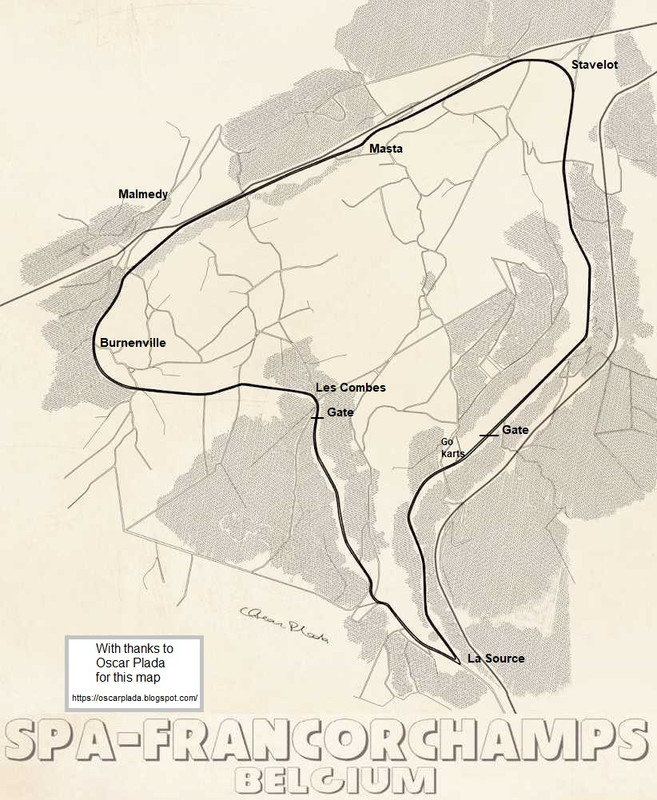
When I reached this point after driving through Burnenville and Masta and Stavelot I decided to go exploring. The side entry road went under a tunnel beneath the new circuit and into the carpark for a go-kart circuit, and the parking area had plenty of occupants.
In the paddock area there were tents set up and people were milling around, some working on cars, women chasing children to feed them their dinner, barbecues were operating and generally it all looked like a good place for me to go to join in the fun. I had noticed the vans in the carpark had numberplates from the Netherlands, and motifs painted across them with drivers’ names tied to ‘go-kart racing.’
I soon learned that it was a round of the Dutch National Championship for go-karts. But the surprising part was that it was those children who were being rounded up for dinner who were the drivers! Six to eight-year-olds and nine and ten-year-olds…
…who finally ate their food as their fathers were busy in the tents, go-karts were up on stands and expensive-looking laser wheel alignment equipment was being used to make sure they had the front ends straight. “Yes, for the first corner crash, I thought to myself.”
In one tent where I got thoroughly involved in conversation with the father and uncle of one of the kids…
…the mother came in and offered me something to eat, so that was a pleasant surprise and not to be knocked back. All in all it was a pleasant evening and I slept in the car in the carpark there.
I awoke early and wandered around again, this time I went up to have a look at the go-kart circuit. But more evident than that was a billboard in the marshalling area, which I thought was amazing. It had been just two weeks since Max Verstappen had become the first Dutchman to win a World Championship race and already they had this prepared:

Then it was time for me to go off on my photographic mission. I drove right to the other end of the old road section, but stopped off on the way as I had now identified the spot at which this photo was taken:
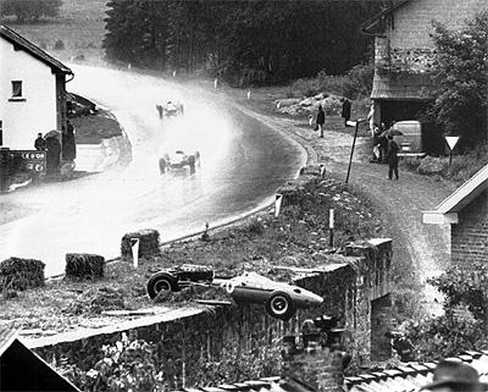
That was during the 1966 Belgian Grand Prix, when a cloudburst on one end of the circuit just as the race began in completely dry conditions at the other end. Many cars spun off and/or crashed, this one is the Cooper Maserati of Jo Bonnier, the photo was posted on the Nostalgia Forum about twenty years ago.
At Burnenville here I photographed what I thought might be the spot, though I hadn’t seen the original pic in a long time and I wasn’t yet completely absolutely convinced…
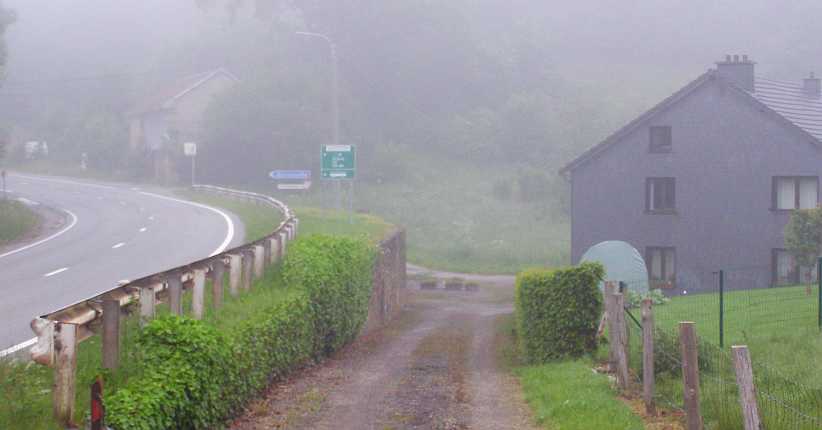
And then I drove to the gate above the present-day Raidillon at Les Combes, turned around and started taking my photographic record of what was once one of the most exciting circuits in the world. And the fastest, its 8.6 miles were covered at tremendous speed by the brave pilots of the fifties, sixties and seventies. This gate…
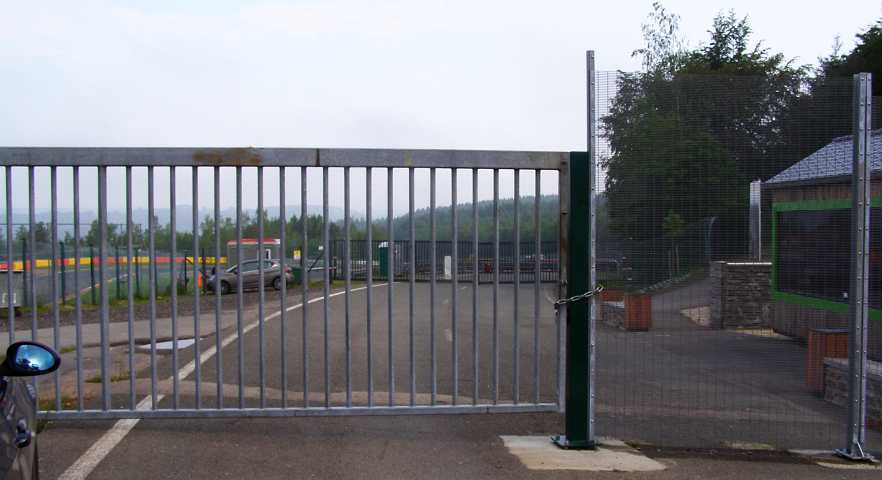
…now provides the line of demarcation, the new circuit is seen going off to the left here after the climb from the Raidillon. On the real circuit, however, this lefthander…
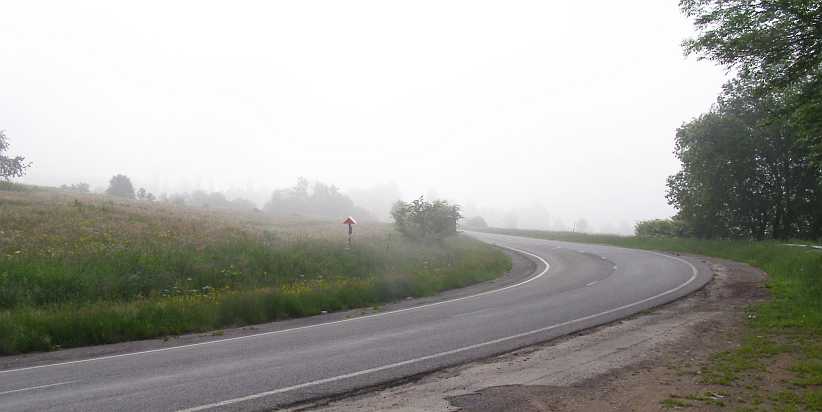
…started the run to Burnenville rolling. As can be seen, I had shot myself in the foot skipping this the previous evening as now I had to do it in misty conditions. The ensuing straight now has a roundabout disturbing the smooth flow that once allowed full throttle for miles along here…
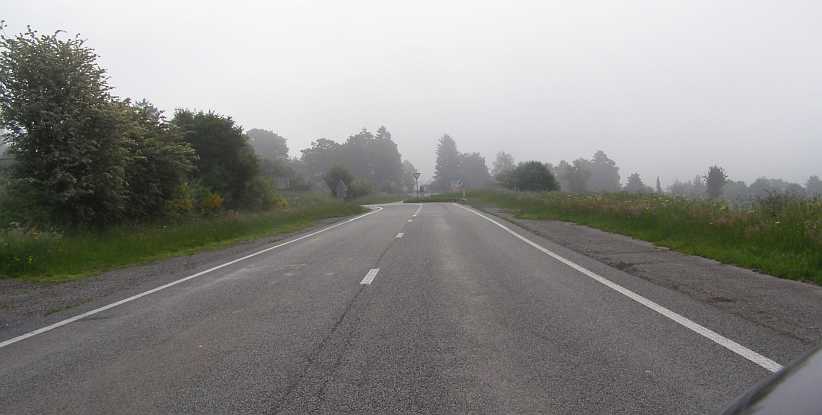
…full throttle running being a feature of this older version of the Spa-Francorchamps circuit. A left-hander comes up…
…followed by a right. Both of these bends would have been taken flat out by the quickest drivers, maybe a ‘confidence lift’ from the second-string driver…
…and holding it flat through them meant speed kept on increasing for this straight which led to…
…the long, long sweeping right-hander through Burnenville…
…which went between fields and past houses…
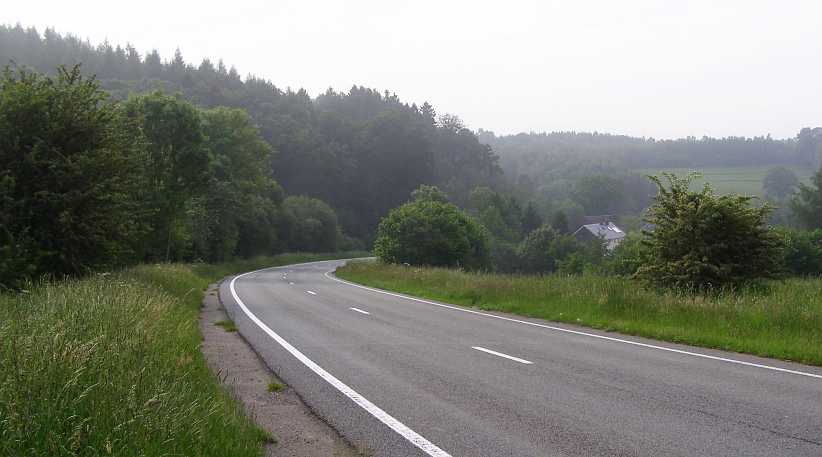
…and if you look at the map it just keeps on curving around. This pic is leading to the area where I’d taken that photo earlier:
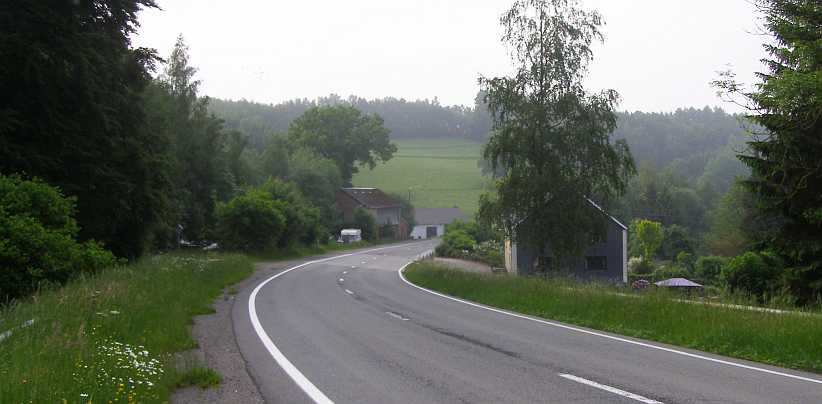
The final part of the Burnenville curve, where the road has reached the bottom of the hill and starts to climb a little again…
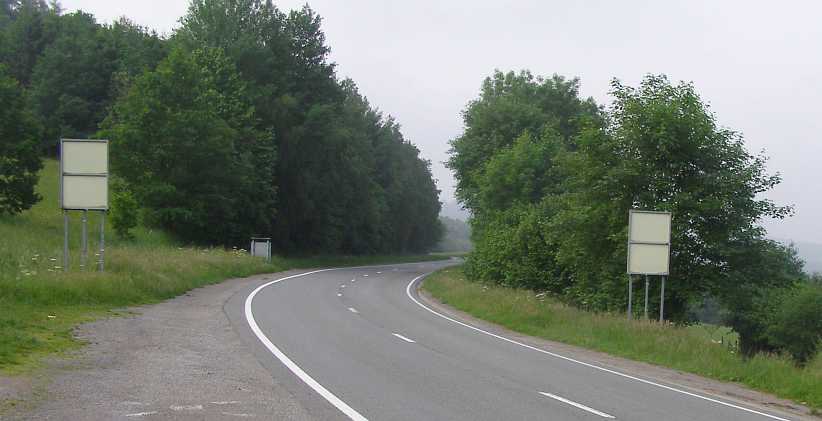
…with a short straight leading to a fast ess-bend…
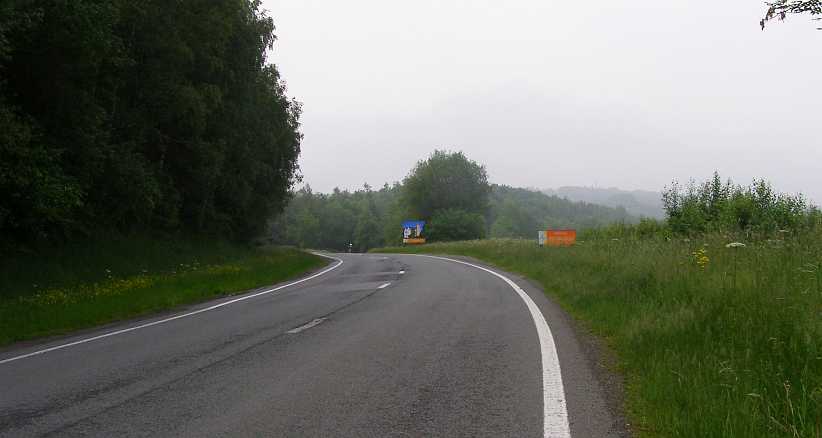
…a left, then a right…
…which leads to the straight towards Malmedy…
…which is much-changed to cater for modern traffic conditons:
They’ve created ‘traffic calming’ islands and diversions here to create safety, but you can see how this once was a straight run through:
And now we’re heading towards Masta and the famous Masta Kink. A very fast straight…
…went for a long way, with the left-hander part of the ‘kink’ in the distance…
…with this left and right, again, taken flat out by the top drivers. Do you think you would?
On the exit this building comes close to the road…
…but speed must be maintained for a quick lap time…
…and continued full-throttle down this hill, easing back (perhaps)…
…for this curve, just before which we see a road go off, that leads into a railway underpass as the railway follows the line along this part of the circuit. We are now heading into Stavelot:
This is where the Belgians got into the ‘oneupmanship’ game begun in the thirties. As speeds rose in motor racing, there was another ‘race’ developing, with circuits trying to become the fastest in Europe. There was Reims, Monza and Spa in the running.
To that end, the Belgians put a new road in so that what was originally a hairpin at Stavelot was bypassed in 1947, shortening the circuit a little and creating a reasonably fast and slightly banked curve to join the run from Masta to the road to Blanchimont. The speeds certainly rose, and alarmingly so as wider tyres, wings and big power came in the late sixties and early seventies. The final lap record was somewhere around 162mph.
From the point where the turnoff went right, above, the curve flowed smoothly…
…and came out on the straight road which came from the old hairpin:
After this straight…
…came La Carriere…
…which was very fast, once again, as was the second part…
…with another right kink to follow…
…and still another…
…with this last one onto this straight…
…followed by another long turn to the right…
…before the straight that leads to the gate and…
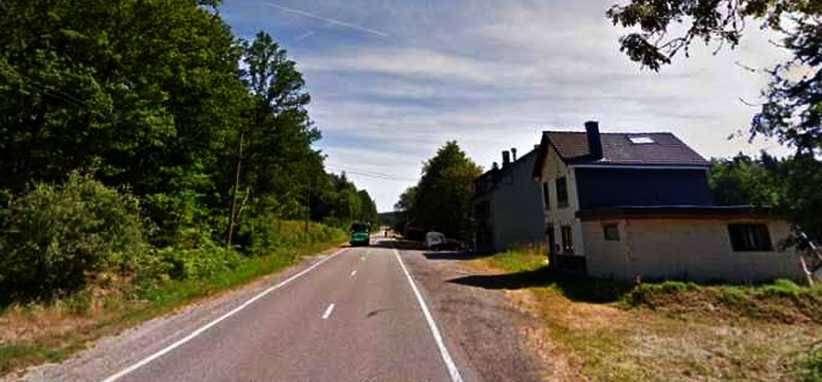
…the road which goes down to the tunnel to the go-kart track:
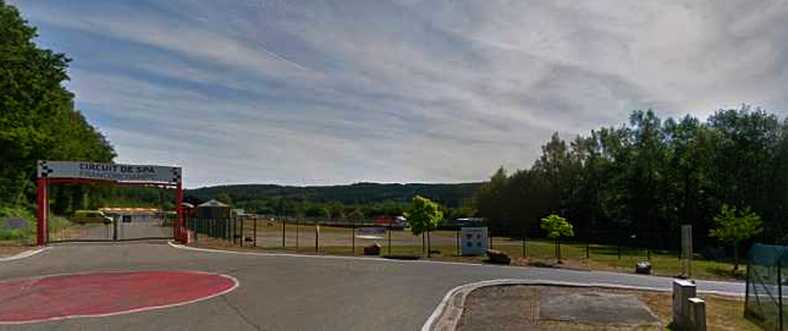
Those last pics I had to rely on Google Earth street view, not realising I hadn’t photographed them.
I was still looking to see if I had the right spot for my site for Jo Bonnier’s 1966 experience, and when I was convinced the one at Burnenville was it I went back and photographed the tunnel under the road from the other side:
Note that the sun was now breaking well and truly through the morning mist. I wanted to get rolling, with a desire to get through Liege and into Holland before the afternoon was out. But I decided to have a bit more of a look around this area and ultimately I was so glad I did.
So I went back to the road to Malmedy and went exploring…
On this Oscar Plada circuit map I’ve marked the main points, and I’ve marked the two ‘gates’ which define where the road has been closed off for the modern circuit.
When I reached this point after driving through Burnenville and Masta and Stavelot I decided to go exploring. The side entry road went under a tunnel beneath the new circuit and into the carpark for a go-kart circuit, and the parking area had plenty of occupants.
In the paddock area there were tents set up and people were milling around, some working on cars, women chasing children to feed them their dinner, barbecues were operating and generally it all looked like a good place for me to go to join in the fun. I had noticed the vans in the carpark had numberplates from the Netherlands, and motifs painted across them with drivers’ names tied to ‘go-kart racing.’
I soon learned that it was a round of the Dutch National Championship for go-karts. But the surprising part was that it was those children who were being rounded up for dinner who were the drivers! Six to eight-year-olds and nine and ten-year-olds…
…who finally ate their food as their fathers were busy in the tents, go-karts were up on stands and expensive-looking laser wheel alignment equipment was being used to make sure they had the front ends straight. “Yes, for the first corner crash, I thought to myself.”
In one tent where I got thoroughly involved in conversation with the father and uncle of one of the kids…
…the mother came in and offered me something to eat, so that was a pleasant surprise and not to be knocked back. All in all it was a pleasant evening and I slept in the car in the carpark there.
I awoke early and wandered around again, this time I went up to have a look at the go-kart circuit. But more evident than that was a billboard in the marshalling area, which I thought was amazing. It had been just two weeks since Max Verstappen had become the first Dutchman to win a World Championship race and already they had this prepared:
Then it was time for me to go off on my photographic mission. I drove right to the other end of the old road section, but stopped off on the way as I had now identified the spot at which this photo was taken:
That was during the 1966 Belgian Grand Prix, when a cloudburst on one end of the circuit just as the race began in completely dry conditions at the other end. Many cars spun off and/or crashed, this one is the Cooper Maserati of Jo Bonnier, the photo was posted on the Nostalgia Forum about twenty years ago.
At Burnenville here I photographed what I thought might be the spot, though I hadn’t seen the original pic in a long time and I wasn’t yet completely absolutely convinced…
And then I drove to the gate above the present-day Raidillon at Les Combes, turned around and started taking my photographic record of what was once one of the most exciting circuits in the world. And the fastest, its 8.6 miles were covered at tremendous speed by the brave pilots of the fifties, sixties and seventies. This gate…
…now provides the line of demarcation, the new circuit is seen going off to the left here after the climb from the Raidillon. On the real circuit, however, this lefthander…
…started the run to Burnenville rolling. As can be seen, I had shot myself in the foot skipping this the previous evening as now I had to do it in misty conditions. The ensuing straight now has a roundabout disturbing the smooth flow that once allowed full throttle for miles along here…
…full throttle running being a feature of this older version of the Spa-Francorchamps circuit. A left-hander comes up…
…followed by a right. Both of these bends would have been taken flat out by the quickest drivers, maybe a ‘confidence lift’ from the second-string driver…
…and holding it flat through them meant speed kept on increasing for this straight which led to…
…the long, long sweeping right-hander through Burnenville…
…which went between fields and past houses…
…and if you look at the map it just keeps on curving around. This pic is leading to the area where I’d taken that photo earlier:
The final part of the Burnenville curve, where the road has reached the bottom of the hill and starts to climb a little again…
…with a short straight leading to a fast ess-bend…
…a left, then a right…
…which leads to the straight towards Malmedy…
…which is much-changed to cater for modern traffic conditons:
They’ve created ‘traffic calming’ islands and diversions here to create safety, but you can see how this once was a straight run through:
And now we’re heading towards Masta and the famous Masta Kink. A very fast straight…
…went for a long way, with the left-hander part of the ‘kink’ in the distance…
…with this left and right, again, taken flat out by the top drivers. Do you think you would?
On the exit this building comes close to the road…
…but speed must be maintained for a quick lap time…
…and continued full-throttle down this hill, easing back (perhaps)…
…for this curve, just before which we see a road go off, that leads into a railway underpass as the railway follows the line along this part of the circuit. We are now heading into Stavelot:
This is where the Belgians got into the ‘oneupmanship’ game begun in the thirties. As speeds rose in motor racing, there was another ‘race’ developing, with circuits trying to become the fastest in Europe. There was Reims, Monza and Spa in the running.
To that end, the Belgians put a new road in so that what was originally a hairpin at Stavelot was bypassed in 1947, shortening the circuit a little and creating a reasonably fast and slightly banked curve to join the run from Masta to the road to Blanchimont. The speeds certainly rose, and alarmingly so as wider tyres, wings and big power came in the late sixties and early seventies. The final lap record was somewhere around 162mph.
From the point where the turnoff went right, above, the curve flowed smoothly…
…and came out on the straight road which came from the old hairpin:
After this straight…
…came La Carriere…
…which was very fast, once again, as was the second part…
…with another right kink to follow…
…and still another…
…with this last one onto this straight…
…followed by another long turn to the right…
…before the straight that leads to the gate and…
…the road which goes down to the tunnel to the go-kart track:
Those last pics I had to rely on Google Earth street view, not realising I hadn’t photographed them.
I was still looking to see if I had the right spot for my site for Jo Bonnier’s 1966 experience, and when I was convinced the one at Burnenville was it I went back and photographed the tunnel under the road from the other side:
Note that the sun was now breaking well and truly through the morning mist. I wanted to get rolling, with a desire to get through Liege and into Holland before the afternoon was out. But I decided to have a bit more of a look around this area and ultimately I was so glad I did.
So I went back to the road to Malmedy and went exploring…
Last edited by Ray Bell; May 30, 2020 at 08:15 PM.
Thread Starter
|
Captain
Joined: Oct 2005
Posts: 568
Likes: 8
From: The Summit, Queensland, Australia
Malmedy and Stavelot are very old towns. Like much of Europe, they've had wars fought all around and through them, but also like so many they have bounced back and have covered the scars. And within the town of Stavelot is a little museum related to cars and the racing on the nearby circuit. One way to get there from the circuit is via this underpass between Masta and Blanchimont…
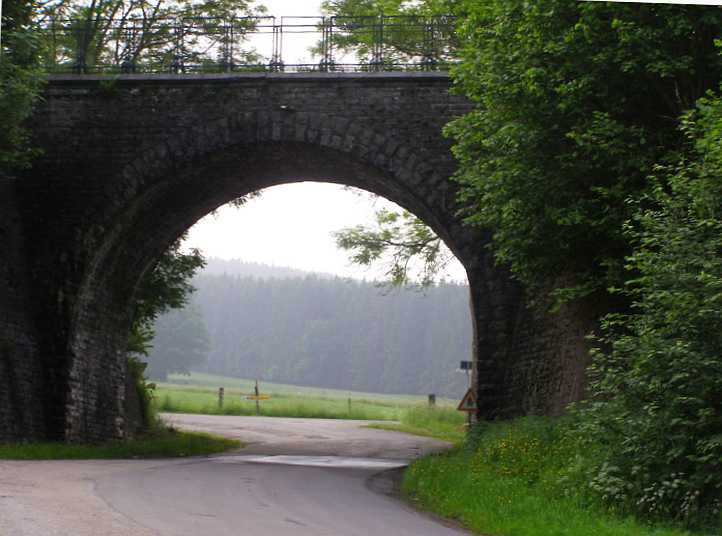
It's a railway line which follows along that side of the circuit all the way from Malmedy to Stavelot. I drove into the area where the museum is located and there was a lot of parking space. Surprising me was the RAM pickup parked among the other cars:
The museum was in the basement of a building, the charge for admission wasn’t too bad, five or six Euros, and I was to come away thinking it was good value.
The Belgians showed great pride here in the FN marque, First, with this 1912 model car…
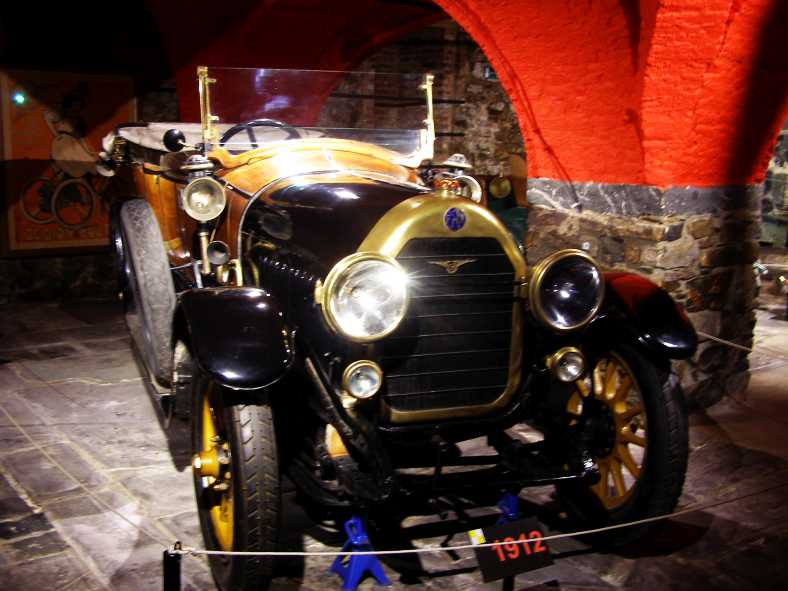
…and with these motorcycles, which looked very interesting examples. Note the foot pedals…
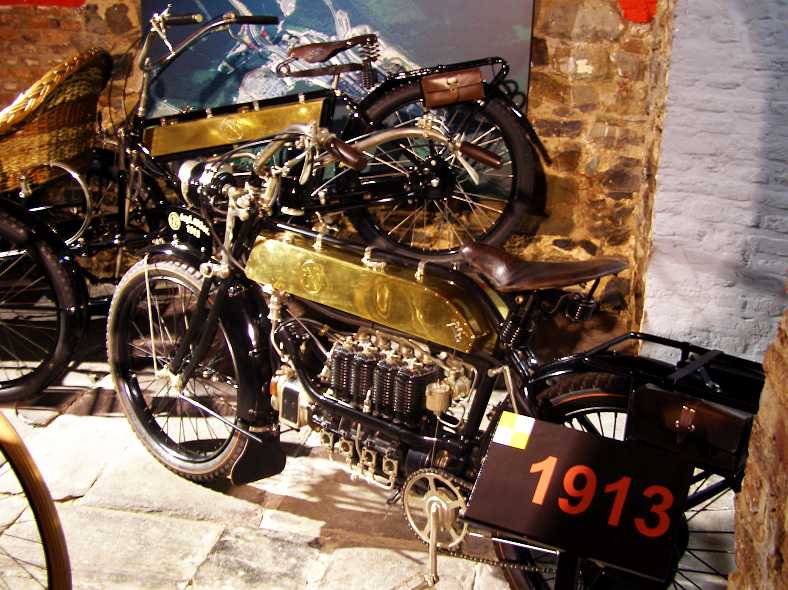
…and note how the foot pedals on this FN bicycle, a type made for about thirty years, don’t turn the wheel via chain, but have gears and a drive shaft:
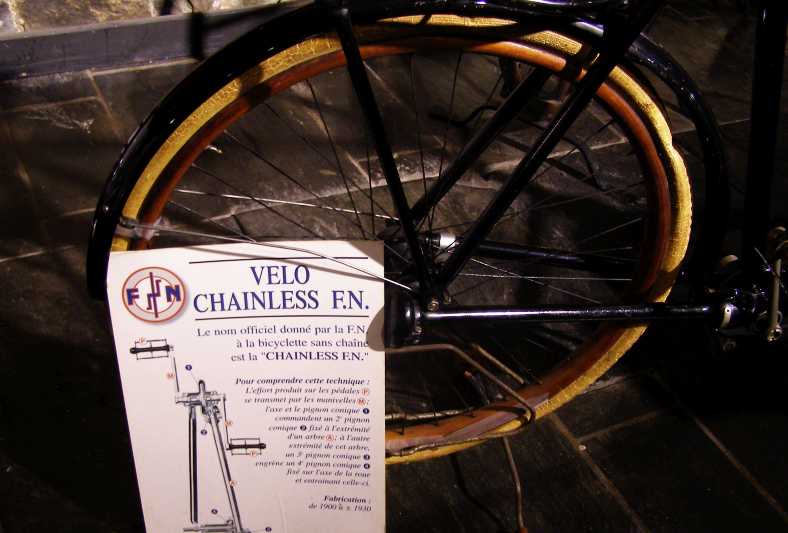
Belgian racing drivers get a good mention, of course. Teddy Pilette, being one of the best known of (relatively) recent times, was honoured with the presence of two cars. His 1965 Formula Vee…
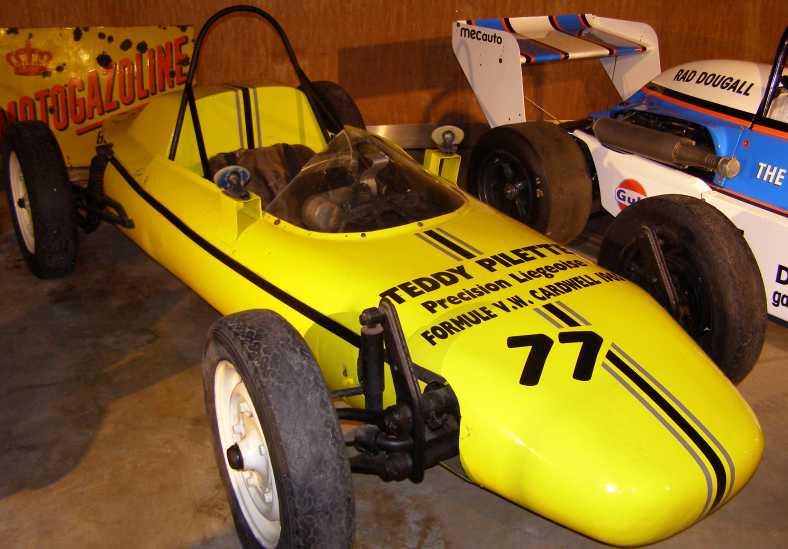
…was rather impotent alongside the Team VDS (a Belgian team, of course) Lola T400 he raced ten years later:
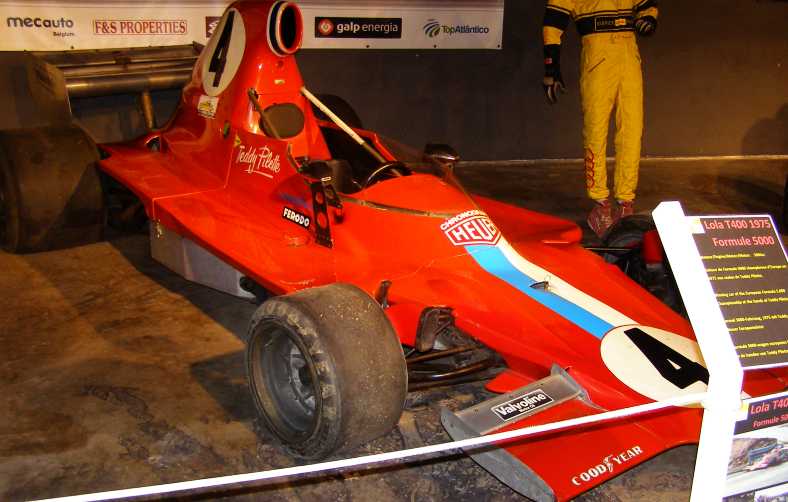
The circuit was shown off, of course, this photo showing a start-line scene from the 1920s:
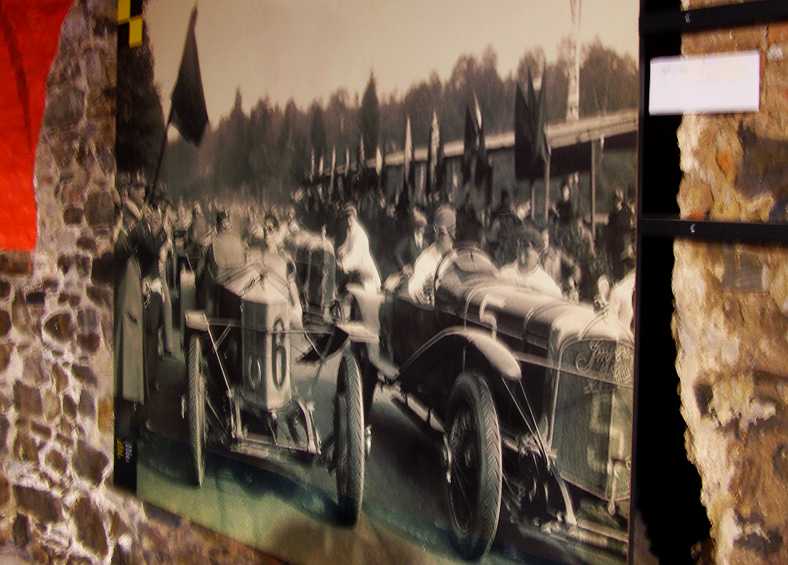
Thierry Boutson achieved a ride in Formula One, this Benetton being one of the cars he drove…
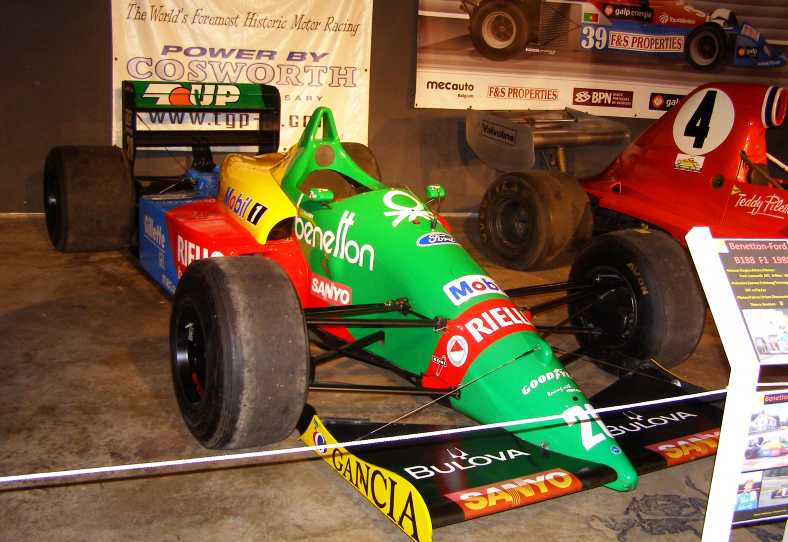
…while this Tyrrell from 1993 provided it with company:
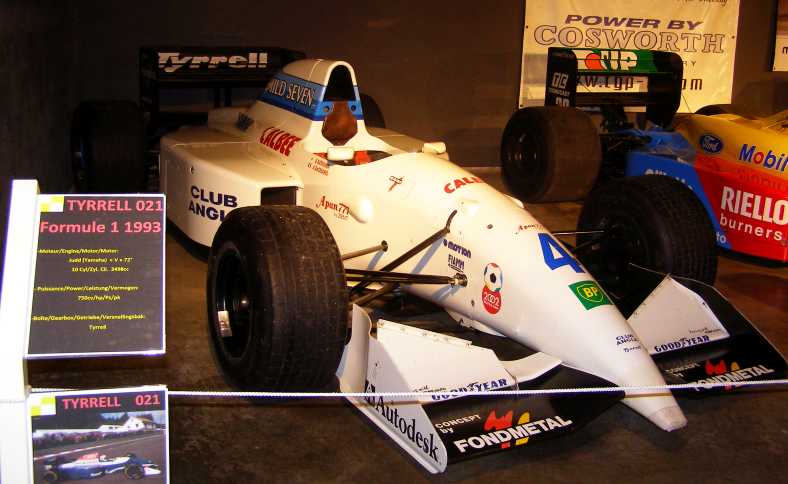
The 4-cylinder Megatron engine…
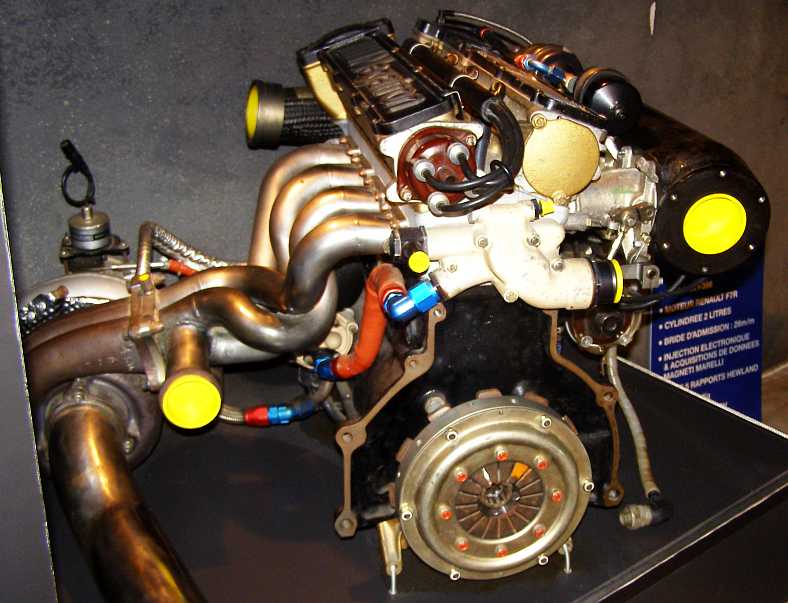
…was one of the contending power units of the turbocharged era. Meanwhile, while less powerful bolides were also on show:
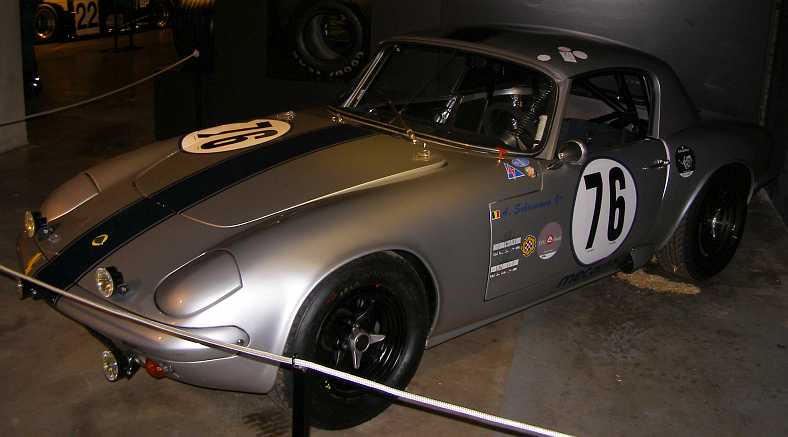
Anthony Schrauwen races this lightweight Lotus Elan in Historic events.
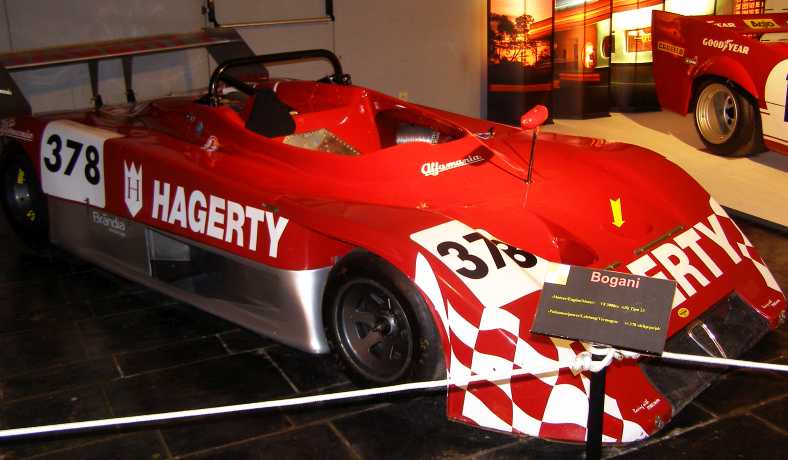
This Bogani has an Alfa V8 in it, but in its day raced with four cylinders. A more genuine location for an Alfa V8 is in the back of this Alfa T33:
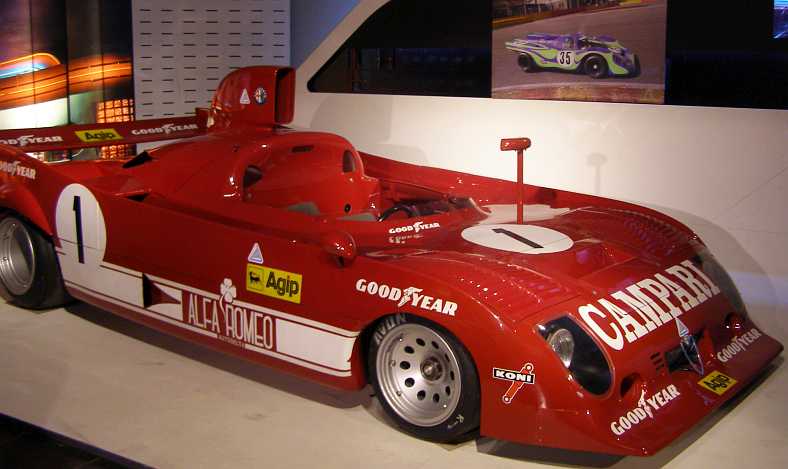
Homage is paid to one of the stars of the latter years of the big and fast circuit…
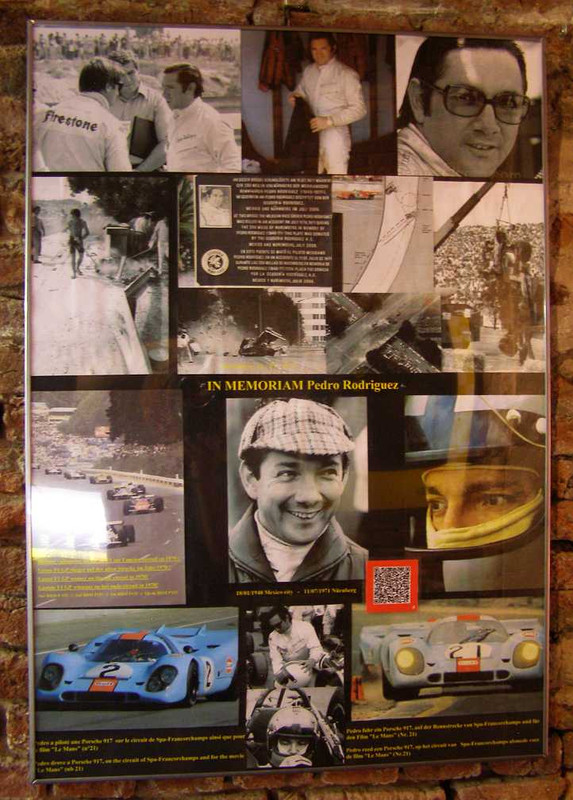
…with this tribute to Pedro Rodriguez.
Then there is a Lotus Elite from the fifties – or maybe early sixties – with Porsches flanking it here:
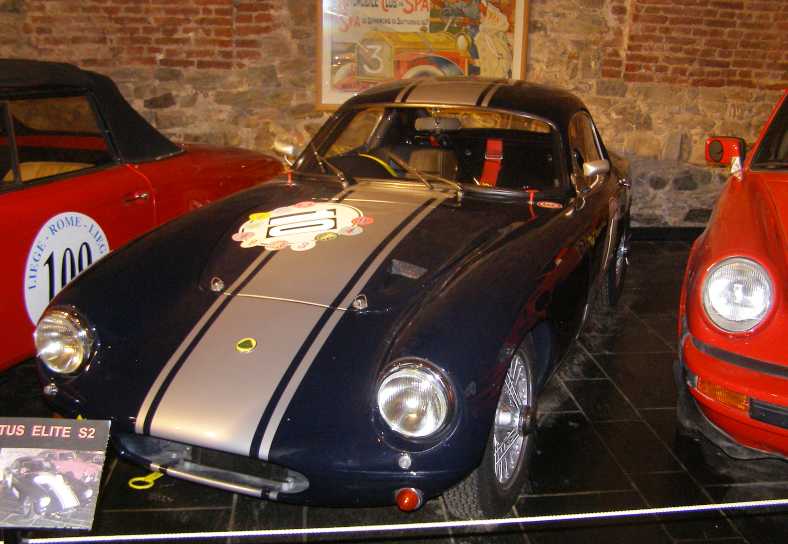
The Spa-Francorchamps circuit has changed a lot and this rather fortuitous aerial photograph of the La Source end, which shows the old section which went to a hairpin upstream from the Raidillon. The Eau Rouge creek flows through here and the circuit went to a hairpin called “Virage de l’Ancienne Douane” because there was a customs office there up until 1920. So this photo shows some of that history:
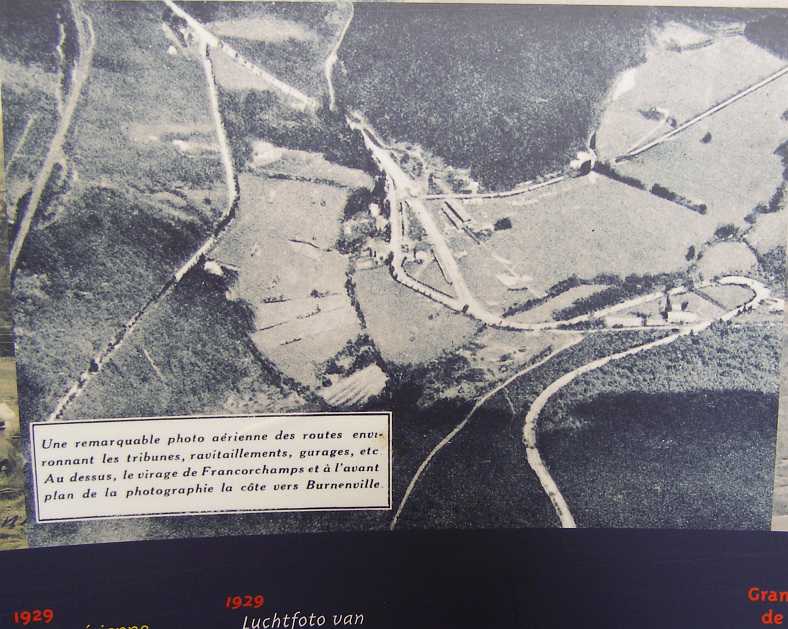
And this relief map of the area gives a good idea of the topography and gradients…
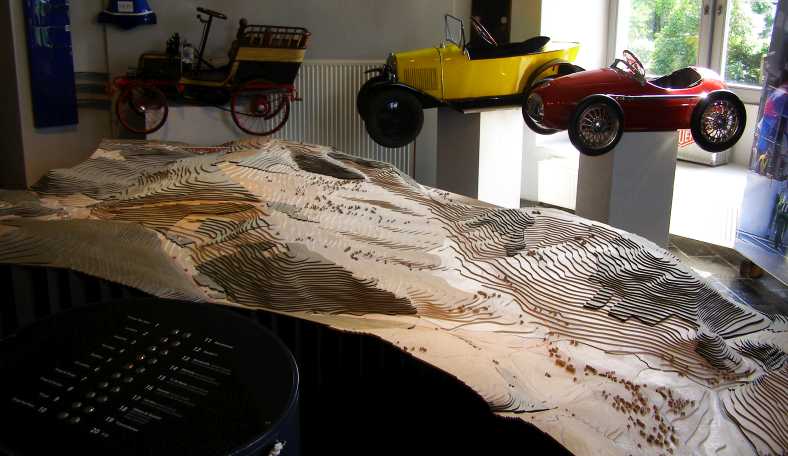
…with buttons to push to highlight the circuit sections.
All in all, I felt this little museum was well worth the admission charge, but I do wish I had taken more notice of this car…
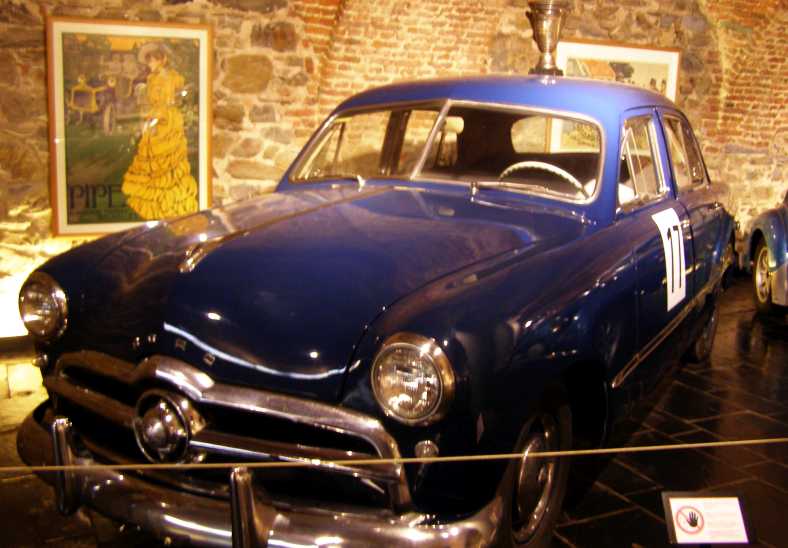
…which won the Spa 24-hour race for production cars about 1950. I accepted it would have been a V8, but surprisingly it had a side-valve six in it. This 24-hour race was an important event for American car manufacturers wanting to sell on European markets, with a particular emphasis on the Swiss market.
Having got my money’s worth there I drove off to Liege to meet up with some people, the only outstanding feature of Liege to me being the cobblestone streets:
From there I went on towards the Dutch border…
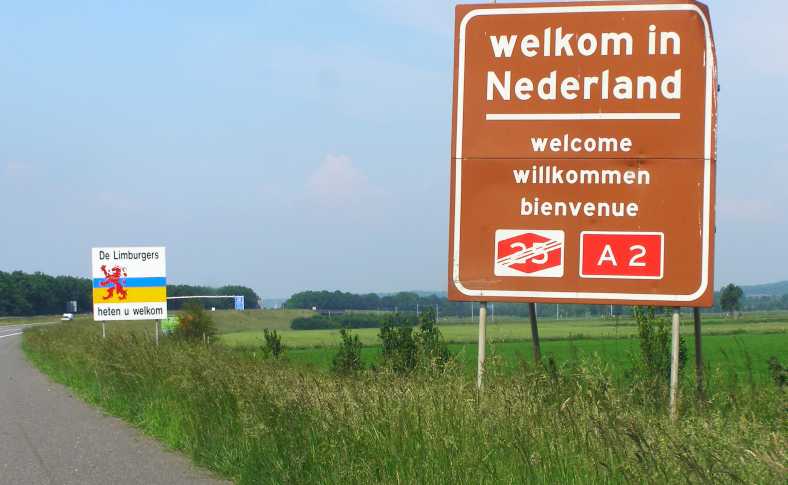
…Just after crossing that I pulled in to the McDonalds at Gronsveld, where I took advantage of the free wi-fi as I had a burger. Driving further North, I phoned a friend in America and told them I was in the Netherlands. “Have you seen a windmill yet?” I was asked. I was driving along a freeway, and I note now that the Dutch don’t keep the grass down as other countries seem to do…
…and I hadn’t thought of windmills. So I started looking out for one, which took a little while. There was one I spotted in the distance…
…but looking at it from so far away, and with the highway’s sound-deadening wall in the way, was no good so I decided I should chase after the location of one and headed off the main road. I was near Neederweert and I saw another, drove into the village and there it was – right next to a house:
I then restarted the GPS to head for my next destination, crossing the canal which runs between Wessem and Neederweert…
…which, being a sizeable canal required a sizeable bridge:
Another windmill on a farm sprang into view…
…as I headed towards Baexem and then I spotted this old one. Looking it up on the internet I learned it’s called ‘Aurora’ and it certainly looks different to most of the windmills in this area:
The whole body of the building rotates on the base to allow the blades to catch the wind. Across the road this paddock, right on the edge of town, was all ready to grow a crop…
…and then I drove towards the German border. Along the way I caught up to this Audi at the traffic lights and the fact that it was the highly-fancied black I was seeing everywhere, and because of the unusual numberplate, I snapped a pic of it:
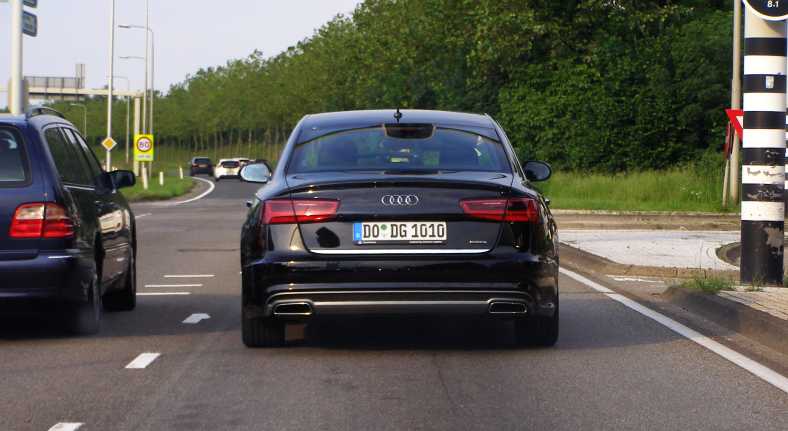
I started looking for somewhere to spend the night. I really wanted to get a room somewhere so I could refresh myself more completely than usual. I had more people to visit in the morning but I was unable to locate anything obvious and drove on, once again camping in the car for the night.
I was in the seventeenth country I’d visited in Europe as I came through that small corner of the Netherlands. Sunday was over and now I looked to Monday with the plan being to visit the people I wanted to see in Westerwald, then head down through Luxembourg to see a little more of France before I caught the ferry from Dunkirk. So this was the path from Sunday and the plan for Monday:
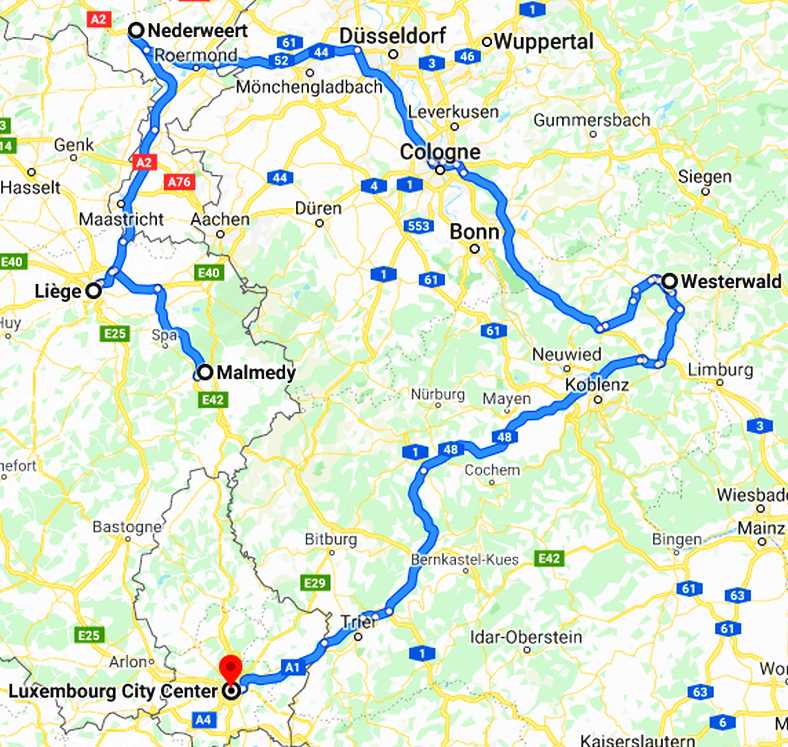
During Monday, however, it would occur to me that a change of plans might be advantageous…
It's a railway line which follows along that side of the circuit all the way from Malmedy to Stavelot. I drove into the area where the museum is located and there was a lot of parking space. Surprising me was the RAM pickup parked among the other cars:
The museum was in the basement of a building, the charge for admission wasn’t too bad, five or six Euros, and I was to come away thinking it was good value.
The Belgians showed great pride here in the FN marque, First, with this 1912 model car…
…and with these motorcycles, which looked very interesting examples. Note the foot pedals…
…and note how the foot pedals on this FN bicycle, a type made for about thirty years, don’t turn the wheel via chain, but have gears and a drive shaft:
Belgian racing drivers get a good mention, of course. Teddy Pilette, being one of the best known of (relatively) recent times, was honoured with the presence of two cars. His 1965 Formula Vee…
…was rather impotent alongside the Team VDS (a Belgian team, of course) Lola T400 he raced ten years later:
The circuit was shown off, of course, this photo showing a start-line scene from the 1920s:
Thierry Boutson achieved a ride in Formula One, this Benetton being one of the cars he drove…
…while this Tyrrell from 1993 provided it with company:
The 4-cylinder Megatron engine…
…was one of the contending power units of the turbocharged era. Meanwhile, while less powerful bolides were also on show:
Anthony Schrauwen races this lightweight Lotus Elan in Historic events.
This Bogani has an Alfa V8 in it, but in its day raced with four cylinders. A more genuine location for an Alfa V8 is in the back of this Alfa T33:
Homage is paid to one of the stars of the latter years of the big and fast circuit…
…with this tribute to Pedro Rodriguez.
Then there is a Lotus Elite from the fifties – or maybe early sixties – with Porsches flanking it here:
The Spa-Francorchamps circuit has changed a lot and this rather fortuitous aerial photograph of the La Source end, which shows the old section which went to a hairpin upstream from the Raidillon. The Eau Rouge creek flows through here and the circuit went to a hairpin called “Virage de l’Ancienne Douane” because there was a customs office there up until 1920. So this photo shows some of that history:
And this relief map of the area gives a good idea of the topography and gradients…
…with buttons to push to highlight the circuit sections.
All in all, I felt this little museum was well worth the admission charge, but I do wish I had taken more notice of this car…
…which won the Spa 24-hour race for production cars about 1950. I accepted it would have been a V8, but surprisingly it had a side-valve six in it. This 24-hour race was an important event for American car manufacturers wanting to sell on European markets, with a particular emphasis on the Swiss market.
Having got my money’s worth there I drove off to Liege to meet up with some people, the only outstanding feature of Liege to me being the cobblestone streets:
From there I went on towards the Dutch border…
…Just after crossing that I pulled in to the McDonalds at Gronsveld, where I took advantage of the free wi-fi as I had a burger. Driving further North, I phoned a friend in America and told them I was in the Netherlands. “Have you seen a windmill yet?” I was asked. I was driving along a freeway, and I note now that the Dutch don’t keep the grass down as other countries seem to do…
…and I hadn’t thought of windmills. So I started looking out for one, which took a little while. There was one I spotted in the distance…
…but looking at it from so far away, and with the highway’s sound-deadening wall in the way, was no good so I decided I should chase after the location of one and headed off the main road. I was near Neederweert and I saw another, drove into the village and there it was – right next to a house:
I then restarted the GPS to head for my next destination, crossing the canal which runs between Wessem and Neederweert…
…which, being a sizeable canal required a sizeable bridge:
Another windmill on a farm sprang into view…
…as I headed towards Baexem and then I spotted this old one. Looking it up on the internet I learned it’s called ‘Aurora’ and it certainly looks different to most of the windmills in this area:
The whole body of the building rotates on the base to allow the blades to catch the wind. Across the road this paddock, right on the edge of town, was all ready to grow a crop…
…and then I drove towards the German border. Along the way I caught up to this Audi at the traffic lights and the fact that it was the highly-fancied black I was seeing everywhere, and because of the unusual numberplate, I snapped a pic of it:
I started looking for somewhere to spend the night. I really wanted to get a room somewhere so I could refresh myself more completely than usual. I had more people to visit in the morning but I was unable to locate anything obvious and drove on, once again camping in the car for the night.
I was in the seventeenth country I’d visited in Europe as I came through that small corner of the Netherlands. Sunday was over and now I looked to Monday with the plan being to visit the people I wanted to see in Westerwald, then head down through Luxembourg to see a little more of France before I caught the ferry from Dunkirk. So this was the path from Sunday and the plan for Monday:
During Monday, however, it would occur to me that a change of plans might be advantageous…
Last edited by Ray Bell; May 25, 2020 at 09:02 AM.