



Vibration only in 4wd


Champion
Joined: Feb 2007
Posts: 3,103
Likes: 109
From:

Not that I've noticed on my D44 but I have marked them when removed. I suppose it could be out of balance if mounted in a different orientation, but mine is flange mounted so it should always be flat (smooth) no matter what I do. What's the D60 look like?

All Star


Joined: Sep 2012
Posts: 803
Likes: 87
From: Europe
Can't remember how the front shaft is, but 2-piece rear has keyed splines so it can be mounted only in one position.
Went through my picture gallery, but there wasn't any good pics about the front shaft splines, but I'm quite certain that it's not keyed.
Went through my picture gallery, but there wasn't any good pics about the front shaft splines, but I'm quite certain that it's not keyed.
Last edited by HeikIlm; Jan 22, 2019 at 03:11 AM.

Thread Starter
|
Legend


Joined: Nov 2014
Posts: 8,098
Likes: 318
Same way. I'm talking about the slip yolk part can spin causing it to be out of balance. I have the flange for the transfer case side and straps for the diff. I know I spun the diff side which I think is throwing it out of balance
Champion
Joined: Feb 2007
Posts: 3,103
Likes: 109
From:
How did the slip yoke spin independently?? It's female splines! Or did you remove it, turn it, and reinstall? Is that your question? I'm confused.
Maybe relevant: a while ago I was looking up any and all info on vibrations since I have a bad one and there is a somewhat common notion out there for early ford superduties that the drive shafts would be the cause of a vibration. The cure was to remove it from the slip yoke into the trans and grease the splines. I'm not even kidding. Food for thought.
Maybe relevant: a while ago I was looking up any and all info on vibrations since I have a bad one and there is a somewhat common notion out there for early ford superduties that the drive shafts would be the cause of a vibration. The cure was to remove it from the slip yoke into the trans and grease the splines. I'm not even kidding. Food for thought.


Thread Starter
|
Legend
Joined: Nov 2014
Posts: 8,098
Likes: 318
How did the slip yoke spin independently?? It's female splines! Or did you remove it, turn it, and reinstall? Is that your question? I'm confused.
Maybe relevant: a while ago I was looking up any and all info on vibrations since I have a bad one and there is a somewhat common notion out there for early ford superduties that the drive shafts would be the cause of a vibration. The cure was to remove it from the slip yoke into the trans and grease the splines. I'm not even kidding. Food for thought.
Maybe relevant: a while ago I was looking up any and all info on vibrations since I have a bad one and there is a somewhat common notion out there for early ford superduties that the drive shafts would be the cause of a vibration. The cure was to remove it from the slip yoke into the trans and grease the splines. I'm not even kidding. Food for thought.
dang I wonder if it's my transfer case then
Champion
Joined: Feb 2007
Posts: 3,103
Likes: 109
From:
I don't know what's under the boot on my front driveshaft but the only "slip yoke" design I've ever seen is a jaw on one end and female splined hole on the other. I'm still not sure what you accidentally did to turn it. . ?
Remove the driveshaft and go for a spin. Quick way to figure where the vibe is coming from. And don't discount a ujoint somewhere. They can look good but act bad. I agree that the shaft should be true no matter how you mount it.
Remove the driveshaft and go for a spin. Quick way to figure where the vibe is coming from. And don't discount a ujoint somewhere. They can look good but act bad. I agree that the shaft should be true no matter how you mount it.
Thread Starter
|
Legend
Joined: Nov 2014
Posts: 8,098
Likes: 318
I don't know what's under the boot on my front driveshaft but the only "slip yoke" design I've ever seen is a jaw on one end and female splined hole on the other. I'm still not sure what you accidentally did to turn it. . ?
Remove the driveshaft and go for a spin. Quick way to figure where the vibe is coming from. And don't discount a ujoint somewhere. They can look good but act bad. I agree that the shaft should be true no matter how you mount it.
Remove the driveshaft and go for a spin. Quick way to figure where the vibe is coming from. And don't discount a ujoint somewhere. They can look good but act bad. I agree that the shaft should be true no matter how you mount it.
All Star
Joined: Sep 2012
Posts: 803
Likes: 87
From: Europe
There is a plastic lining on a male splines, which wears out. Like this:
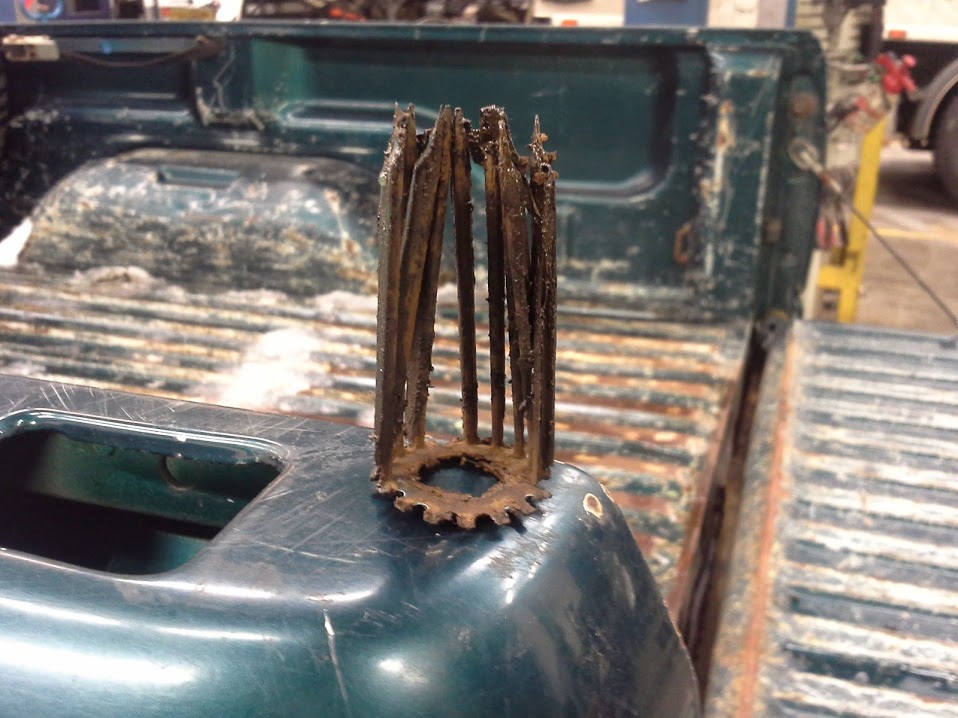
When that goes, there's a quite a much play, and when enough torque is applied to the 'shaft the splines will jump and eventually destroy them.
When that goes, there's a quite a much play, and when enough torque is applied to the 'shaft the splines will jump and eventually destroy them.


