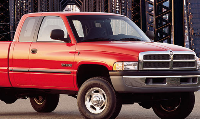
When you click on links to various merchants on this site and make a purchase, this can result in this site earning a commission. Affiliate programs and affiliations include, but are not limited to, the eBay Partner Network.
2nd Gen Ram Tech1994-2001 Rams: This section is for TECHNICAL discussions only, that involve the 1994 through 2001 Rams. For any non-tech discussions, please direct your attention to the "General discussion/NON-tech" sub sections.
I've got a '99 Ford Superduty with good cab mounts. The frame though....
The rest of the frame isn't quite as bad, ut I've gotten my use out of it and I'm selling it as a parts truck. It runs and drives okay, but if it gets hit in front, it'll fold up.
Ooof. That's rough.
I really like the first gen super duty, great looking truck.
Honestly I'm pretty shocked how nice the frame on my truck has stayed considering how bad the rockers, cab mounts, fenders, doors, etc are.
I really like the first gen super duty, great looking truck.
Honestly I'm pretty shocked how nice the frame on my truck has stayed considering how bad the rockers, cab mounts, fenders, doors, etc are.
I'll bet your truck isn't a former plow truck from up north. My truck still looks good. Straight body, the diesel purrs like a kitten, the transmission shifts good and the 4X4 works pretty good. If it wasn't a Ford, I'd probably post it in the market place here.
I'll bet your truck isn't a former plow truck from up north. My truck still looks good. Straight body, the diesel purrs like a kitten, the transmission shifts good and the 4X4 works pretty good. If it wasn't a Ford, I'd probably post it in the market place here.
Nope, not a plow truck, though it has lived it's entire life up here in the north.
Man this thread is killing me. I tried to find a nice ORE 1500 years ago, specifically a sport package, but got impatient and bought the v10. I even drove 7hrs to look at one just to find out the dealer neglected to tell me about all the hail damage (it was not visible in the photos). Starting to get that itch again but I like my charger too much.
Man this thread is killing me. I tried to find a nice ORE 1500 years ago, specifically a sport package, but got impatient and bought the v10. I even drove 7hrs to look at one just to find out the dealer neglected to tell me about all the hail damage (it was not visible in the photos). Starting to get that itch again but I like my charger too much.
If I can sell 2 or three vehicles, I've found an '81 F-250 with a four speed granny transmission. Busted timing chain, but otherwise in decent shape. Just an old beater to tinker with and haul heavier loads than my '96 1500 Dodge.
I was finally able to get ahold of Daniel Powell from Powell Machine today about a camshaft. He's been real busy. Fortunately he's got one ductile iron short nose core left we can build.
We talked for a good while and we're pretty settled on the camshaft specifications. I feel really good about the fact that his recommendations are damn close to what I came up with. I researched the hell out of camshaft tech, but this is my first build, so the fact that I got it almost dead nuts right for the application is something I'm proud of.
We settled on these valve events:
Here are the grind specs:
217/232 @.050" duration
.568"/.571" lift (head max is .580")
116+6 lsa (110 intake centerline)
You'll recall that I am wanting to run this thing on 87 octane, but also wanted to get a nice tight quench in the head, which necessitates a little higher static compression (10.1:1 in this case). That 68.5* intake closing event will bleed off some cylinder pressure and get us down to a 7.8:1 dynamic compression (155psi estimated cylinder pressure), which should be safe for 87.
Since I'm going to run iron manifolds, we're throwing a lot of exhaust duration at it to help with that, so you'll see a 15* split there between intake an exhaust. I had guessed we wanted to run around 8* split because that's about the max I'd seen others run, but he said adding even more duration over there would be a good idea and it makes sense to me.
Last edited by Skeptic68W; Nov 15, 2024 at 05:04 PM.
Seems like a lot of LSA for a truck cam. I realize you are trying to make up for that with a 110 centerline, seems like an awful lot of exhaust duration as well. Typically you add exhaust duration to soften the bottom end/enhance the top end. When I did my v10 I went with a 110lsa+4, 106 centerline (ended up being 105 degrees because of sprocket limitations), 212 duration single pattern. Lift sucked at .450 but that's all they would do on a regrind.
I spoke with Daniel for quite a while and am confident we're on the right track. I also had emailed Robert at NK Racing (the winner of the Weingartner cam challenge) while I was waiting to hear back from Powell and after explaining my chosen specifications his response was "I like it!"
The problem I think with the way a lot of folks talk about cams is that it's all relative, not grounded in a good comprehensive understanding of valve timing (which is understandable, it's complicated as hell and I've taken forever to get even a modest understanding). They're assuming that if you change none of the other variables in a stock small block chevy and put in a cam with X characteristic, it's going to do Y. The trouble is, that's often wrong in other situations. In general, running a higher duration and wider LSA camshaft would result in a weak low end, but no-one says why. It's because it's bleeding too much cylinder pressure. In my case however, since I'm tightening up the quench and raising the static compression to 10.1:1, if I chose a cam that was traditionally considered a good "truck cam", it would detonate from too much cylinder pressure. So as you point out adukart, I am doing precisely that, trading off some bottom end to prevent detonation and because it's already going to have an uber abundence there for some mid range and top end power. The notion of trading off some low end in a truck application seems insane, but you can see how this relative thinking gets you in trouble in such a situation. I'm pretty confident this thing will still make over 500lb-ft, and probably over 400lb-ft at like 2500rpm.
There is more than one way to skin a cat, but the way I went about choosing my valve events was as follows:
Priority 1: Cylinder Pressure Optimization
This is set by Intake valve closing
I knew the dynamic compression target I was aiming at, which was as much as I could run on 87 octane since this is still primarily a daily. Vizard's guidelines say that 165psi of cylinder pressure on a tight quench engine with an aluminum head is the max. So I was gonna need a 64* IVC to make that happen with my bottom end combination. Daniel recommended just a slightly more conservative approach, which is probably good since it's a heavy truck, so we settled on 68*, which puts the dynamic compression just a hair under 8:1.
Priority 2: Driveability & Idle vacuum
This is set by Overlap
Under no circumstances was I changing over to a higher stall torque converter, so I needed a camshaft that's going to play nice with the stock 1800 rpm unit (I may replace it with a nicer quality unit, but it will stay a very low stall). I put a 224 duration camshaft on a 112lsa in an LS1 camaro about 12 years ago and it needed a converter to handle it. I then put in a 3200 rpm converter and it just utterly ruined the driving experience. It was fast, but MISERABLE in daily use. I'll never do that again on a street car, let alone a truck that will be loaded. This camshaft is going in a larger engine (408 vs 350) and is slightly smaller, but most of all it has WAY less overlap.
The stock 5.9 camshaft has 40* of overlap @.006". I knew that generally somewhere in the 40s or 50s would be acceptable for this build, and with the above specs it will be 51*.
From there the name of the game is simply to maximize duration so the engine can breathe as much as possible in the mid range and top end without going out of bounds from those two above targets. That got me to a camshaft with around 210 - 220 duration @ 0.050", and in this range I could sneak in a little more duration by advancing it (either ground that way or with the timing set). The wider you separate the lobes, the more duration you can run for an equivilent overlap figure. Hell, with the cam I've spec'd, it has nearly 220* of intake duration but is still -7.5* over overlap @ .050", so it should have a very mild idle, great vacuum, and get decent economy (for what it is). The OEMs have all moved in this direction over the years in their performance applications, and there's a good reason.
On the exhaust side, with this truck running iron manifolds and the exhaust port in the head flowing only 73% of the intake port, it makes all the sense in the world to throw extra exhaust duration at it. So that means pushing that exhaust valve opening event out a bit giving it more time to blow down and get those gasses out of there. Again, this is accomplished with more exhaust lobe duration and a wider lobe separation.
The cool thing is we are going to get to see how well my theories work out. The truck goes to the chassis dyno next wednesday with the stock engine for a baseline, and we will get to see next year how it does with the 408. I can promise you it won't make the biggest peak numbers around, but that isn't the goal, the goal is a very meaty torque curve with excellent driveability on a stock converter, highly responsive, good economy (relatively), OEM-like reliability, and the ability to run 87 octane.
Last edited by Skeptic68W; Nov 19, 2024 at 07:25 PM.
Well, the truck made it's first voyage off my property today for the first time in over a year. I actually can't recall how long it's been, though it was registered in 2023. I took it up to Costco for fuel in preparation for it's trip to the dyno shop next wednesday.
To do this I needed to get some things done. Here's how it has been sitting for quite some time. The passenger fender has been off while I prepped and primed the replacement, removed the original inner and welded it to the new outer, welded in a new coil bucket on the axle, installed a new cab mount, and in general just did a few little jobs in that area. The bed has also been off for a long time getting bodyworked. Unfortunately as documented earlier it fell in a windstorm and will need to be repaired a bit before the final paint job.
The other day I got a few things painted.
And today I got the fender installed and the bed placed back on for a while so it's roadworthy.
Last edited by Skeptic68W; Nov 19, 2024 at 07:33 PM.