


Ride along with me...


Thread Starter
|
Captain

Joined: Oct 2005
Posts: 570
Likes: 8
From: The Summit, Queensland, Australia

The problems I was having with exhibits which were unlabelled were troubling me. I’d been to the front desk to ask about things and not everything was known even there. In order to ensure that I’ve got it all sorted now I’ve called on the assistance of noted author, journalist and historian Doug Nye and he’s further referred to Rick Hall of Hall & Hall, who restore these cars for clients including, in the past, Tom Wheatcroft.
In the end we’ve managed to confirm things, even one crankshaft which was incorrectly labelled!
I mentioned that I knew some prize exhibits were no longer there, but one of the great ones did remain, that was a replica of a Mercedes-Benz W125 from the mid to late-thirties:
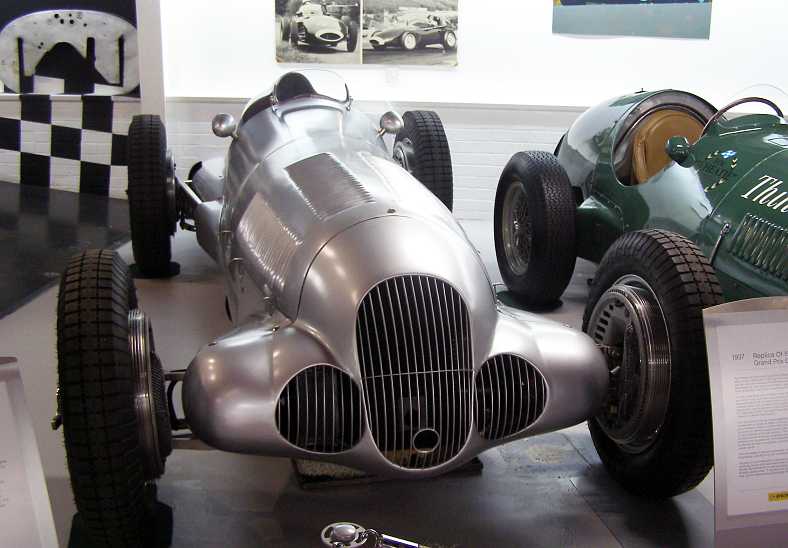
W125 replica. It was very appropriate to have such a car here as the two German teams raced at the Donington circuit in that era. But this was the only such car on display.
Then, across the aisle, was the whole BRM display. I have a bit of a soft spot for BRM as they came good after years of failure just as I was taking an interest in Grand Prix racing. Before BRM – British Racing Motors – came English Racing Automobiles, though, the main people involved had been building the ERA…
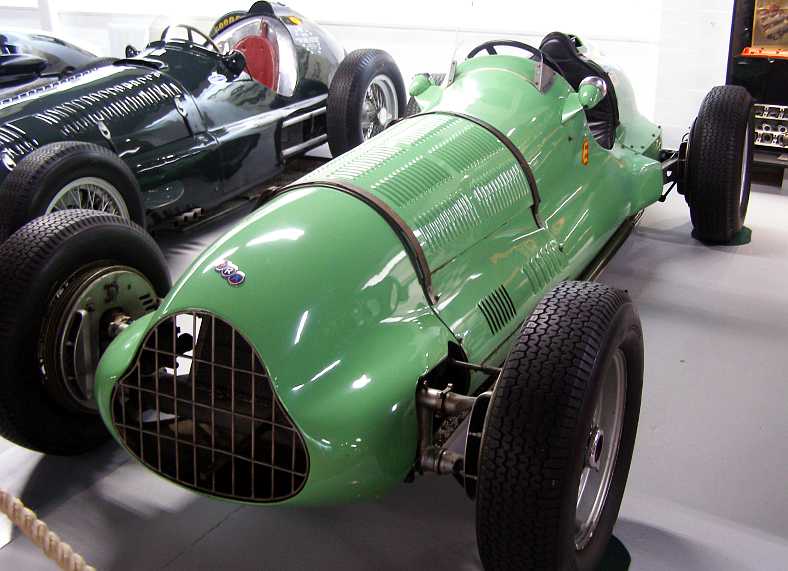
ERA E type. With a 2-litre engine, this car’s history is both pre-war and post-war, developed in 1939 but not raced until after hostilities ended. A sister car which has some minor differences was racing before the war.
Note that it has an independent front suspension by trailing arms, like a Volkswagen. It had a rear suspension with swing axles for a short time, this being replaced by a de Dion arrangement. The first BRM, the V16, had a similar front end and it can be seen here:
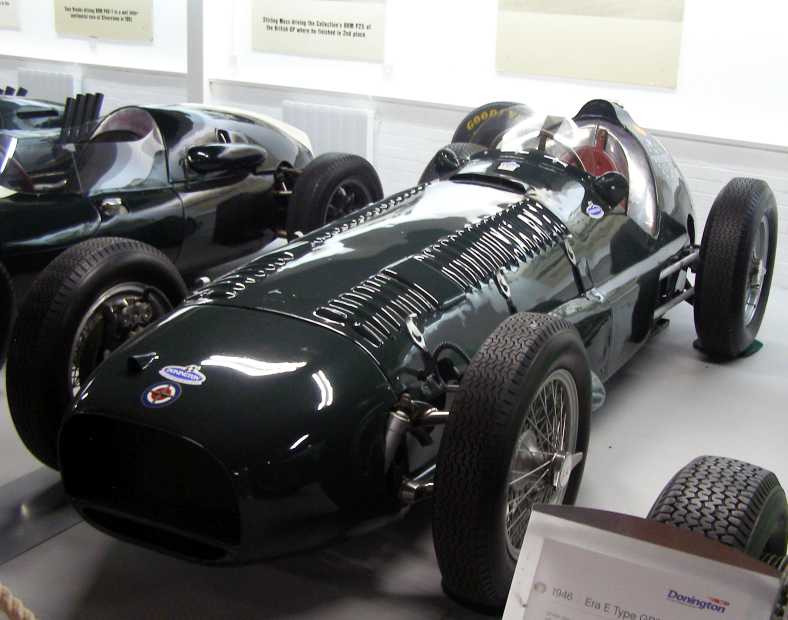
BRM V16. The pinnacle of complication, this car was built to show British engineering prowess and featured a 12,000rpm 1.5-litre V16 engine which had an engine note to delight any enthusiast. It was also a dismal failure for the first couple of years.
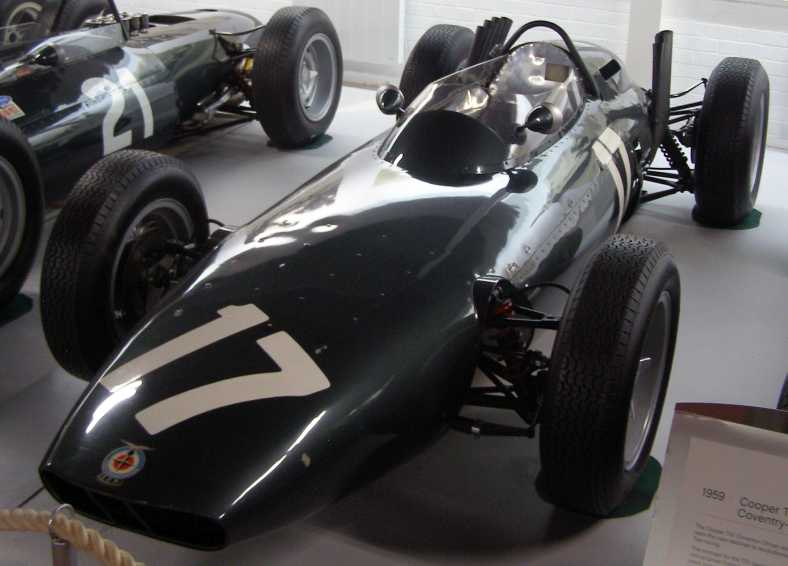
BRM P57. Displayed in pretty much the form in which it won the opening Grand Prix of 1962, the Dutch Grand Prix, this is the car which turned around the fortunes of BRM. Some variations came later in the year which made it look better, and it kept going so well that it took Graham Hill to his first World Championship.
As BRM had gone away from being a consortium drawing assistance from the whole British Motor Industry and was now owned by Sir Arthur Owen it was determined by him that they had to win or die. The ultimatum was put down and the team were able to respond. They even delved into other activities, like building and selling engines to other teams and privateers and building the Rover-BRM turbine car for Le Mans. Another project was a 4-wheel-drive car for F1:
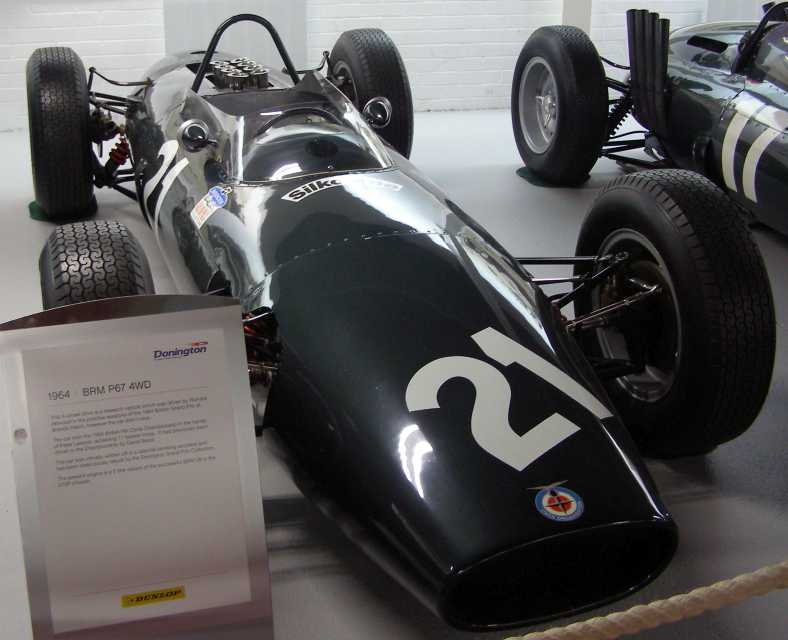
BRM P67 4WD. With the 3-litre formula having been announced, BRM indulged in experimenting with a 4WD car with the 1.5-litre engine, it was a dead-end and that was reflected in that they were not among the teams which built 4WD cars later in the sixties.
After sinking into oblivion again with the highly complex H16 engine at the beginning of the 3-litre formula, BRM relented and simplified with a string of V12-engined cars. These engines were effectively ‘extensions’ of the 2-litre versions of the 1.5 engine which had proved so successful. Success didn’t come to the V12 overnight, however, as Grand Prix cars were changing rapidly.
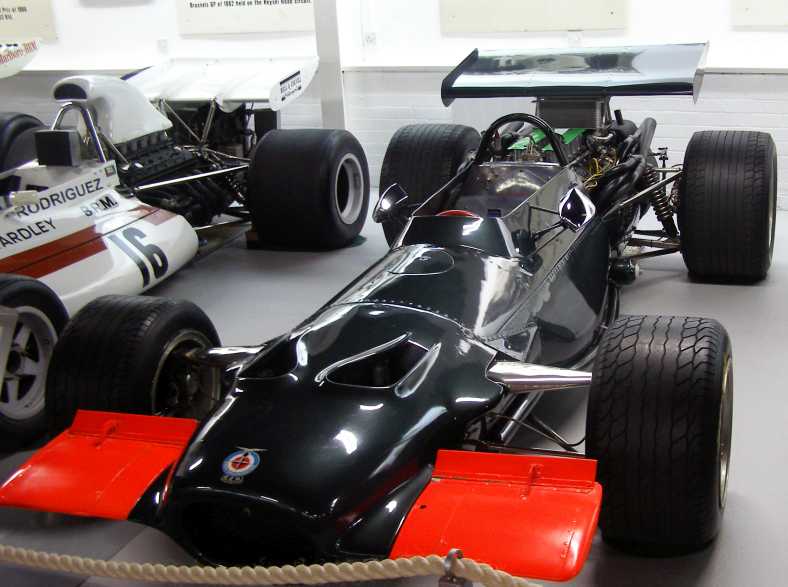
BRM P139. One of a string of V12 cars, this one didn’t achieve much for BRM, only some minor places in the hands of John Surtees.
Finally they hit their straps again beginning with the P153. At the same time they obtained some sponsorship which finally took the cars out of their drab dark green colour. Some very talented drivers helped out too, principally Pedro Rodriguez and Jo Siffert.
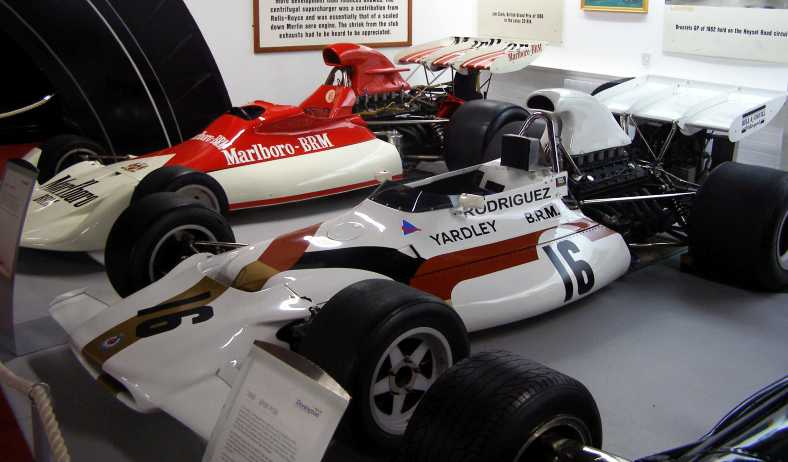
P153 and P160. Both of these cars won races for BRM, but it came at a price as Jo Siffert lost his life in one. Wins also came from Peter Gethin and Jean-Pierre Beltoise.
These cars were to be the last of the successful string of cars which had been winning for a little over a decade. The team began to stumble and fall into decline, it was sad to see it happen but that’s the way it has always been in such a highly competitive environment.
Going back to the original BRM, however, the Donington collection had some great exhibits. The V16 was incredibly complicated, as can be seen in these pictures:
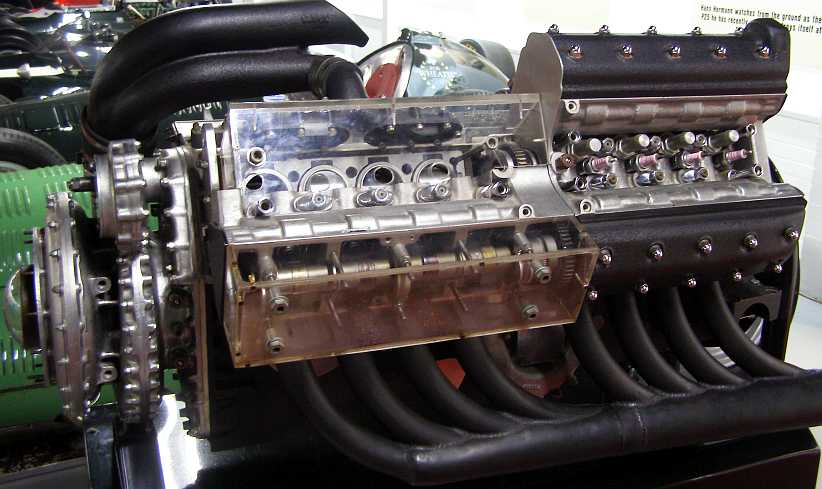
V16 cutaway. No doubt this was prepared many years ago, but still worth looking at. The engine’s central gear train to the camshafts is seen, preventing camshaft whip, the huge centrifugal supercharger on the front, the big pipes from the supercharger too.
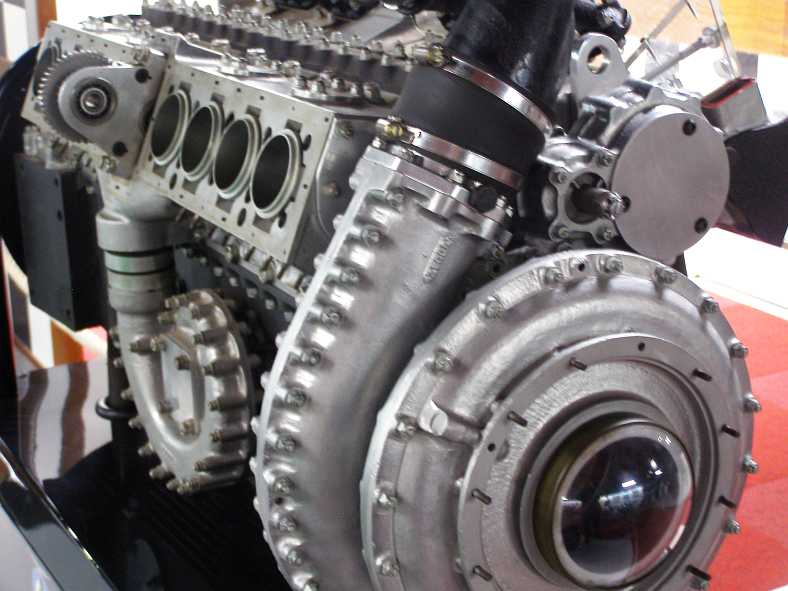
Front view. Looking from the front the size of the supercharger, made by Rolls-Royce, is clearer. Again the central drive train for the cams, but also the water pump can be seen on the side of the crankcase, driven by a jackshaft skew-driven off that central drive train. The tiny sleeves for the four cylinders are clear in this shot, protruding from the block and to be sealed with compressible rings which were charged with holding in the cylinder pressures at 11,500 rpm and 585 horsepower.. The cylinder bores are just 1.95” and the stroke a mere 1.9”.
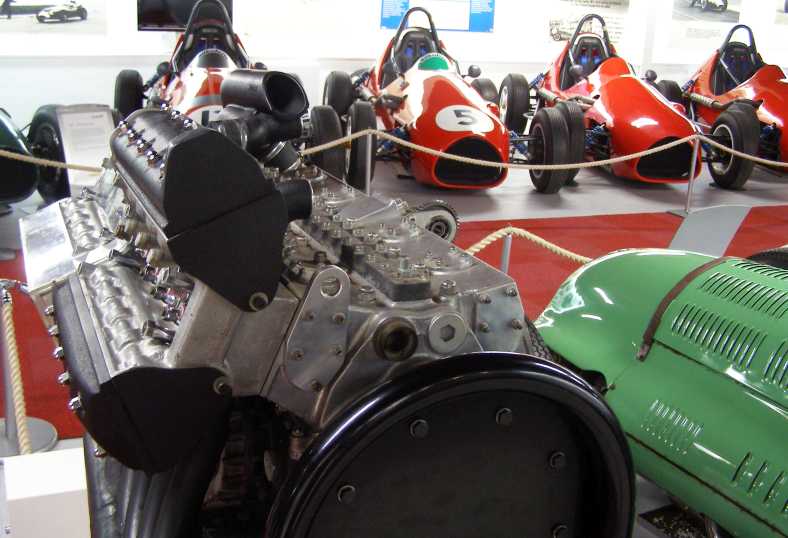
Rear view. This view emphasises the wide vee angle, 135°, and the size of the pipes carrying mixture to the cylinders from the supercharger.
In the background to this picture is a line of ‘Formula Classic’ racing cars. These were built by the Donington people to create an old-look class – front engined and open cockpits – for historic-type racing with modern conveniences. Like fuel injected engines etc. The presence of so many of these emphasised to me how many proper exhibits were no longer in place.
But there were still things to see and maybe I should stop complaining?
A very popular car in the late sixties…
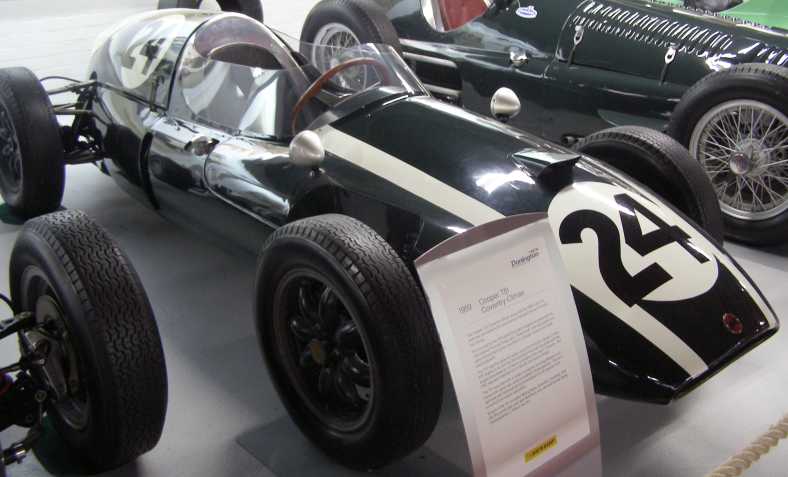
Cooper T51 Coventry-Climax. A hugely successful car in 1959, this car like the one in which Jack Brabham won his first title was a very simple machine compared to its competitors.
These Coopers were campaigned by many people in Formula One, Formula Two (with the 1.5-litre Climax engine at that time) and all around the world. There must have been half a dozen of them in Australia by the end of 1960.
I mentioned 4WD Formula One cars, a popular diversion before the true effects of wings became obvious. This one was from Lotus and was one of the few which raced:
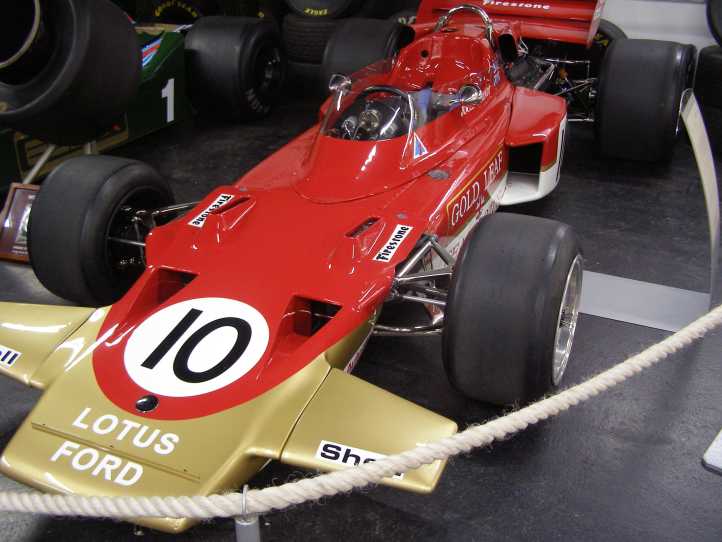
Lotus 63. Lotus used the 4-wheel drive setup in both F1 and Indianapolis cars, this one has the conventional Cosworth DFV engine.
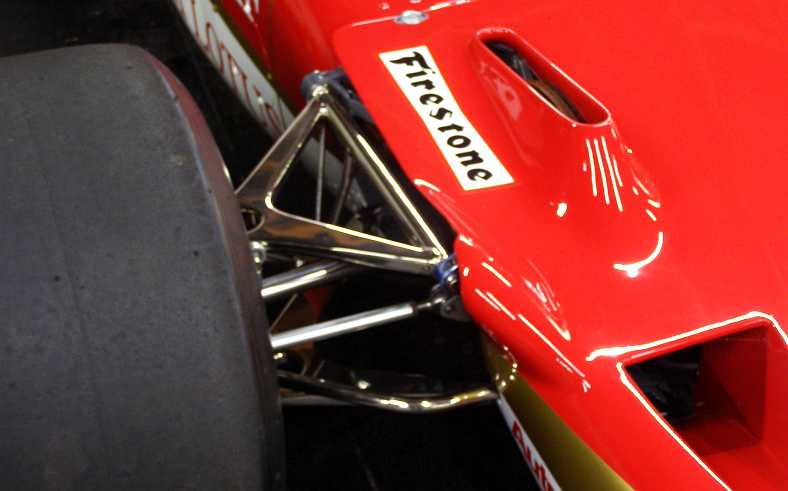
Lotus 63 front suspension. There’s a driveshaft hidden in among the wishbones of the front end and inboard discs were a natural feature.
One of the really bright stars of the Formula One firmament in the late seventies and eighties was the Canadian firebrand, Gilles Villeneuve. He arrived in a spectacular flurry and turned on some great performances when his ‘never say die’ attitude shone through.
It was one such race which I saw him win on my only previous trip to Europe, the 1981 Monaco race, where he plugged on and got the win after Alan Jones had fuel pickup problems when in a dominant position. A very popular driver, especially in this car:
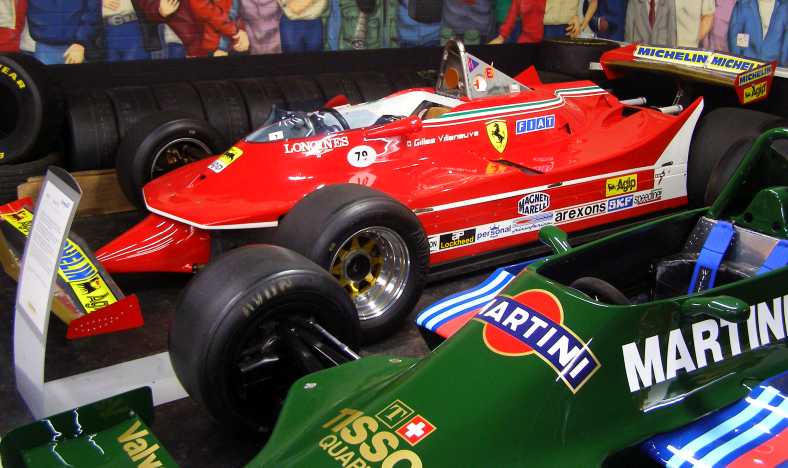
Ferrari 312T4. The ‘312’ designated 3-litres, 12 cylinders. The ‘T4’ was for a transverse gearbox, and it was the fourth iteration of the type. The ‘Villeneuve’ on the side means it was a car to be watched, very spectacular.
Ferrari persisted with the flat-12 engines for several years despite the difficulty they created as ‘ground effect’ became the prevailing performance feature of Formula One. Many feel, as do I, that aerodynamics and the big-spending allowed by big sponsorships spoiled Formula One.
In with that car is the Lotus which followed up from the last of the John Player Specials. Lotus struggled for a few years at that time.
Not all Formula One cars are built to be winners. When their engines were proving to be almost universally successful, Cosworth branched out to build a car that never raced:
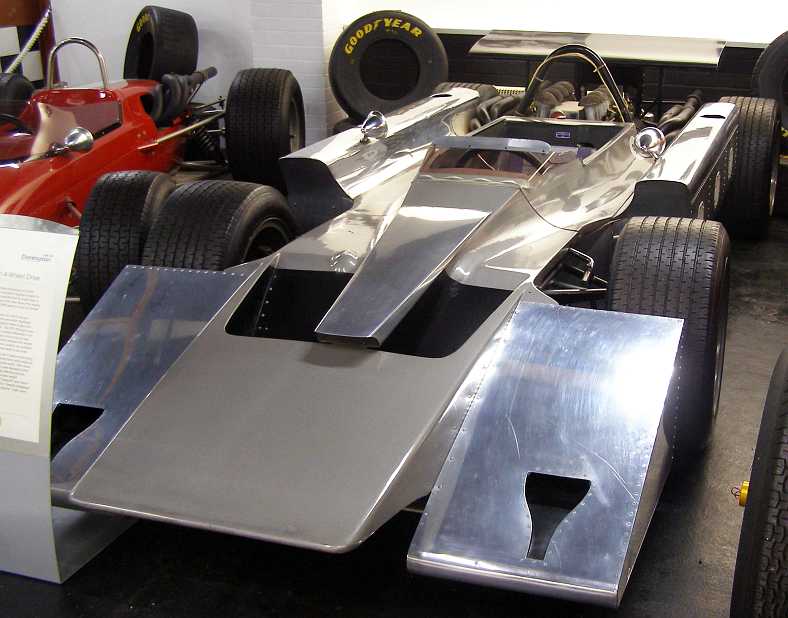
Cosworth. Designed by Robin Herd and featuring 4-wheel drive, this 1969 project never amounted to anything as Herd left to design the first March cars. It had a unique 4WD system designed by Keith Duckworth while all others used the Ferguson system.
Among the large number of McLaren cars on display there was an Indianapolis car, the M24:
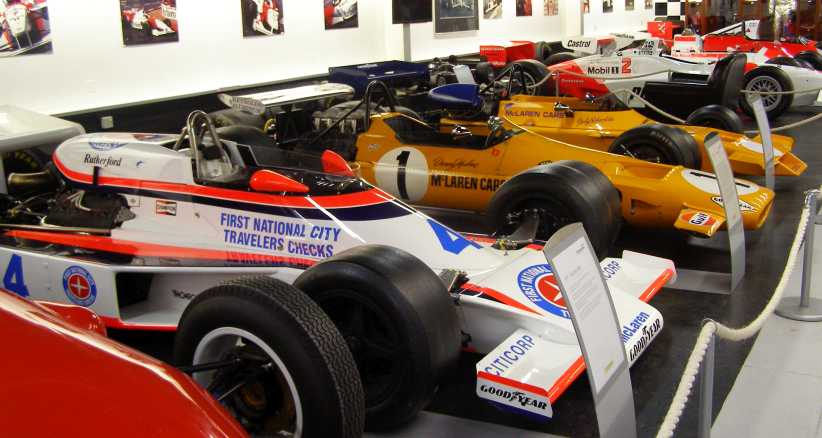
McLarens. The McLaren M24 Indianapolis car used the Cosworth DFX engine, this car sits next to the M7C F1 car of 1969 with the M21 next in line. The driver names are Johnny Rutherford, Denny Hulme and Jody Scheckter respectively.

Penske PC27. Roger Penske’s team built their own cars and this one is the PC 27. In line beyond it are McLarens M28, M29 and MP4/8.
Still looking for anything different, I found this engine. Designed by Weslake – who had a big part in the Eagle V12 of the late sixties – it was designed to be used in long-distance racing and was considered for Brabham F1 cars but never tried. It ultimately was a costly failure.
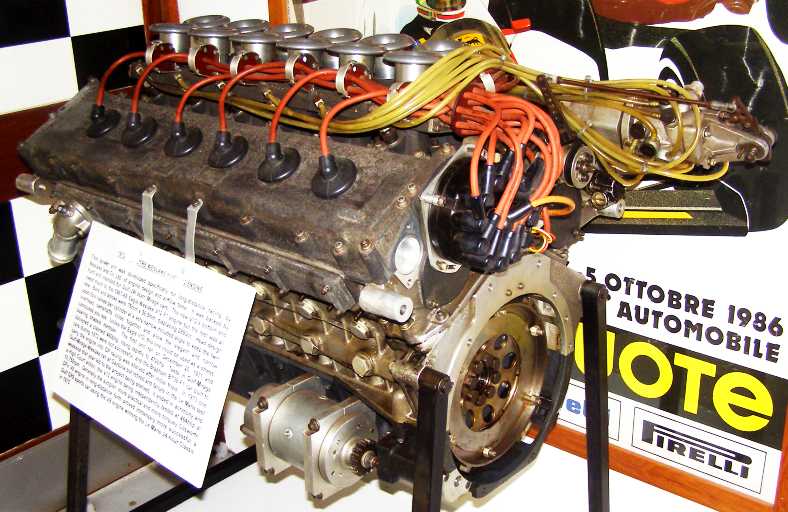
Weslake V12. Designed to be used in the Gulf Mirage team cars it was effectively based on the Eagle V12’s bottom end with a more modern top end.
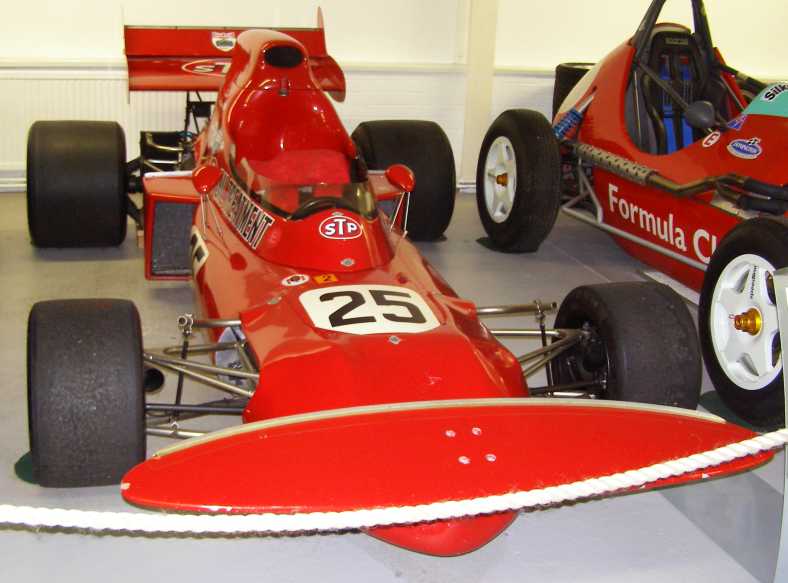
March 711. The Ronnie Peterson model, the front wing, variously described as a tea-tray or other derogatory names, was unique.
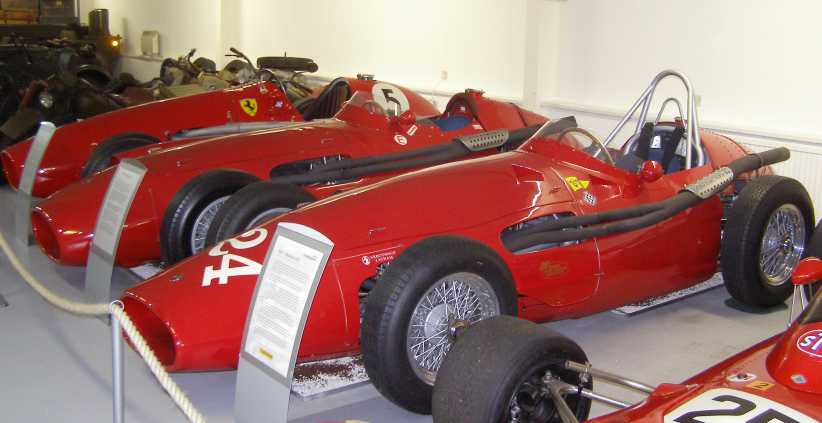
Maserati and Ferrari. More cars from the fifties at last. Two Maserati 250Fs, each different to the other in small ways, and the very successful Ferrari 500 of the Alberto Ascari years.
These were cars which won many races and a championship or two. Just why they share company with WW2 German motorcycles escapes me.
And I escaped too. My time was up in the museum, I might well have judged it harshly but that was how I felt about it. So disappointed was I that I drove off and totally forgot to have a look at the famous Donington Park circuit!
I was well on my way to Telford and the cast iron bridge before I remembered and I wasn’t turning back.
This bridge had captured my imagination when I saw it on an episode of an Australian-made TV documentary called Out of the Fiery Furnace (sub-titled ‘Man’s history with metals). It was the first large bridge built out of cast iron and one of the few still standing today.
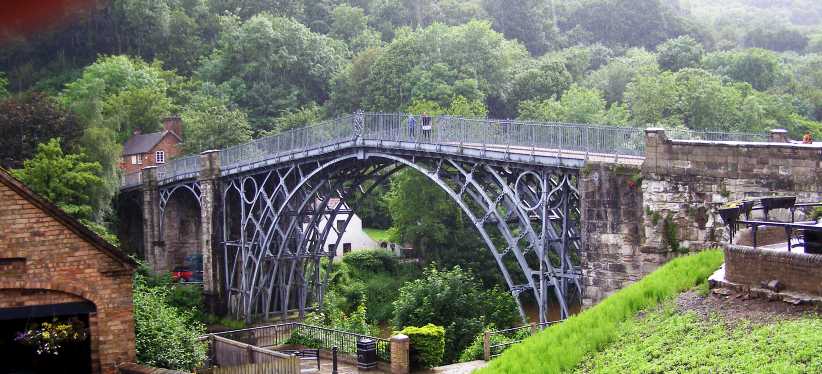
The iron bridge. This was my first sight of the bridge when I arrived in Telford. Its quaint design is backed up by detail well worth looking at.
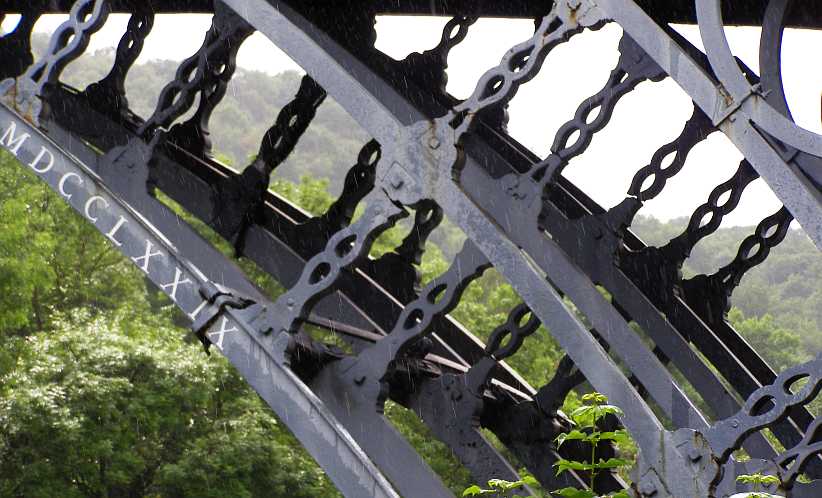
Built in 1779. The Roman numerals tell the story, the bridge dates from 1779, nine years before the first European settlement in Australia.
Also visible in that photo are a couple of other points. The first is that its sections are held together by methods used with timber, the most evident being the dovetail joints. But note also that there are many broken pieces of iron compromising the strength of the structure.
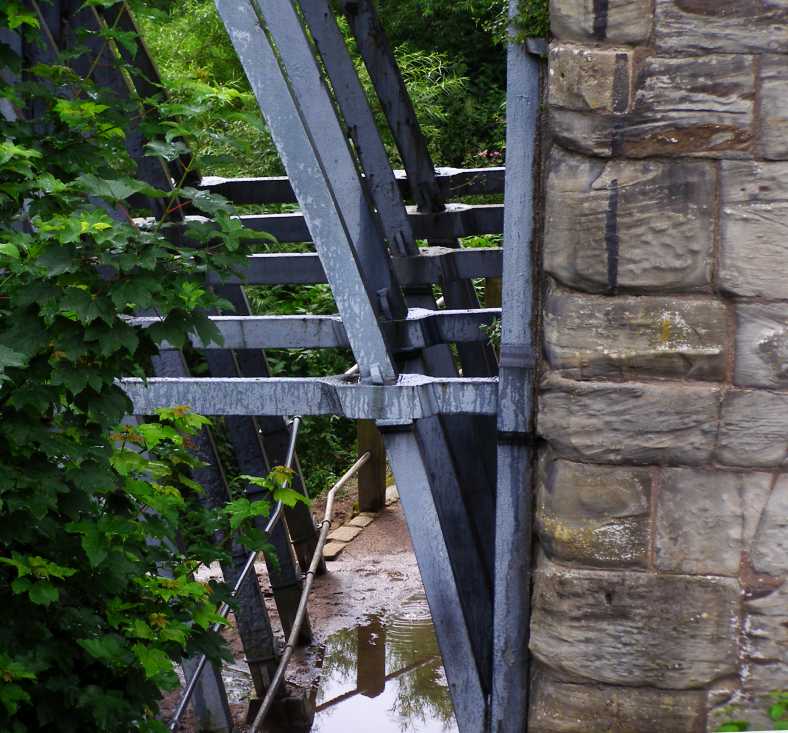
Iron and stone. Stonemasons had a part in the construction too, while for many years there was conjecture about how the span sections were supported during construction.
As we’ve seen before, supporting a structure like this before it’s able to hold its own weight can be a bit of a problem. How it was done was lost in the mists of time (using boats was suggested) until a painting was discovered in Stockholm in 1997 which shows timber scaffold and derrick poles standing in the bed of the river to support the main beams.
There is a nearby town called Coalbrookdale, and it’s from there that the coke was obtained to fire the furnaces which were used to smelt the iron from locally available ore, sections being cast about half a mile downstream and taken on barges to the construction site. Some pieces were about five tons in weight.
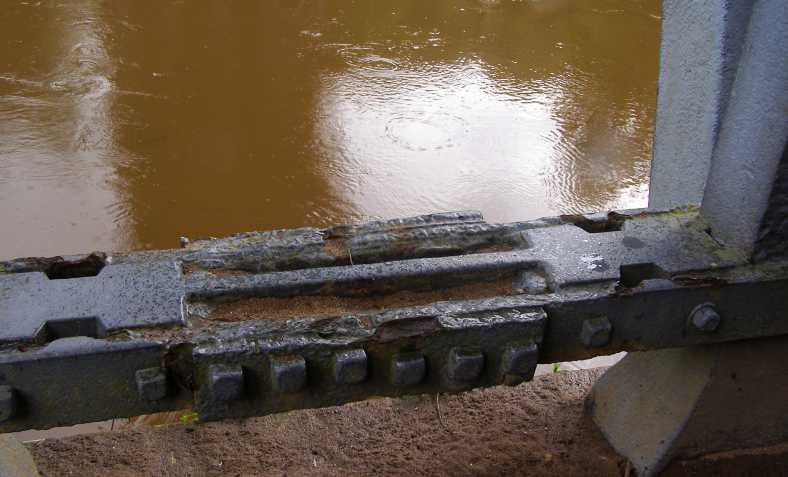
Bolts. Bolts are also used in the bridge, while this photo also shows that rust has taken a toll over the years.
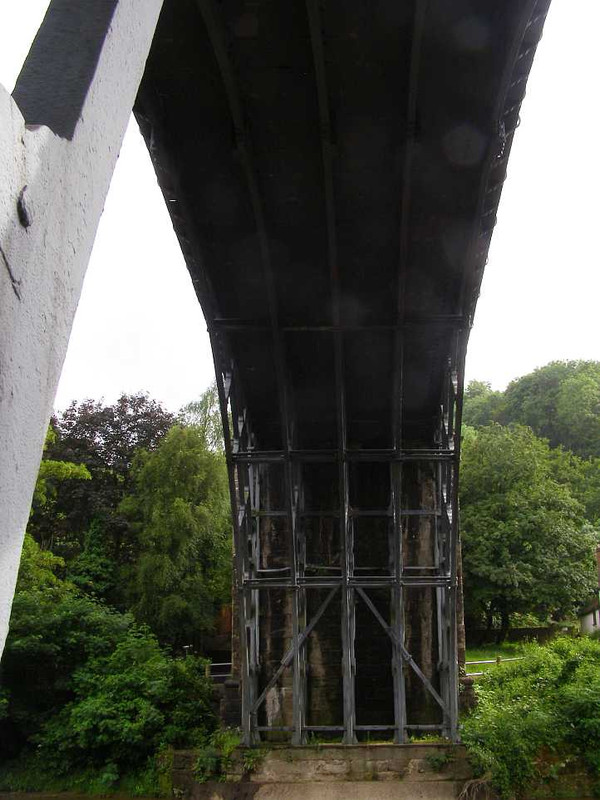
Underside. The five main arches are visible here. The span of the bridge is just over 100 feet.
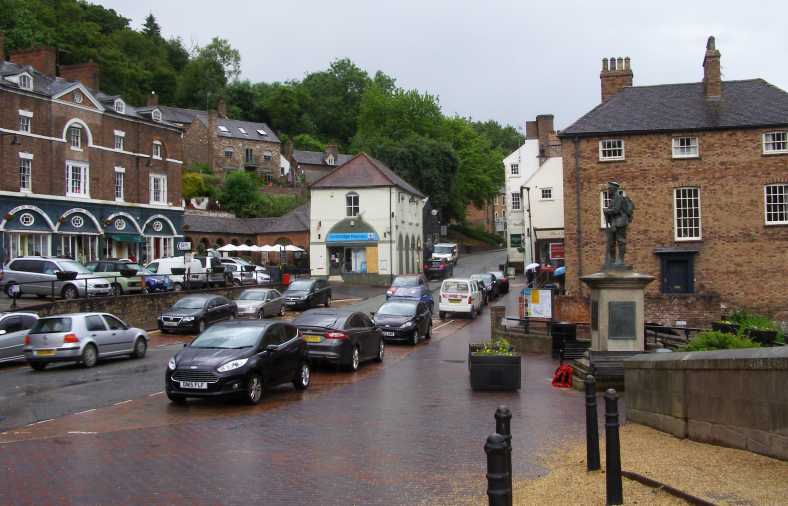
Telford. The popularity of the iron bridge brings many tourists to the town, but it retains an old English character.
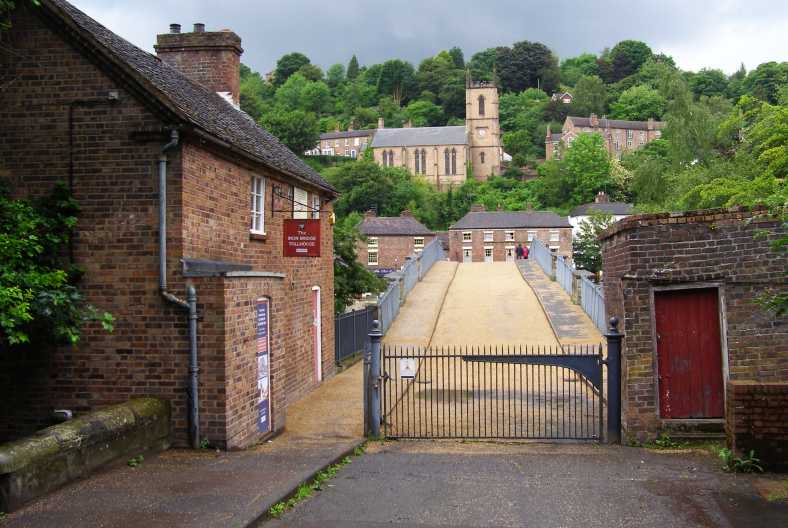
Tollhouse. It was a commercial enterprise building the bridge and tolls used to be collected for vehicles and pedestrians crossing. Vehicles were stopped in the early part of the twentieth century and pedestrian tolls ended in 1950.
The bridge is heritage listed, in fact it’s a World Heritage site along with the adjacent town of Ironbridge and the gorge. And it was time for me to leave as I was hungry and didn’t see anything to eat locally. I did see this numberplate, however:
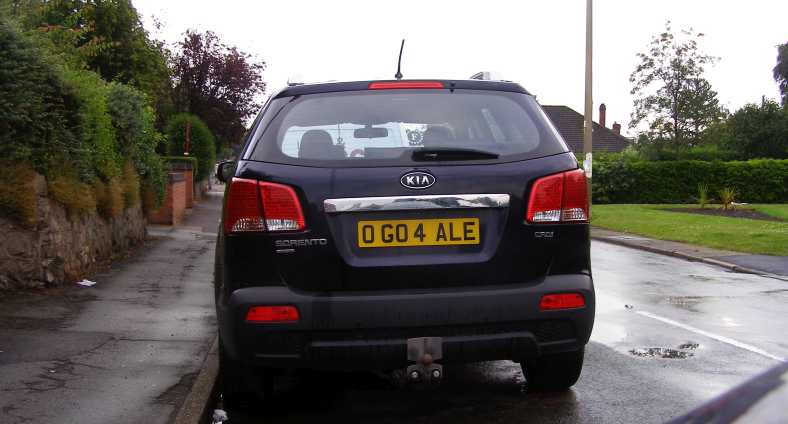
Go for ale. I wonder if the driver sees more breath tests than usual?
And after stopping off on the next stage of the drive I obtained a (very late) traditional British lunch:
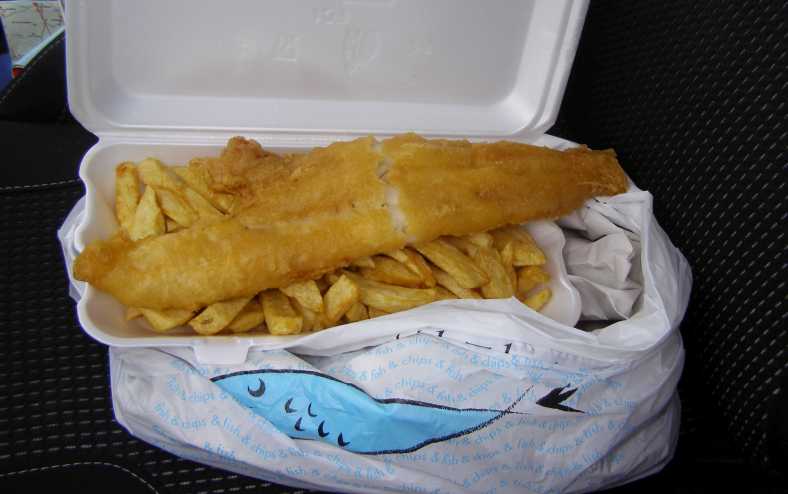
Fish and chips. Familiar fare to me as Australia has followed England in packaging battered fish with crisp chips.
After the motor racing disappointments of the day I was looking forward to seeing Oulton Park. I expected to find a circuit which had a different atmosphere to the likes of Brands Hatch and Silverstone, big time Grand Prix circuits. It was a nice drive.
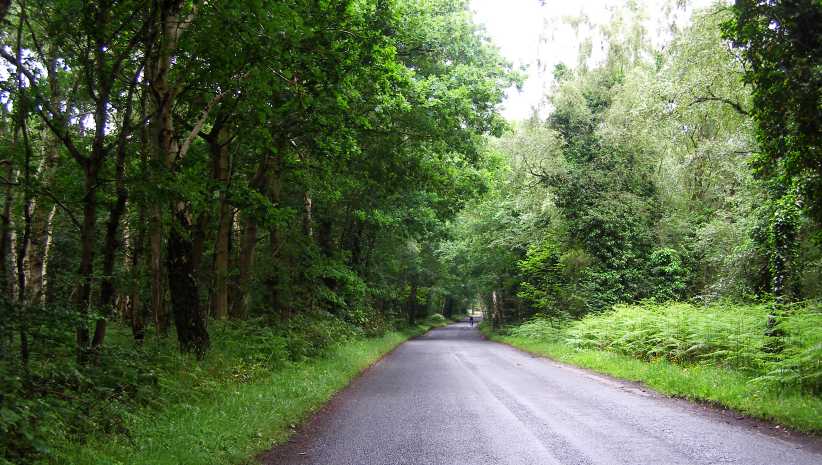
Narrow roads. It was still wet, I’d been on wet roads most of the day, and these narrow ones were rather picturesque.
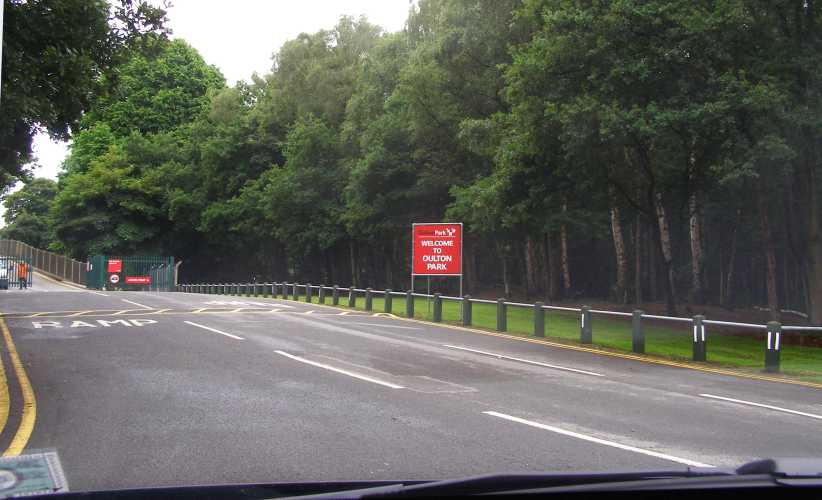
‘Welcome to Oulton Park.’ Well, the sign says so, but I was to find out it didn’t mean me.
On my arrival at the gate I was told I couldn’t go in. “There’s a corporate day on,” I was told. Ever keen to find a way around these things, I suggested he let me just go in the 100 yards or so that would enable me to see something from the top of a bridge.
But no, I’d gone there for nothing. So I tried to drive around and find somewhere I could see something from outside the property.
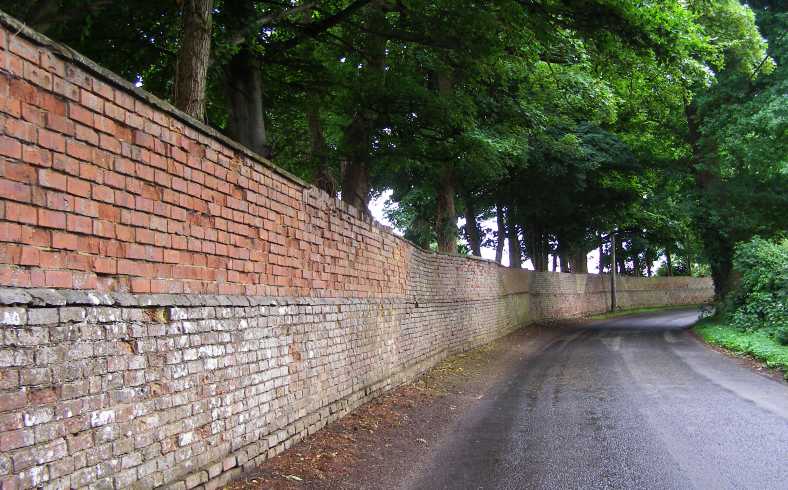
Brick wall. I was incredulous at finding there was a high brick wall around the place.
Who builds a brick wall like that which goes for miles like this one does? I’ve never seen such a thing before, even jails aren’t that big!
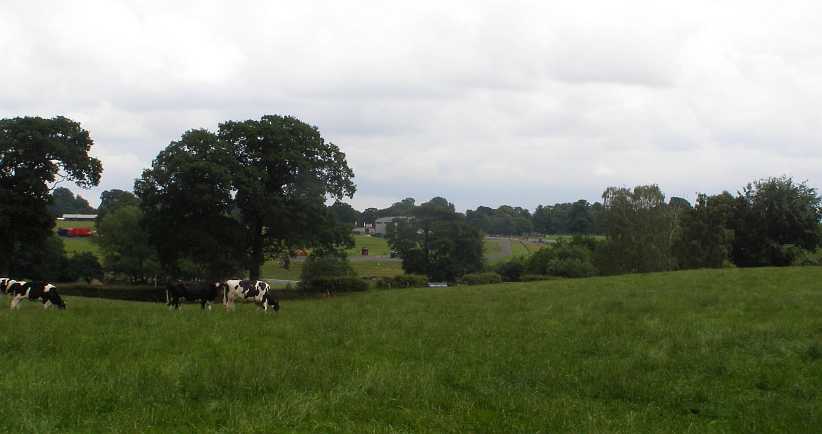
Over the cow paddock. By the time I reached higher ground to be able to see over the wall I was too far away to see anything anyway.
So Oulton Park was a failure for me too. The scene of one of Stirling Moss’ more famous wins when he took the annual Gold Cup in the 4WD Ferguson Grand Prix car (the last F1 win for a front-engined car if my memory serves me right), the unfortunate setting in which Australian Paul Hawkins lost his life, too.
I started looking for somewhere to spend the night, I wanted to meet up with forum member Roger Clark and it was a good idea to spend a few quid on getting a room for the night. I found this place:
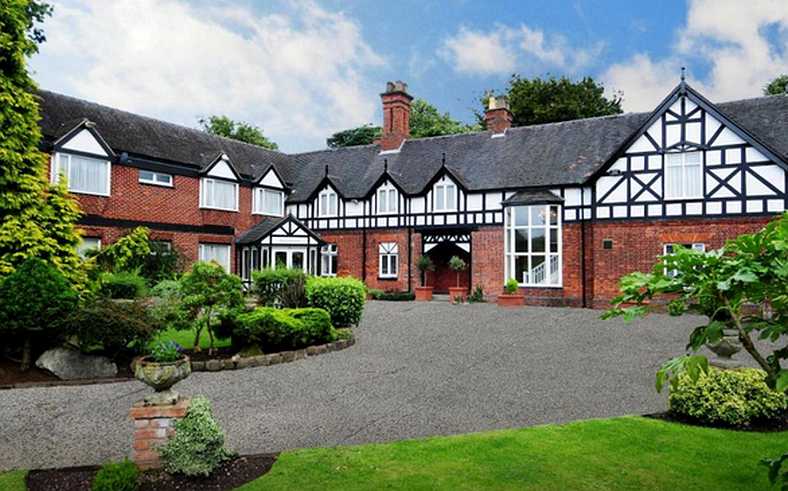
Chimney House Hotel. A stately-looking hotel on a broad estate area, this was to be my home this Wednesday night.
Roger duly arrived and we had some discussion about common interests and generally enjoyed the evening. After he left I started thinking about Thursday, when Hadrian’s Wall would provide a major attraction…
In the end we’ve managed to confirm things, even one crankshaft which was incorrectly labelled!
I mentioned that I knew some prize exhibits were no longer there, but one of the great ones did remain, that was a replica of a Mercedes-Benz W125 from the mid to late-thirties:
W125 replica. It was very appropriate to have such a car here as the two German teams raced at the Donington circuit in that era. But this was the only such car on display.
Then, across the aisle, was the whole BRM display. I have a bit of a soft spot for BRM as they came good after years of failure just as I was taking an interest in Grand Prix racing. Before BRM – British Racing Motors – came English Racing Automobiles, though, the main people involved had been building the ERA…
ERA E type. With a 2-litre engine, this car’s history is both pre-war and post-war, developed in 1939 but not raced until after hostilities ended. A sister car which has some minor differences was racing before the war.
Note that it has an independent front suspension by trailing arms, like a Volkswagen. It had a rear suspension with swing axles for a short time, this being replaced by a de Dion arrangement. The first BRM, the V16, had a similar front end and it can be seen here:
BRM V16. The pinnacle of complication, this car was built to show British engineering prowess and featured a 12,000rpm 1.5-litre V16 engine which had an engine note to delight any enthusiast. It was also a dismal failure for the first couple of years.
BRM P57. Displayed in pretty much the form in which it won the opening Grand Prix of 1962, the Dutch Grand Prix, this is the car which turned around the fortunes of BRM. Some variations came later in the year which made it look better, and it kept going so well that it took Graham Hill to his first World Championship.
As BRM had gone away from being a consortium drawing assistance from the whole British Motor Industry and was now owned by Sir Arthur Owen it was determined by him that they had to win or die. The ultimatum was put down and the team were able to respond. They even delved into other activities, like building and selling engines to other teams and privateers and building the Rover-BRM turbine car for Le Mans. Another project was a 4-wheel-drive car for F1:
BRM P67 4WD. With the 3-litre formula having been announced, BRM indulged in experimenting with a 4WD car with the 1.5-litre engine, it was a dead-end and that was reflected in that they were not among the teams which built 4WD cars later in the sixties.
After sinking into oblivion again with the highly complex H16 engine at the beginning of the 3-litre formula, BRM relented and simplified with a string of V12-engined cars. These engines were effectively ‘extensions’ of the 2-litre versions of the 1.5 engine which had proved so successful. Success didn’t come to the V12 overnight, however, as Grand Prix cars were changing rapidly.
BRM P139. One of a string of V12 cars, this one didn’t achieve much for BRM, only some minor places in the hands of John Surtees.
Finally they hit their straps again beginning with the P153. At the same time they obtained some sponsorship which finally took the cars out of their drab dark green colour. Some very talented drivers helped out too, principally Pedro Rodriguez and Jo Siffert.
P153 and P160. Both of these cars won races for BRM, but it came at a price as Jo Siffert lost his life in one. Wins also came from Peter Gethin and Jean-Pierre Beltoise.
These cars were to be the last of the successful string of cars which had been winning for a little over a decade. The team began to stumble and fall into decline, it was sad to see it happen but that’s the way it has always been in such a highly competitive environment.
Going back to the original BRM, however, the Donington collection had some great exhibits. The V16 was incredibly complicated, as can be seen in these pictures:
V16 cutaway. No doubt this was prepared many years ago, but still worth looking at. The engine’s central gear train to the camshafts is seen, preventing camshaft whip, the huge centrifugal supercharger on the front, the big pipes from the supercharger too.
Front view. Looking from the front the size of the supercharger, made by Rolls-Royce, is clearer. Again the central drive train for the cams, but also the water pump can be seen on the side of the crankcase, driven by a jackshaft skew-driven off that central drive train. The tiny sleeves for the four cylinders are clear in this shot, protruding from the block and to be sealed with compressible rings which were charged with holding in the cylinder pressures at 11,500 rpm and 585 horsepower.. The cylinder bores are just 1.95” and the stroke a mere 1.9”.
Rear view. This view emphasises the wide vee angle, 135°, and the size of the pipes carrying mixture to the cylinders from the supercharger.
In the background to this picture is a line of ‘Formula Classic’ racing cars. These were built by the Donington people to create an old-look class – front engined and open cockpits – for historic-type racing with modern conveniences. Like fuel injected engines etc. The presence of so many of these emphasised to me how many proper exhibits were no longer in place.
But there were still things to see and maybe I should stop complaining?
A very popular car in the late sixties…
Cooper T51 Coventry-Climax. A hugely successful car in 1959, this car like the one in which Jack Brabham won his first title was a very simple machine compared to its competitors.
These Coopers were campaigned by many people in Formula One, Formula Two (with the 1.5-litre Climax engine at that time) and all around the world. There must have been half a dozen of them in Australia by the end of 1960.
I mentioned 4WD Formula One cars, a popular diversion before the true effects of wings became obvious. This one was from Lotus and was one of the few which raced:
Lotus 63. Lotus used the 4-wheel drive setup in both F1 and Indianapolis cars, this one has the conventional Cosworth DFV engine.
Lotus 63 front suspension. There’s a driveshaft hidden in among the wishbones of the front end and inboard discs were a natural feature.
One of the really bright stars of the Formula One firmament in the late seventies and eighties was the Canadian firebrand, Gilles Villeneuve. He arrived in a spectacular flurry and turned on some great performances when his ‘never say die’ attitude shone through.
It was one such race which I saw him win on my only previous trip to Europe, the 1981 Monaco race, where he plugged on and got the win after Alan Jones had fuel pickup problems when in a dominant position. A very popular driver, especially in this car:
Ferrari 312T4. The ‘312’ designated 3-litres, 12 cylinders. The ‘T4’ was for a transverse gearbox, and it was the fourth iteration of the type. The ‘Villeneuve’ on the side means it was a car to be watched, very spectacular.
Ferrari persisted with the flat-12 engines for several years despite the difficulty they created as ‘ground effect’ became the prevailing performance feature of Formula One. Many feel, as do I, that aerodynamics and the big-spending allowed by big sponsorships spoiled Formula One.
In with that car is the Lotus which followed up from the last of the John Player Specials. Lotus struggled for a few years at that time.
Not all Formula One cars are built to be winners. When their engines were proving to be almost universally successful, Cosworth branched out to build a car that never raced:
Cosworth. Designed by Robin Herd and featuring 4-wheel drive, this 1969 project never amounted to anything as Herd left to design the first March cars. It had a unique 4WD system designed by Keith Duckworth while all others used the Ferguson system.
Among the large number of McLaren cars on display there was an Indianapolis car, the M24:
McLarens. The McLaren M24 Indianapolis car used the Cosworth DFX engine, this car sits next to the M7C F1 car of 1969 with the M21 next in line. The driver names are Johnny Rutherford, Denny Hulme and Jody Scheckter respectively.
Penske PC27. Roger Penske’s team built their own cars and this one is the PC 27. In line beyond it are McLarens M28, M29 and MP4/8.
Still looking for anything different, I found this engine. Designed by Weslake – who had a big part in the Eagle V12 of the late sixties – it was designed to be used in long-distance racing and was considered for Brabham F1 cars but never tried. It ultimately was a costly failure.
Weslake V12. Designed to be used in the Gulf Mirage team cars it was effectively based on the Eagle V12’s bottom end with a more modern top end.
March 711. The Ronnie Peterson model, the front wing, variously described as a tea-tray or other derogatory names, was unique.
Maserati and Ferrari. More cars from the fifties at last. Two Maserati 250Fs, each different to the other in small ways, and the very successful Ferrari 500 of the Alberto Ascari years.
These were cars which won many races and a championship or two. Just why they share company with WW2 German motorcycles escapes me.
And I escaped too. My time was up in the museum, I might well have judged it harshly but that was how I felt about it. So disappointed was I that I drove off and totally forgot to have a look at the famous Donington Park circuit!
I was well on my way to Telford and the cast iron bridge before I remembered and I wasn’t turning back.
This bridge had captured my imagination when I saw it on an episode of an Australian-made TV documentary called Out of the Fiery Furnace (sub-titled ‘Man’s history with metals). It was the first large bridge built out of cast iron and one of the few still standing today.
The iron bridge. This was my first sight of the bridge when I arrived in Telford. Its quaint design is backed up by detail well worth looking at.
Built in 1779. The Roman numerals tell the story, the bridge dates from 1779, nine years before the first European settlement in Australia.
Also visible in that photo are a couple of other points. The first is that its sections are held together by methods used with timber, the most evident being the dovetail joints. But note also that there are many broken pieces of iron compromising the strength of the structure.
Iron and stone. Stonemasons had a part in the construction too, while for many years there was conjecture about how the span sections were supported during construction.
As we’ve seen before, supporting a structure like this before it’s able to hold its own weight can be a bit of a problem. How it was done was lost in the mists of time (using boats was suggested) until a painting was discovered in Stockholm in 1997 which shows timber scaffold and derrick poles standing in the bed of the river to support the main beams.
There is a nearby town called Coalbrookdale, and it’s from there that the coke was obtained to fire the furnaces which were used to smelt the iron from locally available ore, sections being cast about half a mile downstream and taken on barges to the construction site. Some pieces were about five tons in weight.
Bolts. Bolts are also used in the bridge, while this photo also shows that rust has taken a toll over the years.
Underside. The five main arches are visible here. The span of the bridge is just over 100 feet.
Telford. The popularity of the iron bridge brings many tourists to the town, but it retains an old English character.
Tollhouse. It was a commercial enterprise building the bridge and tolls used to be collected for vehicles and pedestrians crossing. Vehicles were stopped in the early part of the twentieth century and pedestrian tolls ended in 1950.
The bridge is heritage listed, in fact it’s a World Heritage site along with the adjacent town of Ironbridge and the gorge. And it was time for me to leave as I was hungry and didn’t see anything to eat locally. I did see this numberplate, however:
Go for ale. I wonder if the driver sees more breath tests than usual?
And after stopping off on the next stage of the drive I obtained a (very late) traditional British lunch:
Fish and chips. Familiar fare to me as Australia has followed England in packaging battered fish with crisp chips.
After the motor racing disappointments of the day I was looking forward to seeing Oulton Park. I expected to find a circuit which had a different atmosphere to the likes of Brands Hatch and Silverstone, big time Grand Prix circuits. It was a nice drive.
Narrow roads. It was still wet, I’d been on wet roads most of the day, and these narrow ones were rather picturesque.
‘Welcome to Oulton Park.’ Well, the sign says so, but I was to find out it didn’t mean me.
On my arrival at the gate I was told I couldn’t go in. “There’s a corporate day on,” I was told. Ever keen to find a way around these things, I suggested he let me just go in the 100 yards or so that would enable me to see something from the top of a bridge.
But no, I’d gone there for nothing. So I tried to drive around and find somewhere I could see something from outside the property.
Brick wall. I was incredulous at finding there was a high brick wall around the place.
Who builds a brick wall like that which goes for miles like this one does? I’ve never seen such a thing before, even jails aren’t that big!
Over the cow paddock. By the time I reached higher ground to be able to see over the wall I was too far away to see anything anyway.
So Oulton Park was a failure for me too. The scene of one of Stirling Moss’ more famous wins when he took the annual Gold Cup in the 4WD Ferguson Grand Prix car (the last F1 win for a front-engined car if my memory serves me right), the unfortunate setting in which Australian Paul Hawkins lost his life, too.
I started looking for somewhere to spend the night, I wanted to meet up with forum member Roger Clark and it was a good idea to spend a few quid on getting a room for the night. I found this place:
Chimney House Hotel. A stately-looking hotel on a broad estate area, this was to be my home this Wednesday night.
Roger duly arrived and we had some discussion about common interests and generally enjoyed the evening. After he left I started thinking about Thursday, when Hadrian’s Wall would provide a major attraction…
Last edited by Ray Bell; Jun 16, 2020 at 05:02 AM.
Thread Starter
|
Captain
Joined: Oct 2005
Posts: 570
Likes: 8
From: The Summit, Queensland, Australia
Northern England was my viewing territory for the day on Thursday, June 16, 2016.
It reminds me that Farrar Fenton, who did his own bible translation about 120 years ago, wrote that the reason he wanted to do this was because the language of the King James bible was no longer that of the common man. “It’s only used by the shepherd boys of the North of England, the most ignorant of our countrymen.”
I wasn’t really expecting to find any ignorance, nor shepherd boys, but I looked forward to investigating the ancient Hadrian’s Wall, which separated the English and Scottish people in the days of the Roman Empire. But that was still some distance away, about 140 miles, as I left the Chimney House Hotel under the inevitable cloudy skies.
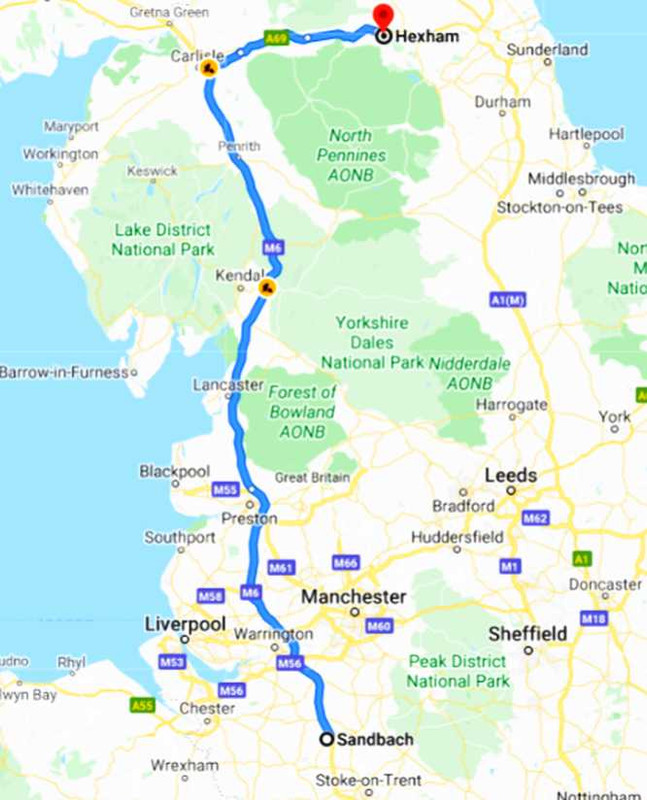
I drove up the M56 motorway and onto the M6 after bypassing Manchester. Then, with Blackpool somewhere to my left, I spotted the Irish Sea in the distance.
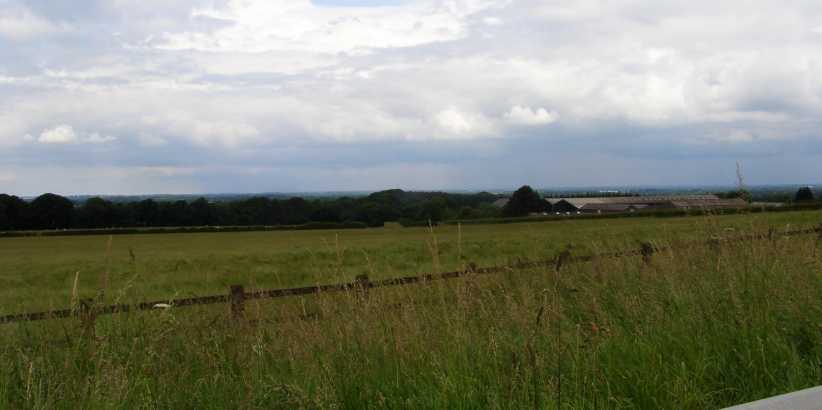
Irish Sea. From a high point in the motorway I was able to see across the Blackpool area with the Irish Sea out on the horizon. The Isle of Man is out there somewhere too.
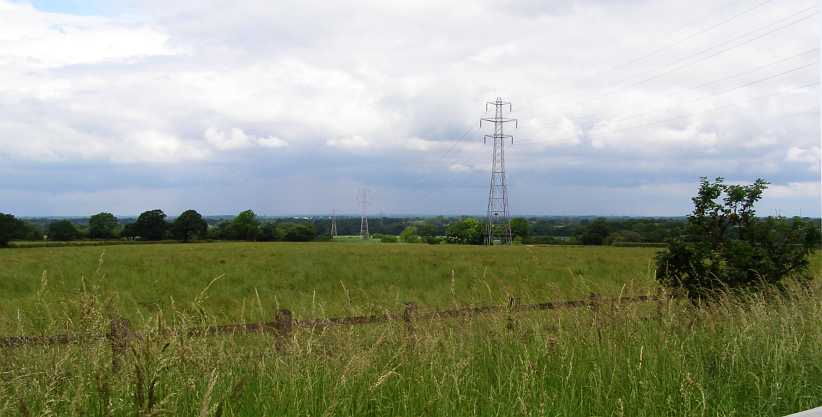
Power lines. Like everywhere else there are major power lines, even going to Blackpool. I don’t know why, but I have photographed them in many countries.
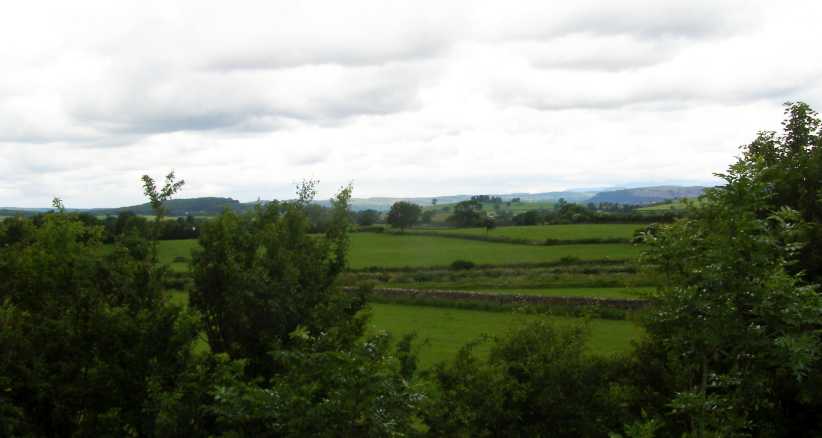
Stone fences. A sign of the old world is the use of stones to build fences everywhere. It cleared the paddocks and it was a resource locally available in a time when labour was plentiful. But who collected all the rocks?
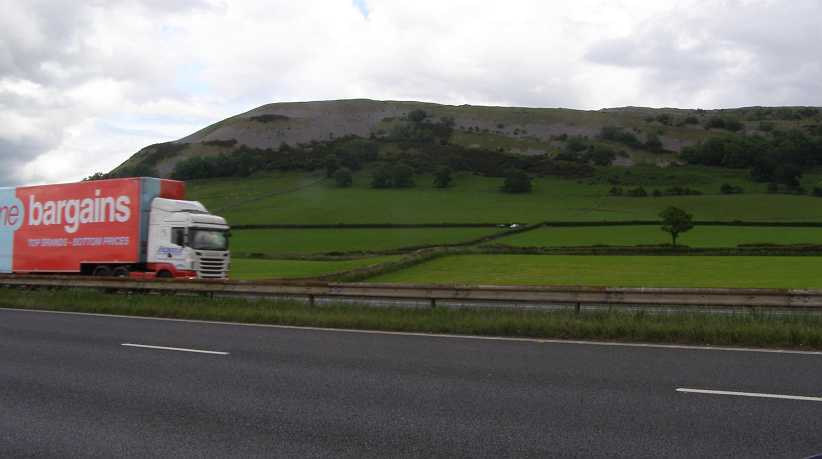
M6 trucking and more fences. Yes, there is plenty of freight on these roads going by yet more of the stone fences.
A glimmer of hope arose as I drove along. The persistence of the overcast days looked like it might fall down for a while as some blue sky appeared:
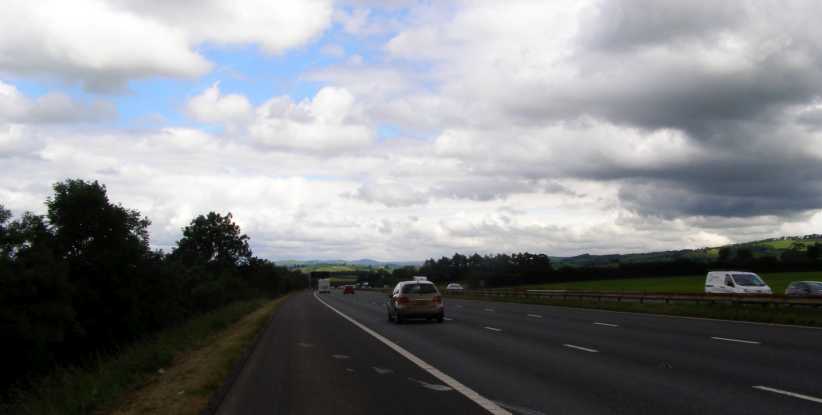
M6 under blue sky. Well, that’s an optimistic view, but some blue was certainly most welcome.
And the scenery rolled by with plenty of nice scenery. The line, “Of ordered woods and gardens” [“My Country” by Dorothea Mackellar] comes to mind when one compares this kind of setting with what I’m more used to seeing in Australia…
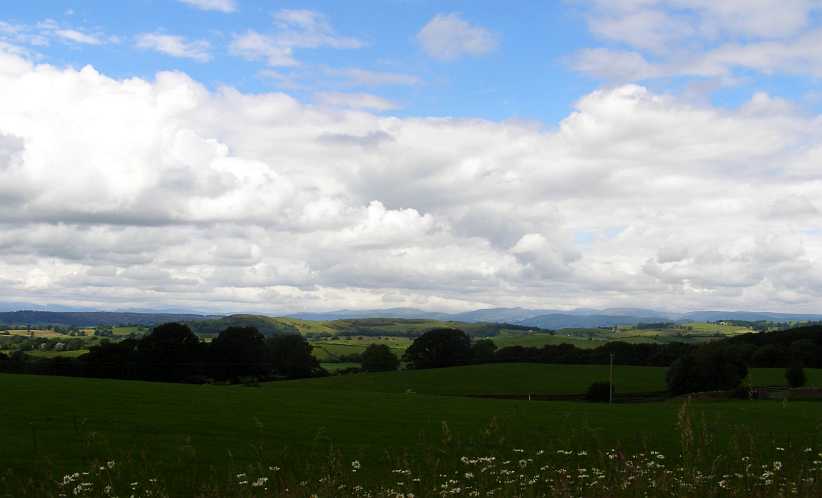
Rolling hills and blue skies. Sadly, this was as good as it got, but it did paint a nice picture of well-manicured farming land.
Soon enough the blue patches in the sky went behind more clouds, however…
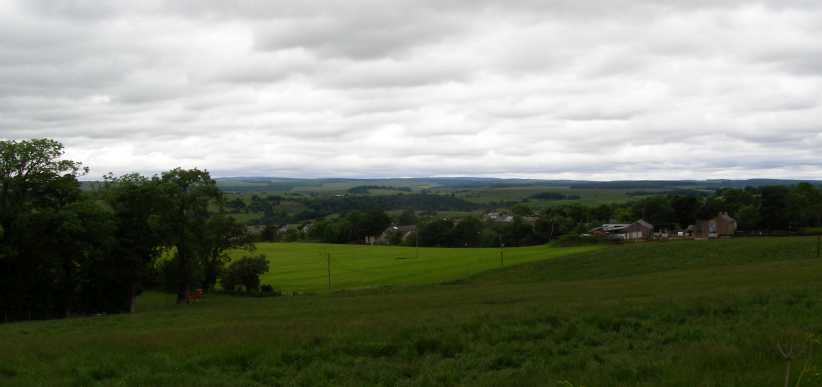
Rolling hills and clouds. How much better would it be under blue skies? The hills roll off into the distance while these homes are a part of some nice scenery.
I left the M6 to head across towards Newcastle upon Tyne, the main road which gives access to Hadrian’s Wall. It was no longer the motorway, but a main road which was still of a high standard.
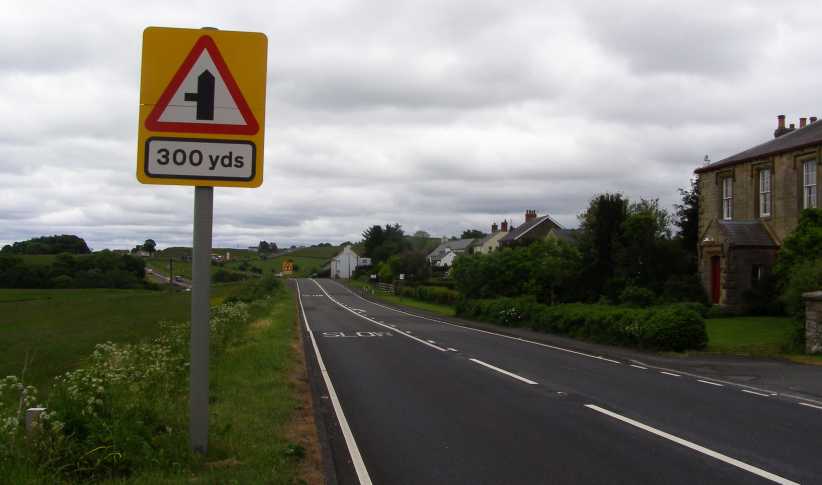
The road to Newcastle. Heading East I got this pic of houses facing the main road, I was by now getting eager to see some of the famous stone wall.
So who was Hadrian? A Roman Emporer, no less, ruling from 117 to 138CE, a time when the Roman Empire was huge. As this sign explains, he toured the Empire ensuring that there was no revolt, that they didn’t suffer from incursions and that steps were taken to help with that:
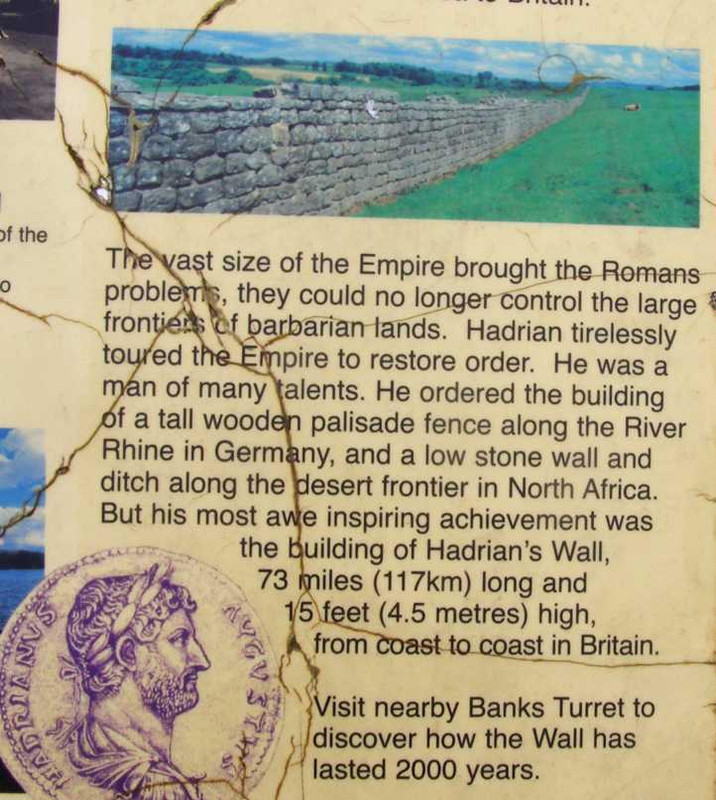
Hadrian. A well-travelled Roman Emporer and the man who made the biggest impact on this part of the world.
This was, it says, the Northernmost point of an Empire which stretched all the way to the Middle East. Quelling any local problems would be very important, I’d imagine, as news couldn’t have travelled all that quickly in those times and reacting with a large force would be very difficult.
But a wall 15 feet high and 73 miles long would mean collecting a lot of rocks!
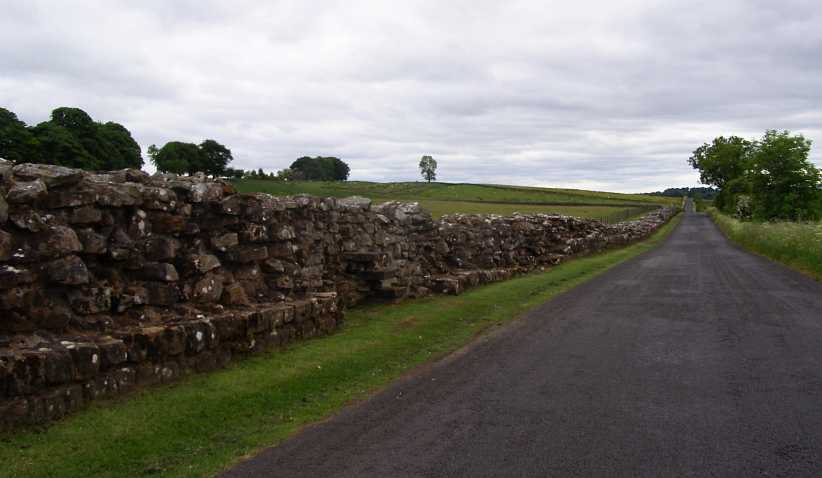
The wall. My first sighting of the famous wall, driving down a side road it appeared for me.
Even though this looks a substantial wall, it’s not like it used to be. Whether it’s lost height – as it’s probably a little over half the original height here – due to it sinking into the ground, or because rocks have been taken from its top over the years, or both, I don’t know. I suspect it’s both, I was told that many homes in the districts along the way had been built with rocks taken from the wall.
But it wasn’t just a wall. There were structures called ‘milecastles’ every Roman mile along its length. A Roman mile is 1.48kms, or 0.92 miles, and there were two ‘turrets’ between each of the milecastles. What a lot of work!
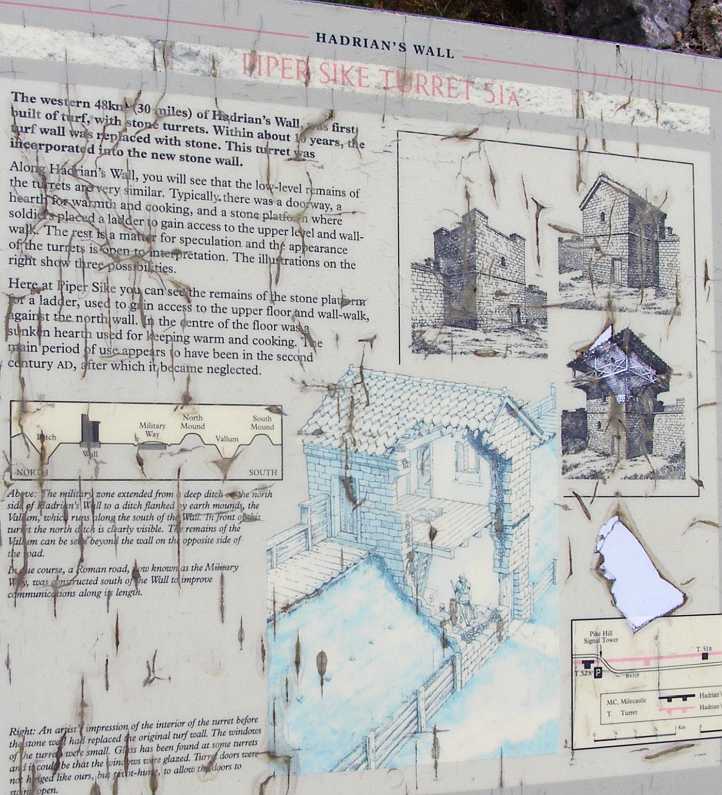
Information. I encountered no places where there was printed information available, but at a few places there were signboards like this one.
Note that it explains that it wasn’t just the wall, or its turrets or milecastles, which provided the protection from invaders. A ditch was dug on the ‘foreign’ side, with the soil thrown up to form a bank the other side of that ditch, so any threatening force would have to climb that bank and be exposed right down into the ditch before they got very close.
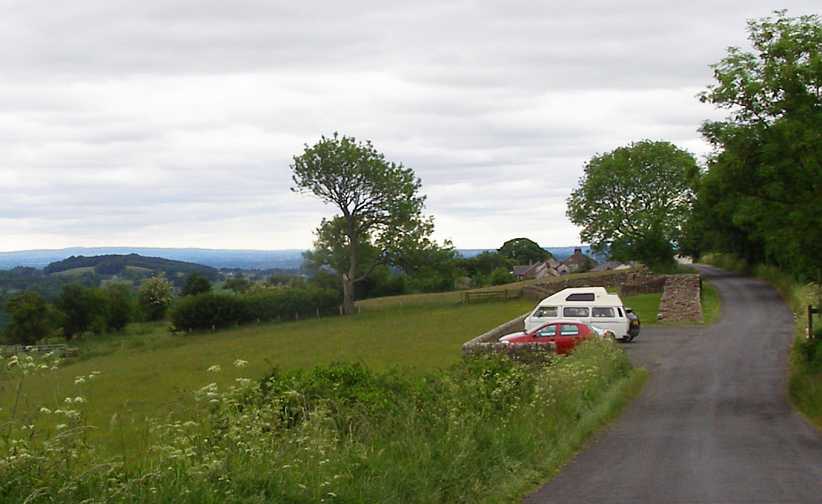
Viewing place. Here’s a section where the turret wall has been used as a border for a parking space for visitors. Again, the wall has lost most of its height.
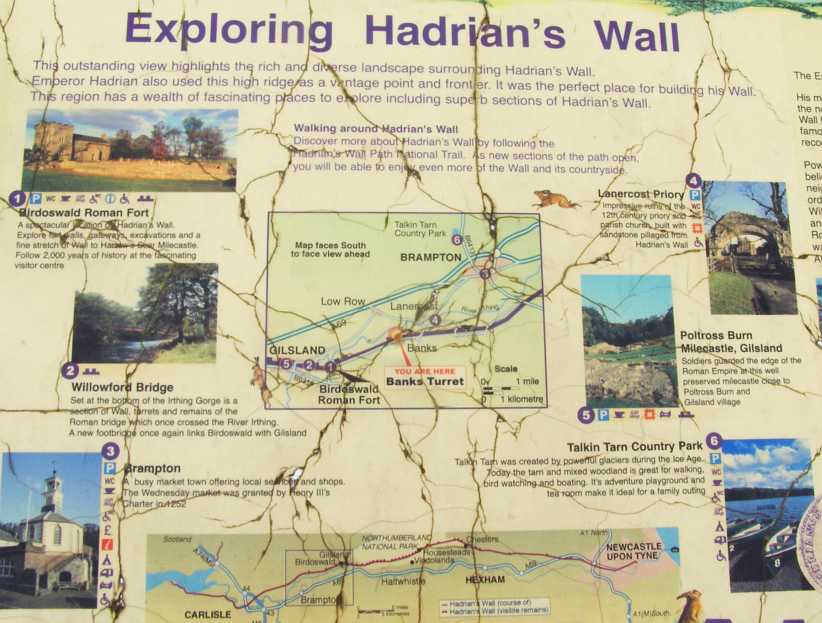
More information. To this point, almost halfway along the wall, it had been built originally of soil, with the rock construction following about ten years later.
Not forgetting that this area has some very nice scenery. Despite the overcast day I was getting the odd worthwhile picture showing what it was like. The homes of those ‘ignorant shepherd boys’ were often seen, with the stables these days used to house cars and the homes no doubt featuring those odd random-sized doorways that have many people ducking as they walk through.
And one has to think that some of those shepherd lads had a part in the manicuring of the scenery over the centuries:
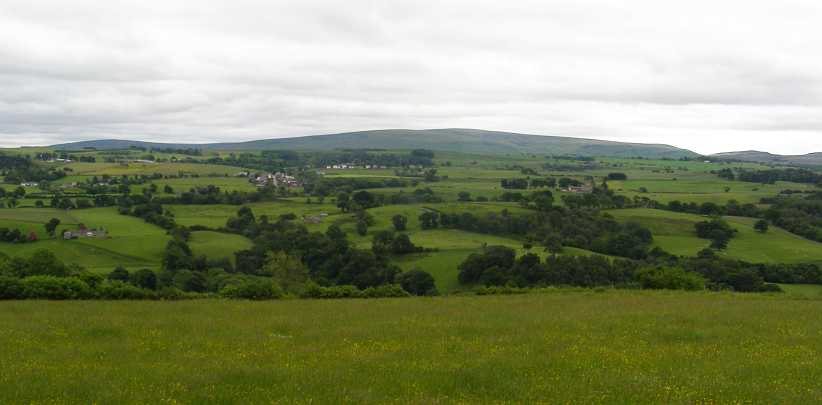
Farms, homes and hills. A small village, hedges and tree-lined boundaries are typical of this part of England.
Some historic buildings are to be seen. On a back road between the main highway and the wall I came across this stone archway:
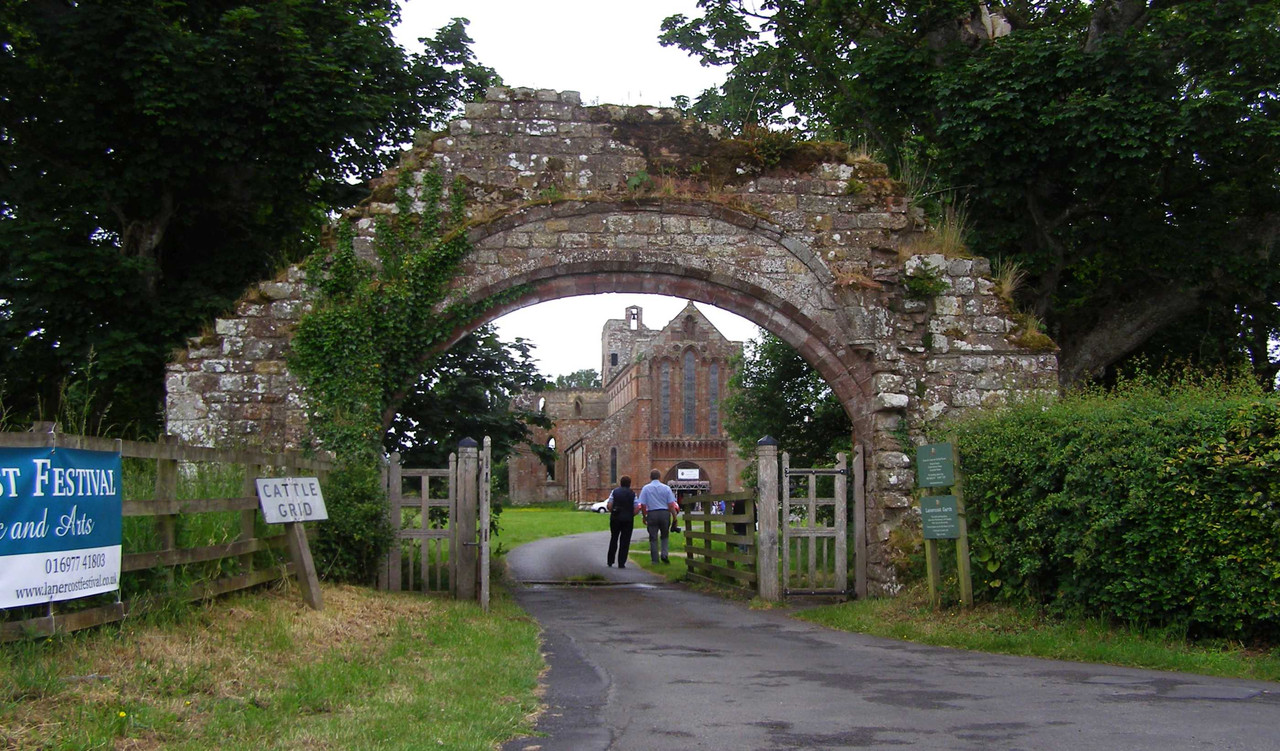
Lanercost Priory. The building visible here is a church structure, but just around the corner were tea-rooms so tourists could get refreshments during their visit.
It was a little place called Lanercost, and just down the road from this was an old stone bridge which was also worth a moment to photograph and admire…
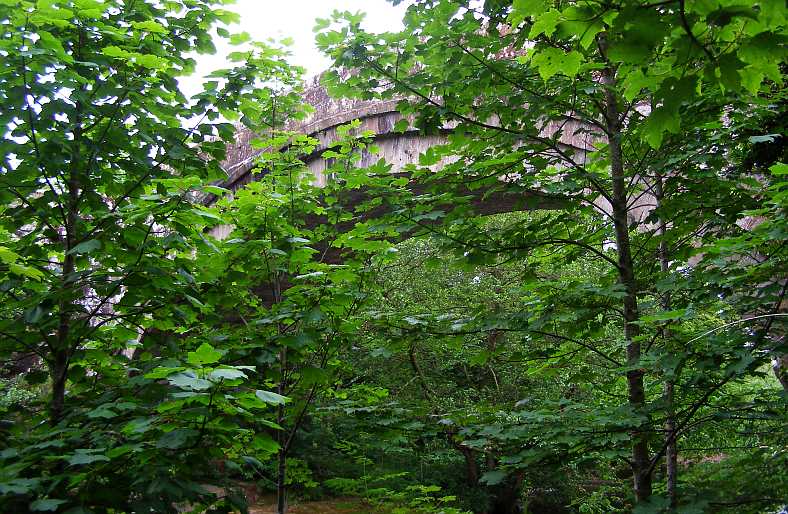
Lanercost Bridge. Believed to have been built in 1543 and restored (or rebuilt) in 1724, it no longer carries traffic.
Some fascination with bridges leads me to photograph these. Years ago I read somewhere that the average life of a bridge is fifty years, but this one might be said to have stood the test of time. Or, perhaps, bearing in mind the few ‘rebuilds’ it’s had along the way, staggered through the test of time.
Checking it out I found a really good example of the older language used in this part of the country, this sample being from a more learned man, the local Bishop, writing about the bridge in 1705: “Sharp Repartees in ye morning ’twixt Mr. Recr. Aglionby and Mr. Gilpin on ye subject of ye decay’d Bridge at Lennard-Cost.” That certainly justifies Mr Fenton’s statement in his bible translation, doesn’t it?
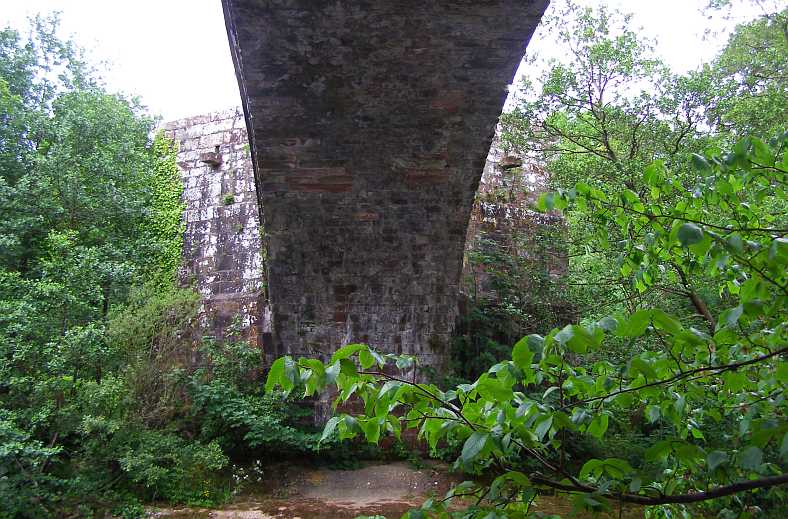
Hard work! It wasn’t just a matter of collecting the rocks, but cutting them to shape and keying them into place to carry the load.
And so I drove on, spending most of my time on the back roads. They’re still subject to the presence of wildlife between the roadside hedges. Wildflowers and greenery were abundant.
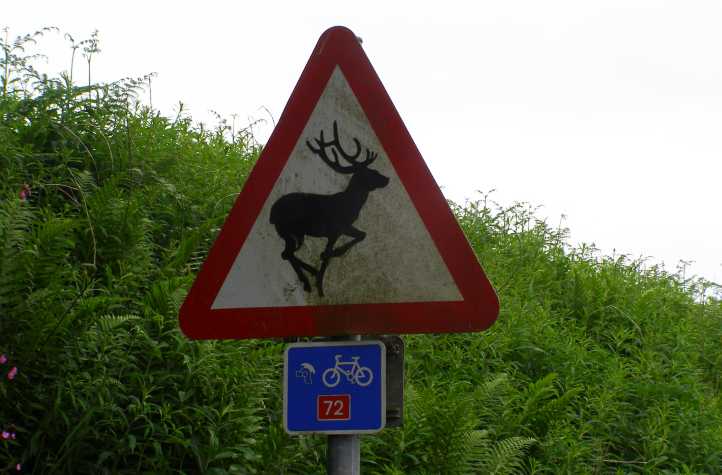
Deer sign. Probably not at the time I drove through, but a warning more for night drivers. But what is the meaning of the umbrella on the sign?
Another chance to get a picture of an old stone-arch bridge came up, this one out in the clear and much larger. This was at a village called Haltwhistle along the main road, from which I took the photo:
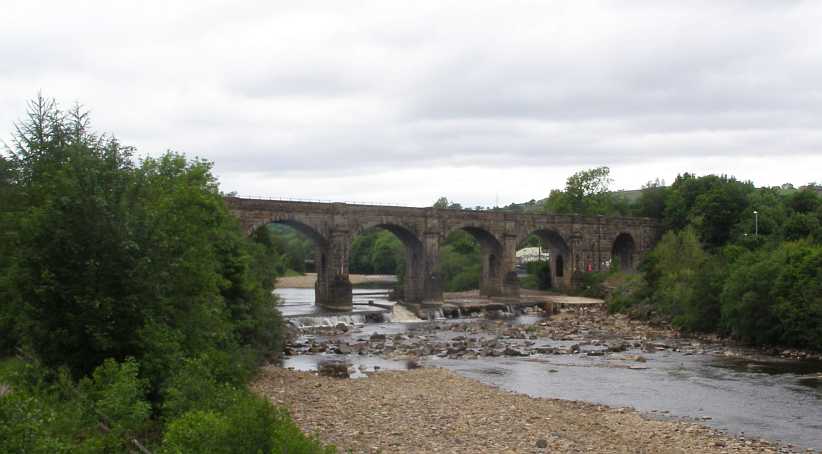
Alston Archive Viaduct. A lengthy name to be sure, but the bridge is longer than the other one and crosses the Tyne. The archways in the supports are unusual.
But mainly I was here to look at Hadrian’s Wall. To keep on progressing sometimes required driving away from it and then back on those minor roads. And always it was there somewhere, if emaciated after 1,850 years.
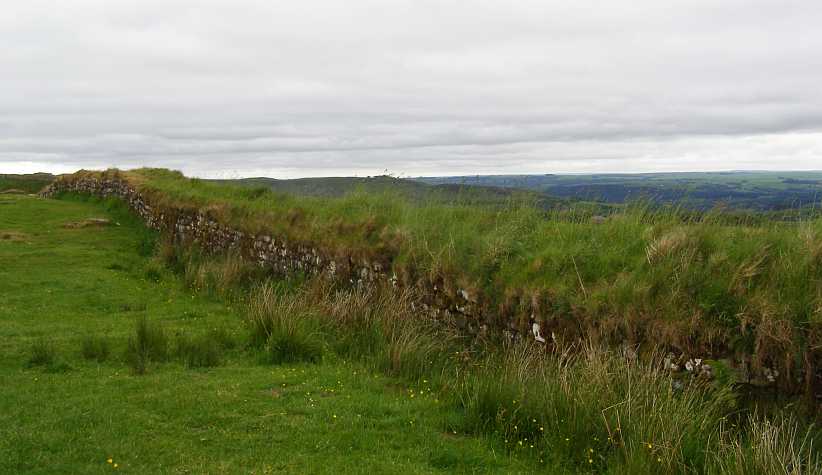
Wall along hill. Roman soldiers patrolling along this section of wall could enjoy some nice views. The wall went over hill…
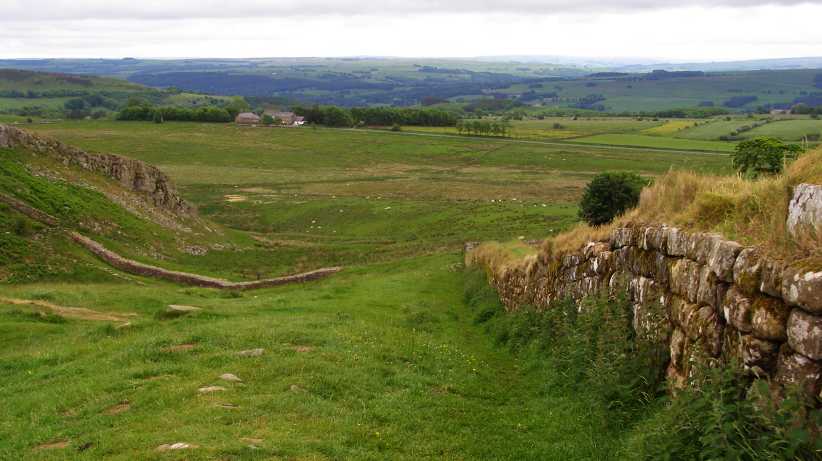
Hill and dale. …and dale. Here it comes off that same hill and curves down through the gap to the next hill.
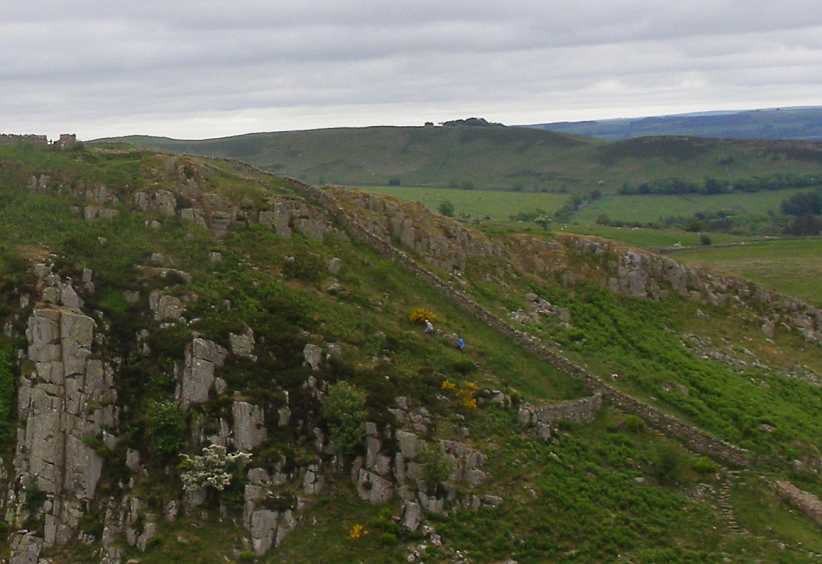
Turret on top. Looking closely at this steep climb to the next hill we see the remnants of one of the turrets. Or, perhaps, a milecastle.
I went no closer, but the couple in the photo obviously did. I didn’t see very many tourists out looking at the wall on this Thursday, a weekend would probably find more wandering around.
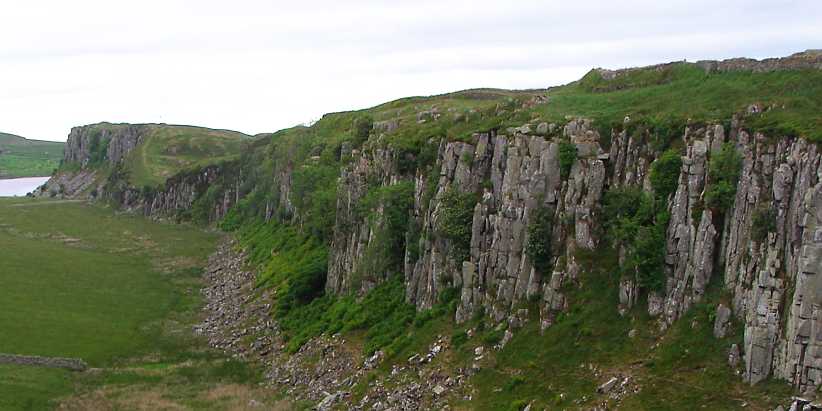
Along the cliff. And from that point the wall continues along the top, the cliff here probably being enough of a barrier anyway.
One of the famous points along the wall is called ‘Sycamore Gap.’ My stepson and his family visited this part of the world on that 2014 trip Janet and I helped them to have and made mention of this place frequently as I was planning my trip. Perhaps they got a bit closer to the tree?
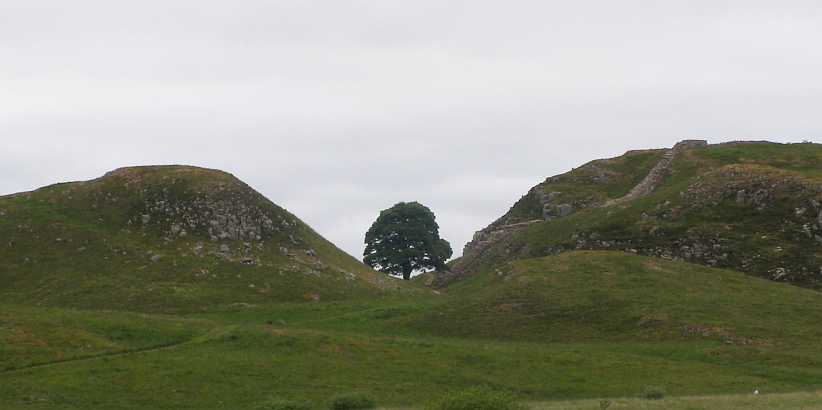
Sycamore Gap. Where the wall crosses this gap in the hills a sycamore tree has grown to maturity, becoming famous no doubt because its silhouette is a significant part of the scenery.
My time along the wall was coming to a close as I wanted to go back to Carlisle to head into the Western part of Scotland and resume my journey to a fresh destination there. Not far from Hexham, a bit over half-way along the wall I took my last photo:
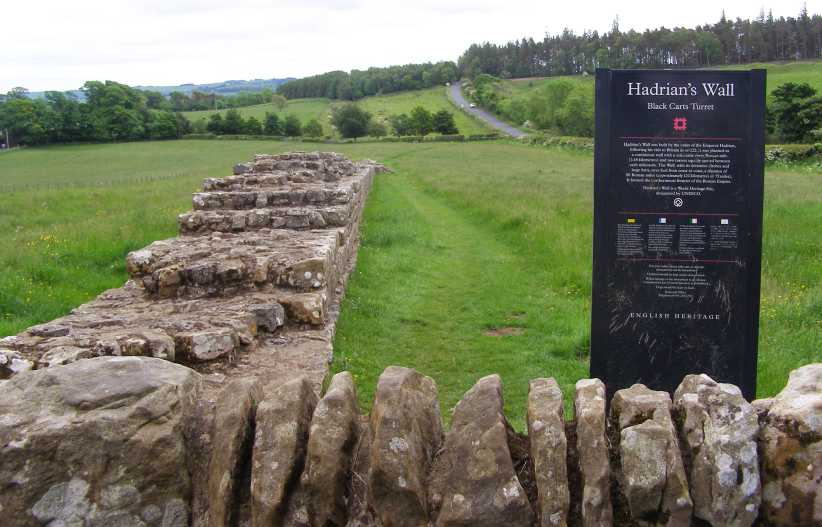
Black Carts Turret. Noted as a particularly well-preserved section of the wall, this was where I left this famous barrier.
And so I headed cross-country to Hexham, which is a larger town on the main road. The whole area reminded me of home, Newcastle is a major city in New South Wales and Hexham is just outside that city, while other local names have also been transferred to ‘the colony’ from this district. But not Chollerford which is on the ‘River North Tyne’…
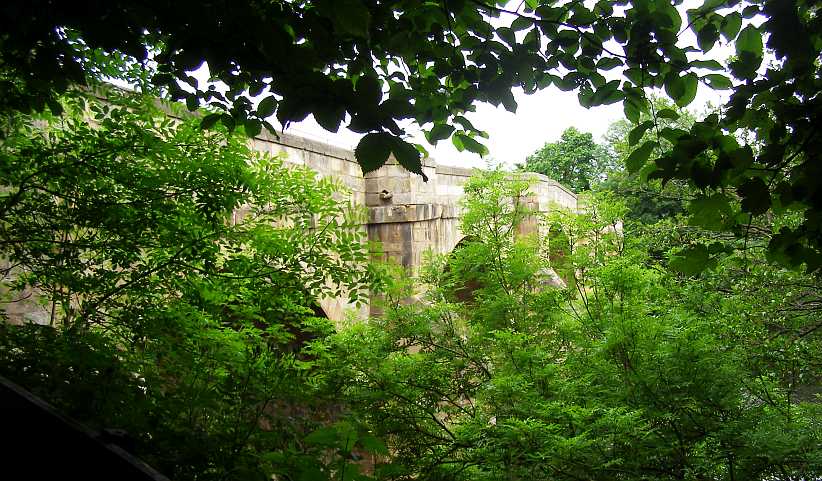
Chollerford Bridge. A bit harder to photograph, but Chollerford Bridge was another example of a stone structure suspended over water, in this case still in use, but harder to get a clear shot.
I went through there to nearby Hexham, where I tracked down some food for the late-afternoon meal. The shopping centre was a mix of old world and modern shops, and parking was tight. And one of my sour-grape cars of the trip was there too.
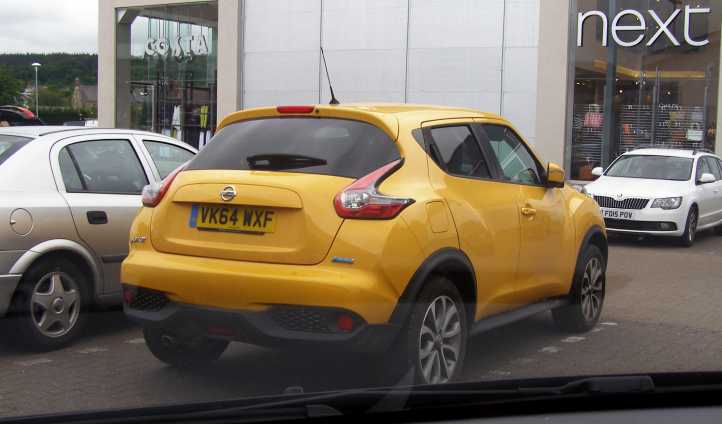
Juke in Hexham. The extreme ‘hippy’ shape of the Nissan Juke had been bugging me all the way through Europe.
I had fish and chips again, strangely enough, then turned back along the road to cruise towards the M6 again. It was getting dark by the time I got to cross the border…
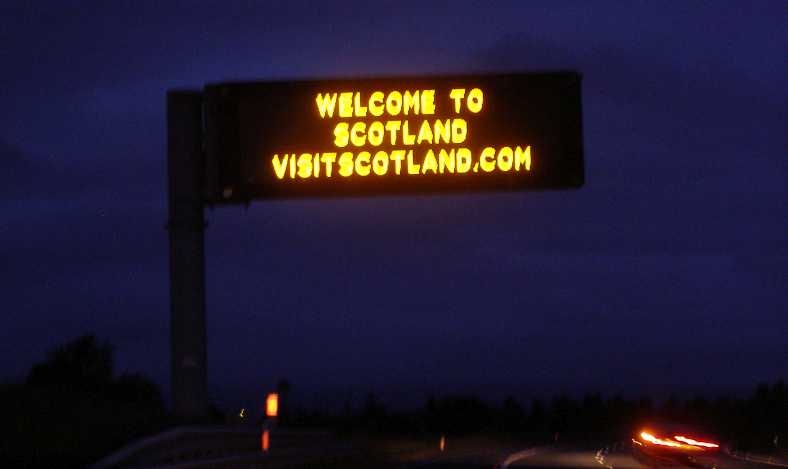
Scotland. Crossing into Scotland was taking me into the final new country, the twenty-first of the European segment of the journey.
When you reflect on the setting here, how a wall just 73 (or 74 on another sign...) miles long can cross the whole country, it really does show that England and Scotland are small countries. And now in the first few miles of Scotland I needed to find somewhere to get a night's rest, I found a large service station with a parking area out the back, it had all the amenities needed, food, toilets and a quiet corner. I was able to sleep there the night. Perhaps the morning would bring sunshine?
Actually, it had been a day which brought bad news. While driving along with the radio on I heard the news that there’d been a murder in Bristol. I’d been in Bristol just a few days ago and now a member of the British Parliament was shot, Jo ***, a lady of just 41, and stabbed while holding a ‘meet the people’ session in her electorate.
Britain was in the middle of the campaign for ‘Brexit’ while I was there, there was quite a lot of talk about it. But that wasn’t any of my business, I was just there to see the sights and meet some people. I slept that night feeling that I was accomplishing that goal…
It reminds me that Farrar Fenton, who did his own bible translation about 120 years ago, wrote that the reason he wanted to do this was because the language of the King James bible was no longer that of the common man. “It’s only used by the shepherd boys of the North of England, the most ignorant of our countrymen.”
I wasn’t really expecting to find any ignorance, nor shepherd boys, but I looked forward to investigating the ancient Hadrian’s Wall, which separated the English and Scottish people in the days of the Roman Empire. But that was still some distance away, about 140 miles, as I left the Chimney House Hotel under the inevitable cloudy skies.
I drove up the M56 motorway and onto the M6 after bypassing Manchester. Then, with Blackpool somewhere to my left, I spotted the Irish Sea in the distance.
Irish Sea. From a high point in the motorway I was able to see across the Blackpool area with the Irish Sea out on the horizon. The Isle of Man is out there somewhere too.
Power lines. Like everywhere else there are major power lines, even going to Blackpool. I don’t know why, but I have photographed them in many countries.
Stone fences. A sign of the old world is the use of stones to build fences everywhere. It cleared the paddocks and it was a resource locally available in a time when labour was plentiful. But who collected all the rocks?
M6 trucking and more fences. Yes, there is plenty of freight on these roads going by yet more of the stone fences.
A glimmer of hope arose as I drove along. The persistence of the overcast days looked like it might fall down for a while as some blue sky appeared:
M6 under blue sky. Well, that’s an optimistic view, but some blue was certainly most welcome.
And the scenery rolled by with plenty of nice scenery. The line, “Of ordered woods and gardens” [“My Country” by Dorothea Mackellar] comes to mind when one compares this kind of setting with what I’m more used to seeing in Australia…
Rolling hills and blue skies. Sadly, this was as good as it got, but it did paint a nice picture of well-manicured farming land.
Soon enough the blue patches in the sky went behind more clouds, however…
Rolling hills and clouds. How much better would it be under blue skies? The hills roll off into the distance while these homes are a part of some nice scenery.
I left the M6 to head across towards Newcastle upon Tyne, the main road which gives access to Hadrian’s Wall. It was no longer the motorway, but a main road which was still of a high standard.
The road to Newcastle. Heading East I got this pic of houses facing the main road, I was by now getting eager to see some of the famous stone wall.
So who was Hadrian? A Roman Emporer, no less, ruling from 117 to 138CE, a time when the Roman Empire was huge. As this sign explains, he toured the Empire ensuring that there was no revolt, that they didn’t suffer from incursions and that steps were taken to help with that:
Hadrian. A well-travelled Roman Emporer and the man who made the biggest impact on this part of the world.
This was, it says, the Northernmost point of an Empire which stretched all the way to the Middle East. Quelling any local problems would be very important, I’d imagine, as news couldn’t have travelled all that quickly in those times and reacting with a large force would be very difficult.
But a wall 15 feet high and 73 miles long would mean collecting a lot of rocks!
The wall. My first sighting of the famous wall, driving down a side road it appeared for me.
Even though this looks a substantial wall, it’s not like it used to be. Whether it’s lost height – as it’s probably a little over half the original height here – due to it sinking into the ground, or because rocks have been taken from its top over the years, or both, I don’t know. I suspect it’s both, I was told that many homes in the districts along the way had been built with rocks taken from the wall.
But it wasn’t just a wall. There were structures called ‘milecastles’ every Roman mile along its length. A Roman mile is 1.48kms, or 0.92 miles, and there were two ‘turrets’ between each of the milecastles. What a lot of work!
Information. I encountered no places where there was printed information available, but at a few places there were signboards like this one.
Note that it explains that it wasn’t just the wall, or its turrets or milecastles, which provided the protection from invaders. A ditch was dug on the ‘foreign’ side, with the soil thrown up to form a bank the other side of that ditch, so any threatening force would have to climb that bank and be exposed right down into the ditch before they got very close.
Viewing place. Here’s a section where the turret wall has been used as a border for a parking space for visitors. Again, the wall has lost most of its height.
More information. To this point, almost halfway along the wall, it had been built originally of soil, with the rock construction following about ten years later.
Not forgetting that this area has some very nice scenery. Despite the overcast day I was getting the odd worthwhile picture showing what it was like. The homes of those ‘ignorant shepherd boys’ were often seen, with the stables these days used to house cars and the homes no doubt featuring those odd random-sized doorways that have many people ducking as they walk through.
And one has to think that some of those shepherd lads had a part in the manicuring of the scenery over the centuries:
Farms, homes and hills. A small village, hedges and tree-lined boundaries are typical of this part of England.
Some historic buildings are to be seen. On a back road between the main highway and the wall I came across this stone archway:
Lanercost Priory. The building visible here is a church structure, but just around the corner were tea-rooms so tourists could get refreshments during their visit.
It was a little place called Lanercost, and just down the road from this was an old stone bridge which was also worth a moment to photograph and admire…
Lanercost Bridge. Believed to have been built in 1543 and restored (or rebuilt) in 1724, it no longer carries traffic.
Some fascination with bridges leads me to photograph these. Years ago I read somewhere that the average life of a bridge is fifty years, but this one might be said to have stood the test of time. Or, perhaps, bearing in mind the few ‘rebuilds’ it’s had along the way, staggered through the test of time.
Checking it out I found a really good example of the older language used in this part of the country, this sample being from a more learned man, the local Bishop, writing about the bridge in 1705: “Sharp Repartees in ye morning ’twixt Mr. Recr. Aglionby and Mr. Gilpin on ye subject of ye decay’d Bridge at Lennard-Cost.” That certainly justifies Mr Fenton’s statement in his bible translation, doesn’t it?
Hard work! It wasn’t just a matter of collecting the rocks, but cutting them to shape and keying them into place to carry the load.
And so I drove on, spending most of my time on the back roads. They’re still subject to the presence of wildlife between the roadside hedges. Wildflowers and greenery were abundant.
Deer sign. Probably not at the time I drove through, but a warning more for night drivers. But what is the meaning of the umbrella on the sign?
Another chance to get a picture of an old stone-arch bridge came up, this one out in the clear and much larger. This was at a village called Haltwhistle along the main road, from which I took the photo:
Alston Archive Viaduct. A lengthy name to be sure, but the bridge is longer than the other one and crosses the Tyne. The archways in the supports are unusual.
But mainly I was here to look at Hadrian’s Wall. To keep on progressing sometimes required driving away from it and then back on those minor roads. And always it was there somewhere, if emaciated after 1,850 years.
Wall along hill. Roman soldiers patrolling along this section of wall could enjoy some nice views. The wall went over hill…
Hill and dale. …and dale. Here it comes off that same hill and curves down through the gap to the next hill.
Turret on top. Looking closely at this steep climb to the next hill we see the remnants of one of the turrets. Or, perhaps, a milecastle.
I went no closer, but the couple in the photo obviously did. I didn’t see very many tourists out looking at the wall on this Thursday, a weekend would probably find more wandering around.
Along the cliff. And from that point the wall continues along the top, the cliff here probably being enough of a barrier anyway.
One of the famous points along the wall is called ‘Sycamore Gap.’ My stepson and his family visited this part of the world on that 2014 trip Janet and I helped them to have and made mention of this place frequently as I was planning my trip. Perhaps they got a bit closer to the tree?
Sycamore Gap. Where the wall crosses this gap in the hills a sycamore tree has grown to maturity, becoming famous no doubt because its silhouette is a significant part of the scenery.
My time along the wall was coming to a close as I wanted to go back to Carlisle to head into the Western part of Scotland and resume my journey to a fresh destination there. Not far from Hexham, a bit over half-way along the wall I took my last photo:
Black Carts Turret. Noted as a particularly well-preserved section of the wall, this was where I left this famous barrier.
And so I headed cross-country to Hexham, which is a larger town on the main road. The whole area reminded me of home, Newcastle is a major city in New South Wales and Hexham is just outside that city, while other local names have also been transferred to ‘the colony’ from this district. But not Chollerford which is on the ‘River North Tyne’…
Chollerford Bridge. A bit harder to photograph, but Chollerford Bridge was another example of a stone structure suspended over water, in this case still in use, but harder to get a clear shot.
I went through there to nearby Hexham, where I tracked down some food for the late-afternoon meal. The shopping centre was a mix of old world and modern shops, and parking was tight. And one of my sour-grape cars of the trip was there too.
Juke in Hexham. The extreme ‘hippy’ shape of the Nissan Juke had been bugging me all the way through Europe.
I had fish and chips again, strangely enough, then turned back along the road to cruise towards the M6 again. It was getting dark by the time I got to cross the border…
Scotland. Crossing into Scotland was taking me into the final new country, the twenty-first of the European segment of the journey.
When you reflect on the setting here, how a wall just 73 (or 74 on another sign...) miles long can cross the whole country, it really does show that England and Scotland are small countries. And now in the first few miles of Scotland I needed to find somewhere to get a night's rest, I found a large service station with a parking area out the back, it had all the amenities needed, food, toilets and a quiet corner. I was able to sleep there the night. Perhaps the morning would bring sunshine?
Actually, it had been a day which brought bad news. While driving along with the radio on I heard the news that there’d been a murder in Bristol. I’d been in Bristol just a few days ago and now a member of the British Parliament was shot, Jo ***, a lady of just 41, and stabbed while holding a ‘meet the people’ session in her electorate.
Britain was in the middle of the campaign for ‘Brexit’ while I was there, there was quite a lot of talk about it. But that wasn’t any of my business, I was just there to see the sights and meet some people. I slept that night feeling that I was accomplishing that goal…
Last edited by Ray Bell; Nov 24, 2021 at 04:58 AM.
Thread Starter
|
Captain
Joined: Oct 2005
Posts: 570
Likes: 8
From: The Summit, Queensland, Australia
I was to spend almost a day in Scotland. My first goal was to see the old road which was used as a hillclimb called Rest and be Thankful. I recall reading about this in British magazines back in the sixties and not thinking much about it, but not long before I left on this trip I read about the place in a book I had to review.
The road was a military road built in 1753 when the Scots were being oppressed after forming alliances with Spain and France to put James on the British throne. Or something. Anyway, for quite a number of years it was used as a hillclimb and I decided that was good enough reason for me to want to look at it.
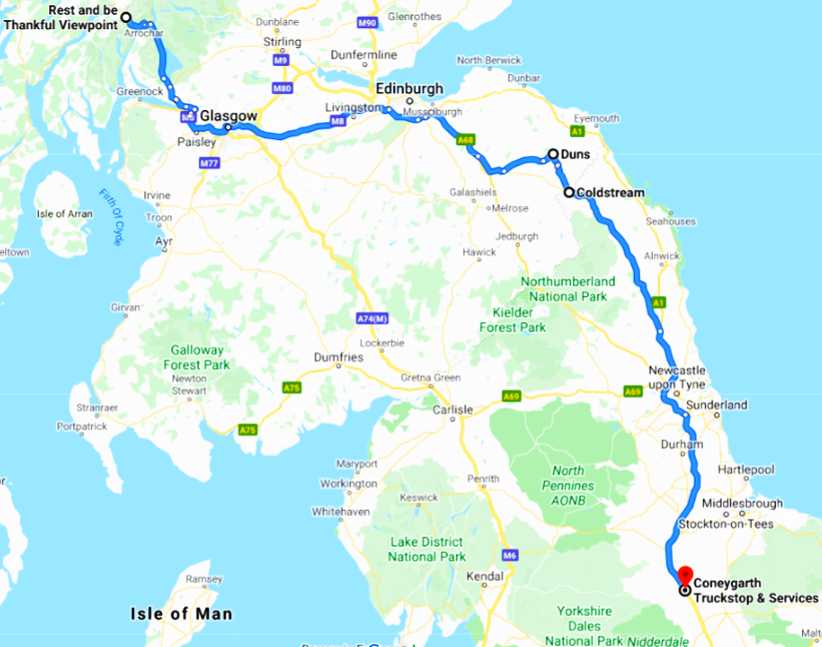
Here’s the path I took:
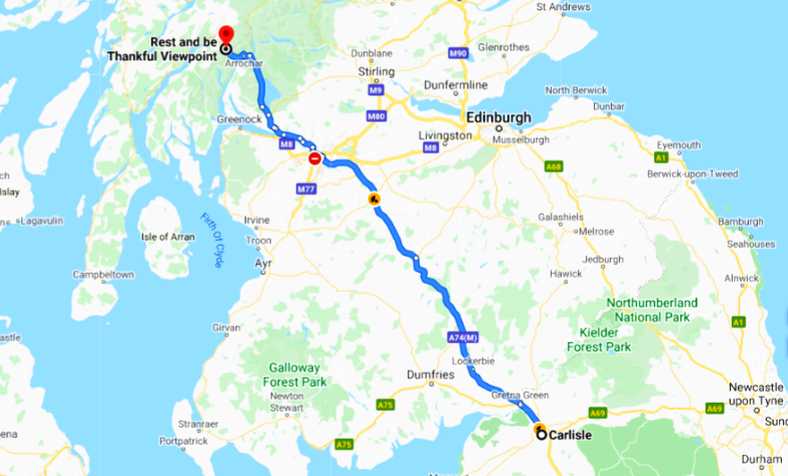
The name, by the way, comes from a stone carved at the top of the hill. When the troops had completed the task of building the road someone carved ‘Rest and be Thankful’ on it. And the name stuck. But the first thing I saw this morning was a family affair at the place where I’d camped:
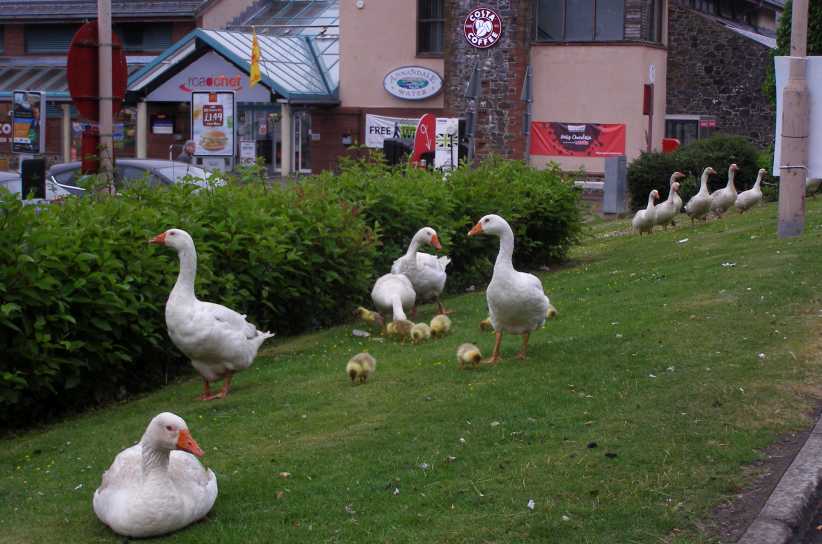
Goosed. The Road Chef motorway stop featured plenty of choices and had space in the parking area for me to get some sleep. Seeing this family of geese in the morning was an unexpected pleasure.
I was actually about 30kms North of Carlisle at a place called Annandale Water and you can see in that picture there’s plenty of options (even if the McDonalds sign is hidden above the edge of the pic). I had my breakfast and then started heading further North. It was certainly not a path devoid of views and scenery…
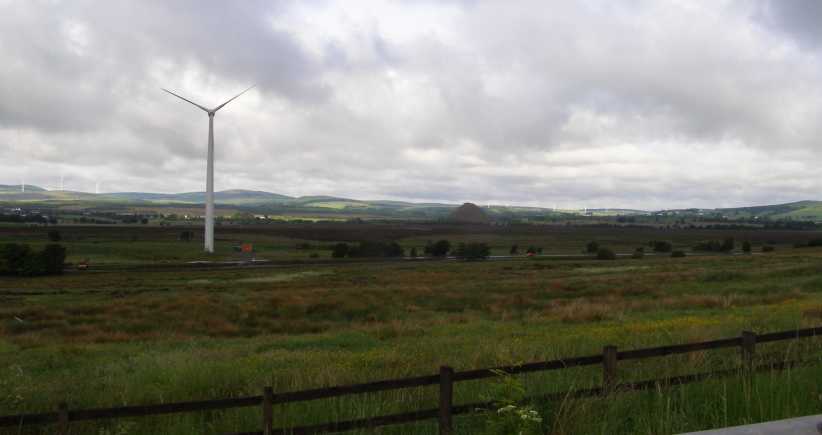
Distant views. Not all of Scotland is mountains, I quickly learned. This early part of the day’s drive was just like the North of England.
And the motorways continued just as in England as well. It was very easy driving and I was pretty relaxed as I motored along following the GPS.
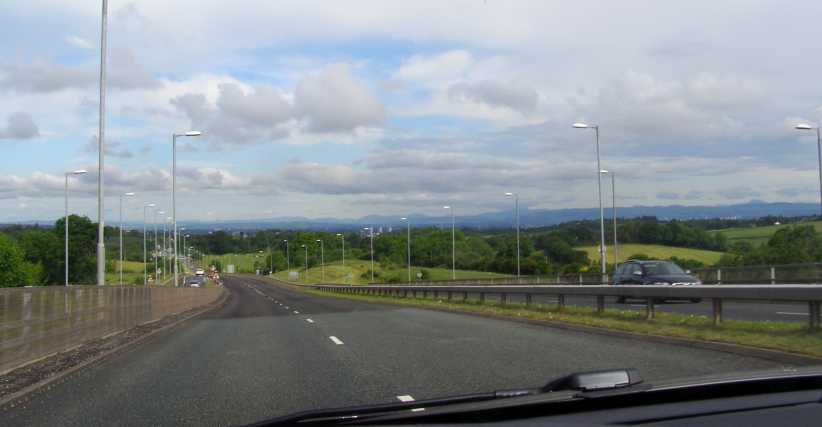
Left hand drive. Of course I had been getting used to being on the ‘wrong’ side of the car when I was on the ‘right’ side of the road. This picture is getting nearer to Glagow.
Glasgow didn’t present any real problems, the GPS guiding me and even though we got onto some ordinary roads it was without congestion or qualm.
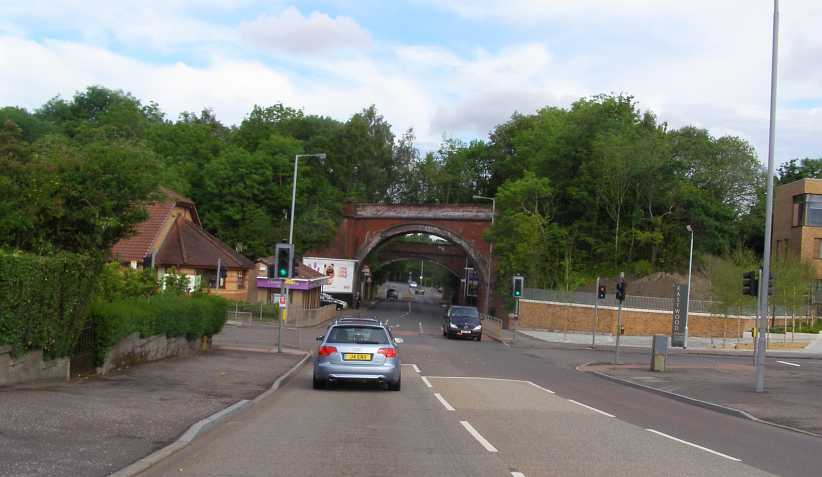
Bridges. I had to get a photo of these bridges, of course. The first is a disused line which used to connect the East-West line which is over the second bridge to another North-South line nearby.
Even the traffic lights and railway bridges at Eastwood proved no obstacle, then through Paisley and across to the A82 near Clydebank. This was the direct road to Loch Lomond, which wasn’t far away, but the road did reduce from a multi-lane divided road to a 2-lane beyond this roundabout:
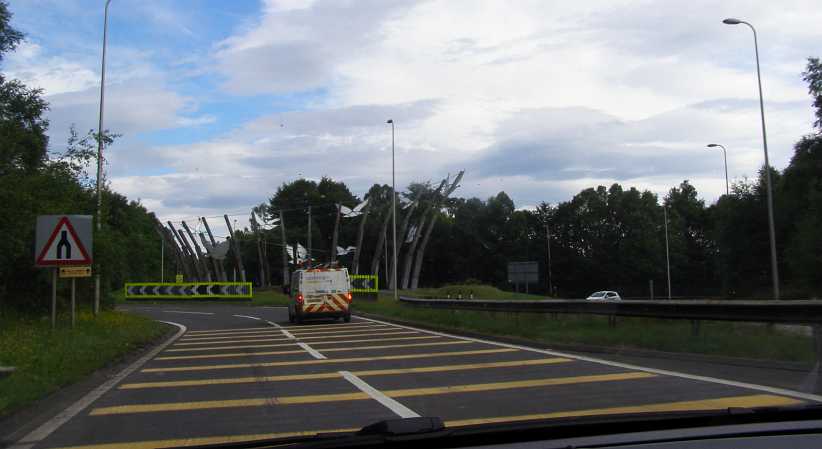
Roundabout geese. Near Jamestown this roundabout has been decorated with cutouts of flying geese.
Soon I was to see the lake made so famous in song, Loch Lomond. I managed to pull up at a couple of spots to take photos, as you can see there were some bright spots in the sky so it wasn’t all cloudy as I’d become used to.
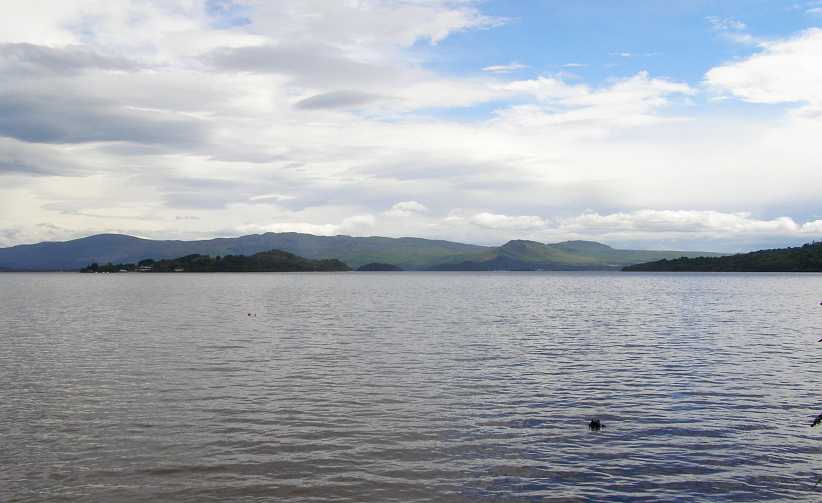
Loch Lomond. It isn’t far across the lake, which would be second only to Loch Ness in fame.
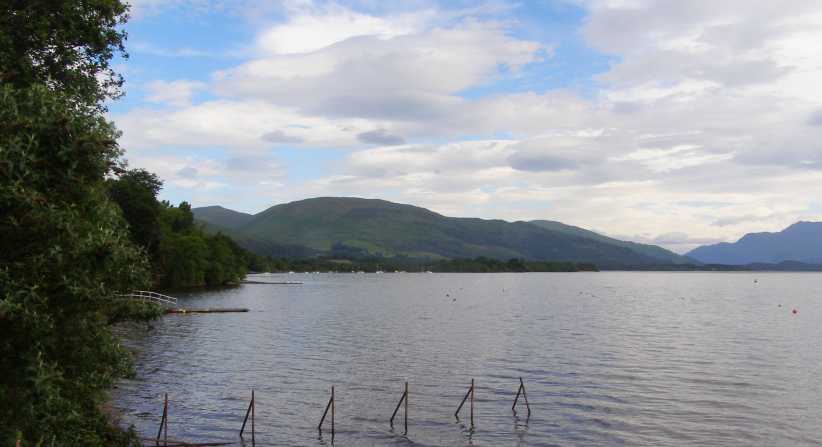
Along the shore. From the same spot, looking along the shoreline there were placid waters, but I wasn’t going for a swim.
The spots where one could pull up and get close to the water were separated by some kilometres. At the second one there was a walking trail and the mountains were much closer.
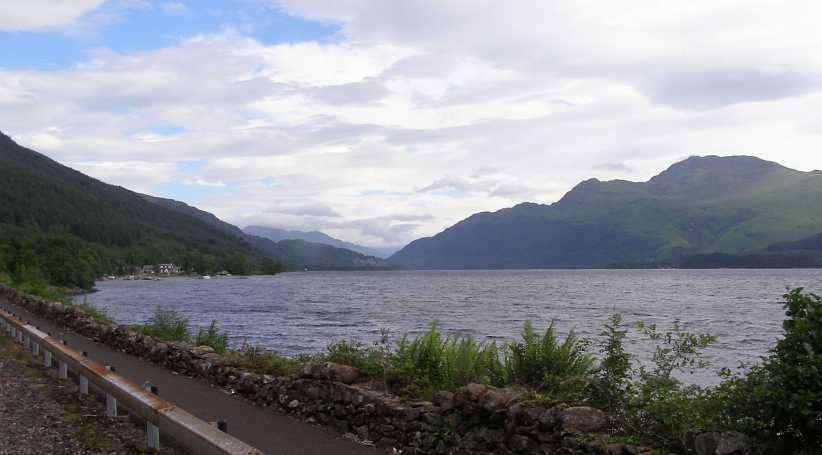
The Bonnie Banks. I’m sure many a tourist has walked along here singing about the Bonnie Bonnie Banks of Loch Lomond.
I left the water’s edge at Tarbet and headed across to Arrochar…
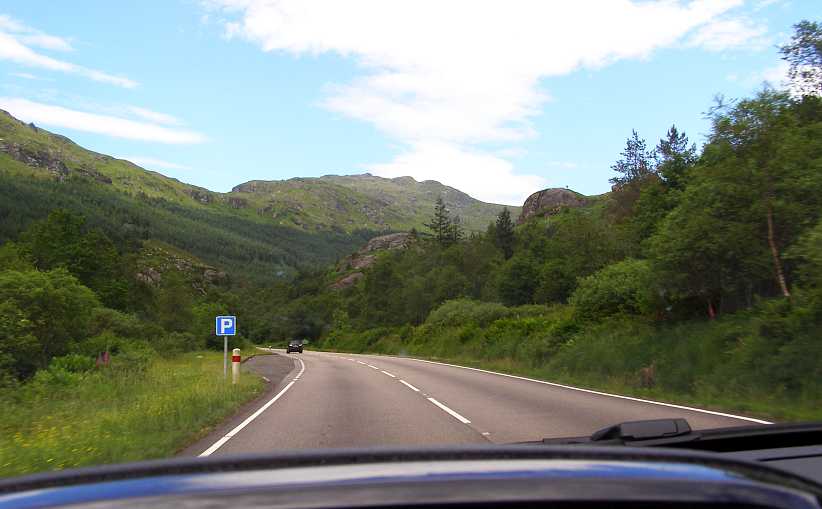
Into the hills. Finally off the flat country and into some kind of hilly terrain, this run was short.
Arrochar is a small town adjacent to another loch, but a different one I learned.
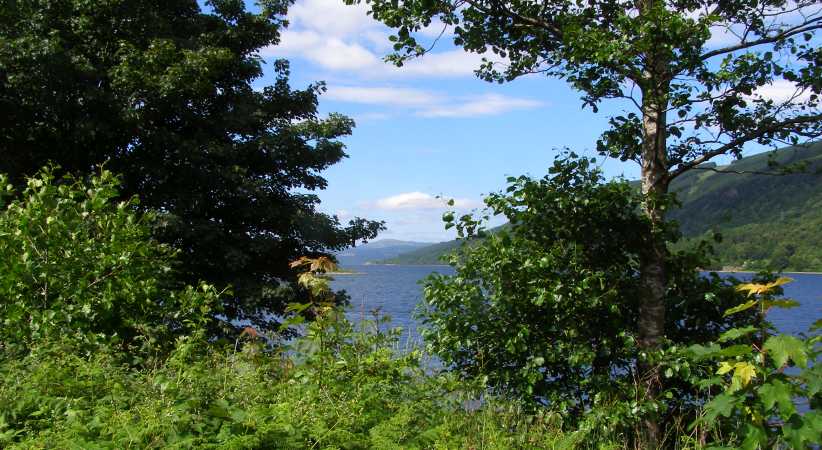
Loch Long. Not all lochs are lakes! Loch Long, at the tip of which is Arrochar, is an inlet coming indirectly from the North Atlantic Ocean.
This was the last diversion before I headed for my quarry for the morning, the Rest and be Thankful road. I can well understand why travellers ascending this long climb on foot or horseback would take a break at the top and be grateful that the climb was over.
A new road was built in the late thirties, it’s seen winding its way up the hill to the left of the original road:
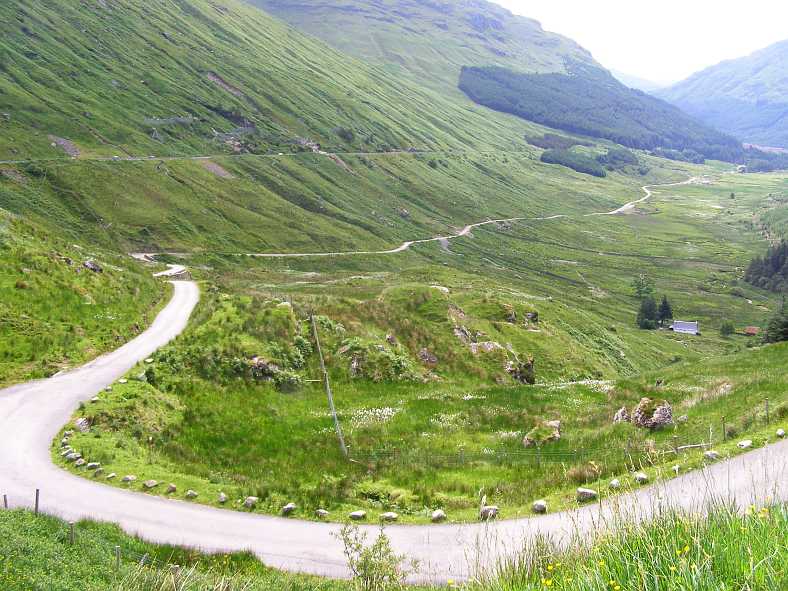
Rest and be Thankful. The famous stretch of road which had become something I needed to see because I’d read about it in a book I reviewed.
The road as seen there continues through a gate to the right, then there’s a hairpin bend which completed the climb:
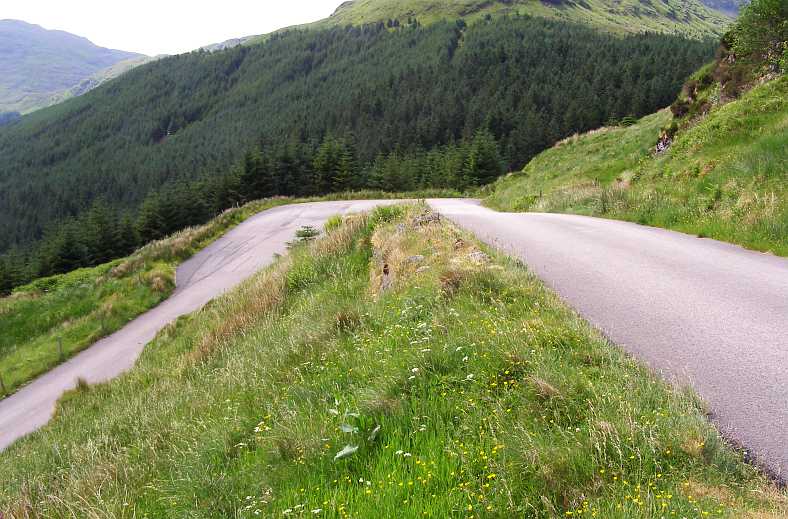
Hairpin bend. To complete the hillclimb competitors had to make it around this hairpin and rush to the finish line.
And so I had seen the road on which regular hillcimbing had taken place from the forties until 1970, and the landscapes which led to it being built. I went a little further over the hill to see just a bit more…
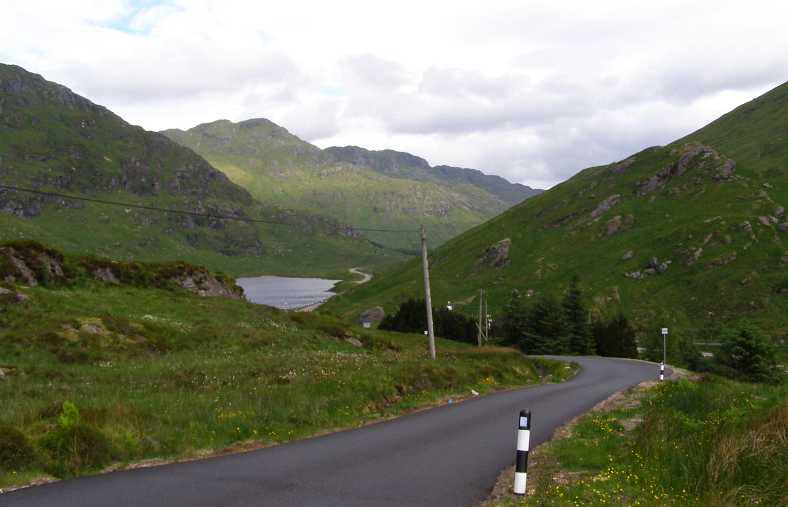
Over the hill. Lakes and winding roads are the order of the day in this part of the world.
But I was mindful that there was still some distance to cover during this day, more of Scotland to be seen before I headed back into England. I turned around to follow this path:
I still wasn’t finished with Arrochar and Loch Long, on the way back I managed to get this view of the village from across Loch Long:
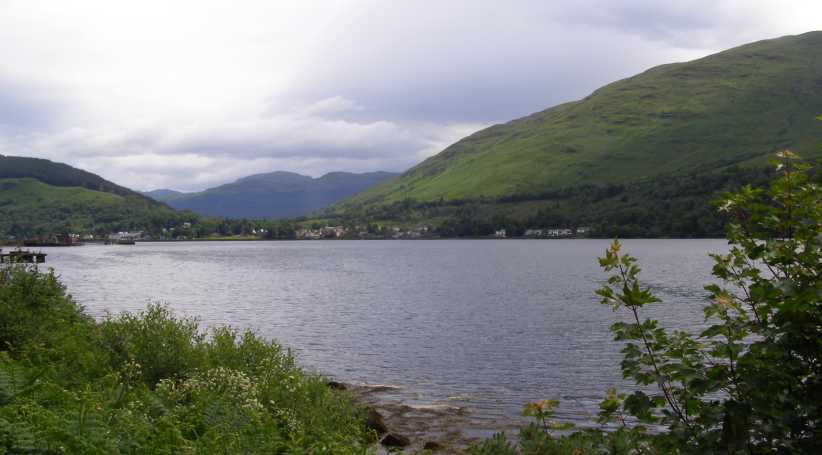
Arrochar. A nice quiet little village nestling in between the hills and at the top of the inlet.
On the way through I had caught a glimpse of a ship right at the end of Loch Long. At that point the loch joins with the waters of Port Glasgow, so such a sighting would be a regular thing. Unfortunately there was none there when I got this photo:
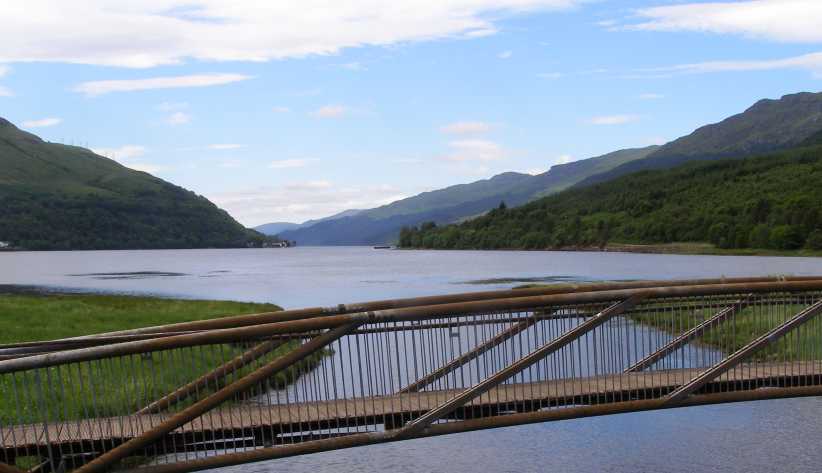
Long loch. Some miles from Arrochar the loch joins with the waters that form Port Glasgow, the hills and the waters form a pleasant scene.
Back along the Loch Lomond stretch I stopped to photograph the flowers for Sandra…
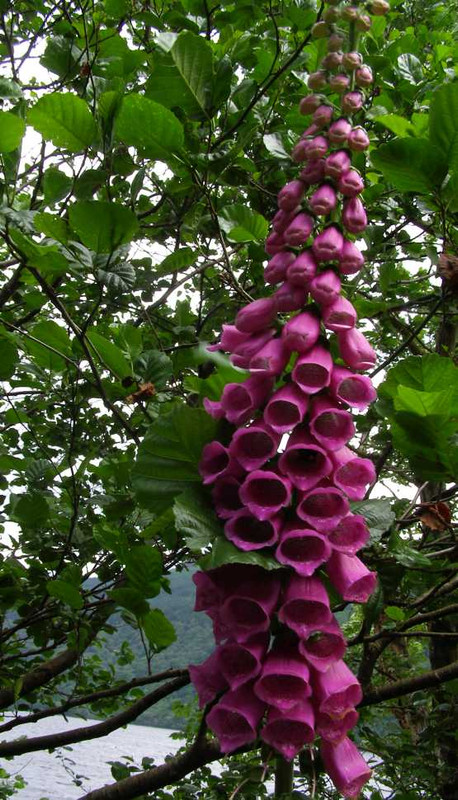
Colours of Scotland. There were different flowers growing by the road, all about this same colour.
And so I headed towards the East. Through Glasgow and on to Edinburgh, where I bypassed the city. I had to keep pressing on to be in time to spend a while at Duns, and I had to get a lot closer to Cadwell Park by the end of the day.
Going through Glasgow I crossed the River Clyde and got this photo of the Clyde Arc and some city buildings as I drove over the bridge:
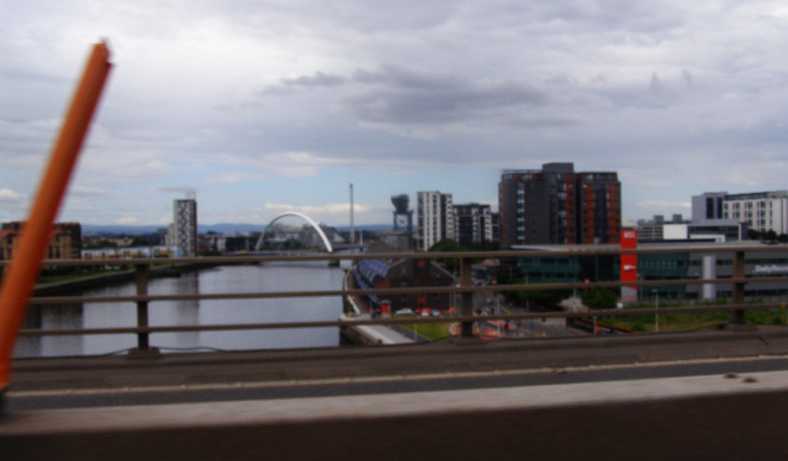
Clyde Arc. Only ten years old when I took the photo, the Clyde Arc is a bridge with a difference.
Unlike other arch bridges, the arch of this one is placed at an angle to the roadway it supports, so it is on one side of the roadway at one end and the other across the river.
I didn’t dally at all between there and Edinburgh, but stopped for lunch somewhere between Edinburgh and Duns, taking a brief break to go online and check forums and e.mails.
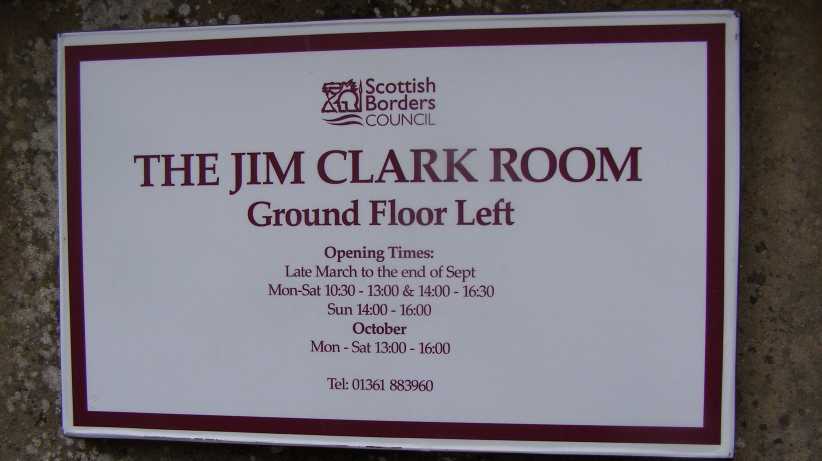
Sign at Duns. The Jim Clark Room was in an unpretentious building in the middle of Duns.
Jim Clark, a great racing driver who was a modest man and, at heart, a Scottish farmer. I met him several times when he raced in Australia and, though I was never a big fan of his, I appreciated that he had more talent than most drivers ever dreamed of having.
One of the best lines ever crafted to describe his skills was one which said that, “Races just surrendered to Jim Clark.” That was how easy it appeared to be for him to take so many wins.
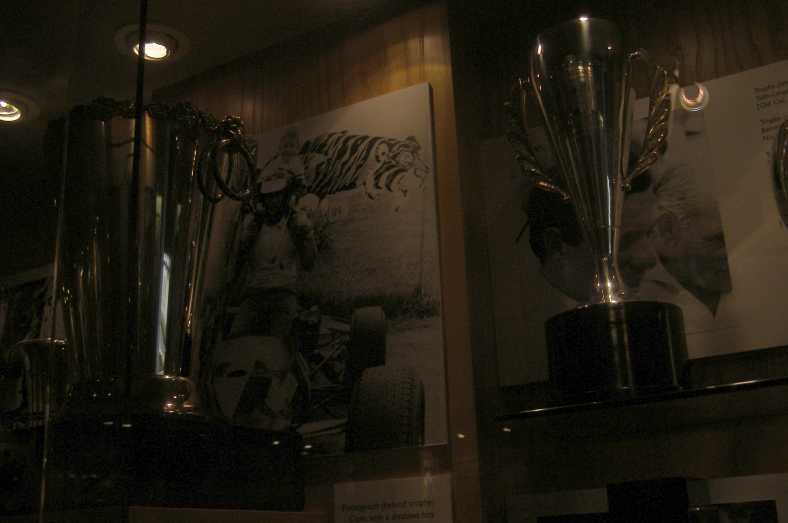
Trophies and picture. Flash wasn’t allowed in the room so I did my best to get this picture. The trophies might have been from big races, but the picture shows the man with a child on his shoulders standing in his Lotus.
From there, and in increasingly wet conditions, I took the shortest road to head South. As I drove down narrow roads, which would be called lanes if they were allowed to exist in Australia, I could readily picture the kind of driving Jim would have done in these conditions.
I came to the town of Coldstream…
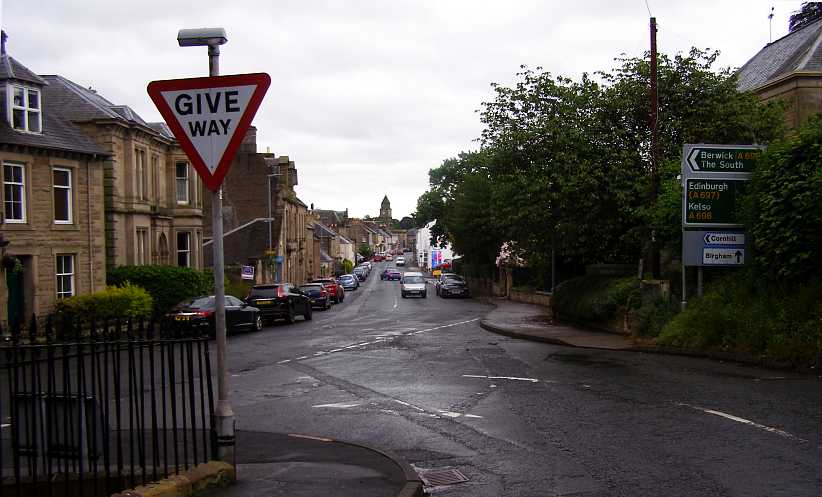
Coldstream. Very close to the border, Coldstream looked a busy town, but I didn’t stop.
Around to the left I went, and it was only a little way to the border crossing:
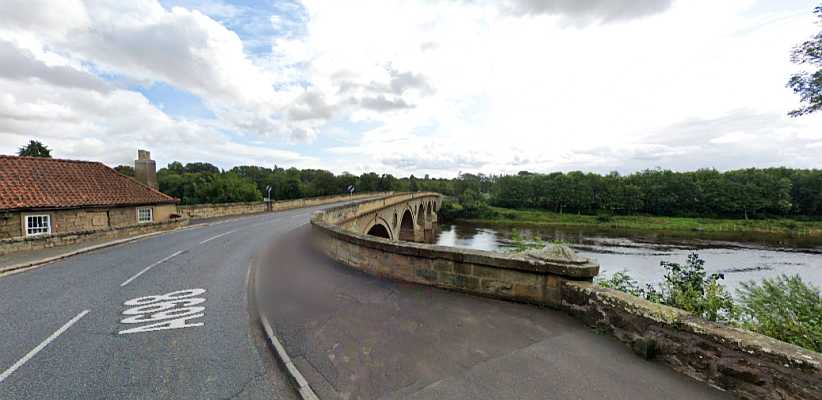
Border bridge. Thanks to Google Earth I have this picture of the border crossing of the River Tweed.
Little villages were bisected by the A697, like this one:
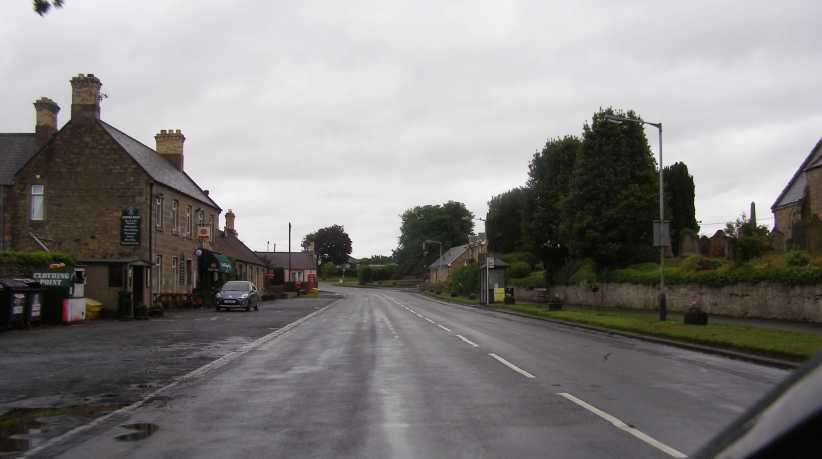
Cornhill on Tweed. Cornhill Village Store, with an emphasis on coffee, but I didn’t stop for one.
And there was this one, too, more of a residential setting shown:
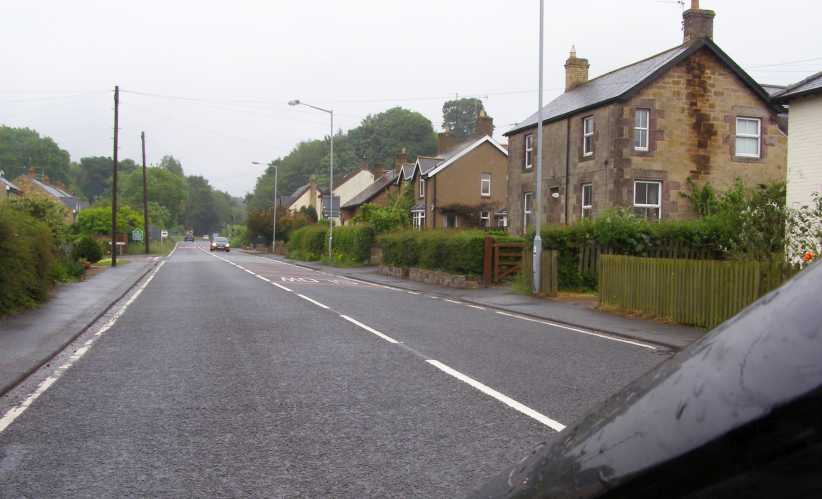
Powburn. The dim late afternoon, the moist road, I held the camera out the window to get this shot and the previous one because the screen was wet.
Newcastle soon loomed large. Of course, without wanting to stop I was able to take the through-road, the A1, which bypassed the city itself. But crossing the Tyne presented another photo opportunity.
These are at Scotswood, the nearest one, half-hidden by the bridge railing, is a disused railway bridge which still carries water and gas lines across the Tyne, the arch bridge is a more modern construction built in the sixties, almost a hundred years after the railway bridge was constructed.
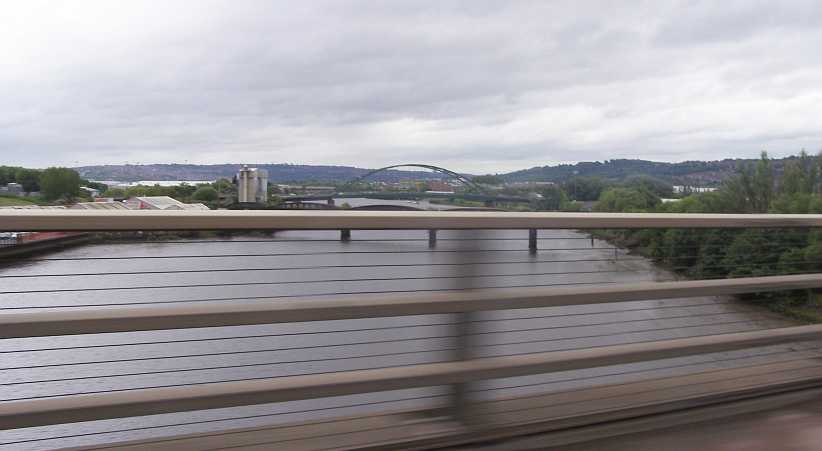
Scotswood bridges. Almost a century apart, these bridges span the Tyne upstream from Newcastle.
Now I was past Newcastle, and on a motorway, I wanted to put as many miles behind me as I could. I had every desire to be on deck early on Saturday at Cadwell Park, where Alan Morgan was ready to greet me. Alan is a contributor to the Nostalgia Forum.
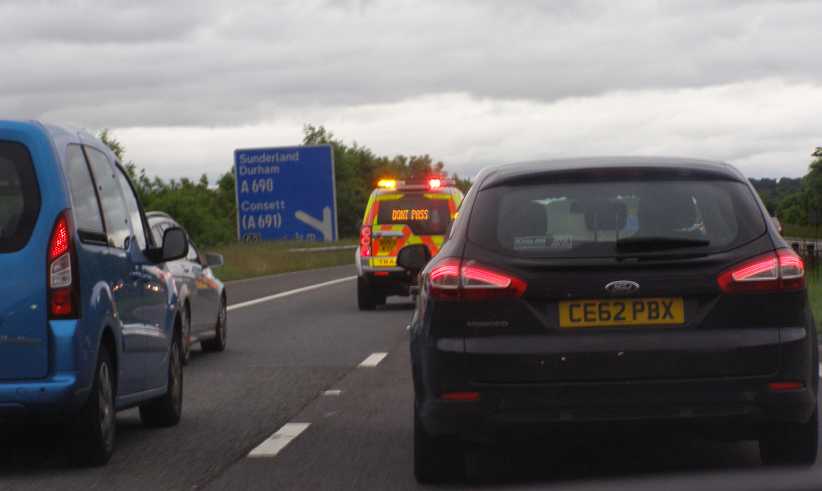
Holdup on the motorway. I’d never seen this before, the ‘Don’t Pass’ sign in the back of the official vehicle was on as it straddled the two lanes and slowed everyone to a stop.
There was something on the road which posed a danger to traffic and the man in the dayglo suit picked it up and made things safe for us. As can be seen, even with cloud cover it was still fairly light, but night was to come and I was covering those miles.
Eventually I tired and needed to eat and sleep. I was past Darlington when I saw signs pointing to a truck stop and so I pulled in there and found a parking spot. With the miles I’d covered this day I needed a bit of rest…
The road was a military road built in 1753 when the Scots were being oppressed after forming alliances with Spain and France to put James on the British throne. Or something. Anyway, for quite a number of years it was used as a hillclimb and I decided that was good enough reason for me to want to look at it.
Here’s the path I took:
The name, by the way, comes from a stone carved at the top of the hill. When the troops had completed the task of building the road someone carved ‘Rest and be Thankful’ on it. And the name stuck. But the first thing I saw this morning was a family affair at the place where I’d camped:
Goosed. The Road Chef motorway stop featured plenty of choices and had space in the parking area for me to get some sleep. Seeing this family of geese in the morning was an unexpected pleasure.
I was actually about 30kms North of Carlisle at a place called Annandale Water and you can see in that picture there’s plenty of options (even if the McDonalds sign is hidden above the edge of the pic). I had my breakfast and then started heading further North. It was certainly not a path devoid of views and scenery…
Distant views. Not all of Scotland is mountains, I quickly learned. This early part of the day’s drive was just like the North of England.
And the motorways continued just as in England as well. It was very easy driving and I was pretty relaxed as I motored along following the GPS.
Left hand drive. Of course I had been getting used to being on the ‘wrong’ side of the car when I was on the ‘right’ side of the road. This picture is getting nearer to Glagow.
Glasgow didn’t present any real problems, the GPS guiding me and even though we got onto some ordinary roads it was without congestion or qualm.
Bridges. I had to get a photo of these bridges, of course. The first is a disused line which used to connect the East-West line which is over the second bridge to another North-South line nearby.
Even the traffic lights and railway bridges at Eastwood proved no obstacle, then through Paisley and across to the A82 near Clydebank. This was the direct road to Loch Lomond, which wasn’t far away, but the road did reduce from a multi-lane divided road to a 2-lane beyond this roundabout:
Roundabout geese. Near Jamestown this roundabout has been decorated with cutouts of flying geese.
Soon I was to see the lake made so famous in song, Loch Lomond. I managed to pull up at a couple of spots to take photos, as you can see there were some bright spots in the sky so it wasn’t all cloudy as I’d become used to.
Loch Lomond. It isn’t far across the lake, which would be second only to Loch Ness in fame.
Along the shore. From the same spot, looking along the shoreline there were placid waters, but I wasn’t going for a swim.
The spots where one could pull up and get close to the water were separated by some kilometres. At the second one there was a walking trail and the mountains were much closer.
The Bonnie Banks. I’m sure many a tourist has walked along here singing about the Bonnie Bonnie Banks of Loch Lomond.
I left the water’s edge at Tarbet and headed across to Arrochar…
Into the hills. Finally off the flat country and into some kind of hilly terrain, this run was short.
Arrochar is a small town adjacent to another loch, but a different one I learned.
Loch Long. Not all lochs are lakes! Loch Long, at the tip of which is Arrochar, is an inlet coming indirectly from the North Atlantic Ocean.
This was the last diversion before I headed for my quarry for the morning, the Rest and be Thankful road. I can well understand why travellers ascending this long climb on foot or horseback would take a break at the top and be grateful that the climb was over.
A new road was built in the late thirties, it’s seen winding its way up the hill to the left of the original road:
Rest and be Thankful. The famous stretch of road which had become something I needed to see because I’d read about it in a book I reviewed.
The road as seen there continues through a gate to the right, then there’s a hairpin bend which completed the climb:
Hairpin bend. To complete the hillclimb competitors had to make it around this hairpin and rush to the finish line.
And so I had seen the road on which regular hillcimbing had taken place from the forties until 1970, and the landscapes which led to it being built. I went a little further over the hill to see just a bit more…
Over the hill. Lakes and winding roads are the order of the day in this part of the world.
But I was mindful that there was still some distance to cover during this day, more of Scotland to be seen before I headed back into England. I turned around to follow this path:
I still wasn’t finished with Arrochar and Loch Long, on the way back I managed to get this view of the village from across Loch Long:
Arrochar. A nice quiet little village nestling in between the hills and at the top of the inlet.
On the way through I had caught a glimpse of a ship right at the end of Loch Long. At that point the loch joins with the waters of Port Glasgow, so such a sighting would be a regular thing. Unfortunately there was none there when I got this photo:
Long loch. Some miles from Arrochar the loch joins with the waters that form Port Glasgow, the hills and the waters form a pleasant scene.
Back along the Loch Lomond stretch I stopped to photograph the flowers for Sandra…
Colours of Scotland. There were different flowers growing by the road, all about this same colour.
And so I headed towards the East. Through Glasgow and on to Edinburgh, where I bypassed the city. I had to keep pressing on to be in time to spend a while at Duns, and I had to get a lot closer to Cadwell Park by the end of the day.
Going through Glasgow I crossed the River Clyde and got this photo of the Clyde Arc and some city buildings as I drove over the bridge:
Clyde Arc. Only ten years old when I took the photo, the Clyde Arc is a bridge with a difference.
Unlike other arch bridges, the arch of this one is placed at an angle to the roadway it supports, so it is on one side of the roadway at one end and the other across the river.
I didn’t dally at all between there and Edinburgh, but stopped for lunch somewhere between Edinburgh and Duns, taking a brief break to go online and check forums and e.mails.
Sign at Duns. The Jim Clark Room was in an unpretentious building in the middle of Duns.
Jim Clark, a great racing driver who was a modest man and, at heart, a Scottish farmer. I met him several times when he raced in Australia and, though I was never a big fan of his, I appreciated that he had more talent than most drivers ever dreamed of having.
One of the best lines ever crafted to describe his skills was one which said that, “Races just surrendered to Jim Clark.” That was how easy it appeared to be for him to take so many wins.
Trophies and picture. Flash wasn’t allowed in the room so I did my best to get this picture. The trophies might have been from big races, but the picture shows the man with a child on his shoulders standing in his Lotus.
From there, and in increasingly wet conditions, I took the shortest road to head South. As I drove down narrow roads, which would be called lanes if they were allowed to exist in Australia, I could readily picture the kind of driving Jim would have done in these conditions.
I came to the town of Coldstream…
Coldstream. Very close to the border, Coldstream looked a busy town, but I didn’t stop.
Around to the left I went, and it was only a little way to the border crossing:
Border bridge. Thanks to Google Earth I have this picture of the border crossing of the River Tweed.
Little villages were bisected by the A697, like this one:
Cornhill on Tweed. Cornhill Village Store, with an emphasis on coffee, but I didn’t stop for one.
And there was this one, too, more of a residential setting shown:
Powburn. The dim late afternoon, the moist road, I held the camera out the window to get this shot and the previous one because the screen was wet.
Newcastle soon loomed large. Of course, without wanting to stop I was able to take the through-road, the A1, which bypassed the city itself. But crossing the Tyne presented another photo opportunity.
These are at Scotswood, the nearest one, half-hidden by the bridge railing, is a disused railway bridge which still carries water and gas lines across the Tyne, the arch bridge is a more modern construction built in the sixties, almost a hundred years after the railway bridge was constructed.
Scotswood bridges. Almost a century apart, these bridges span the Tyne upstream from Newcastle.
Now I was past Newcastle, and on a motorway, I wanted to put as many miles behind me as I could. I had every desire to be on deck early on Saturday at Cadwell Park, where Alan Morgan was ready to greet me. Alan is a contributor to the Nostalgia Forum.
Holdup on the motorway. I’d never seen this before, the ‘Don’t Pass’ sign in the back of the official vehicle was on as it straddled the two lanes and slowed everyone to a stop.
There was something on the road which posed a danger to traffic and the man in the dayglo suit picked it up and made things safe for us. As can be seen, even with cloud cover it was still fairly light, but night was to come and I was covering those miles.
Eventually I tired and needed to eat and sleep. I was past Darlington when I saw signs pointing to a truck stop and so I pulled in there and found a parking spot. With the miles I’d covered this day I needed a bit of rest…
Thread Starter
|
Captain
Joined: Oct 2005
Posts: 570
Likes: 8
From: The Summit, Queensland, Australia
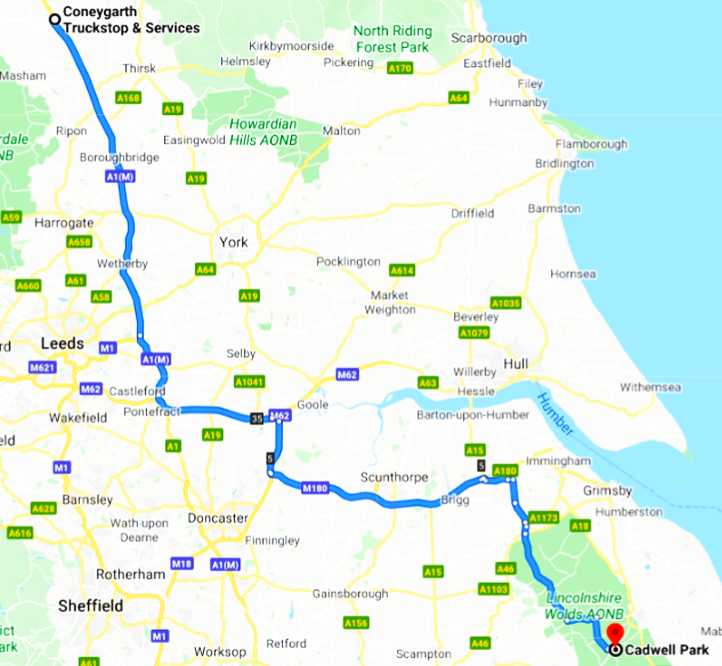
I was up and away early so I could cover the remaining miles, something over 120 of them, to Cadwell Park and get in the gate early enough that I didn’t miss too much. Alan had arranged a ticket for me and would effectively be my host for the weekend.
It was a fairly straightforward run…
…and as soon as I arrived I made my acquaintance with Alan I started to acquaint myself with the circuit and the cars. The meeting was essentially an ‘Historic’ meeting, where all the categories of cars running were from the past. There was a small number of cars competing which were current models, these were the Clubmens.
In America, of course, this type of racing is referred to as ‘Vintage’ racing, but I can’t reconcile to a name which really applies to cars built before 1931. That is in the strictest sense of the word ‘vintage’ when applied to cars. Then again, I guess it’s now 57 years since I first went to a race meeting so the cars I saw that day would have to qualify for a word that makes them sound old.
There was a big map up on a board in the paddock area:
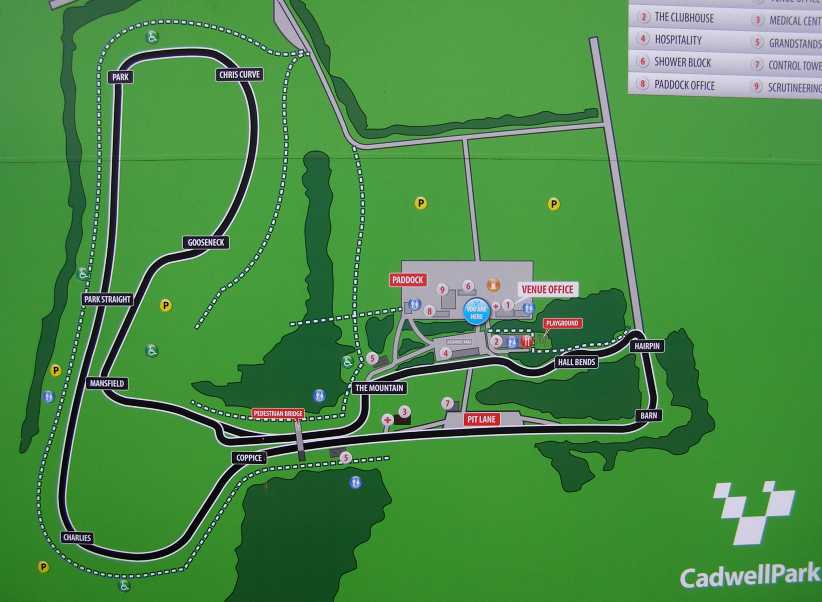
The map. I found this very handy as I started to find my way around the circuit.
As the circuit is operated by the same people as Brands Hatch, some of the arrangements are very similar. Catering, is consistent, for instance, and I was to take advantage of this pretty soon after getting there.
Which put me in the Clubhouse area overlooking the Hall bends. Immediately I was attracted to the lovely setting and I started watching the cars through here. Having seen the map, I knew they were headed for the hairpin, so I walked down in that direction and saw some things I really liked.
But that’s putting the cart before the horse. What I’d like to do is show the circuit as best my photos will allow and comment on each part as the photos come up. And to do that we really should start at the beginning… err, at the start. A Sports Car race was getting under way:
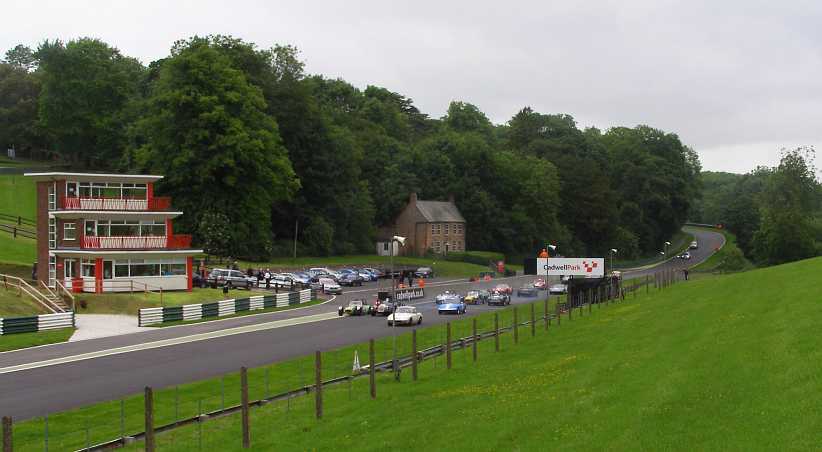
The start. A slight uphill slope faces the starters…
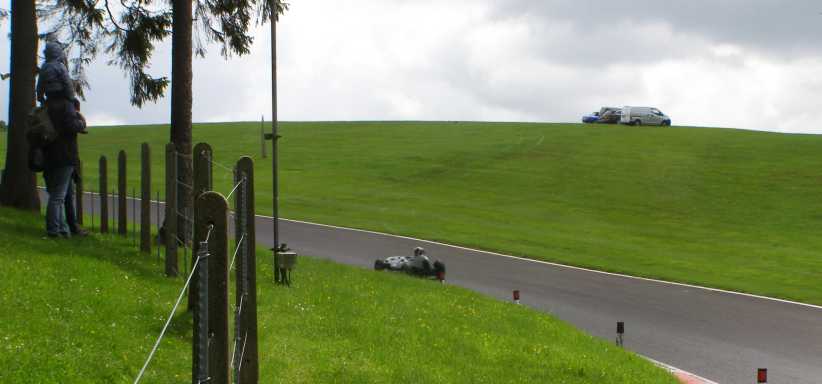
Coppice. …with this climbing left-hander leading to a long right-hander over the crest of the hill.
So far that’s simple enough. Spectators can walk along the outside of the circuit right through this section and vantage points are plentiful. So that right-hander…
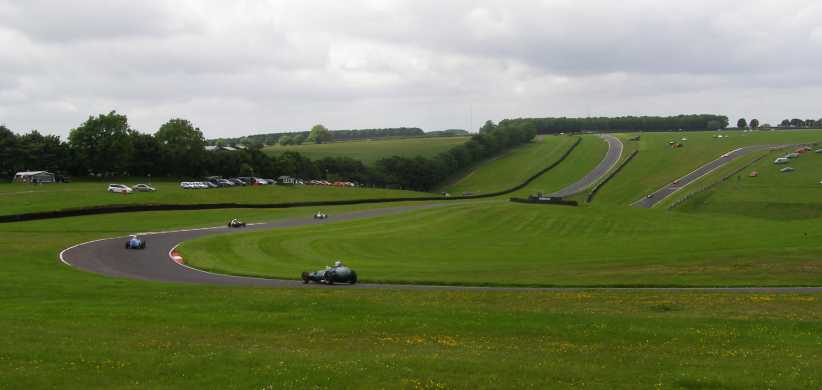
Charlies. Up into open country and then a long, long right followed by a long straight which starts out downhill and then climbs fairly steeply.
…starts uphill, crests the hill and then drops away quickly towards the straight. We’ll come back to that feature.
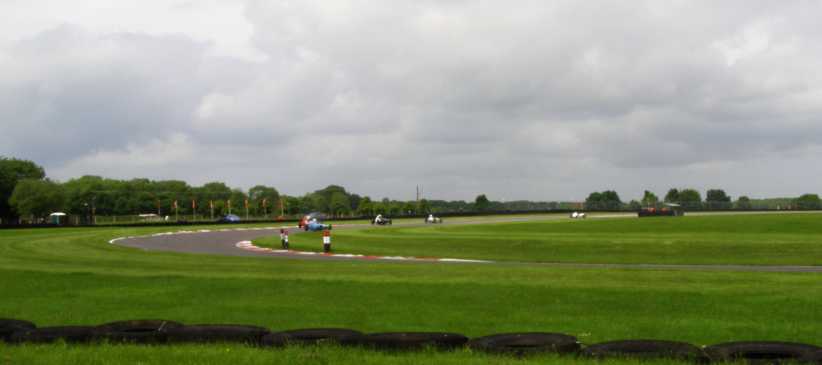
Park and Chris. This is the most ‘ordinary’ part of the circuit, out in the open, flat and not apparently challenging. That changes.
As you can see, from wooded areas and tricky turns, to fast straights and some very open and ordinary-looking road, Cadwell Park has some variety. But more is to come.
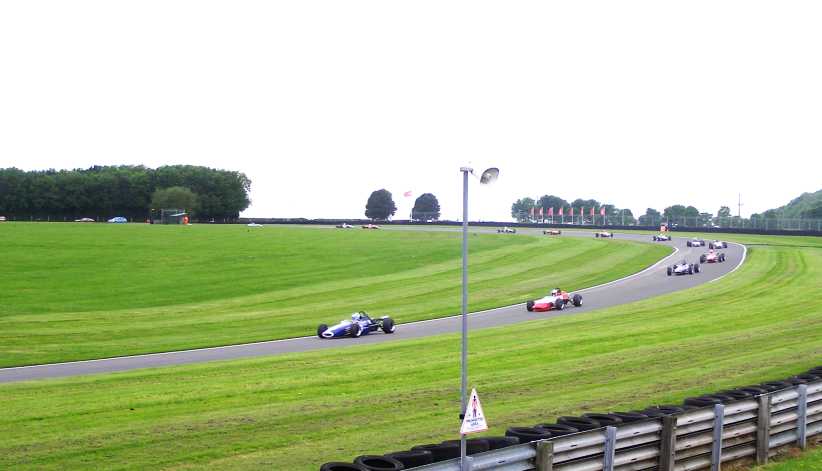
Heading for Gooseneck. Cars gather speed out of Chris corner…
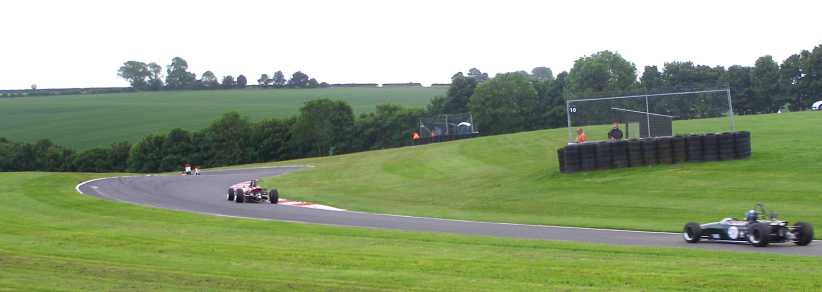
Gooseneck. …and then there’s the downhill entry to the ess-bend that forms Gooseneck.
Out of Goosneck, the circuit continues to drop away:
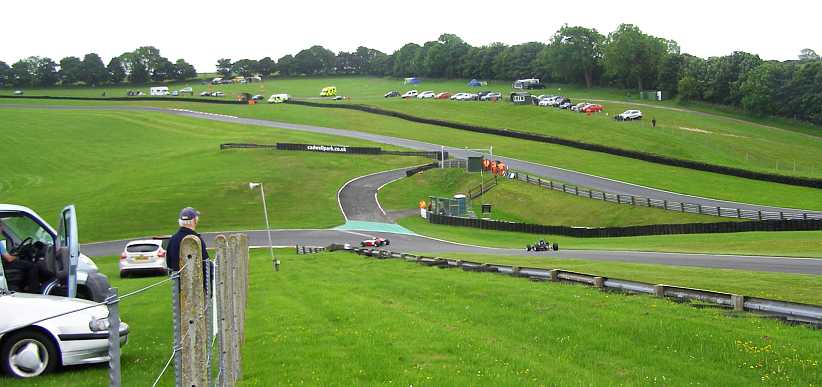
Drop to Mansfield. Gathering speed quickly, judging Mansfield is important.

Heading for the bridge. Drivers continue down the hill to the bend under the spectator bridge.
There’s a kink in this stretch which doesn’t show in these photos, but appears as a fairly serious bend in this one from the other direction:
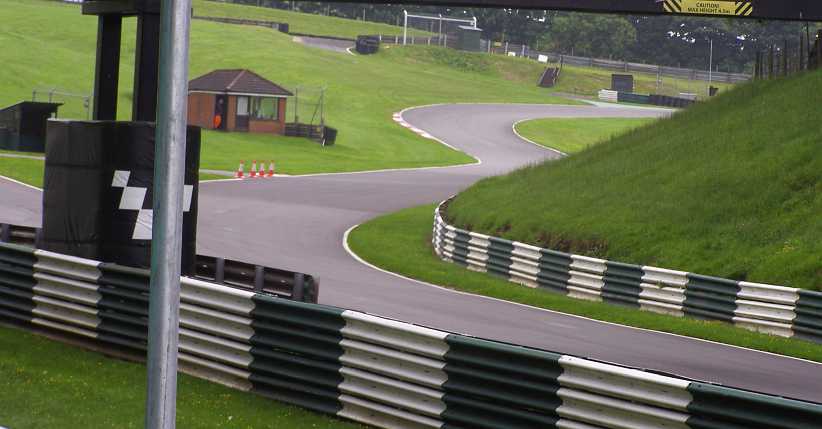
Under the bridge. At this point the cars are racing towards the dividing fence which separates the starting straight from the road returning to the valley in which the start line is located.
While they have the speed up, drivers try to maintain it through the corner under the bridge.
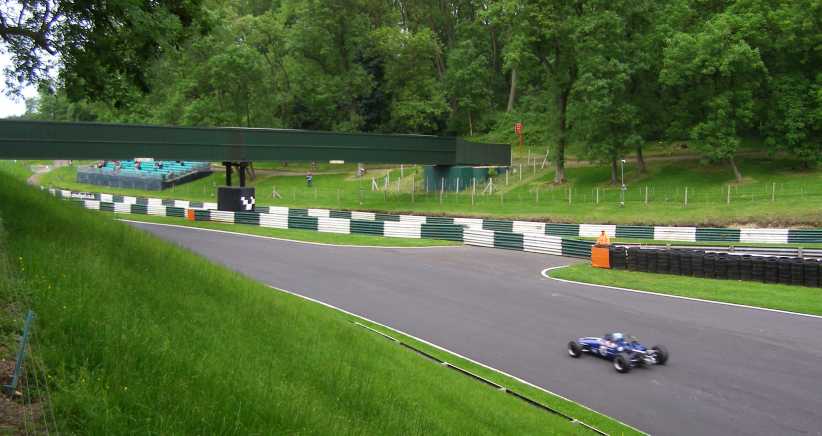
Lining up the bridge bend. Precision is called for here as the car has to be placed well for the braking area ahead.
If the car is quick it won’t have a lot of time to brake and prepare for the turn towards ‘The Mountain’:
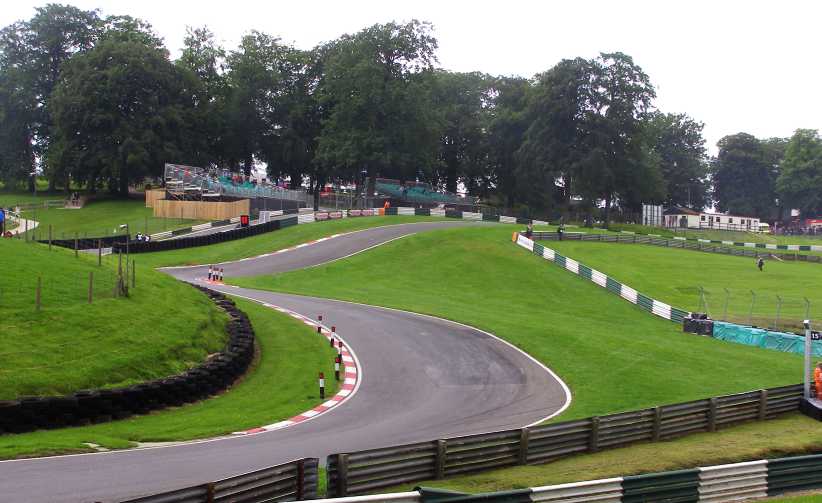
Left to the Mountain. Saving time through here calls for accurate lines and smoothness.
The Mountain is a feature which provides a bit more spectacle as almost every car gets wheels off the road as it goes over the crest.
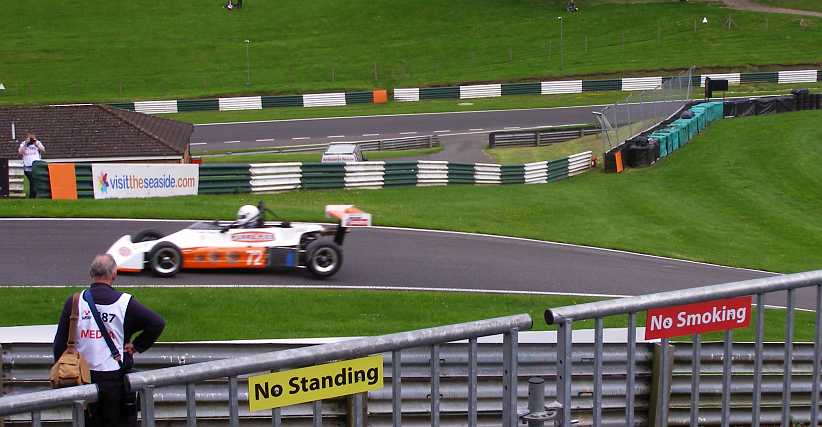
Rear wheels up. Revs rise as the rear wheels come off the ground. A Formula Ford 2000 car comes over The Mountain.
And then the really tricky stuff begins. Again, precise lines and smoothness will pay dividends here, but there’s no prize for being too slow about it, there’s no time to admire the scenery either.
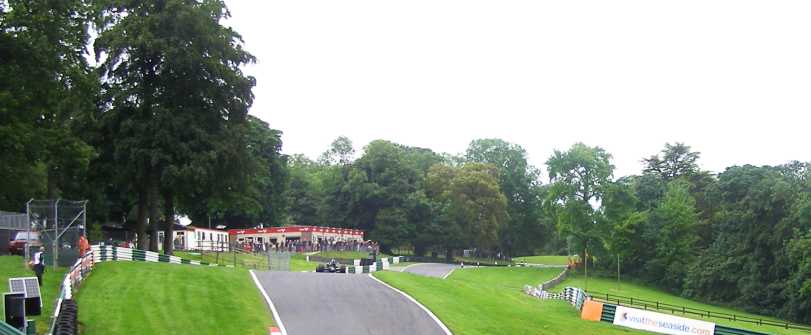
Past the Clubhouse. Following the natural contours, the circuit dips a little and the esses which are the Hall Bends come up quickly.
Right, left, right, left, right, the Hall Bends get the driver busy…
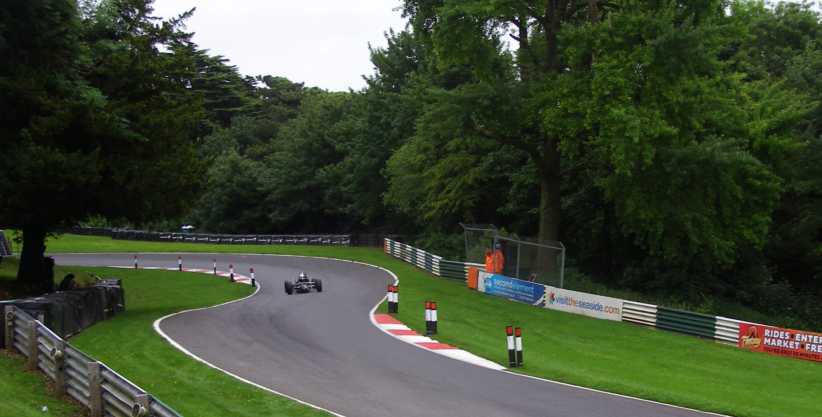
First of Hall Bends. The first right and left are followed by…
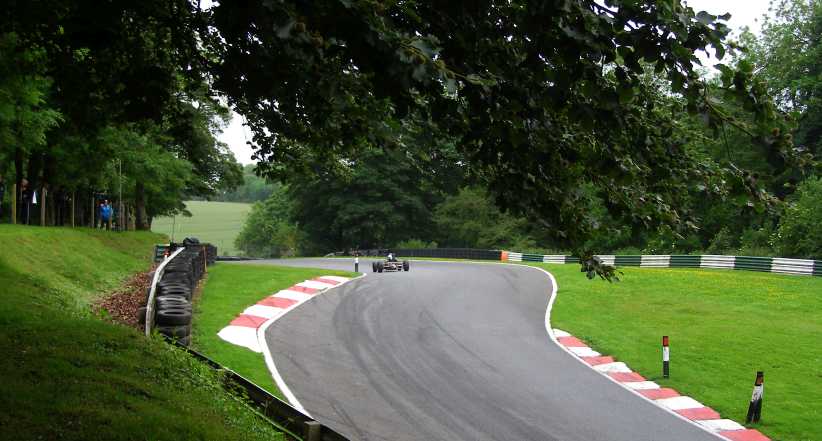
More Hall Bends. …the next right and left. And after the last it gets really tricky.
The Hall Bends lead to a braking area for The Hairpin. But the driver is still coming out of the turn as he needs to haul back the speed, he’s heading wide into the braking area and it’s no comfort to him that it’s off-camber.
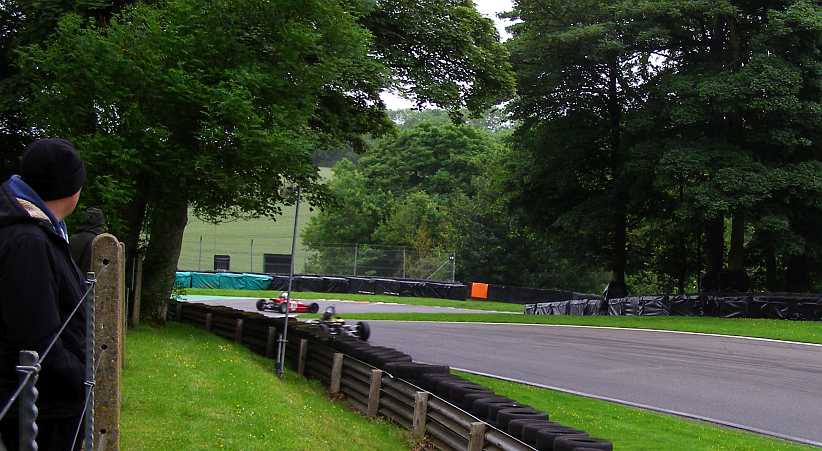
Into The Hairpin. Balancing traction against turning and braking all at once, reaching The Hairpin at the right speed is a matter of practice and judgement.
The cars go right out of sight after the Hairpin, rushing downhill to the not-so-tight right-hander called Barn that leads them back to the start/finish line.
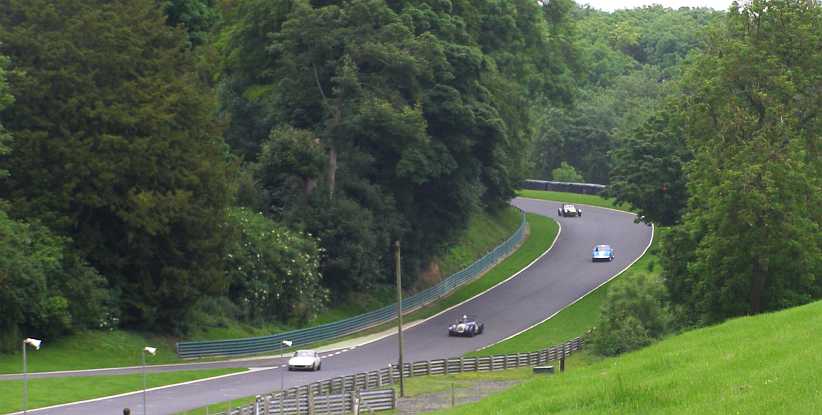
Exiting Barn. A downhill corner that sweeps onto the straight completes the circuit.
The drive around Cadwell is almost 3.5km, or just under 2.2 miles. It’s busy all the way save for that straight towards Park corner and I quickly came to regard it as the best purpose-built (ie. non-public road or airfield) circuit I’ve ever seen.
Of course, any circuit which presents challenges usually sees mistakes made and damage to cars. The first race I watched had a little carnage:
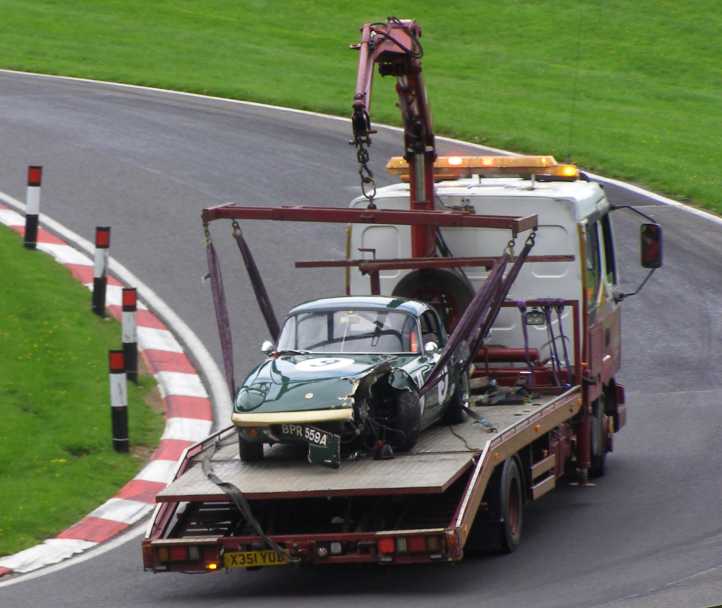
Bent Elan. The result of a tangle with another car, there’s a fair bit of fibreglass damage and probably some to the suspension as well.
And if you are game to ask, “But what happened to the other bloke?” here’s your answer:
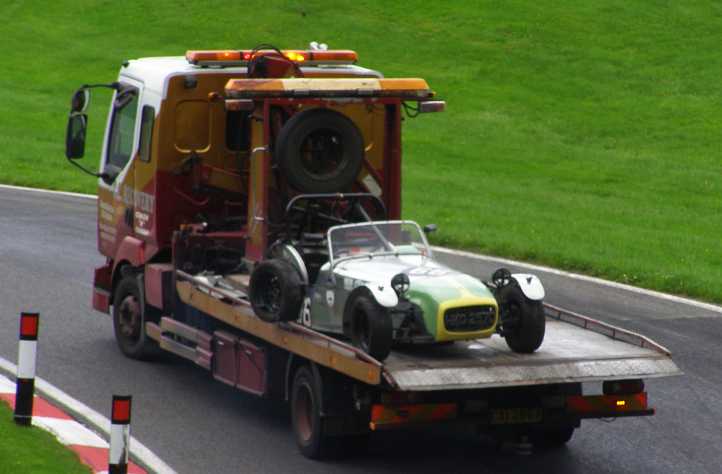
The other bloke. The Lotus 7-style car appears to have serious rear axle problems, probably a little chassis damage in that area too.
They came to grief at the tricky exit from Charlies:
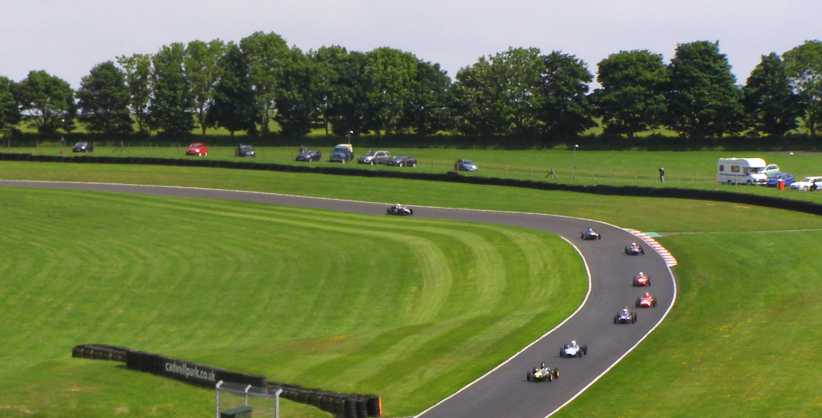
Exit from Charlies. The radius of Charlies remains constant, but the topography changes, the track drops away. So the speed at which you can corner in the first part of the bend is too high once your traction goes away with the falling road surface.
And so the challenges of Cadwell Park bring drivers back time after time. The circuit is not licensed for faster cars. It was, incidentally, originally built as a motorcycle circuit and the first version of it didn’t have the section out in the open country, a hairpin bend near the climb up the Mountain made it quite a short circuit.
For anyone wanting to see what it’s like from the driver’s point of view, here’s a 2m 11s You Tube clip of a Formula 3 car doing a quick time:
Not forgetting that I was also there to see the cars. At Monaco the Formula Juniors were all front-engined, but here they had the whole range. And there were some very different cars among them.
One that really got my attention was a car I’d never heard of before, a rear-engined car built in California to use the BMC engine and called the ‘BMC’. This was built by (or for) British Motor Cars, who were BMC (British Motor Corporation) retailers at that time. The people involved were Joe Huffaker and Kjell Qvale and they certainly did a nice job with this car:
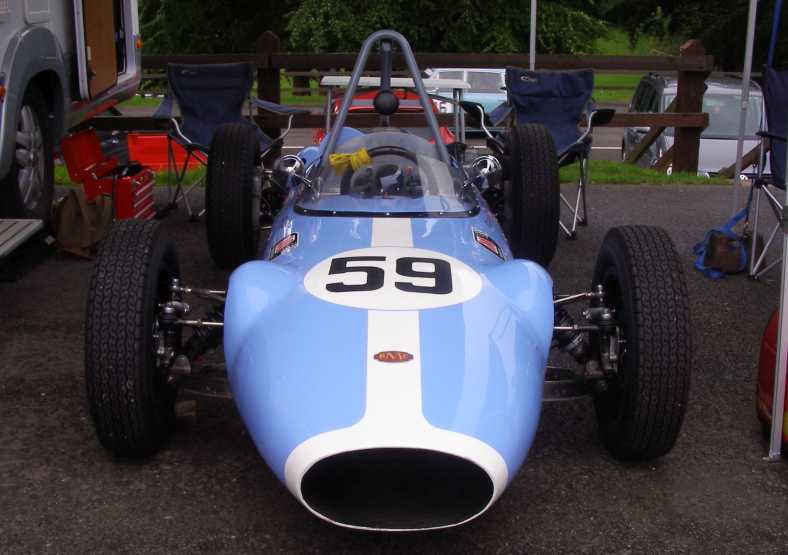
BMC Junior. A very tidy design, clean lines, using lots of standard car parts from the BMC range.
Badge engineering. Apart from building a very nicely engineered car, the BMC team created a neat badge for it too.
The engine was, remembering that it had to be either 1-litre or 1.1-litres, based on the unit sold in Morris Minors, Austin Healey Sprites and the Minis. BMC referred to these as the A-series.
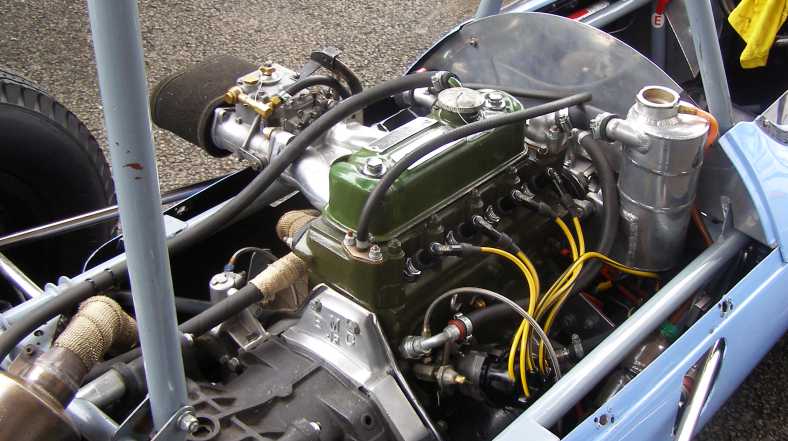
A-series. Siamesed inlet ports mean there’s only potential for one dual-choke Weber carby, but these long-stroke engines still provided plenty of ‘go’ in their day.
Early Formula Juniors were often fitted with drum brakes, but rule changes saw these go out the window and discs became universal. However, we’re looking at some of the earliest Juniors here and drum brakes were there in numbers.
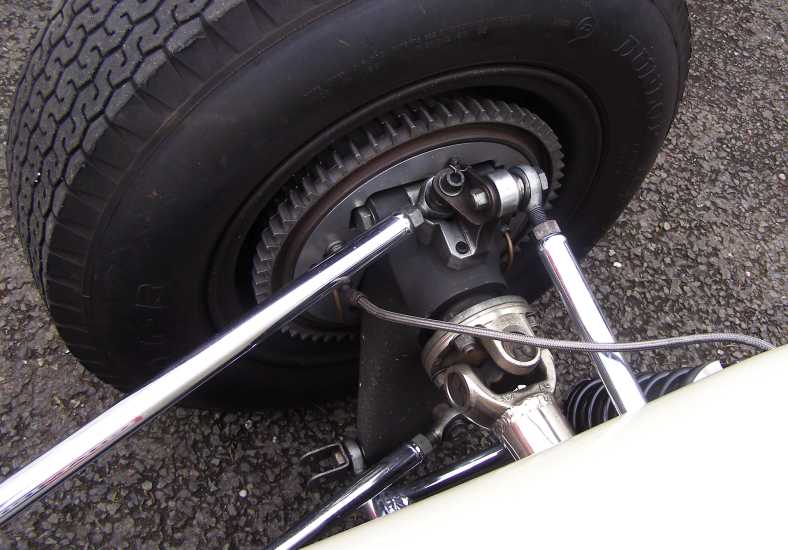
Drum brakes. A very nice setup with a finned alloy drum on this rear suspension. Detail like this appeals to me.
Another class of car running which I appreciated seeing was the category which replaced Formula Junior in the early sixties, Formula 3 with 1-litre engines fed by a single-choke carby. Or, as in this case, one choke of a dual-choke carby.
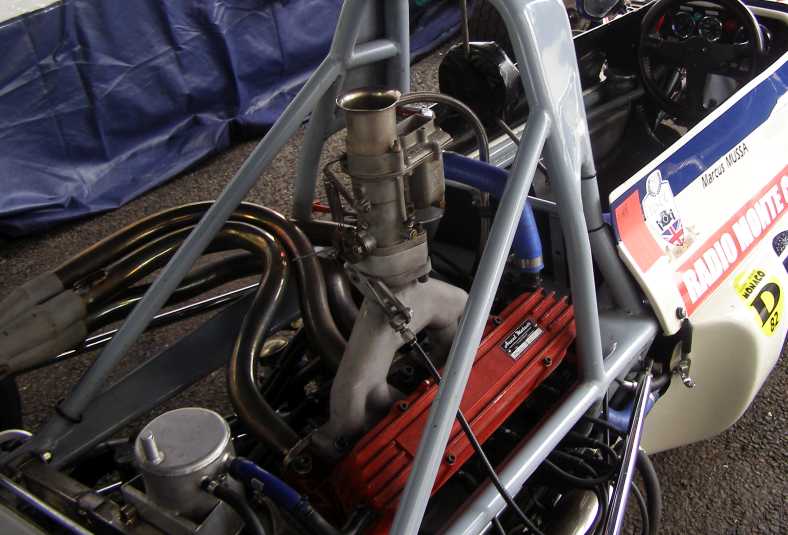
One-litre screamers. Lots of new development went into making these engines ‘scream’ with minimal carburetion. There was a specification for the size of a restrictor in the intake too.
Much of the day I spent either cruising around the circuit or walking from car to car and enjoying seeing such things up close. Of course, I joined Alan from time to time at the base he had set up for the Formula Ford 2000 cars. This class dates back to the seventies and the cars have wings, which certainly takes them out of the same category as the Juniors and the Formula 3s.
Alan provides services for these entrants and sets up with a motorhome and a tent, refreshments are there and as the day goes on he takes care of any wrinkles that come up. When the day’s over there’s food and drink available and I was very grateful to be able to join the boys in this, as I was that Alan let me sleep in the motorhome that night.
It was a pretty good way for me to go to a race meeting. My plans for Sunday were to spend much of the day there, but I needed to move on to catch up with some people in Lincoln before the afternoon was gone.
The next post will look at a few more cars of different classes and some oddities in the Junior ranks…
It was a fairly straightforward run…
…and as soon as I arrived I made my acquaintance with Alan I started to acquaint myself with the circuit and the cars. The meeting was essentially an ‘Historic’ meeting, where all the categories of cars running were from the past. There was a small number of cars competing which were current models, these were the Clubmens.
In America, of course, this type of racing is referred to as ‘Vintage’ racing, but I can’t reconcile to a name which really applies to cars built before 1931. That is in the strictest sense of the word ‘vintage’ when applied to cars. Then again, I guess it’s now 57 years since I first went to a race meeting so the cars I saw that day would have to qualify for a word that makes them sound old.
There was a big map up on a board in the paddock area:
The map. I found this very handy as I started to find my way around the circuit.
As the circuit is operated by the same people as Brands Hatch, some of the arrangements are very similar. Catering, is consistent, for instance, and I was to take advantage of this pretty soon after getting there.
Which put me in the Clubhouse area overlooking the Hall bends. Immediately I was attracted to the lovely setting and I started watching the cars through here. Having seen the map, I knew they were headed for the hairpin, so I walked down in that direction and saw some things I really liked.
But that’s putting the cart before the horse. What I’d like to do is show the circuit as best my photos will allow and comment on each part as the photos come up. And to do that we really should start at the beginning… err, at the start. A Sports Car race was getting under way:
The start. A slight uphill slope faces the starters…
Coppice. …with this climbing left-hander leading to a long right-hander over the crest of the hill.
So far that’s simple enough. Spectators can walk along the outside of the circuit right through this section and vantage points are plentiful. So that right-hander…
Charlies. Up into open country and then a long, long right followed by a long straight which starts out downhill and then climbs fairly steeply.
…starts uphill, crests the hill and then drops away quickly towards the straight. We’ll come back to that feature.
Park and Chris. This is the most ‘ordinary’ part of the circuit, out in the open, flat and not apparently challenging. That changes.
As you can see, from wooded areas and tricky turns, to fast straights and some very open and ordinary-looking road, Cadwell Park has some variety. But more is to come.
Heading for Gooseneck. Cars gather speed out of Chris corner…
Gooseneck. …and then there’s the downhill entry to the ess-bend that forms Gooseneck.
Out of Goosneck, the circuit continues to drop away:
Drop to Mansfield. Gathering speed quickly, judging Mansfield is important.
Heading for the bridge. Drivers continue down the hill to the bend under the spectator bridge.
There’s a kink in this stretch which doesn’t show in these photos, but appears as a fairly serious bend in this one from the other direction:
Under the bridge. At this point the cars are racing towards the dividing fence which separates the starting straight from the road returning to the valley in which the start line is located.
While they have the speed up, drivers try to maintain it through the corner under the bridge.
Lining up the bridge bend. Precision is called for here as the car has to be placed well for the braking area ahead.
If the car is quick it won’t have a lot of time to brake and prepare for the turn towards ‘The Mountain’:
Left to the Mountain. Saving time through here calls for accurate lines and smoothness.
The Mountain is a feature which provides a bit more spectacle as almost every car gets wheels off the road as it goes over the crest.
Rear wheels up. Revs rise as the rear wheels come off the ground. A Formula Ford 2000 car comes over The Mountain.
And then the really tricky stuff begins. Again, precise lines and smoothness will pay dividends here, but there’s no prize for being too slow about it, there’s no time to admire the scenery either.
Past the Clubhouse. Following the natural contours, the circuit dips a little and the esses which are the Hall Bends come up quickly.
Right, left, right, left, right, the Hall Bends get the driver busy…
First of Hall Bends. The first right and left are followed by…
More Hall Bends. …the next right and left. And after the last it gets really tricky.
The Hall Bends lead to a braking area for The Hairpin. But the driver is still coming out of the turn as he needs to haul back the speed, he’s heading wide into the braking area and it’s no comfort to him that it’s off-camber.
Into The Hairpin. Balancing traction against turning and braking all at once, reaching The Hairpin at the right speed is a matter of practice and judgement.
The cars go right out of sight after the Hairpin, rushing downhill to the not-so-tight right-hander called Barn that leads them back to the start/finish line.
Exiting Barn. A downhill corner that sweeps onto the straight completes the circuit.
The drive around Cadwell is almost 3.5km, or just under 2.2 miles. It’s busy all the way save for that straight towards Park corner and I quickly came to regard it as the best purpose-built (ie. non-public road or airfield) circuit I’ve ever seen.
Of course, any circuit which presents challenges usually sees mistakes made and damage to cars. The first race I watched had a little carnage:
Bent Elan. The result of a tangle with another car, there’s a fair bit of fibreglass damage and probably some to the suspension as well.
And if you are game to ask, “But what happened to the other bloke?” here’s your answer:
The other bloke. The Lotus 7-style car appears to have serious rear axle problems, probably a little chassis damage in that area too.
They came to grief at the tricky exit from Charlies:
Exit from Charlies. The radius of Charlies remains constant, but the topography changes, the track drops away. So the speed at which you can corner in the first part of the bend is too high once your traction goes away with the falling road surface.
And so the challenges of Cadwell Park bring drivers back time after time. The circuit is not licensed for faster cars. It was, incidentally, originally built as a motorcycle circuit and the first version of it didn’t have the section out in the open country, a hairpin bend near the climb up the Mountain made it quite a short circuit.
For anyone wanting to see what it’s like from the driver’s point of view, here’s a 2m 11s You Tube clip of a Formula 3 car doing a quick time:
Not forgetting that I was also there to see the cars. At Monaco the Formula Juniors were all front-engined, but here they had the whole range. And there were some very different cars among them.
One that really got my attention was a car I’d never heard of before, a rear-engined car built in California to use the BMC engine and called the ‘BMC’. This was built by (or for) British Motor Cars, who were BMC (British Motor Corporation) retailers at that time. The people involved were Joe Huffaker and Kjell Qvale and they certainly did a nice job with this car:
BMC Junior. A very tidy design, clean lines, using lots of standard car parts from the BMC range.
Badge engineering. Apart from building a very nicely engineered car, the BMC team created a neat badge for it too.
The engine was, remembering that it had to be either 1-litre or 1.1-litres, based on the unit sold in Morris Minors, Austin Healey Sprites and the Minis. BMC referred to these as the A-series.
A-series. Siamesed inlet ports mean there’s only potential for one dual-choke Weber carby, but these long-stroke engines still provided plenty of ‘go’ in their day.
Early Formula Juniors were often fitted with drum brakes, but rule changes saw these go out the window and discs became universal. However, we’re looking at some of the earliest Juniors here and drum brakes were there in numbers.
Drum brakes. A very nice setup with a finned alloy drum on this rear suspension. Detail like this appeals to me.
Another class of car running which I appreciated seeing was the category which replaced Formula Junior in the early sixties, Formula 3 with 1-litre engines fed by a single-choke carby. Or, as in this case, one choke of a dual-choke carby.
One-litre screamers. Lots of new development went into making these engines ‘scream’ with minimal carburetion. There was a specification for the size of a restrictor in the intake too.
Much of the day I spent either cruising around the circuit or walking from car to car and enjoying seeing such things up close. Of course, I joined Alan from time to time at the base he had set up for the Formula Ford 2000 cars. This class dates back to the seventies and the cars have wings, which certainly takes them out of the same category as the Juniors and the Formula 3s.
Alan provides services for these entrants and sets up with a motorhome and a tent, refreshments are there and as the day goes on he takes care of any wrinkles that come up. When the day’s over there’s food and drink available and I was very grateful to be able to join the boys in this, as I was that Alan let me sleep in the motorhome that night.
It was a pretty good way for me to go to a race meeting. My plans for Sunday were to spend much of the day there, but I needed to move on to catch up with some people in Lincoln before the afternoon was gone.
The next post will look at a few more cars of different classes and some oddities in the Junior ranks…
Last edited by Ray Bell; Jun 23, 2020 at 09:06 AM.
Thread Starter
|
Captain
Joined: Oct 2005
Posts: 570
Likes: 8
From: The Summit, Queensland, Australia
Sunday morning saw me finding my way around ever more of the cars. One of the things I was doing was photographing suspension detail of a wide range of them to give to Bob Britton at home, he built plenty of cars ‘back in the day’ but retains a keen interest in how others did it too. Many of the cars present never made it to Australia.
But I’m not going to present all those photos, only pics of broader interest. Well, what I think is broader interest. All of this, of course, I was doing while I spent time wandering around the circuit when particular races were on. What a delightful place to be!
But to start with the dull stuff. Yes, I take a lot of notice of wheels, I take note of what stud patterns are shared by different cars, which wheels interchange, all sorts of stuff. And here in England I was presented with wheels I’d never seen before.
It seems that caravan and trailer makers access many wheels from specialty makers, not entirely from production cars like we see in Australia. This caravan came along early in my stay:
These were plainly from a specialist maker…
…this one could be from a car, but it’s not familiar to me, this one…
… is probably from a car. Being German-made it could be a VW wheel, and they fix with bolts rather than studs as does this one, while this 10” model…
…is not from a Mini, so it’s a specialty item. Now it’s time to look at a real oddity:
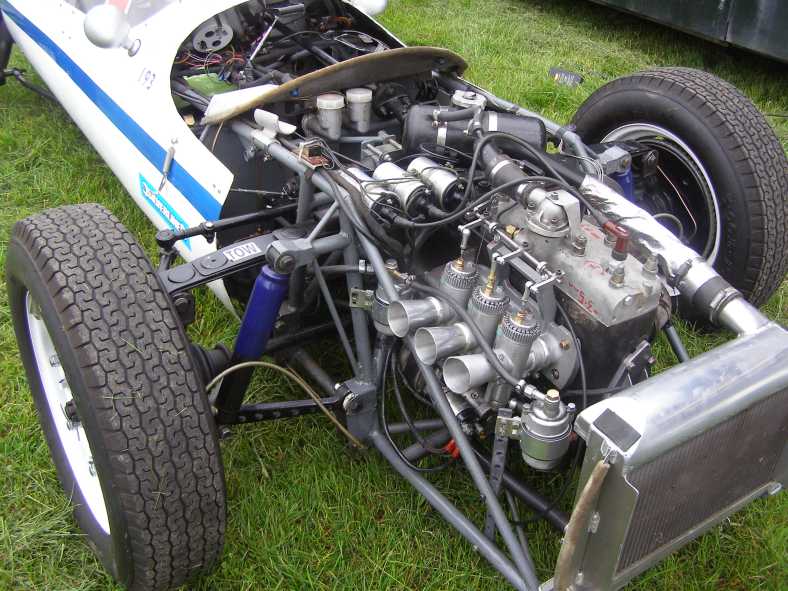
Mitter DKW. Gerhard Mitter was a top German driver of the fifties and sixties and he built this Formula Junior in the first year of the class’ popularity.
The front engine and front wheel drive arrangement was not unknown, but difficult to make work and its time was very limited. Mitter and his crew were renowned for their ability to get tremendous horsepower out of this 2-stroke 3-cylinder engine, but their time in Formula Junior in this form was limited. On this car some of the production car’s suspension components were used, including the leaf springs.
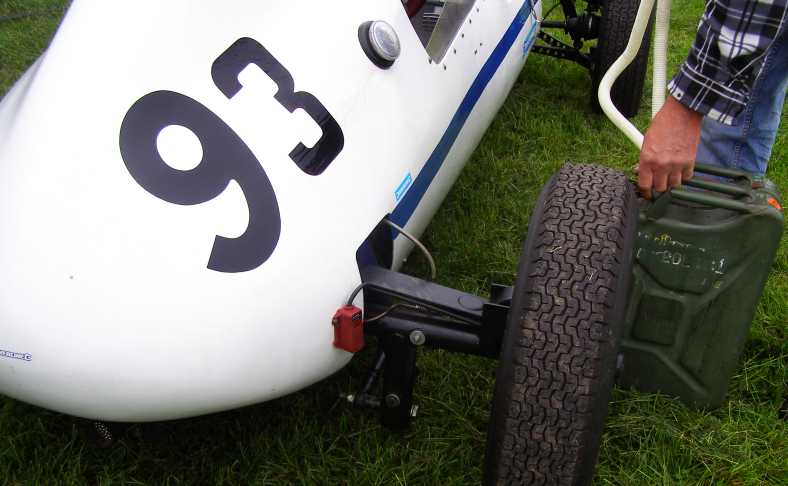
Simple rear end. A lightweight beam axle was all that was needed at the back.
In Italy one of the most prolific cars was the Stanguellini, built with many Fiat 1100 components in front engine rear wheel drive form:
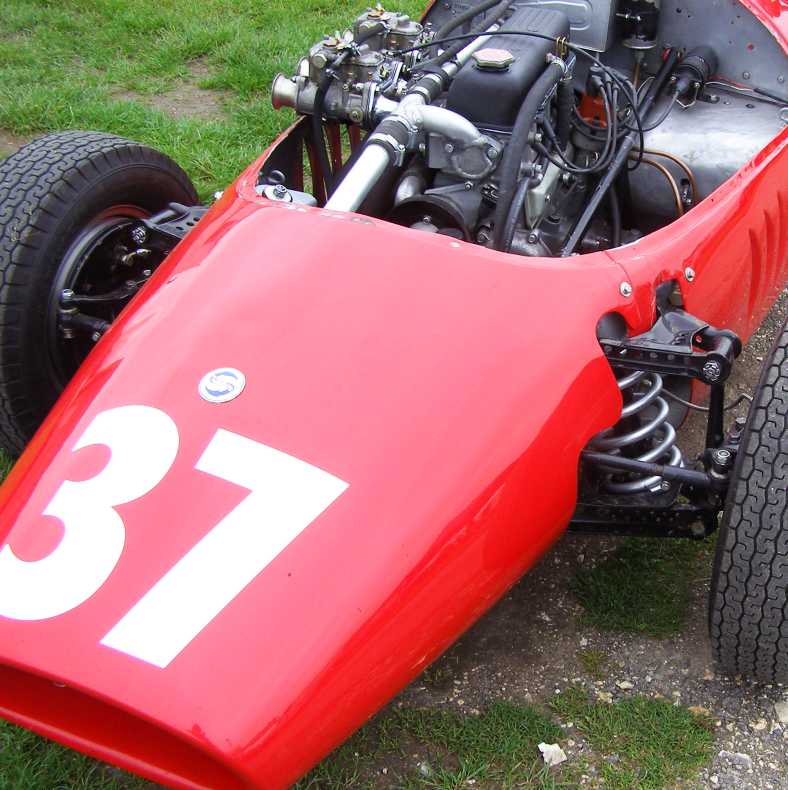
Fiat 1100. Fiat 1100 engines were popular in Italian cars and the Stanguellini was one. Note that the suspension parts and brakes are also from the production model.
Fiat 1100s apparently were not the production cars Count Johnny Lurani had in mind when he formulated the class, as originally the formula was for 1000cc engines. But when the 1100 engines were allowed – with a higher minimum weight limit – they came in droves.
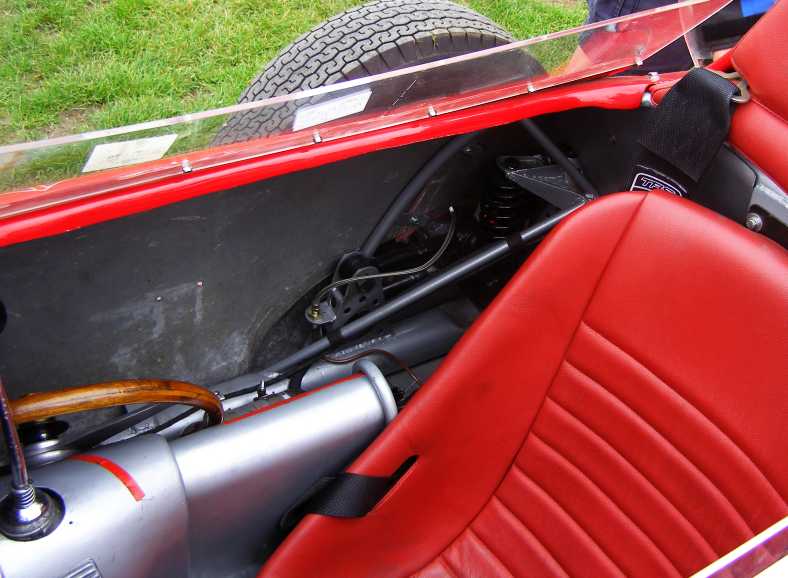
Stanguellini cockpit. A number of things are seen here, the regular Fiat gearbox, offset to the right, the large-diameter chassis tube indented to give axle clearance, the linkage for the rear end and the removable steering wheel lying in wait.
The standard of preparation of these cars reflects the pride the owners take in their charges, almost all of these front-engined cars now being over fifty-nine years old. But there was a selection of other cars at the meeting, this one is from Historic Formula Ford 2000, these are much newer, being only forty years old:
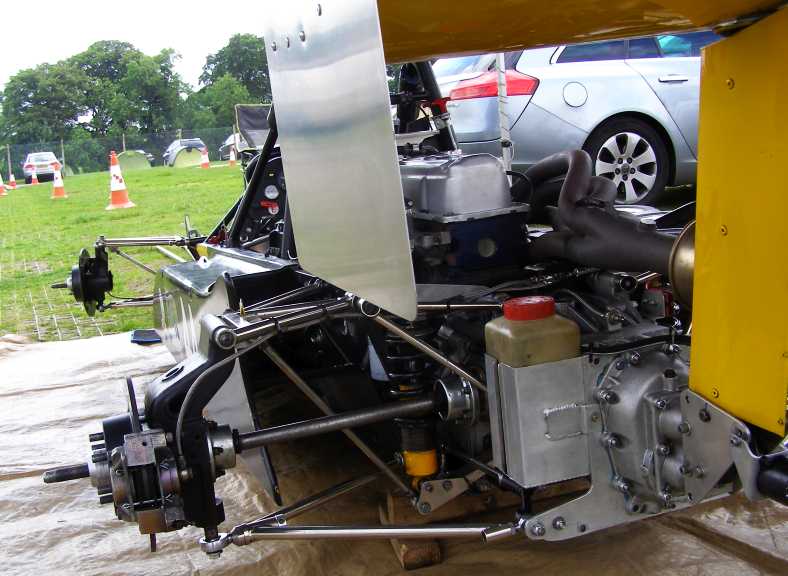
Wings and slicks. Quite a difference with FF2000s as they come from the era in which slicks and wings were well-entrenched as performance necessities.
This car is a very nice example, a Pilbeam – built by Mike Pilbeam – with bespoke suspension components, centre-fix alloy wheels, inboard springing and damping by pull-rod and the universal modified VW beetle gearbox with dog-engagement straight-cut gears in a 5-speed cluster.
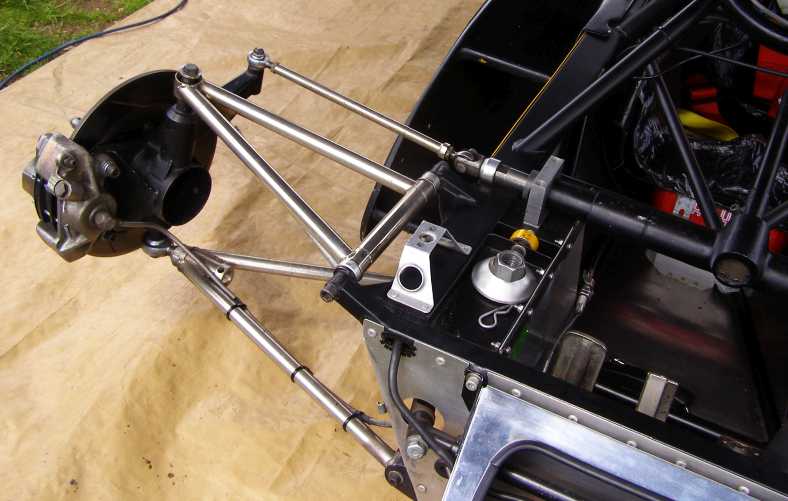
Front suspension. The pull rod is hiding here, visible here are the live-axle upright fabricated around a heavy tube carrying the wheel bearing.
The brakes on these cars use calipers from production cars and the suspensions are very adjustable to tune for different circuits. Camber is adjusted by altering the lower wishbone’s outer rod end, caster relies on spacers for fore-aft adjustment of the top wishbone. There’s a 2-way adjustable damper in the recess in the chassis and the spring mount on that is also adjustable. The steering rack is a special race car unit.
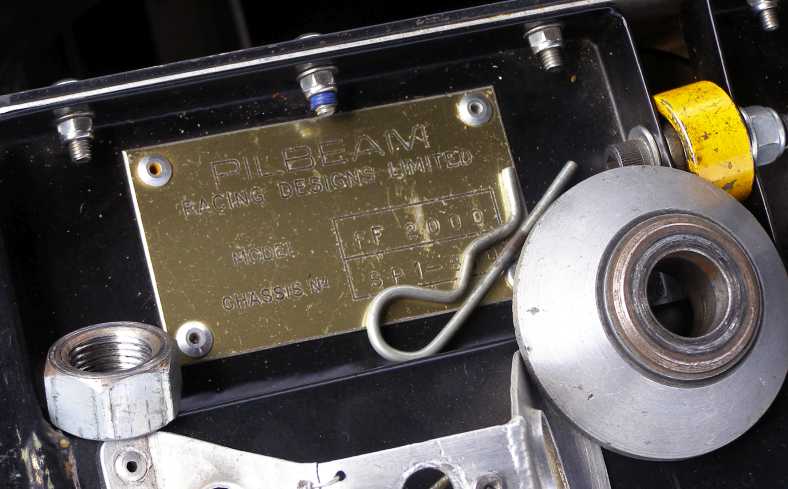
Wheel nut. Pilbeam’s simple ID plate is flanked here by the wheel fixing nut and cap and the top of the damper, which looks like it might be a steel-bodied Koni.
Going back to the Formula Juniors, we can see how different things became with the march of time, development and infusion of better budgets. This is a Caravelle, I’d guess from 1961, and it even has the regular Ford bellhousing in use with a simple alloy plate providing the adapting method to the Renault gearbox. Lotus also used the Renault box, but once Hewland started doing the nice job they did with the VW they fell into general disuse.
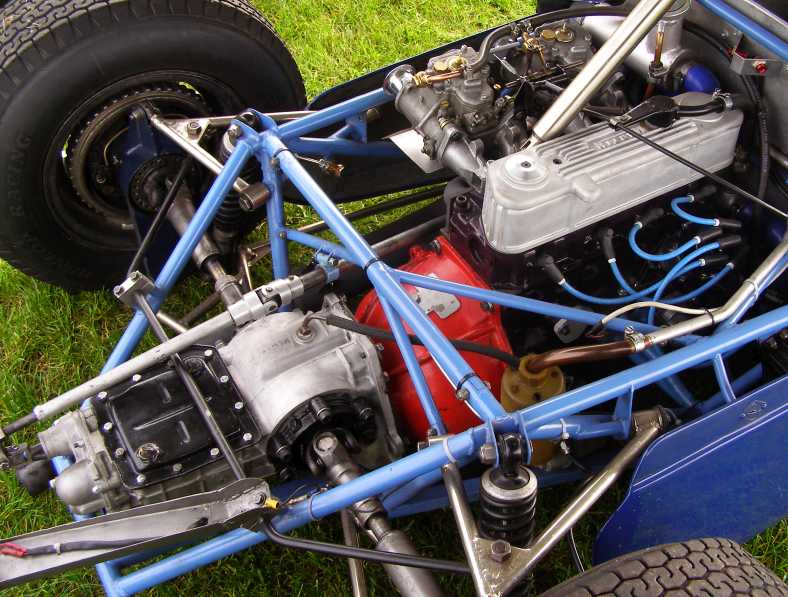
Ford and Renault. The early days of Formula Junior soon found the Ford Anglia engine gave good power, finding the right gearbox for rear-engined cars was more difficult.
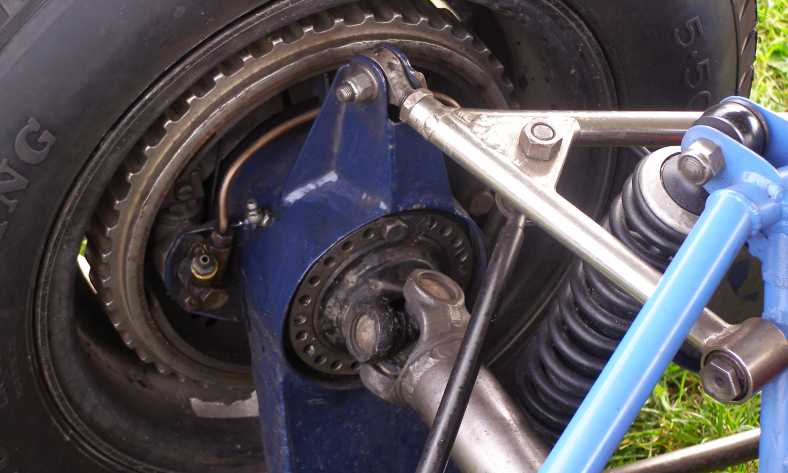
Rear of the Caravelle. The use of a rubber bush at the inner end of the wishbone was soon to disappear, rod ends like that on the upright end became commonplace.
A brake drum with alloy fins encloses a twin-leading shoe drum brake setup here, while the anti-roll bar is mounted in much the same manner as road cars. If the damper is adjustable it will be a mono-adjustment. At the front there’s a drum brake on a Triumph Herald upright and an adjustable spring base on the damper.
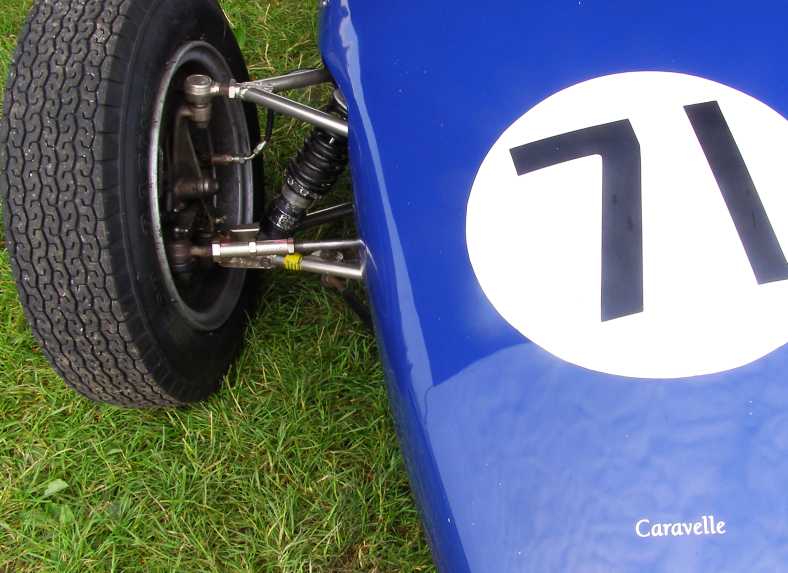
Front suspension. On British cars the Triumph Herald (or Spitfire) uprights were in common use right through the sixties.
Again, I wasn’t just looking at the racing cars, I was taking in so much of things around which are not seen in Australia. And while we do have the Fiat Ducato here the Peugeot Boxer is unknown on our shores. Then it was pointed out to me that they share the same body panels, that was a total surprise.
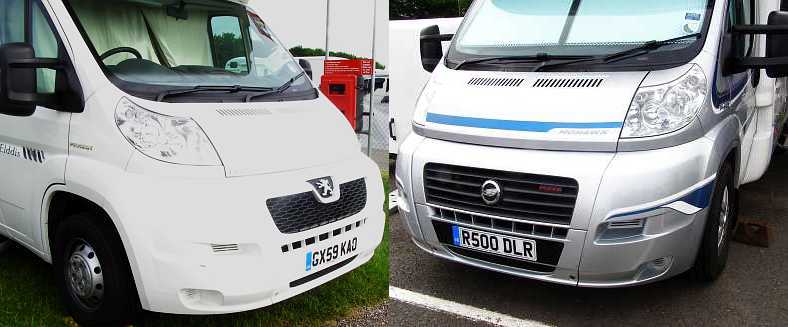
Peugeot and Fiat blended. Almost every feature is the same, badge engineering at work.
The start of the race from which I posted a pic of the previous day was for Sports Cars and one of the starters in this class could well have been at Brands Hatch with the other V8s the previous week. This is a TVR Griffith from the mid to late-sixties and it is powered by Ford:
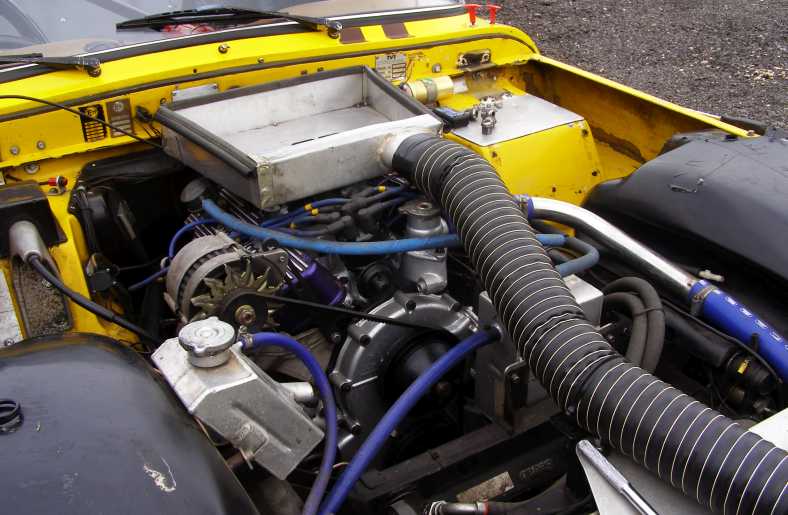
TVR with Ford power. In the sixties a lot of people went for the 221, 260 and 280 Fords with relatively light weight for their power. The air trunk is to get cooler air into the carburettor.
I’ve mentioned the Triumph Herald uprights, this car has a larger version. These components were made by Alford and Alder and they made these larger ones for Standard Vanguards and the TR sports car line. This photo shows another air trunk, this one sending cooling air to the rather smallish brake disc.
You might see under there the tubular chassis the car has, this model featured a space-frame ‘backbone’ down the centre of the car as its main strengthening component. The radiator hose out there among the moving suspension parts is an unusual thing.
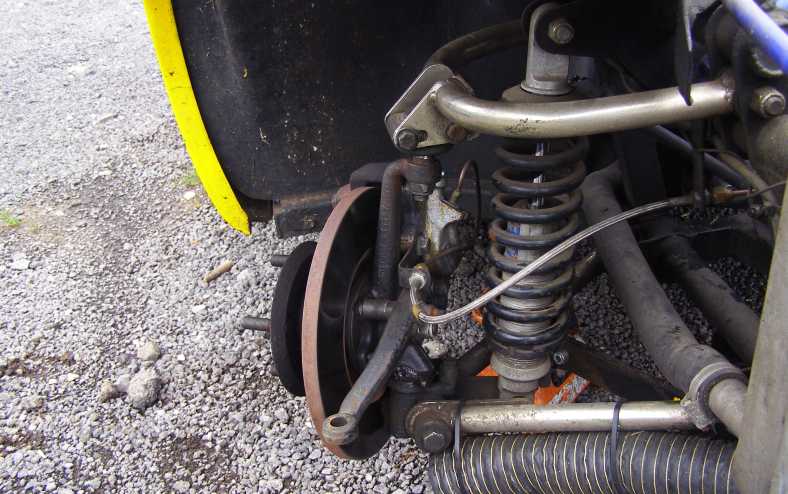
TVR front suspension. Tubular wishbones, a coil-spring/damper unit, it’s all typical of the era. The tie-rod is missing, I guess it was getting a new ball joint fitted.
The Alexis had a couple of things to look at on its rear suspension. Being a few years newer than the Caravelle, it has all rod-ends in the suspension, a nice bespoke casting for the upright, adjustable anti-roll bar and disc brakes.
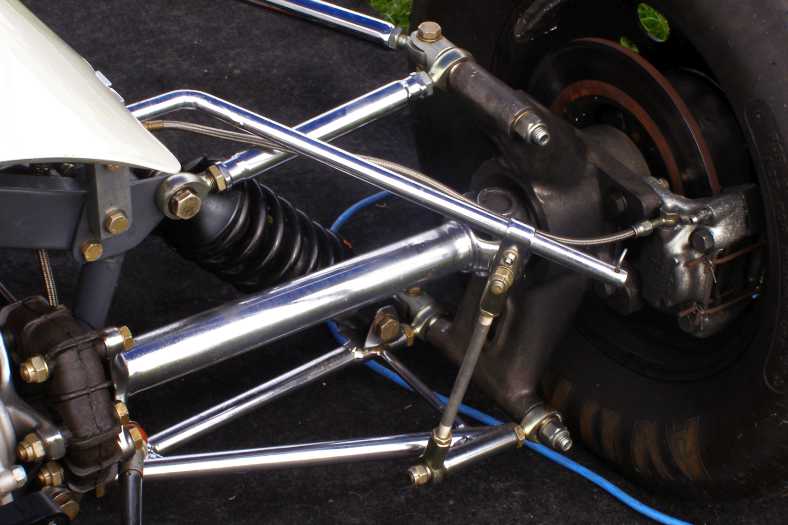
Alexis rear suspension. The rubber ‘doughnut’ at the inner end of the driveshaft was common in the early to mid-sixties, it does provide protection for the driveline but must include a centering setup to ensure it runs true.
What an oddball this thing is! While it has a Wolseley grille (I didn’t get to find out whether or not the light in the badge works), it gives no impression that it’s derived from a Wolseley. Though I guess the front suspension could be from a fifties model.
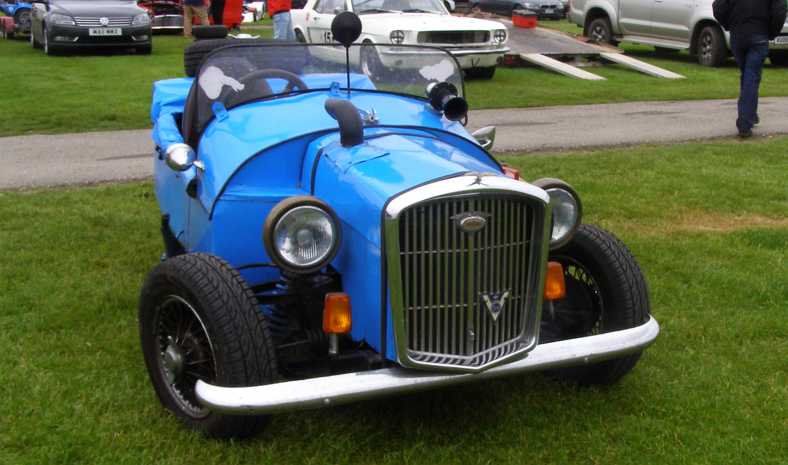
Strange device. I don’t know why someone would have built this, but they did. I have no idea what power unit it possessed.
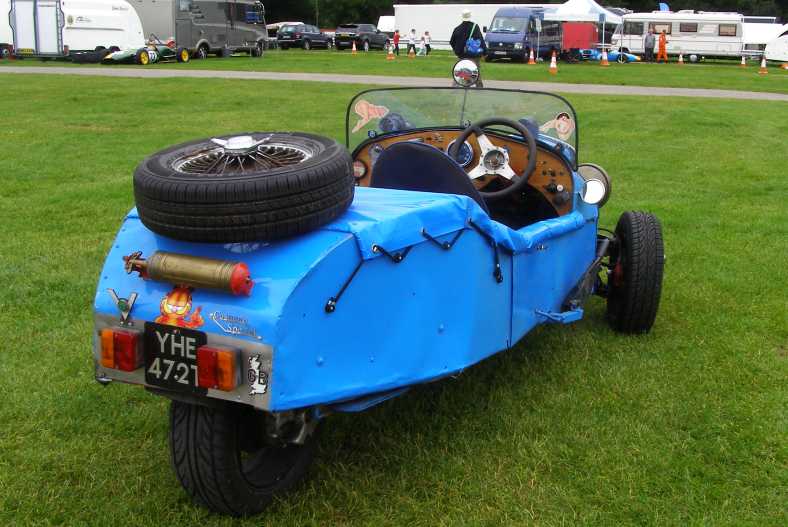
Motorcycle rear drive. It seems to have a fairly modern motorcycle shaft-drive rear. Note that it’s well-endowed with rear vision capability and that the handbrake is outside the cockpit. The badge on the back says 'Cosmore Special.'
While that might not be my cup of tea, I’m a real enthusiast for the Clubman-type formula, though the Brits had taken them well beyond the simplicity of the types I race and liked to work on back in the seventies.
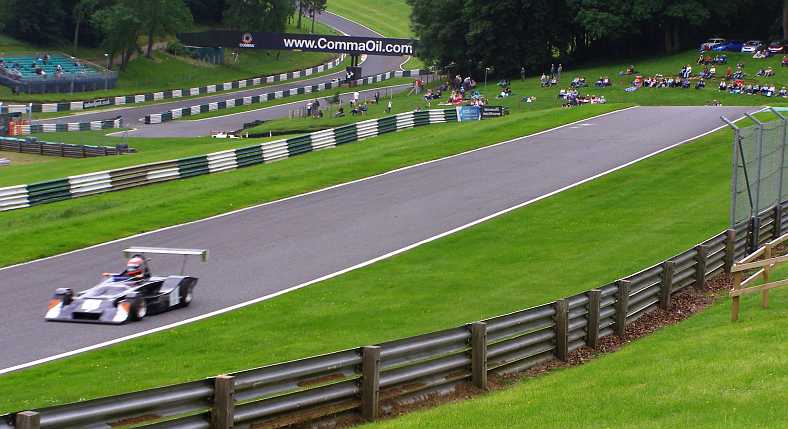
Clubman past the Clubhouse. These are quick cars with their big wings and light weight. They only pay lip-service to passenger accommodation these days.
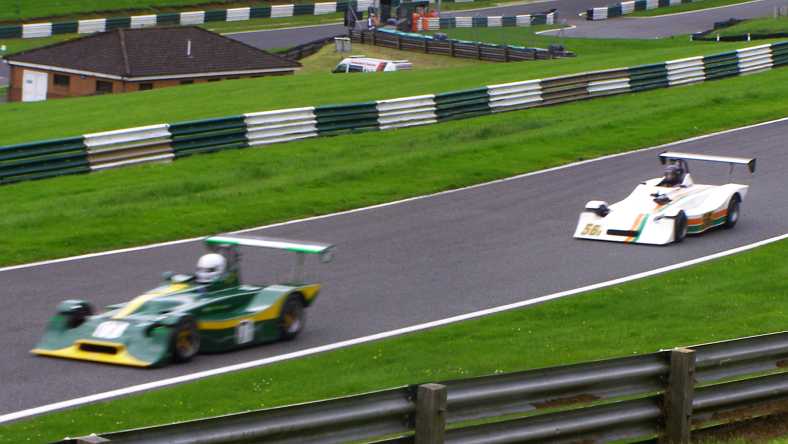
Two of them. Again suffering from the camera’s reluctance to focus quickly, these cars are further examples of the breed which should provide low-cost racing.
Obviously I was keen to get a closer look at the cars here. These ones are not Historic models, but current day cars built to the current-day rules. They fit in with Historic classes because they must be front-engined.
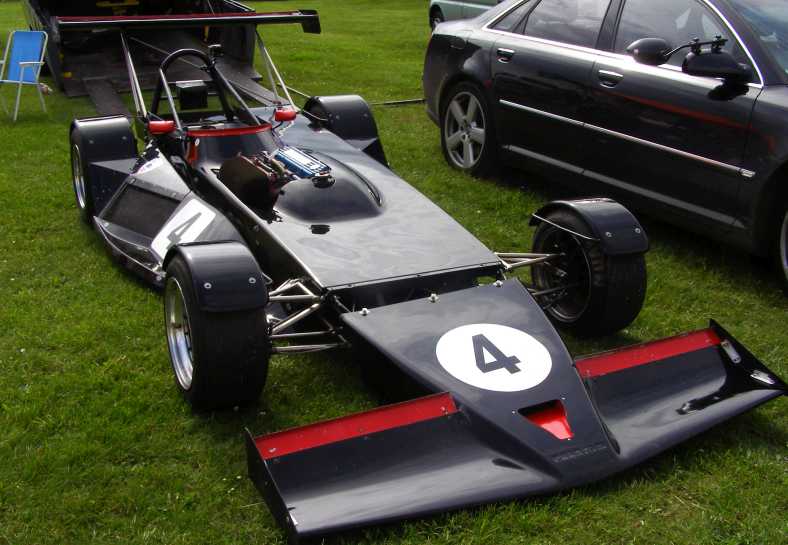
Sleek and neat. This car, sitting with the nose ajar, has all the features of modern racing cars under its skin. But with the front engine mounting dictating many of its characteristics.
Looking at the pic above, you see the radiators in the sidepods to get the weight to the rear wheels, the large wing-area and push-rod front springing.
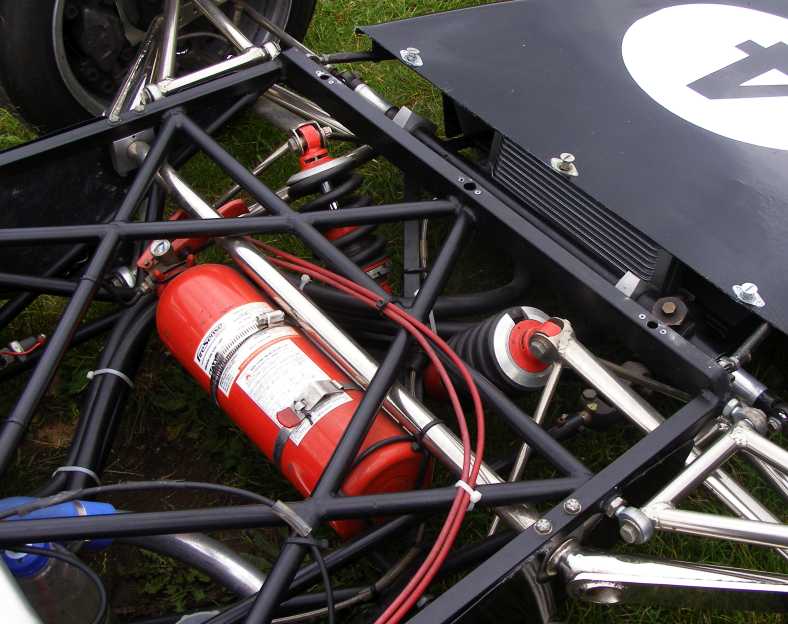
Tricky front end. In among that tangle of tubing you can pick out how the push-rods pivot so that they as the wheel rises they push down on the top of the coil/damper unit.
These dampers are double-adjustable steel-bodied Konis, naturally with adjustable spring height, the wishbone arrangement is very much like the Pilbeam while the anti-roll bar is rather different in the way the large arms at the end have been designed. It’s a tubular ‘bar’ in the modern manner. The oil cooler gets air from the NACA inlet in the centre of the nose.
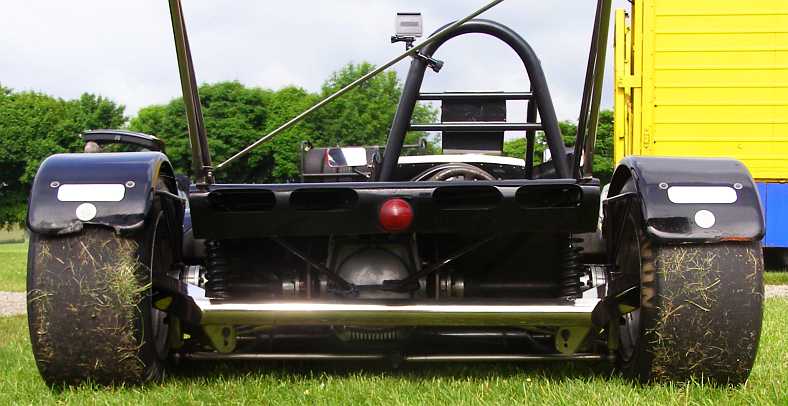
De Dion rear. The rear suspension is by de Dion with lateral location by a horizontal Watts linkage at the bottom of the chassis.
At home independent rear ends were out, ruled out in the days when the primary goal was to make the cars affordable for less well-off enthusiasts. Like me. But here we see the big plated de Dion tube taking the suspension loads while big CV joints are there to feed power in from the solidly-mounted final drive. In a world with ever-more front wheel-drive cars the components used here will become as hard to source as the live axles we use in Australia.
Note also the camera affixed to the rollover bar, many drivers record their racing in this modern age of electronic gadgetry. There’s one on this car too, seen in the initial photo of it going past the Clubhouse. And this one has the more familiar – to me – live rear axle, but with modern ideas applied to its location.
Live rear axle. This car has the old-style axle, but adjustable ride height and damping. Location is by the tricky Mumford link, though it’s hard to see here.
I haven’t yet devoted the day or so it would take to begin to understand how the Mumford link works. Here’s a picture which shows it:
Mumford Link. The modern way to go for lateral location of live axles, maybe promoted by salesman supplying rod ends.
Note that the engines of these cars are all 1600cc Ford Crossflow units, basically as used in the old Formula Ford. But highly modified, exercising lots of freedoms with the internals and ancillaries. I actually don’t like these engines at all, but it’s all my own idea.
There are some interesting things here, the swill-pot in the top radiator line is mounted directly on the thermostat mount point on the cylinder head, an oil pump poking out the front means it’s dry-sumped to avoid oil surge and a Gilmer belt drives the water pump.
Ford engine. It might be out of date and a heavy and unsophisticated lump by comparison with more modern engines, but it’s what the class has to use.
And, of course, the fuel tank precludes the inclusion of a passenger, while the fibreglass enclosure for the driver gives him room to move his left arm to change gears. Of course, the intention of the cars on which this car is based was definitely to make a seat available for a passenger, such as this one out in the spectator area:
Older style. This one is non-combative and has a more modern engine from a Rover. But it’s in the original Lotus 7 mold.
In fact, this car belongs to another forum member, John Aston, who loves going to Cadwell to spectate and usually stays at a Bed & Breakfast about fifteen miles away. I got the address of this establishment so I could also stay there on Sunday night, here’s the map for the balance of the day:
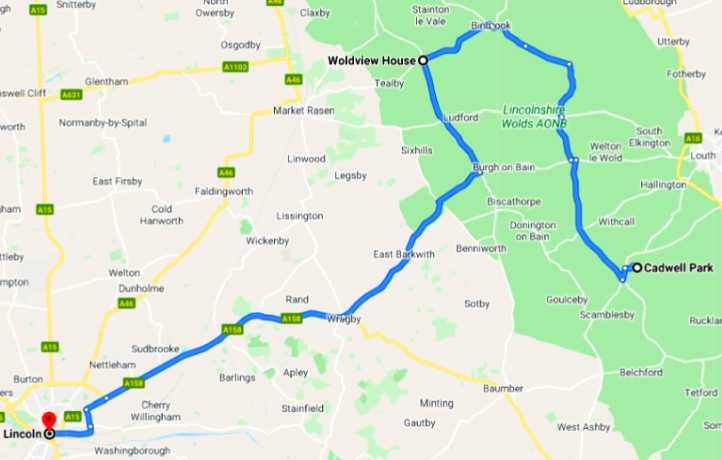
I bid farewell to the nice people I’d met there at Cadwell, in particular Alan who had been such a help, and left in the early afternoon as I had arranged to meet some people at Lincoln and I had to arrange for my accommodation for the night too. I had a shower at the Bully Hill Top B & B, which is at the highest point on the Lincolnshire Wolds near Leath and drove across to Lincoln.
Afterwards I returned to the B & B and settled into a very comfortable room, well satisfied with the weekend I’d enjoyed.
Monday would be my last day in the United Kingdom…
But I’m not going to present all those photos, only pics of broader interest. Well, what I think is broader interest. All of this, of course, I was doing while I spent time wandering around the circuit when particular races were on. What a delightful place to be!
But to start with the dull stuff. Yes, I take a lot of notice of wheels, I take note of what stud patterns are shared by different cars, which wheels interchange, all sorts of stuff. And here in England I was presented with wheels I’d never seen before.
It seems that caravan and trailer makers access many wheels from specialty makers, not entirely from production cars like we see in Australia. This caravan came along early in my stay:
These were plainly from a specialist maker…
…this one could be from a car, but it’s not familiar to me, this one…
… is probably from a car. Being German-made it could be a VW wheel, and they fix with bolts rather than studs as does this one, while this 10” model…
…is not from a Mini, so it’s a specialty item. Now it’s time to look at a real oddity:
Mitter DKW. Gerhard Mitter was a top German driver of the fifties and sixties and he built this Formula Junior in the first year of the class’ popularity.
The front engine and front wheel drive arrangement was not unknown, but difficult to make work and its time was very limited. Mitter and his crew were renowned for their ability to get tremendous horsepower out of this 2-stroke 3-cylinder engine, but their time in Formula Junior in this form was limited. On this car some of the production car’s suspension components were used, including the leaf springs.
Simple rear end. A lightweight beam axle was all that was needed at the back.
In Italy one of the most prolific cars was the Stanguellini, built with many Fiat 1100 components in front engine rear wheel drive form:
Fiat 1100. Fiat 1100 engines were popular in Italian cars and the Stanguellini was one. Note that the suspension parts and brakes are also from the production model.
Fiat 1100s apparently were not the production cars Count Johnny Lurani had in mind when he formulated the class, as originally the formula was for 1000cc engines. But when the 1100 engines were allowed – with a higher minimum weight limit – they came in droves.
Stanguellini cockpit. A number of things are seen here, the regular Fiat gearbox, offset to the right, the large-diameter chassis tube indented to give axle clearance, the linkage for the rear end and the removable steering wheel lying in wait.
The standard of preparation of these cars reflects the pride the owners take in their charges, almost all of these front-engined cars now being over fifty-nine years old. But there was a selection of other cars at the meeting, this one is from Historic Formula Ford 2000, these are much newer, being only forty years old:
Wings and slicks. Quite a difference with FF2000s as they come from the era in which slicks and wings were well-entrenched as performance necessities.
This car is a very nice example, a Pilbeam – built by Mike Pilbeam – with bespoke suspension components, centre-fix alloy wheels, inboard springing and damping by pull-rod and the universal modified VW beetle gearbox with dog-engagement straight-cut gears in a 5-speed cluster.
Front suspension. The pull rod is hiding here, visible here are the live-axle upright fabricated around a heavy tube carrying the wheel bearing.
The brakes on these cars use calipers from production cars and the suspensions are very adjustable to tune for different circuits. Camber is adjusted by altering the lower wishbone’s outer rod end, caster relies on spacers for fore-aft adjustment of the top wishbone. There’s a 2-way adjustable damper in the recess in the chassis and the spring mount on that is also adjustable. The steering rack is a special race car unit.
Wheel nut. Pilbeam’s simple ID plate is flanked here by the wheel fixing nut and cap and the top of the damper, which looks like it might be a steel-bodied Koni.
Going back to the Formula Juniors, we can see how different things became with the march of time, development and infusion of better budgets. This is a Caravelle, I’d guess from 1961, and it even has the regular Ford bellhousing in use with a simple alloy plate providing the adapting method to the Renault gearbox. Lotus also used the Renault box, but once Hewland started doing the nice job they did with the VW they fell into general disuse.
Ford and Renault. The early days of Formula Junior soon found the Ford Anglia engine gave good power, finding the right gearbox for rear-engined cars was more difficult.
Rear of the Caravelle. The use of a rubber bush at the inner end of the wishbone was soon to disappear, rod ends like that on the upright end became commonplace.
A brake drum with alloy fins encloses a twin-leading shoe drum brake setup here, while the anti-roll bar is mounted in much the same manner as road cars. If the damper is adjustable it will be a mono-adjustment. At the front there’s a drum brake on a Triumph Herald upright and an adjustable spring base on the damper.
Front suspension. On British cars the Triumph Herald (or Spitfire) uprights were in common use right through the sixties.
Again, I wasn’t just looking at the racing cars, I was taking in so much of things around which are not seen in Australia. And while we do have the Fiat Ducato here the Peugeot Boxer is unknown on our shores. Then it was pointed out to me that they share the same body panels, that was a total surprise.
Peugeot and Fiat blended. Almost every feature is the same, badge engineering at work.
The start of the race from which I posted a pic of the previous day was for Sports Cars and one of the starters in this class could well have been at Brands Hatch with the other V8s the previous week. This is a TVR Griffith from the mid to late-sixties and it is powered by Ford:
TVR with Ford power. In the sixties a lot of people went for the 221, 260 and 280 Fords with relatively light weight for their power. The air trunk is to get cooler air into the carburettor.
I’ve mentioned the Triumph Herald uprights, this car has a larger version. These components were made by Alford and Alder and they made these larger ones for Standard Vanguards and the TR sports car line. This photo shows another air trunk, this one sending cooling air to the rather smallish brake disc.
You might see under there the tubular chassis the car has, this model featured a space-frame ‘backbone’ down the centre of the car as its main strengthening component. The radiator hose out there among the moving suspension parts is an unusual thing.
TVR front suspension. Tubular wishbones, a coil-spring/damper unit, it’s all typical of the era. The tie-rod is missing, I guess it was getting a new ball joint fitted.
The Alexis had a couple of things to look at on its rear suspension. Being a few years newer than the Caravelle, it has all rod-ends in the suspension, a nice bespoke casting for the upright, adjustable anti-roll bar and disc brakes.
Alexis rear suspension. The rubber ‘doughnut’ at the inner end of the driveshaft was common in the early to mid-sixties, it does provide protection for the driveline but must include a centering setup to ensure it runs true.
What an oddball this thing is! While it has a Wolseley grille (I didn’t get to find out whether or not the light in the badge works), it gives no impression that it’s derived from a Wolseley. Though I guess the front suspension could be from a fifties model.
Strange device. I don’t know why someone would have built this, but they did. I have no idea what power unit it possessed.
Motorcycle rear drive. It seems to have a fairly modern motorcycle shaft-drive rear. Note that it’s well-endowed with rear vision capability and that the handbrake is outside the cockpit. The badge on the back says 'Cosmore Special.'
While that might not be my cup of tea, I’m a real enthusiast for the Clubman-type formula, though the Brits had taken them well beyond the simplicity of the types I race and liked to work on back in the seventies.
Clubman past the Clubhouse. These are quick cars with their big wings and light weight. They only pay lip-service to passenger accommodation these days.
Two of them. Again suffering from the camera’s reluctance to focus quickly, these cars are further examples of the breed which should provide low-cost racing.
Obviously I was keen to get a closer look at the cars here. These ones are not Historic models, but current day cars built to the current-day rules. They fit in with Historic classes because they must be front-engined.
Sleek and neat. This car, sitting with the nose ajar, has all the features of modern racing cars under its skin. But with the front engine mounting dictating many of its characteristics.
Looking at the pic above, you see the radiators in the sidepods to get the weight to the rear wheels, the large wing-area and push-rod front springing.
Tricky front end. In among that tangle of tubing you can pick out how the push-rods pivot so that they as the wheel rises they push down on the top of the coil/damper unit.
These dampers are double-adjustable steel-bodied Konis, naturally with adjustable spring height, the wishbone arrangement is very much like the Pilbeam while the anti-roll bar is rather different in the way the large arms at the end have been designed. It’s a tubular ‘bar’ in the modern manner. The oil cooler gets air from the NACA inlet in the centre of the nose.
De Dion rear. The rear suspension is by de Dion with lateral location by a horizontal Watts linkage at the bottom of the chassis.
At home independent rear ends were out, ruled out in the days when the primary goal was to make the cars affordable for less well-off enthusiasts. Like me. But here we see the big plated de Dion tube taking the suspension loads while big CV joints are there to feed power in from the solidly-mounted final drive. In a world with ever-more front wheel-drive cars the components used here will become as hard to source as the live axles we use in Australia.
Note also the camera affixed to the rollover bar, many drivers record their racing in this modern age of electronic gadgetry. There’s one on this car too, seen in the initial photo of it going past the Clubhouse. And this one has the more familiar – to me – live rear axle, but with modern ideas applied to its location.
Live rear axle. This car has the old-style axle, but adjustable ride height and damping. Location is by the tricky Mumford link, though it’s hard to see here.
I haven’t yet devoted the day or so it would take to begin to understand how the Mumford link works. Here’s a picture which shows it:
Mumford Link. The modern way to go for lateral location of live axles, maybe promoted by salesman supplying rod ends.
Note that the engines of these cars are all 1600cc Ford Crossflow units, basically as used in the old Formula Ford. But highly modified, exercising lots of freedoms with the internals and ancillaries. I actually don’t like these engines at all, but it’s all my own idea.
There are some interesting things here, the swill-pot in the top radiator line is mounted directly on the thermostat mount point on the cylinder head, an oil pump poking out the front means it’s dry-sumped to avoid oil surge and a Gilmer belt drives the water pump.
Ford engine. It might be out of date and a heavy and unsophisticated lump by comparison with more modern engines, but it’s what the class has to use.
And, of course, the fuel tank precludes the inclusion of a passenger, while the fibreglass enclosure for the driver gives him room to move his left arm to change gears. Of course, the intention of the cars on which this car is based was definitely to make a seat available for a passenger, such as this one out in the spectator area:
Older style. This one is non-combative and has a more modern engine from a Rover. But it’s in the original Lotus 7 mold.
In fact, this car belongs to another forum member, John Aston, who loves going to Cadwell to spectate and usually stays at a Bed & Breakfast about fifteen miles away. I got the address of this establishment so I could also stay there on Sunday night, here’s the map for the balance of the day:
I bid farewell to the nice people I’d met there at Cadwell, in particular Alan who had been such a help, and left in the early afternoon as I had arranged to meet some people at Lincoln and I had to arrange for my accommodation for the night too. I had a shower at the Bully Hill Top B & B, which is at the highest point on the Lincolnshire Wolds near Leath and drove across to Lincoln.
Afterwards I returned to the B & B and settled into a very comfortable room, well satisfied with the weekend I’d enjoyed.
Monday would be my last day in the United Kingdom…
Last edited by Ray Bell; Jun 26, 2020 at 09:32 AM.
Thread Starter
|
Captain
Joined: Oct 2005
Posts: 570
Likes: 8
From: The Summit, Queensland, Australia
Yes, my last day in the UK…
Almost the last of the European part of my 3-month ‘adventure’ too. I was booked onto the ferry to Dunkirk late in the evening so I had a lot of day to do whatever I wanted to do. But a keen desire to not be late for the ferry.
Awakening at the B & B I found that the nice weather of the past two days had been replaced overnight with some light rain. I was in e.mail contact with people at home and took some photos out the windows of the B & B and sent them off to them:
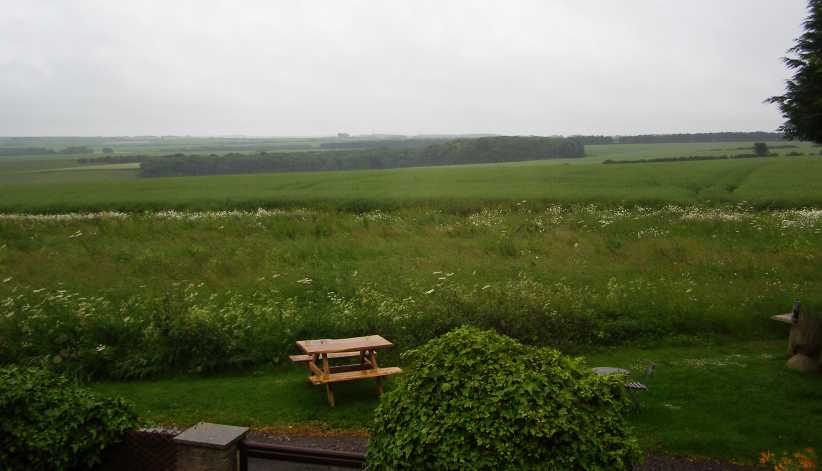
A wet morning. This one of the pics I sent off to Sandra’s grandchildren that morning. Looks dull, doesn’t it?
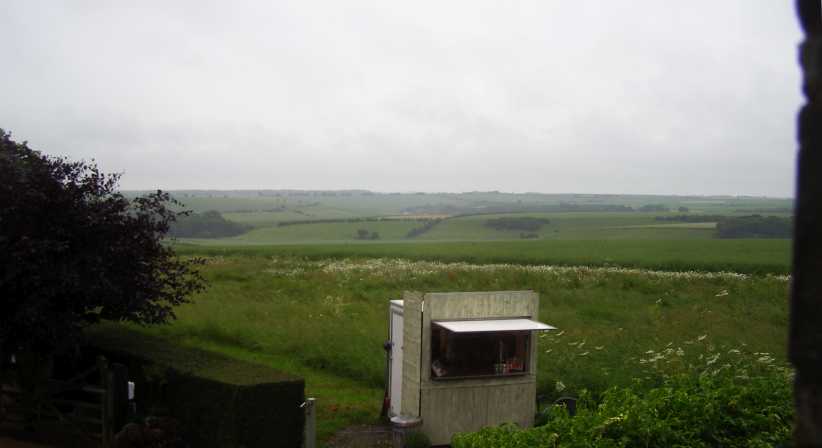
No better out this window. The rain was spoiling the good weather I’d enjoyed for a couple of days, but I’m told England is like that.
Before long, of course, I partook of the ‘& B’ part of ‘B & B’ and loaded the car for the next part of the trip. I set the GPS for and address in Duston where Glen and Carol were staying with Carol’s parents, Joe and Carol. Glen and Carol are the parents of my stepson, Ashley’s wife.
Again I marvelled at the way you put the postal code into the GPS and it takes you to the right address, here’s the morning’s trip:
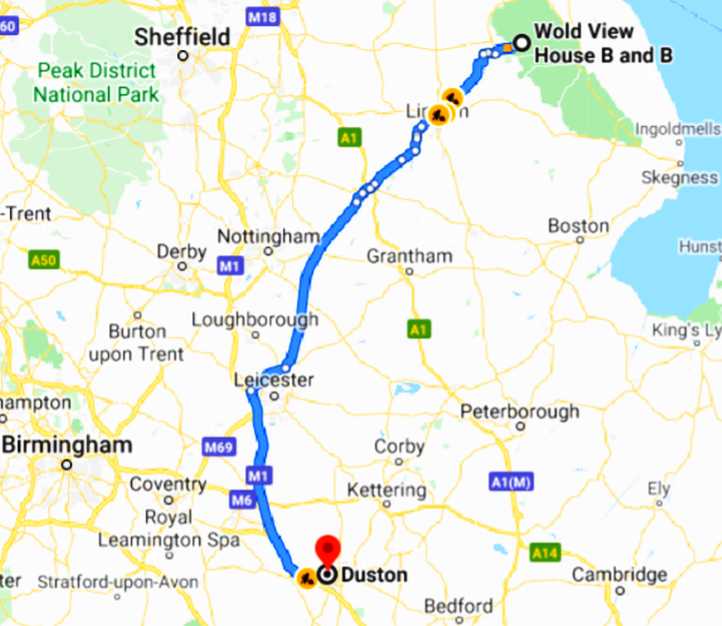
Properly fed, neatly dressed, keen to get on with the trip, I headed off. The first little town was Tealby, only a mile or two from the B & B and it looked typical of so many villages in England…
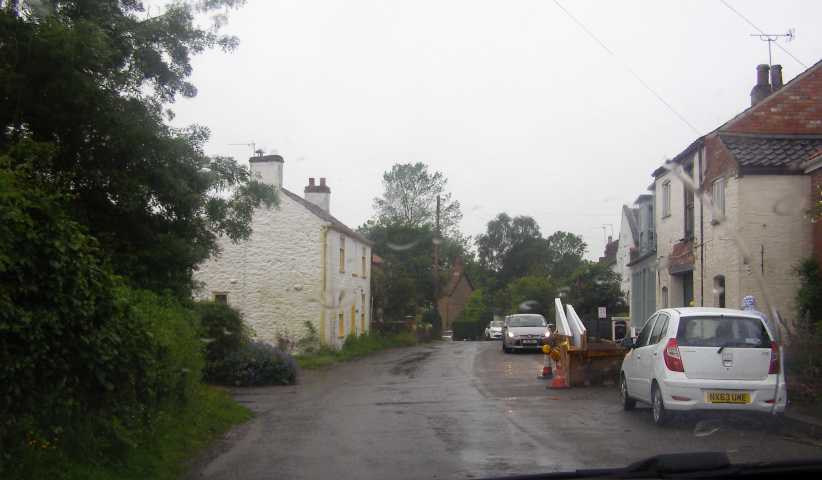
Wet and narrow roads. I would enjoy quite some distance without much room on the roads on this path, between these houses in Tealby was just a start.
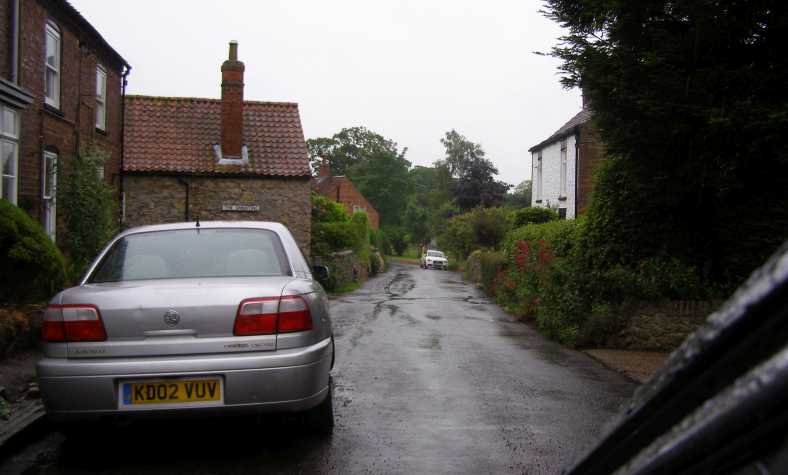
Even narrower. See what I mean? That sign on the wall is a street name for the street between these two houses. I wonder if I was getting homesick?
About fifty miles into the drive, which was about 90 miles all up, I reached the M1 motorway and it got all easy and familiar. Not quite so wet now, I closed up on a Series 3 Morris Oxford cruising along in the regular traffic. You can tell the Series 3 from the Series 2 by the little tail fins and the scallops it has in the bonnet (hood) and it’s the model the Indians copied and produced as the Hindustan Ambassador from 1958 to 2014. British production ceased when they were replaced by the Farina-style models, the Series 3 coming out late in 1956 and being superseded in 1959.
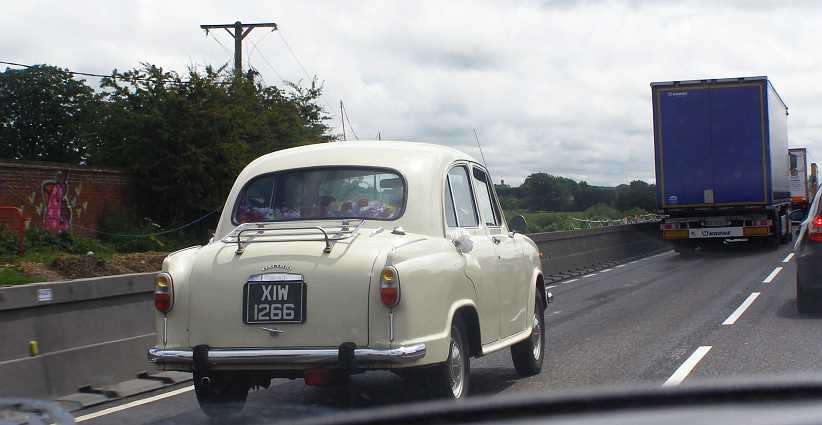
A rarity. A Morris Oxford Series 3, probably the only old car I saw on British roads all the time I was there.
One thing I really liked about these models (I owned the similar ‘55 model Series 2 once... actually, twice as I sold it to my brother in law then bought it back a while later) was that they had decent suspension. No lever-arm dampers, proper telescopic Girlings, so they coped better with rough roads.
I duly arrived at the street in which Joe and Carol live. It was an estate which was probably thrown together in the sixties or seventies, there was a lot of cars parked in the street in front of very plain brick single-story homes.
Squeezing into a parking spot I went to the door and was greeted by Glen. Poor Joe had deteriorated quite a lot in the fifteen years or so since I last saw him during a visit to Australia. I’d been on the road for a couple of hours so a cup of tea was most welcome along with a bit of cake. The two Carols were out shopping and we went for a bit of a walk up a pathway between the homes which led to a small park area which was pleasant.
Poor Joe was slipping in the memory department and showing real signs of going downhill, so we didn’t stay out very long, though we had a brief conversation with another person out walking their dog. At least it was a little sunny by now and when we got back to the house Carol and Carol were returning and another cuppa was dished out.
I had some British currency I wouldn’t need as I was heading for the ferry that night so I sold that to Glen for good old Aussie dollars, we had a discussion about what I should do to fill in the hours and miles between Duston and Dover and the suggestion was made that I go to the Cotswolds.
More setting of the GPS and here’s the resultant path I took to there and then on to the ferry:
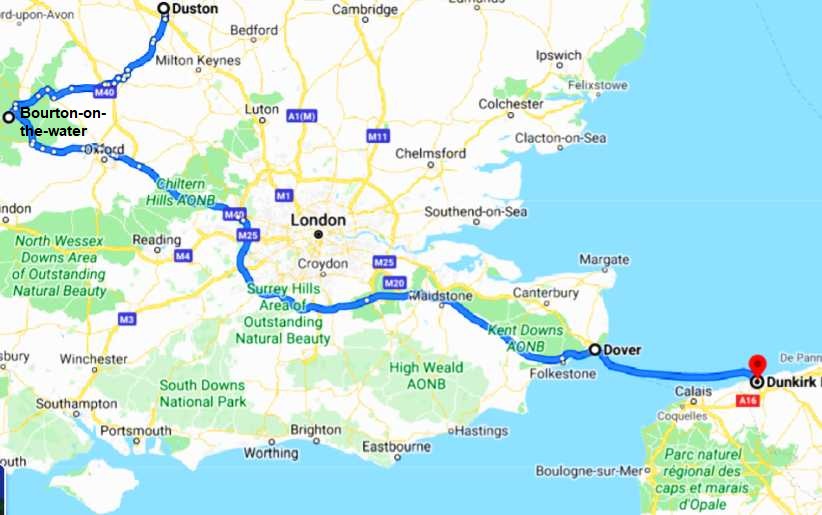
I drove on without much thought for much except to enjoy the view, to soak in the old world charm and to continue to wonder who it was who collected all the rocks. Sometimes things would jump out, like this wheely-bin in front of a house:
Wheely-bin. Things are slipping when this could become the subject of a photo on a trip like this!
A few years ago we had a bit of discussion about these on a forum I use, it was between ‘condor’ (whom I met the previous Sunday) and a Canadian who’d never heard of them. I’m guessing they’ve got them in Canada by now as that discussion was at least 15 years ago. And it was the flowers which led me to take this pic, something to show Sandra when I got home…
Houses and flowers. I did try to take pics of things Sandra would like to look at when I saw her again.
And there was the green of the early Summer in the English countryside, not to be ignored:
Dull countryside. Spoiled by the dullness of the day, the green was still unlike a lot of what we see in Australia.
Brighter countryside. With the sun shining in the distance, this looks a bit more appealing.
Still the roads were narrower than I’m used to, not much room to move on a lot of them. But smooth and well-marked, it was pleasant motoring even from the driver’s seat on the left side of the Peugeot.
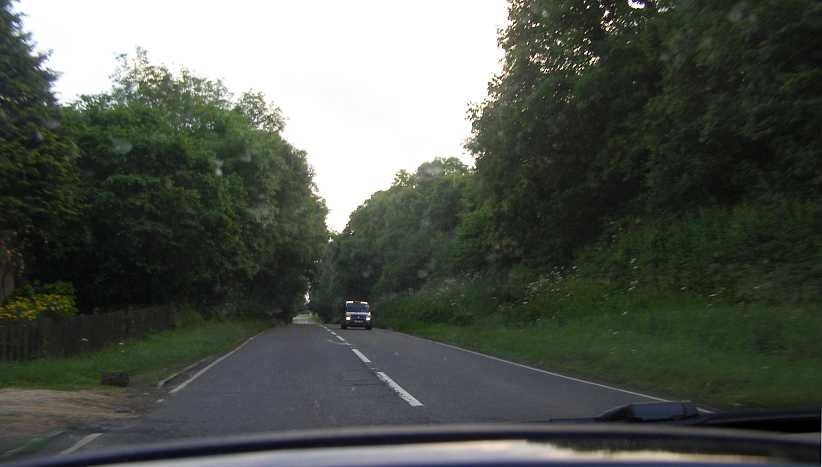
Country road and taxi. An oncoming taxi was probably and unusual sight out in the country like this.
And still the problem of the rock collection persisted. The fence here has plenty of them, while the house (or houses) certainly involved the collection of even more:
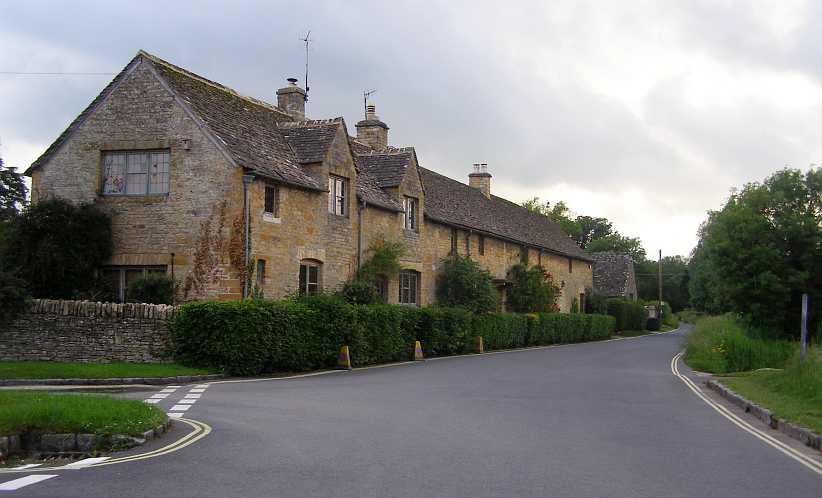
Big house. An imposing structure, no matter how many dwellings it encloses. Another typical English sight.
At one point I noted that I was looking over a village tucked into a little dip between some nice green hills…
A village in the country. A pleasant sight, no doubt better if the sun was shining, this village was well-treed and surrounded by farmlands.
My meanderings, following the GPS, took me through a village…
Village street. Another village, another stone fence, but so neat and clean.
And I reached Bourton-on-the-water. The ‘water’ is the River Windrush and its neatly stone-walled edging borders some parkland with pleasant shade trees. Apparently it’s famous for the ducks which swim in the waters of the Windrush and, I’d say, come out onto dry land to pester park visitors for food.
The River Windrush. This is a pleasant sight, the calm waters, the people in the park, the old-style homes and nice shade trees.
Now I seemed to be in a place where there was some kind of party, the flags flying on strings across the river and a few people out enjoying the afternoon’s weak sunshine. Once again I’m reminded of the words from Dorothea Mackellar, “Brown streams and soft, dim skies, I know but cannot share it, my love is otherwise.”
I was wondering about just how few people were present, but I was forgetting it was now Monday. Over the weekend there had been a village garage sale, but there was none of that here, but the flags probably give a clue. Brexit! The flags represented a desire to come out of the European Union.
Another stone bridge. A few people were out enjoying the afternoon, while the ducks were doing their thing too.
And a closer look at the ducks:
Ducks and drakes. While just one of their number was out for a swim, see the previous pic, these were out looking for booty at the feet of people in the park.
Now it was time to move along. The now-familiar green scenery rolled by. My path was to take me past Oxford and the Chiltern Hills, then South of London yet again:
Green country. Crops growing under grey skies, windbreaks and small stands of trees, it was all there to see.
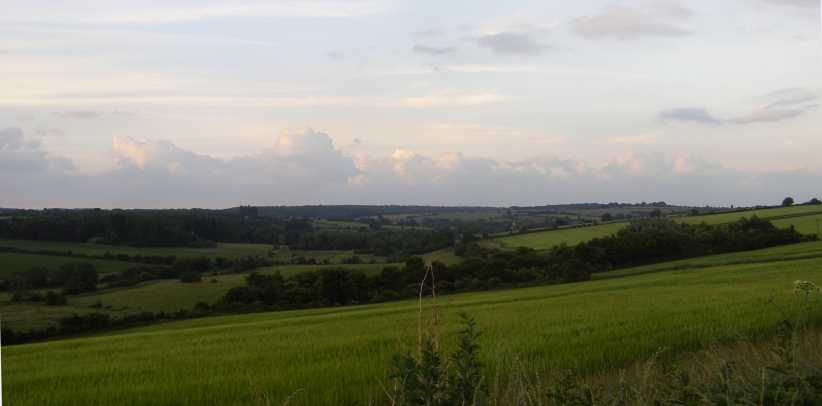
Hills and dales. The hills add to the setting, more crops and more trees spread to the horizon.
Naturally enough, the day was running its course, the grey of the skys was hastening the declining light and there would be, as always a sunset. I still had some distance to go, of course, but I had time to finish that drive in the dark.
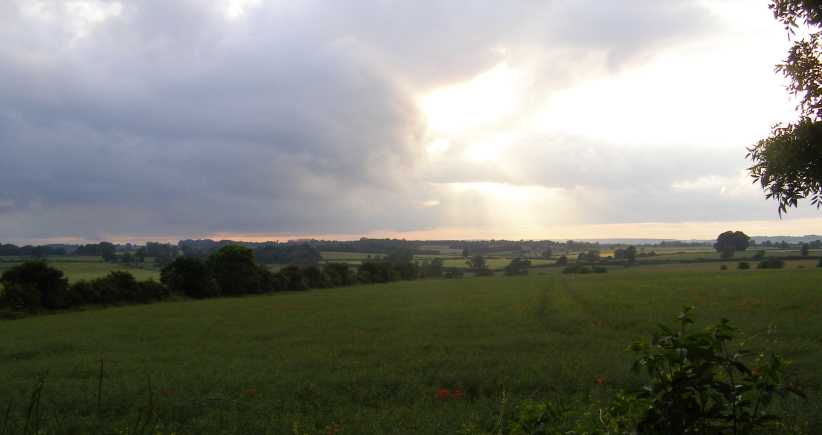
Darkening sky. Just the tiniest bit of this scene is getting sunlight as the clouds and the day close in on this fertile and ancient land where Lords once had serfs to do all the work.
Yes, this country used to work on a system where the ‘landed gentry’ had families doing all the work for them, living out their lives in a condition of being ‘owned’ by the Lord of the Manor and working from dawn to dusk to produce for him. How they would be amazed at today’s system of freedoms and paid work, not to mention modern farming machinery such as the one which left that track across the picture!
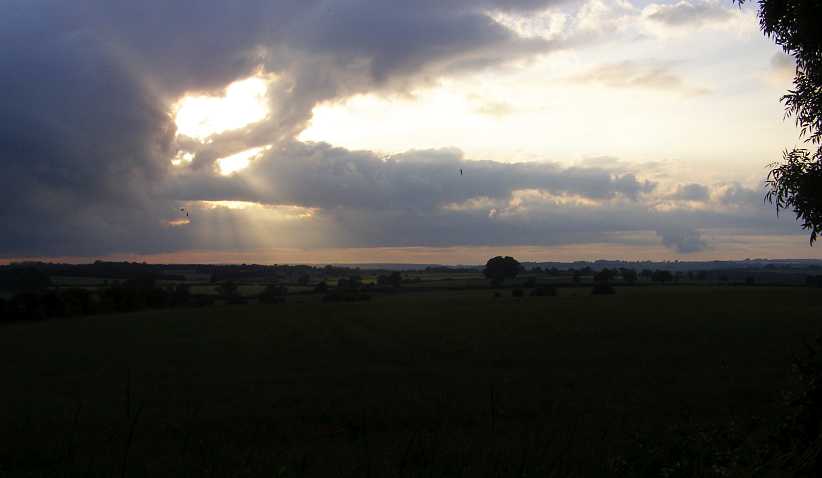
Sun’s display. The clouds broke at times to let the lowering sun come through in patches, shining in this case on a patch beyond a crest, but still showing the beams which bring light, warmth and energy to the world.
The drive from Duston to Bourton-on-the-water had only been a little over fifty miles or eighty kilometres, now there was a drive of about 177 miles (285kms) to the ferry terminal. I wasn’t due there until quite late once again and soon I was back onto motorway to make it quicker and easier…
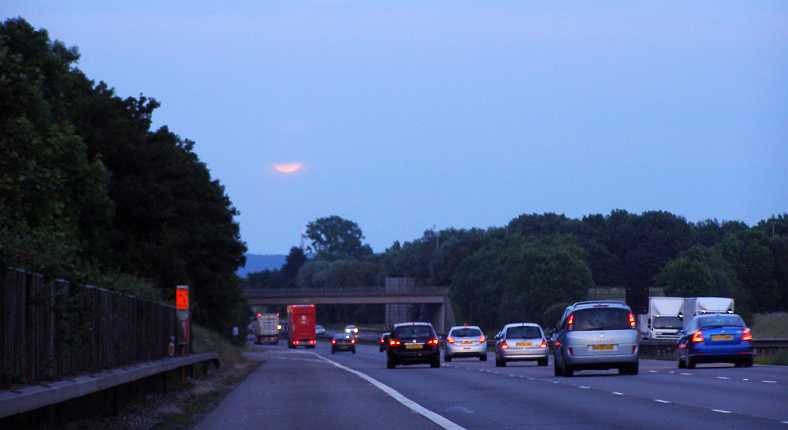
Back on the motorway. Monday evening traffic heading around London, the moon in the sky showing that the clouds were now clearing up.
I stopped and got something to eat as the skies darkened to night and duly arrived at the ferry terminal in time to line up. I had time in hand, but others had still got there ahead of me but it didn’t matter. I had all night, after all.
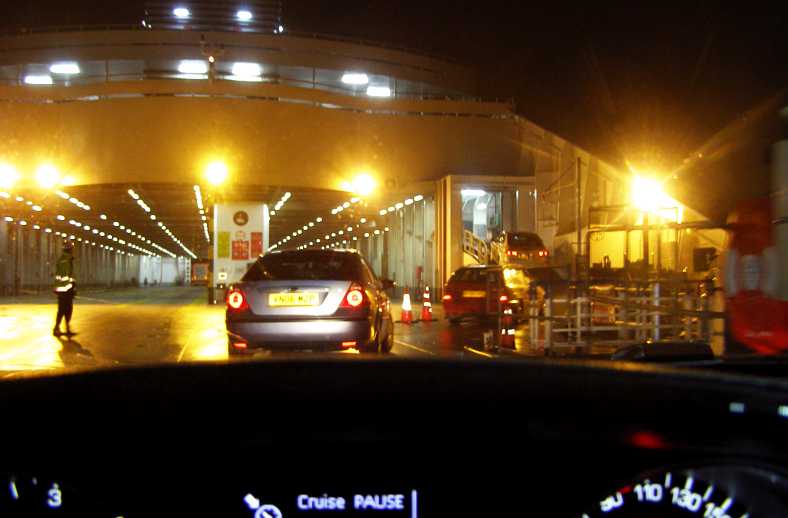
On to the ferry. we were ushered up the ramp and then to leave the huge truck deck to the trucks and sent up another ramp.
The ferries load and unload like this all day, so efficiency is at a high level and it doesn’t take them long to fill the respective decks. At this hour, however, there aren’t as many travelling, one of the reasons I chose to make my ‘sea journeys’ late at night.
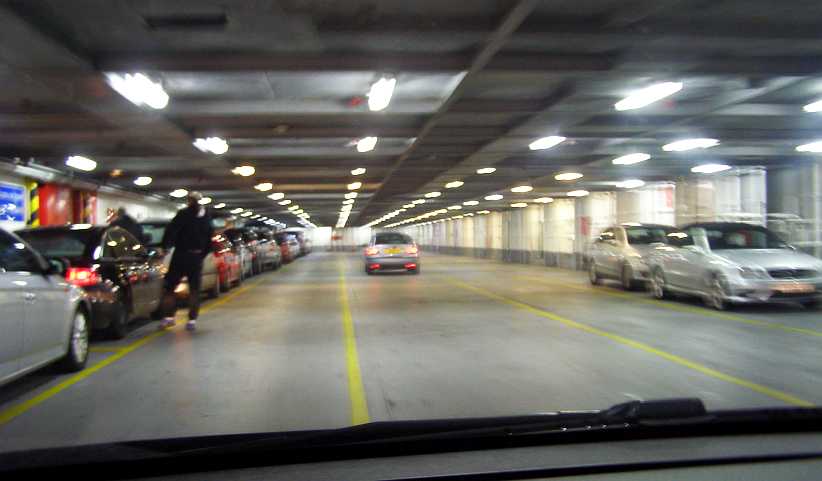
Orderly on the deck. Clear directions from the crew had us all filling the deck in an orderly manner, after which we went up to the passenger lounges.
What I did miss out on was seeing the White Cliffs of Dover. Had there been a brighter moon perhaps I would have done, but the moon was far from bright. The journey across took me to Dunkirk in just a couple of hours, then I was ready for my last two full days in Europe.
How much more could I achieve there?
Almost the last of the European part of my 3-month ‘adventure’ too. I was booked onto the ferry to Dunkirk late in the evening so I had a lot of day to do whatever I wanted to do. But a keen desire to not be late for the ferry.
Awakening at the B & B I found that the nice weather of the past two days had been replaced overnight with some light rain. I was in e.mail contact with people at home and took some photos out the windows of the B & B and sent them off to them:
A wet morning. This one of the pics I sent off to Sandra’s grandchildren that morning. Looks dull, doesn’t it?
No better out this window. The rain was spoiling the good weather I’d enjoyed for a couple of days, but I’m told England is like that.
Before long, of course, I partook of the ‘& B’ part of ‘B & B’ and loaded the car for the next part of the trip. I set the GPS for and address in Duston where Glen and Carol were staying with Carol’s parents, Joe and Carol. Glen and Carol are the parents of my stepson, Ashley’s wife.
Again I marvelled at the way you put the postal code into the GPS and it takes you to the right address, here’s the morning’s trip:
Properly fed, neatly dressed, keen to get on with the trip, I headed off. The first little town was Tealby, only a mile or two from the B & B and it looked typical of so many villages in England…
Wet and narrow roads. I would enjoy quite some distance without much room on the roads on this path, between these houses in Tealby was just a start.
Even narrower. See what I mean? That sign on the wall is a street name for the street between these two houses. I wonder if I was getting homesick?
About fifty miles into the drive, which was about 90 miles all up, I reached the M1 motorway and it got all easy and familiar. Not quite so wet now, I closed up on a Series 3 Morris Oxford cruising along in the regular traffic. You can tell the Series 3 from the Series 2 by the little tail fins and the scallops it has in the bonnet (hood) and it’s the model the Indians copied and produced as the Hindustan Ambassador from 1958 to 2014. British production ceased when they were replaced by the Farina-style models, the Series 3 coming out late in 1956 and being superseded in 1959.
A rarity. A Morris Oxford Series 3, probably the only old car I saw on British roads all the time I was there.
One thing I really liked about these models (I owned the similar ‘55 model Series 2 once... actually, twice as I sold it to my brother in law then bought it back a while later) was that they had decent suspension. No lever-arm dampers, proper telescopic Girlings, so they coped better with rough roads.
I duly arrived at the street in which Joe and Carol live. It was an estate which was probably thrown together in the sixties or seventies, there was a lot of cars parked in the street in front of very plain brick single-story homes.
Squeezing into a parking spot I went to the door and was greeted by Glen. Poor Joe had deteriorated quite a lot in the fifteen years or so since I last saw him during a visit to Australia. I’d been on the road for a couple of hours so a cup of tea was most welcome along with a bit of cake. The two Carols were out shopping and we went for a bit of a walk up a pathway between the homes which led to a small park area which was pleasant.
Poor Joe was slipping in the memory department and showing real signs of going downhill, so we didn’t stay out very long, though we had a brief conversation with another person out walking their dog. At least it was a little sunny by now and when we got back to the house Carol and Carol were returning and another cuppa was dished out.
I had some British currency I wouldn’t need as I was heading for the ferry that night so I sold that to Glen for good old Aussie dollars, we had a discussion about what I should do to fill in the hours and miles between Duston and Dover and the suggestion was made that I go to the Cotswolds.
More setting of the GPS and here’s the resultant path I took to there and then on to the ferry:
I drove on without much thought for much except to enjoy the view, to soak in the old world charm and to continue to wonder who it was who collected all the rocks. Sometimes things would jump out, like this wheely-bin in front of a house:
Wheely-bin. Things are slipping when this could become the subject of a photo on a trip like this!
A few years ago we had a bit of discussion about these on a forum I use, it was between ‘condor’ (whom I met the previous Sunday) and a Canadian who’d never heard of them. I’m guessing they’ve got them in Canada by now as that discussion was at least 15 years ago. And it was the flowers which led me to take this pic, something to show Sandra when I got home…
Houses and flowers. I did try to take pics of things Sandra would like to look at when I saw her again.
And there was the green of the early Summer in the English countryside, not to be ignored:
Dull countryside. Spoiled by the dullness of the day, the green was still unlike a lot of what we see in Australia.
Brighter countryside. With the sun shining in the distance, this looks a bit more appealing.
Still the roads were narrower than I’m used to, not much room to move on a lot of them. But smooth and well-marked, it was pleasant motoring even from the driver’s seat on the left side of the Peugeot.
Country road and taxi. An oncoming taxi was probably and unusual sight out in the country like this.
And still the problem of the rock collection persisted. The fence here has plenty of them, while the house (or houses) certainly involved the collection of even more:
Big house. An imposing structure, no matter how many dwellings it encloses. Another typical English sight.
At one point I noted that I was looking over a village tucked into a little dip between some nice green hills…
A village in the country. A pleasant sight, no doubt better if the sun was shining, this village was well-treed and surrounded by farmlands.
My meanderings, following the GPS, took me through a village…
Village street. Another village, another stone fence, but so neat and clean.
And I reached Bourton-on-the-water. The ‘water’ is the River Windrush and its neatly stone-walled edging borders some parkland with pleasant shade trees. Apparently it’s famous for the ducks which swim in the waters of the Windrush and, I’d say, come out onto dry land to pester park visitors for food.
The River Windrush. This is a pleasant sight, the calm waters, the people in the park, the old-style homes and nice shade trees.
Now I seemed to be in a place where there was some kind of party, the flags flying on strings across the river and a few people out enjoying the afternoon’s weak sunshine. Once again I’m reminded of the words from Dorothea Mackellar, “Brown streams and soft, dim skies, I know but cannot share it, my love is otherwise.”
I was wondering about just how few people were present, but I was forgetting it was now Monday. Over the weekend there had been a village garage sale, but there was none of that here, but the flags probably give a clue. Brexit! The flags represented a desire to come out of the European Union.
Another stone bridge. A few people were out enjoying the afternoon, while the ducks were doing their thing too.
And a closer look at the ducks:
Ducks and drakes. While just one of their number was out for a swim, see the previous pic, these were out looking for booty at the feet of people in the park.
Now it was time to move along. The now-familiar green scenery rolled by. My path was to take me past Oxford and the Chiltern Hills, then South of London yet again:
Green country. Crops growing under grey skies, windbreaks and small stands of trees, it was all there to see.
Hills and dales. The hills add to the setting, more crops and more trees spread to the horizon.
Naturally enough, the day was running its course, the grey of the skys was hastening the declining light and there would be, as always a sunset. I still had some distance to go, of course, but I had time to finish that drive in the dark.
Darkening sky. Just the tiniest bit of this scene is getting sunlight as the clouds and the day close in on this fertile and ancient land where Lords once had serfs to do all the work.
Yes, this country used to work on a system where the ‘landed gentry’ had families doing all the work for them, living out their lives in a condition of being ‘owned’ by the Lord of the Manor and working from dawn to dusk to produce for him. How they would be amazed at today’s system of freedoms and paid work, not to mention modern farming machinery such as the one which left that track across the picture!
Sun’s display. The clouds broke at times to let the lowering sun come through in patches, shining in this case on a patch beyond a crest, but still showing the beams which bring light, warmth and energy to the world.
The drive from Duston to Bourton-on-the-water had only been a little over fifty miles or eighty kilometres, now there was a drive of about 177 miles (285kms) to the ferry terminal. I wasn’t due there until quite late once again and soon I was back onto motorway to make it quicker and easier…
Back on the motorway. Monday evening traffic heading around London, the moon in the sky showing that the clouds were now clearing up.
I stopped and got something to eat as the skies darkened to night and duly arrived at the ferry terminal in time to line up. I had time in hand, but others had still got there ahead of me but it didn’t matter. I had all night, after all.
On to the ferry. we were ushered up the ramp and then to leave the huge truck deck to the trucks and sent up another ramp.
The ferries load and unload like this all day, so efficiency is at a high level and it doesn’t take them long to fill the respective decks. At this hour, however, there aren’t as many travelling, one of the reasons I chose to make my ‘sea journeys’ late at night.
Orderly on the deck. Clear directions from the crew had us all filling the deck in an orderly manner, after which we went up to the passenger lounges.
What I did miss out on was seeing the White Cliffs of Dover. Had there been a brighter moon perhaps I would have done, but the moon was far from bright. The journey across took me to Dunkirk in just a couple of hours, then I was ready for my last two full days in Europe.
How much more could I achieve there?
Last edited by Ray Bell; Jun 27, 2020 at 08:33 AM.
Thread Starter
|
Captain
Joined: Oct 2005
Posts: 570
Likes: 8
From: The Summit, Queensland, Australia
After the ferry ride to Dunkirk, the next step was to find somewhere to park and sleep for a while. As I did so there was some rain falling again, so the roads were wet as I set off towards Rouen. I soon knew I was in France as the French cars became more commonplace.
Cars which sometimes had unpronounceable names…
Citroen Xsara. How should it be pronounced, I ask?
Mind you, the model name is okay, even it it doesn’t paint a picture:
Picasso. But would Pablo roll in his grave if he knew his name is used this way?
And so the trip for the morning was laid out before me:
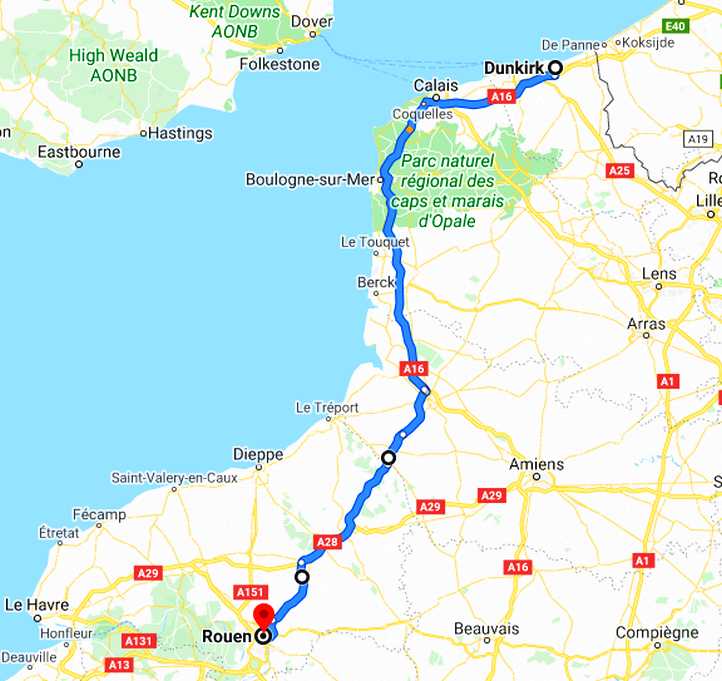
Not a difficult drive at all, a major transport route in fact. Autoroute all the way. I snapped a couple of pics along the Autoroute:
Wildlife bridge. A wildlife bridge to enable animals to travel risk-free in a forest between Bouillancourt-en-Serv and Fontain, South of Calais.
Descending towards Rouen. The French countryside, as green as England’s, spreads out beneath clouds shared by the two countries.
On reaching Rouen I found it has plenty of topographical challenges. It’s downstream from Paris on the Seine and the river has carved the country here so there are many areas with steep hills.
Steep. The extremes of Rouen’s hills haven’t daunted the builders, who have created homes to suit and retaining walls to cope.
Driving into the town I wandered around trying to find somewhere to get a map to enable me to find the Rouen L’Essarts circuit of the fifties and sixties. In the course of my wandering about I learned that some of the streets aren’t very wide…
Narrow streets. The children still play, though the streets are narrow and the houses old.
…and the buildings are usually centuries old. Ultimately I parked in a spot alongside the river to get my bearings as I looked for the tourist office. The GPS wasn’t leading me to it…
Along the Seine. Google Earth provides this view of the area where I parked.
…and I was forced to walk a long way. Asking for directions as I went, of course, and generally not finding the place easy to locate. If only I had asked for the cathedral, which is both famous and located directly across from it:
Tourist office. Across the square from the cathedral, the tourist office was located in the grand old building beyond the pharmacy.
Its position assisted Claude Monet, apparently, as he took a room in the building and used it as his studio as he painted eleven works featuring the cathedral.
But my keen desire was to get a map that showed where the circuit was. And it took a while to get that through to the young man at the counter who seemingly didn’t know that motor racing had ever taken place nearby. Ultimately, though, I found it on one of their maps, that is I found the roads which formed the familiar shape of the lower end of the circuit, and walked back to the car.
I got something to eat as it was by now time to do that and then struggled for a while to find the right roads to get to the circuit. And along the way I got a nice surprise.
Recall that I didn’t see the White Cliffs of Dover? Well here, because I’d not found the short way to get there, I did find some white cliffs:
White cliffs. Here by the banks of the Seine were white cliffs, the area bearing the name ‘des Roches.’
For several kilometres they were there alongside the road, with homes built in their shadow. This area is about 185kms due South of Dover and I wonder if there’s some relationship between these cliffs and those famous ones in England.
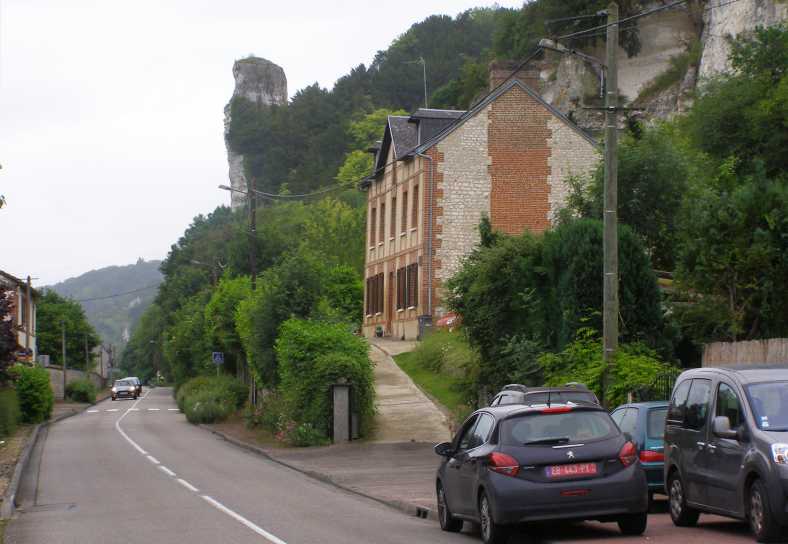
Standing out. One cylindrical form of the rock stood out from the walls, looking a little perilous.
It wasn’t far from there to the roads I was looking to find. The first confirmation I had that I was in the right place was a bus stop!
Bus stop. After finding that nobody knew anything about the circuit, here was evidence that somebody does.
So I set off to do a lap. I realised that a section had been cut off by a freeway and other roadworks, but the main parts were still driveable. But with bollards in place for some reason.
Down the hill. The first section after the start, which was at or near the bus stop, runs downhill through some very fast and tricky bends.
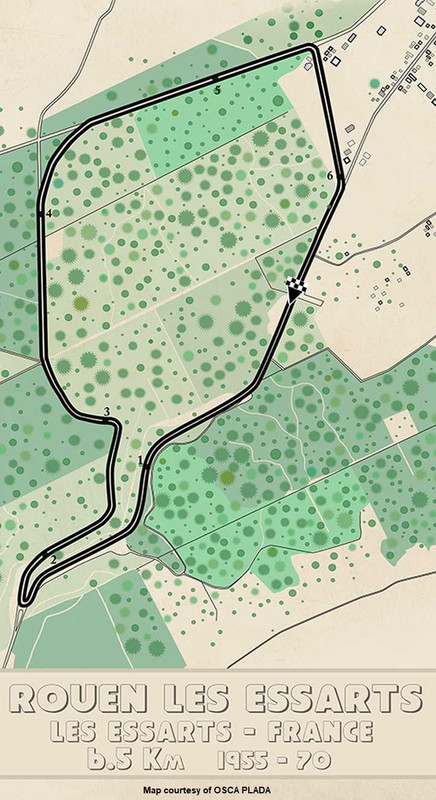
Circuit map. Oscar Plada’s map of the circuit, with kilometres marked on it and the start/finish shown by a small arrow and chequered square.
Some really heroic driving through this section was seen through the decades the circuit was in use, but the most memorable to many, beautifully caught in photos, was Juan Manuel Fangio’s effort in the 1957 French Grand Prix in a Maserati 250F. There have been bad days here too, Jo Schlesser losing his life in a fiery crash in an experimental air-cooled Honda in the 1968 Grand Prix.
Fast curves. Fast and downhill, a combination requiring judgement and skill.
Right and left. The downhill rush continues…
Last one. …to culminate in this left hander before the braking area for the hairpin.
Noveau Monde. The famous hairpin which every photographer seem to love.
Cobblestones. The hairpin was cobblestones, which was a rarety in Grand Prix racing in the sixties.
So that was the stretch down the hill. It was a main road, hence the width, while the road back up the other side was a lesser road and not so wide.
Hairpin exit. The start of the climb, with the encroaching trees – which weren’t so pronounced in the day – giving a different atmosphere.
Sweeping uphill. This easy sweep to the right led to…
Right kink. …a gentle kink then a run to the first left-hander.
Esses. Slight banking of the bends was helpful, this is the bend halfway between the 2km and 3km marks on the map.
Easy right. After the tight left and right, this right isn’t flat out.
Tight bends. Then there’s this tight left ahead, which gives one the impression it’s a part of a hillclimb rather than a circuit.
Climbing exit. This is at the 3km mark, with the next right well in view.
End of climb in sight. Or is it? At least the road is straightening out a bit, but still climbing.
Accelerating hard. This short straight leads to the bend which is followed by the crossroad in the map.
Signs ahead. Those signs relate to the crossroad. Not important from 1955, but before that it was time to take the road to the right.
Top of the hill. At last the climb is over and it’s a fast straight for some distance.
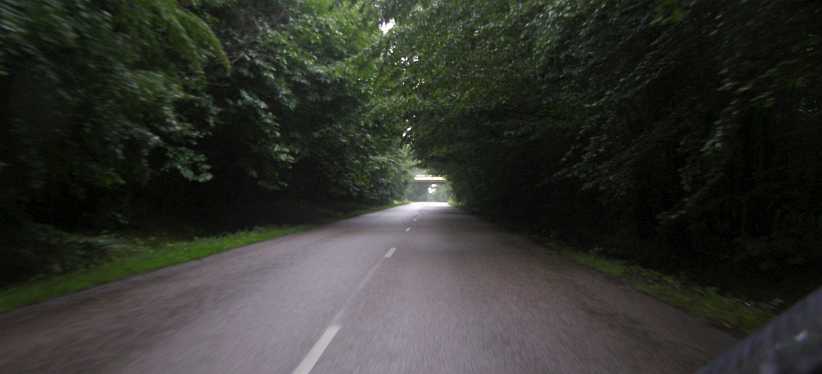
Freeway bridge.That overbridge is just before the 4km mark on the map, there was no point going further as too much has changed.
So I went as far as I could tracing out the circuit of the races I’d taken an interest in. But there were two variations because of the new roads and freeways. So we’ll go back to that crossroad:
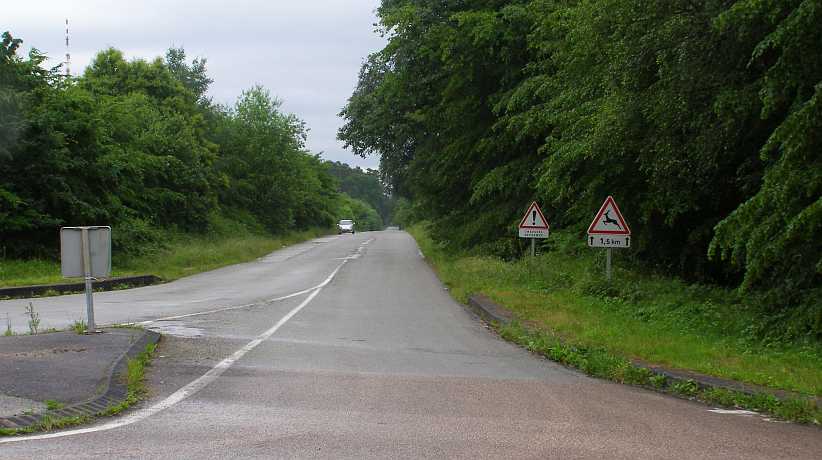
Turn onto old straight. Prior to 1955 this had been the link back to the starting area, giving a shorter circuit of 5.1kms. You can see here that this straight has a couple of rises and falls in it.
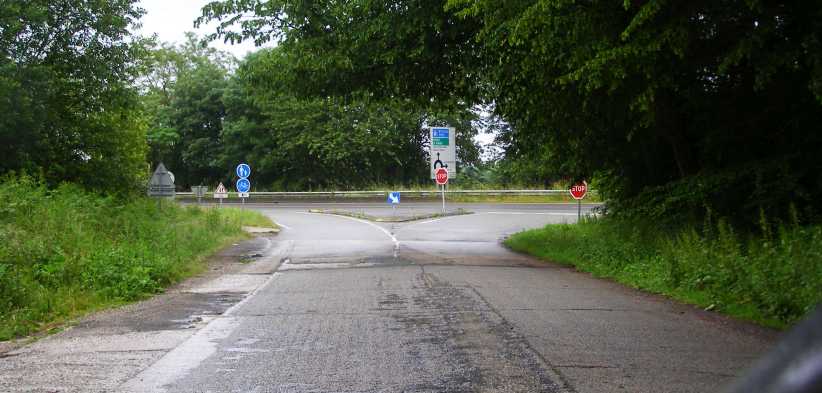
T-junction. This, then, was the final turn in that original circuit, which was used for the 1952 French Grand Prix.
I was a bit amused because a bunch of young blokes were mucking around along this last straight. I don’t know what they were doing, but they stopped when I came on the scene. I stopped and took a photo of one of their vehicles, which had me a bit entranced:
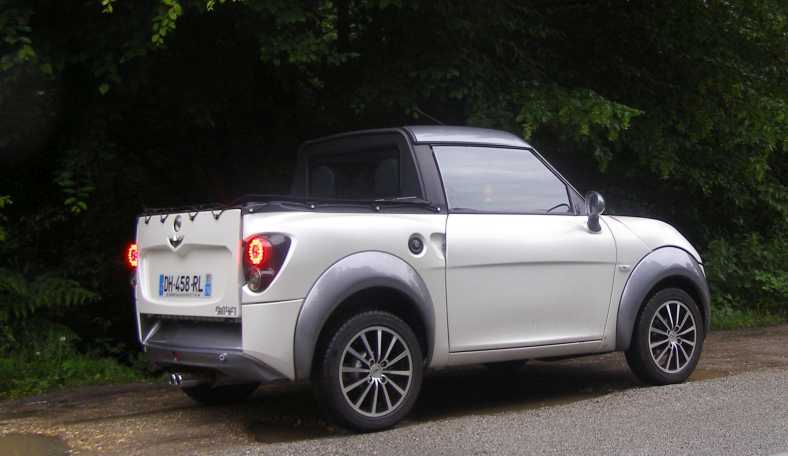
Chatenet. Readers might recall that we saw a car of this make back in Italy when we went on our little exploration drive from Avezzano. Engines of less than 600cc give them tax advantages, but could it carry anything worthwhile in the cargo area?
The day was getting on by this time and I had to work out what I’d do next. I had a bit of spare time I hadn’t yet budgeted for anything, the logical thing for me to do was work out what other open-road French racing circuit was somewhere I could reach and still get close to Paris by the end of the next day.
It was now Tuesday, I had Wednesday to do this, but I was also aware that I had to clean up the car before I headed for the airport on Thursday morning.
Settling down with the internet, I looked at the options and decided I’d go to Amiens. This was a circuit of 30kms used only once prior to World War 1 and so I headed generally in that direction and found somewhere to eat and somewhere to park safely for the night to go to sleep in the car.
I also started making phone calls relevant to my return to Canada, letting people there know when I’d be flying in and making arrangements with them.
I’d been in touch with Virgin, or actually Flight Centres (through whom I booked) repeatedly since Sandra went home trying to get them to let me use her luggage allowance as there was no refund on her tickets. I now had to also make sure I didn’t have too much to take with me as there’d been no help in that quarter.
Nevertheless, with just one full day to go in Europe I was still enjoying myself…
And for those who'd like to take a full lap, including the bits I couldn't show, here's Graham Hill, in the year he won his first World Championship, taking the onboard camera for a full lap:
Cars which sometimes had unpronounceable names…
Citroen Xsara. How should it be pronounced, I ask?
Mind you, the model name is okay, even it it doesn’t paint a picture:
Picasso. But would Pablo roll in his grave if he knew his name is used this way?
And so the trip for the morning was laid out before me:
Not a difficult drive at all, a major transport route in fact. Autoroute all the way. I snapped a couple of pics along the Autoroute:
Wildlife bridge. A wildlife bridge to enable animals to travel risk-free in a forest between Bouillancourt-en-Serv and Fontain, South of Calais.
Descending towards Rouen. The French countryside, as green as England’s, spreads out beneath clouds shared by the two countries.
On reaching Rouen I found it has plenty of topographical challenges. It’s downstream from Paris on the Seine and the river has carved the country here so there are many areas with steep hills.
Steep. The extremes of Rouen’s hills haven’t daunted the builders, who have created homes to suit and retaining walls to cope.
Driving into the town I wandered around trying to find somewhere to get a map to enable me to find the Rouen L’Essarts circuit of the fifties and sixties. In the course of my wandering about I learned that some of the streets aren’t very wide…
Narrow streets. The children still play, though the streets are narrow and the houses old.
…and the buildings are usually centuries old. Ultimately I parked in a spot alongside the river to get my bearings as I looked for the tourist office. The GPS wasn’t leading me to it…
Along the Seine. Google Earth provides this view of the area where I parked.
…and I was forced to walk a long way. Asking for directions as I went, of course, and generally not finding the place easy to locate. If only I had asked for the cathedral, which is both famous and located directly across from it:
Tourist office. Across the square from the cathedral, the tourist office was located in the grand old building beyond the pharmacy.
Its position assisted Claude Monet, apparently, as he took a room in the building and used it as his studio as he painted eleven works featuring the cathedral.
But my keen desire was to get a map that showed where the circuit was. And it took a while to get that through to the young man at the counter who seemingly didn’t know that motor racing had ever taken place nearby. Ultimately, though, I found it on one of their maps, that is I found the roads which formed the familiar shape of the lower end of the circuit, and walked back to the car.
I got something to eat as it was by now time to do that and then struggled for a while to find the right roads to get to the circuit. And along the way I got a nice surprise.
Recall that I didn’t see the White Cliffs of Dover? Well here, because I’d not found the short way to get there, I did find some white cliffs:
White cliffs. Here by the banks of the Seine were white cliffs, the area bearing the name ‘des Roches.’
For several kilometres they were there alongside the road, with homes built in their shadow. This area is about 185kms due South of Dover and I wonder if there’s some relationship between these cliffs and those famous ones in England.
Standing out. One cylindrical form of the rock stood out from the walls, looking a little perilous.
It wasn’t far from there to the roads I was looking to find. The first confirmation I had that I was in the right place was a bus stop!
Bus stop. After finding that nobody knew anything about the circuit, here was evidence that somebody does.
So I set off to do a lap. I realised that a section had been cut off by a freeway and other roadworks, but the main parts were still driveable. But with bollards in place for some reason.
Down the hill. The first section after the start, which was at or near the bus stop, runs downhill through some very fast and tricky bends.
Circuit map. Oscar Plada’s map of the circuit, with kilometres marked on it and the start/finish shown by a small arrow and chequered square.
Some really heroic driving through this section was seen through the decades the circuit was in use, but the most memorable to many, beautifully caught in photos, was Juan Manuel Fangio’s effort in the 1957 French Grand Prix in a Maserati 250F. There have been bad days here too, Jo Schlesser losing his life in a fiery crash in an experimental air-cooled Honda in the 1968 Grand Prix.
Fast curves. Fast and downhill, a combination requiring judgement and skill.
Right and left. The downhill rush continues…
Last one. …to culminate in this left hander before the braking area for the hairpin.
Noveau Monde. The famous hairpin which every photographer seem to love.
Cobblestones. The hairpin was cobblestones, which was a rarety in Grand Prix racing in the sixties.
So that was the stretch down the hill. It was a main road, hence the width, while the road back up the other side was a lesser road and not so wide.
Hairpin exit. The start of the climb, with the encroaching trees – which weren’t so pronounced in the day – giving a different atmosphere.
Sweeping uphill. This easy sweep to the right led to…
Right kink. …a gentle kink then a run to the first left-hander.
Esses. Slight banking of the bends was helpful, this is the bend halfway between the 2km and 3km marks on the map.
Easy right. After the tight left and right, this right isn’t flat out.
Tight bends. Then there’s this tight left ahead, which gives one the impression it’s a part of a hillclimb rather than a circuit.
Climbing exit. This is at the 3km mark, with the next right well in view.
End of climb in sight. Or is it? At least the road is straightening out a bit, but still climbing.
Accelerating hard. This short straight leads to the bend which is followed by the crossroad in the map.
Signs ahead. Those signs relate to the crossroad. Not important from 1955, but before that it was time to take the road to the right.
Top of the hill. At last the climb is over and it’s a fast straight for some distance.
Freeway bridge.That overbridge is just before the 4km mark on the map, there was no point going further as too much has changed.
So I went as far as I could tracing out the circuit of the races I’d taken an interest in. But there were two variations because of the new roads and freeways. So we’ll go back to that crossroad:
Turn onto old straight. Prior to 1955 this had been the link back to the starting area, giving a shorter circuit of 5.1kms. You can see here that this straight has a couple of rises and falls in it.
T-junction. This, then, was the final turn in that original circuit, which was used for the 1952 French Grand Prix.
I was a bit amused because a bunch of young blokes were mucking around along this last straight. I don’t know what they were doing, but they stopped when I came on the scene. I stopped and took a photo of one of their vehicles, which had me a bit entranced:
Chatenet. Readers might recall that we saw a car of this make back in Italy when we went on our little exploration drive from Avezzano. Engines of less than 600cc give them tax advantages, but could it carry anything worthwhile in the cargo area?
The day was getting on by this time and I had to work out what I’d do next. I had a bit of spare time I hadn’t yet budgeted for anything, the logical thing for me to do was work out what other open-road French racing circuit was somewhere I could reach and still get close to Paris by the end of the next day.
It was now Tuesday, I had Wednesday to do this, but I was also aware that I had to clean up the car before I headed for the airport on Thursday morning.
Settling down with the internet, I looked at the options and decided I’d go to Amiens. This was a circuit of 30kms used only once prior to World War 1 and so I headed generally in that direction and found somewhere to eat and somewhere to park safely for the night to go to sleep in the car.
I also started making phone calls relevant to my return to Canada, letting people there know when I’d be flying in and making arrangements with them.
I’d been in touch with Virgin, or actually Flight Centres (through whom I booked) repeatedly since Sandra went home trying to get them to let me use her luggage allowance as there was no refund on her tickets. I now had to also make sure I didn’t have too much to take with me as there’d been no help in that quarter.
Nevertheless, with just one full day to go in Europe I was still enjoying myself…
And for those who'd like to take a full lap, including the bits I couldn't show, here's Graham Hill, in the year he won his first World Championship, taking the onboard camera for a full lap:
Last edited by Ray Bell; Jun 30, 2020 at 07:17 PM.
Thread Starter
|
Captain
Joined: Oct 2005
Posts: 570
Likes: 8
From: The Summit, Queensland, Australia
I awoke to a quiet morning in Northern France. I knew full well what I had to do this day and I started driving towards Amiens. The job list included cleaning out the surplus bits and pieces out of the car, food leftovers, wrappings, unwanted local maps and so on, and towards the end of the day getting the car washed.
But seeing another circuit was to give the day direction and I got some breakfast and headed along some secondary roads following the GPS with ‘no tolls’ selected. I got on the road early, as can be seen from the pics. This is the path I took:
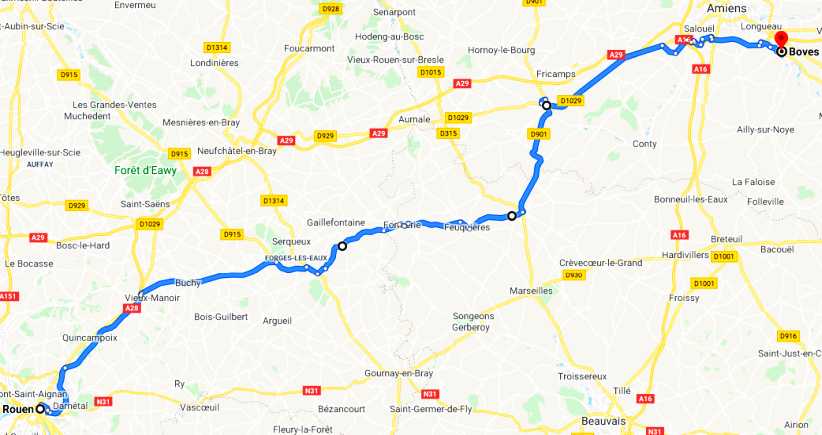
Mostly the countryside was open with villages and crops. Through Grandvillers was fog-free and shortly after that I stopped to throw out some rubbish in a roadside bin. I thought the bountiful crop on the side of the road was worthy of a photo, as was the background:
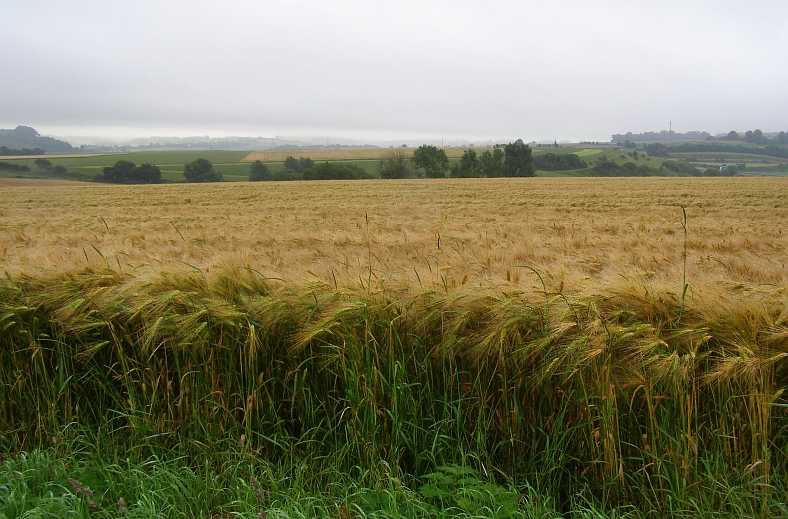
Crops growing well. I feel sure this is barley and it provides a nice foreground for a photo of the gently rolling slopes with more barley and some other crops in the background.
And there was more nature to see, too, though given that I was in France you could just about suggest that this fellow was leading a dangerous life…
Snail in danger. The bin which had lured me to pull up had this surprise for me. No, I didn’t take the snail home – or eat it!
Though much of the road was fairly straight running, from time to time there were changes of scenery…
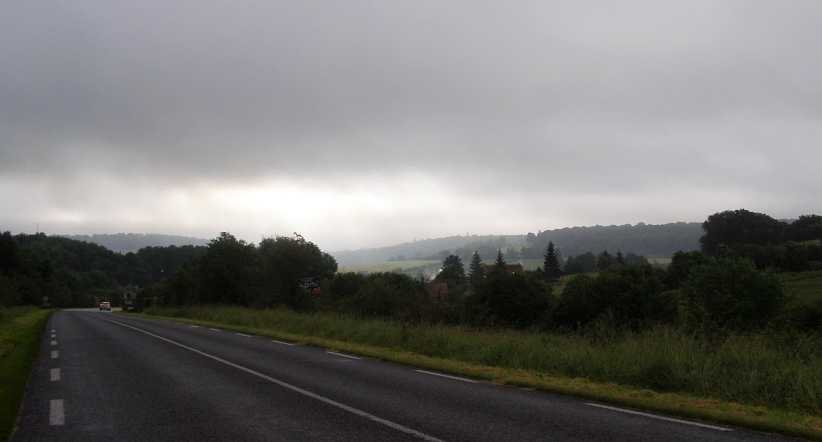
The road North. A stand of trees, a bend in the road leading into a valley, a nice change from the long straight roads.
This was by no means a long drive, it’s less than sixty miles from Rouen to Amiens. But I did run into some morning mists, quite heavy in places.
Wind generators in fog. The need for power has seen a lot of wind-farm construction through the whole area. These are on the Route Nationale 1029 in the Morvillers-Saint-Saturnin area East of Digeon.
Watching the blades of the generators dipping down into the clear air as they turned, I thought, made for interesting photos. I also wonder what nature lovers might say about the blades turning in the fog as birds are flying about. Or do birds stay out of fog?
Quickly enough I got closer to Amiens, the road widened for a while:
Closer to Amiens. A couple of extra lanes were provided, I guess for heavier traffic near the major city I was approaching.
But I was actually heading past Amiens city, for the old circuit was to the South-East of the city and more or less centred on the village of Boves. Here’s Oscar Plada’s nice map of the circuit:
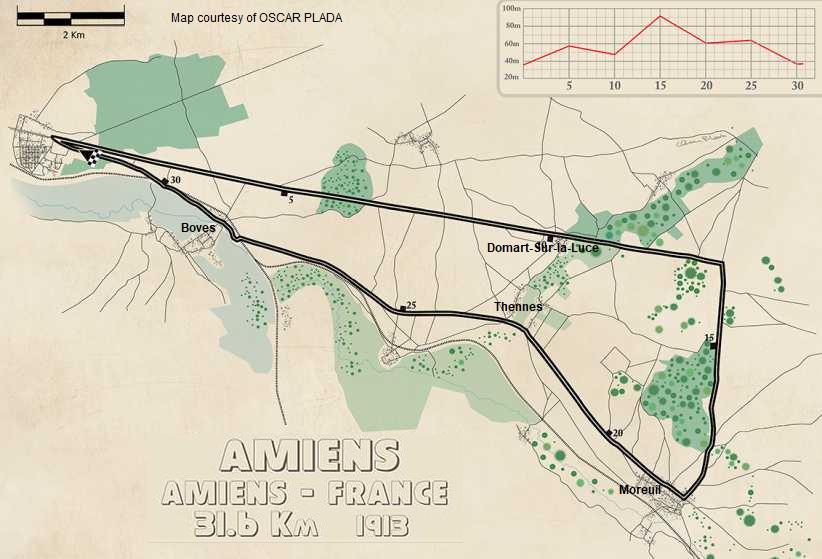
The circuit is very much in the pre-1914 mold, long straights and through various towns and villages, such circuits being seen both in Europe and in the Americas at places like Le Mans, Savannah GA and even, I’ve just learned, San Diego. Also later in Australia at Phillip Island in the twenties and thirties and just once at Victor Harbor in 1936.
I joined it at Boves and headed through under the railway line, but quickly established that the Western end is no longer able to be found, obliterated by modern Autoroute construction. So I turned and headed down the long straight, originally over five miles long, and could see it disappearing into the distance:
Long straight. Disappearing into the distance, the long straight towards Roye isn’t quite straight as it climbs the distant hill.
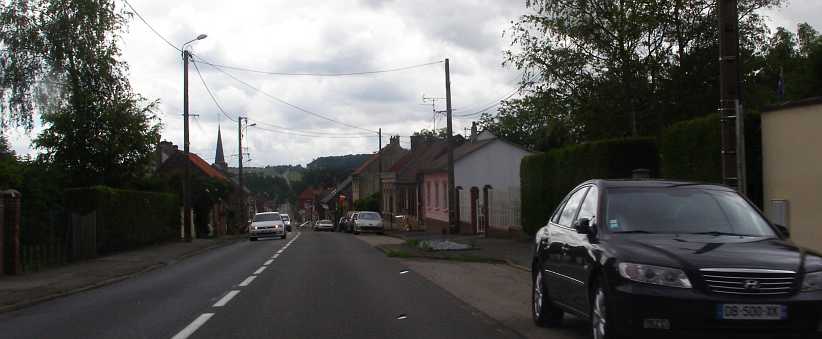
Hidden village. The village of Domart-Sur-la-Luce is settled into a low point along this straight.
How quickly would the cars have been going through this main street of the village? A long straight, a downhill run into the village, the winner of the race averaged 72mph and fastest lap was almost 77mph, so one would have to assume the many spectators who gathered on the sides of the road here saw them going quicker than 100mph.
Just to give a bit of an idea of what it was like, here’s a newsreel about this race:
Apart from the ‘sharp end’ section now overtaken by the Autoroute, there was one other section of the circuit I couldn’t drive on, or at least in the right direction. Modern traffic volumes has led to the Eastbound lanes being sent to a parallel road through this town.
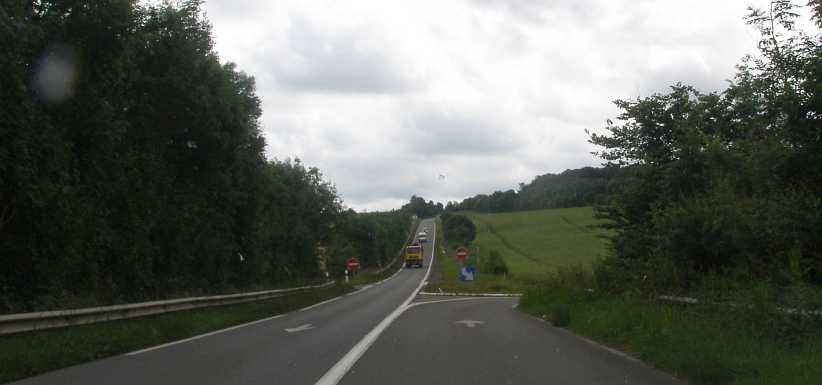
Diversion. It’s one-way the wrong way on the actual path of the old circuit through and after Domart-Sur-la-Luce and the road heading East diverts to a parallel path to the right.
Once the crest of the distant hill is reached, it’s a simple turn to the right and then there’s a few swerves before the downhill run into Moreuil:
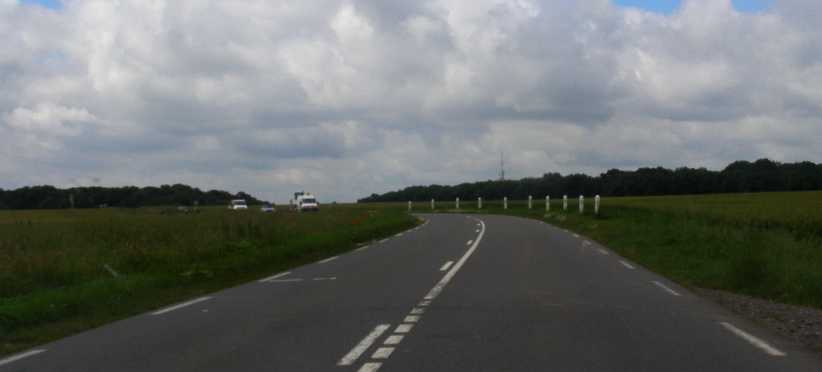
Curves before Moreuil. These swerves might have got exciting on the tyres of the day and the 1913 road surface.
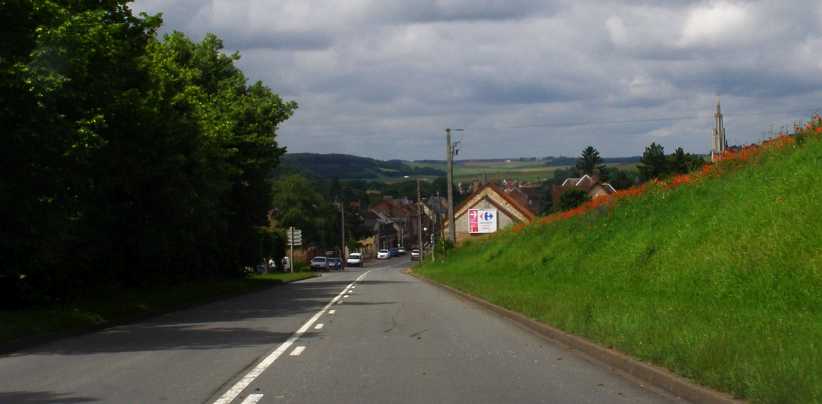
Down into Moreuil. Moreuil is a larger town and the right turn here is approached down hill.
Fences were erected each side of the road here, and there were temporary spectator bridges to allow people to cross the road during the long event. The race lasted almost eight hours and the winner covered almost 917 miles, so it was a real feat of endurance for drivers, cars and spectators.
From the climb out of Moreuil…
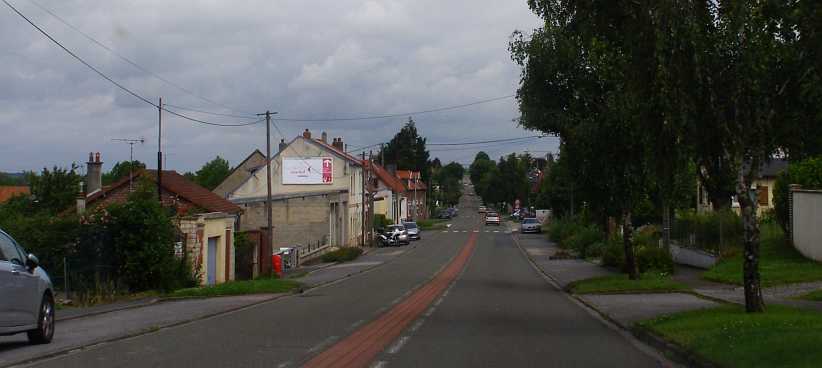
Exiting Moreuil. Climbing from the tight intersection in Moreuil, the cars boomed between the houses as they prepared for the long sweeps of the road to Boves.
…the road went through long sweeps and stretched over the hills…
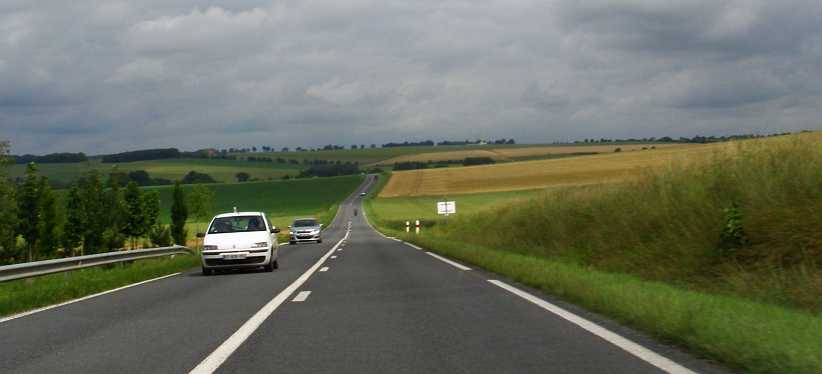
Long sweeps. Plenty of chance to open out the cars here, and test the primitive tyres.
…to descend on the village of Thennes…
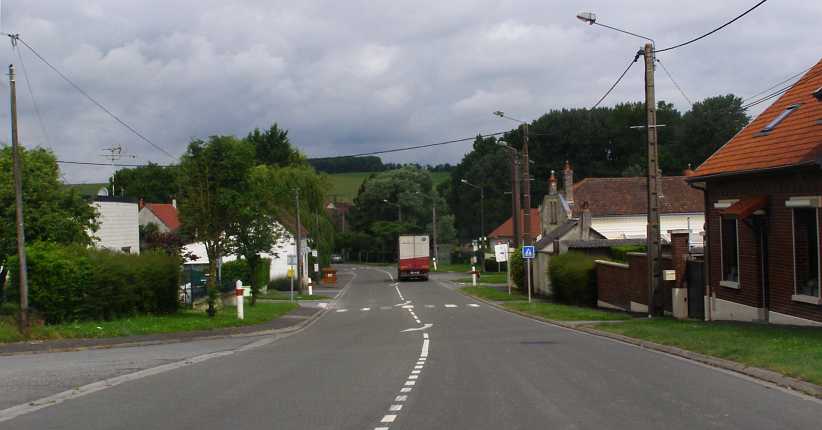
Village of Thennes. Another quick passage past homes, people probably travelled between Thennes and Domart-Sur-la-Luce during the event to get different views.
…and then continue to Boves:
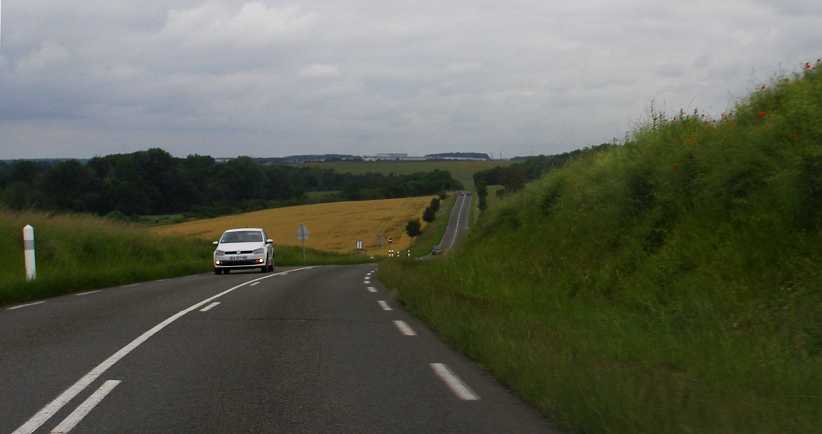
Hills. Fast running up and down hills, it would have been exiting for the riding mechanics.
Straights too. With Boves almost in sight the road straightens out here before the S-bend under the railway bridge.
Into Boves. After the rail underpass the cars went between the houses, again fences were erected and temporary bridges thrown up.
Long drive through Boves. As much of Boves fits between the railway and the river, it’s a long town to traverse.
After Boves there’s a stretch where the river is closer to the railway and the road is a bit hemmed-in between them…
Closing in. This stretch is in a narrow section between river-bank and railway embankment.
…before we get to the next railway underpass…
Right under the railway. Astute readers will have noticed that the railway bridges have been renewed in the 100+ years since this race.
…and then the part where the Autoroute has precluded following the circuit properly. A large roundabout leads to the long straight and the next underpass, this time under the offending Autoroute:
Back to long straight. The long straight is duplicated today because of traffic volume.
Having completed my lap I started to have a look around at things in the immediate vicinity. Another war cemetery really surprised me, not that it was there, but that it was basically located in a creek:
Cemetery in creek. I wondered how the soldiers who died here would have felt about being buried in such a location.
And I wondered about this sign on a renovation being done just near there. The name of the insulation specialist is almost identical to the name of the driver of the winning car in the Grand Prix held here – Georges Boillot.
The sign. Even if the spelling is a little bit different, I have no doubt that people other than myself have noticed the coincidence.
This 1913 French Grand Prix, by the way, was held to a formula which was intended to slow the cars down after the speeds they reached in the previous year’s Grand Prix at Dieppe (and other races) when Peugeot started on their winning streak.
The French company had built their 7.6-litre 4-cylinder L76 model for the 1912 races, it featured four valves per cylinder operated by twin overhead camshafts. Like a lot of road cars today. It was victorious but rising speeds caused the race organisers to introduce a fuel consumption limit. This led to smaller engines, the Peugeot EX3 being a mere 5.6-litres. It still had the four valves per cylinder and became a successful car over the next few years in America, where the likes of Dario Resta raced them while Europe went to war.
Leaving behind the race and the circuit, I had to take a photo of this little bridge, with flowers on the railings:
Flowers on bridge. A bridge decorated with real live flowers is not something I see very often.
And as I headed off towards Roye, where I would get some lunch and turn South towards Paris and the flight back to Canada, I saw yet another war cemetery…
Last cemetery. Neat as many of them are, neater than some, this cemetery is the last resting place for another thousand young men.
…which is no surprise given the history of this area. Villers-Bretonneux, the site of a huge cemetery and memorial as well as being a kind of a Mecca for Aussies who take a deep interest in these things, is only a few miles north of Domart-Sur-la-Luce. Battles between the Germans and the allies in both WW1 and WW2 have left this area very badly bloodstained as they wasted hundreds of thousands of young lives.
Here’s the path for my personal retreat from all of this:
I guess I was tiring, though it wasn’t all that far, less than sixty miles. I didn’t take any more photos as I covered this stretch at all. The next matter of urgency was to wash the car for its return to the Peugeot leasing depot and so I started to look for a car wash. I found this at Fosses, which was almost on their doorstep.
The carwash was attached to a Total service station and I had to wait a short time as another car went through the process ahead of me. Then the little Peugeot was fed into the wash:
Washing off the dust. All the ills of 18,000 kms and 21 countries were washed from the exterior of the car here for a few Euros.
Next order of business was to wrap up the day with a meal, but first I booked into the Hotel Formule 1 at Saint Witz, not far down the road from Fosses.
A bed for the night. A bed and a (communal) shower was to prepare me for the flight back to Toronto.
The hotel was abuzz with young people moving backwards and forwards, I was happy to stay out of their way and settle into my room, use the wi-fi and repack my bags for the flight out.
Again it was a case of making sure everything was in the right place, that I didn’t leave anything behind and that the car was fully prepared for its return. I did feel I had now seen enough of Europe that I didn’t need to go back there, the exception to that being that I hadn’t seen the Norwegian Fjords I’d been told about back in the eighties.
With such thoughts I settled into the bed and slept comfortably…
But seeing another circuit was to give the day direction and I got some breakfast and headed along some secondary roads following the GPS with ‘no tolls’ selected. I got on the road early, as can be seen from the pics. This is the path I took:
Mostly the countryside was open with villages and crops. Through Grandvillers was fog-free and shortly after that I stopped to throw out some rubbish in a roadside bin. I thought the bountiful crop on the side of the road was worthy of a photo, as was the background:
Crops growing well. I feel sure this is barley and it provides a nice foreground for a photo of the gently rolling slopes with more barley and some other crops in the background.
And there was more nature to see, too, though given that I was in France you could just about suggest that this fellow was leading a dangerous life…
Snail in danger. The bin which had lured me to pull up had this surprise for me. No, I didn’t take the snail home – or eat it!
Though much of the road was fairly straight running, from time to time there were changes of scenery…
The road North. A stand of trees, a bend in the road leading into a valley, a nice change from the long straight roads.
This was by no means a long drive, it’s less than sixty miles from Rouen to Amiens. But I did run into some morning mists, quite heavy in places.
Wind generators in fog. The need for power has seen a lot of wind-farm construction through the whole area. These are on the Route Nationale 1029 in the Morvillers-Saint-Saturnin area East of Digeon.
Watching the blades of the generators dipping down into the clear air as they turned, I thought, made for interesting photos. I also wonder what nature lovers might say about the blades turning in the fog as birds are flying about. Or do birds stay out of fog?
Quickly enough I got closer to Amiens, the road widened for a while:
Closer to Amiens. A couple of extra lanes were provided, I guess for heavier traffic near the major city I was approaching.
But I was actually heading past Amiens city, for the old circuit was to the South-East of the city and more or less centred on the village of Boves. Here’s Oscar Plada’s nice map of the circuit:
The circuit is very much in the pre-1914 mold, long straights and through various towns and villages, such circuits being seen both in Europe and in the Americas at places like Le Mans, Savannah GA and even, I’ve just learned, San Diego. Also later in Australia at Phillip Island in the twenties and thirties and just once at Victor Harbor in 1936.
I joined it at Boves and headed through under the railway line, but quickly established that the Western end is no longer able to be found, obliterated by modern Autoroute construction. So I turned and headed down the long straight, originally over five miles long, and could see it disappearing into the distance:
Long straight. Disappearing into the distance, the long straight towards Roye isn’t quite straight as it climbs the distant hill.
Hidden village. The village of Domart-Sur-la-Luce is settled into a low point along this straight.
How quickly would the cars have been going through this main street of the village? A long straight, a downhill run into the village, the winner of the race averaged 72mph and fastest lap was almost 77mph, so one would have to assume the many spectators who gathered on the sides of the road here saw them going quicker than 100mph.
Just to give a bit of an idea of what it was like, here’s a newsreel about this race:
Apart from the ‘sharp end’ section now overtaken by the Autoroute, there was one other section of the circuit I couldn’t drive on, or at least in the right direction. Modern traffic volumes has led to the Eastbound lanes being sent to a parallel road through this town.
Diversion. It’s one-way the wrong way on the actual path of the old circuit through and after Domart-Sur-la-Luce and the road heading East diverts to a parallel path to the right.
Once the crest of the distant hill is reached, it’s a simple turn to the right and then there’s a few swerves before the downhill run into Moreuil:
Curves before Moreuil. These swerves might have got exciting on the tyres of the day and the 1913 road surface.
Down into Moreuil. Moreuil is a larger town and the right turn here is approached down hill.
Fences were erected each side of the road here, and there were temporary spectator bridges to allow people to cross the road during the long event. The race lasted almost eight hours and the winner covered almost 917 miles, so it was a real feat of endurance for drivers, cars and spectators.
From the climb out of Moreuil…
Exiting Moreuil. Climbing from the tight intersection in Moreuil, the cars boomed between the houses as they prepared for the long sweeps of the road to Boves.
…the road went through long sweeps and stretched over the hills…
Long sweeps. Plenty of chance to open out the cars here, and test the primitive tyres.
…to descend on the village of Thennes…
Village of Thennes. Another quick passage past homes, people probably travelled between Thennes and Domart-Sur-la-Luce during the event to get different views.
…and then continue to Boves:
Hills. Fast running up and down hills, it would have been exiting for the riding mechanics.
Straights too. With Boves almost in sight the road straightens out here before the S-bend under the railway bridge.
Into Boves. After the rail underpass the cars went between the houses, again fences were erected and temporary bridges thrown up.
Long drive through Boves. As much of Boves fits between the railway and the river, it’s a long town to traverse.
After Boves there’s a stretch where the river is closer to the railway and the road is a bit hemmed-in between them…
Closing in. This stretch is in a narrow section between river-bank and railway embankment.
…before we get to the next railway underpass…
Right under the railway. Astute readers will have noticed that the railway bridges have been renewed in the 100+ years since this race.
…and then the part where the Autoroute has precluded following the circuit properly. A large roundabout leads to the long straight and the next underpass, this time under the offending Autoroute:
Back to long straight. The long straight is duplicated today because of traffic volume.
Having completed my lap I started to have a look around at things in the immediate vicinity. Another war cemetery really surprised me, not that it was there, but that it was basically located in a creek:
Cemetery in creek. I wondered how the soldiers who died here would have felt about being buried in such a location.
And I wondered about this sign on a renovation being done just near there. The name of the insulation specialist is almost identical to the name of the driver of the winning car in the Grand Prix held here – Georges Boillot.
The sign. Even if the spelling is a little bit different, I have no doubt that people other than myself have noticed the coincidence.
This 1913 French Grand Prix, by the way, was held to a formula which was intended to slow the cars down after the speeds they reached in the previous year’s Grand Prix at Dieppe (and other races) when Peugeot started on their winning streak.
The French company had built their 7.6-litre 4-cylinder L76 model for the 1912 races, it featured four valves per cylinder operated by twin overhead camshafts. Like a lot of road cars today. It was victorious but rising speeds caused the race organisers to introduce a fuel consumption limit. This led to smaller engines, the Peugeot EX3 being a mere 5.6-litres. It still had the four valves per cylinder and became a successful car over the next few years in America, where the likes of Dario Resta raced them while Europe went to war.
Leaving behind the race and the circuit, I had to take a photo of this little bridge, with flowers on the railings:
Flowers on bridge. A bridge decorated with real live flowers is not something I see very often.
And as I headed off towards Roye, where I would get some lunch and turn South towards Paris and the flight back to Canada, I saw yet another war cemetery…
Last cemetery. Neat as many of them are, neater than some, this cemetery is the last resting place for another thousand young men.
…which is no surprise given the history of this area. Villers-Bretonneux, the site of a huge cemetery and memorial as well as being a kind of a Mecca for Aussies who take a deep interest in these things, is only a few miles north of Domart-Sur-la-Luce. Battles between the Germans and the allies in both WW1 and WW2 have left this area very badly bloodstained as they wasted hundreds of thousands of young lives.
Here’s the path for my personal retreat from all of this:
I guess I was tiring, though it wasn’t all that far, less than sixty miles. I didn’t take any more photos as I covered this stretch at all. The next matter of urgency was to wash the car for its return to the Peugeot leasing depot and so I started to look for a car wash. I found this at Fosses, which was almost on their doorstep.
The carwash was attached to a Total service station and I had to wait a short time as another car went through the process ahead of me. Then the little Peugeot was fed into the wash:
Washing off the dust. All the ills of 18,000 kms and 21 countries were washed from the exterior of the car here for a few Euros.
Next order of business was to wrap up the day with a meal, but first I booked into the Hotel Formule 1 at Saint Witz, not far down the road from Fosses.
A bed for the night. A bed and a (communal) shower was to prepare me for the flight back to Toronto.
The hotel was abuzz with young people moving backwards and forwards, I was happy to stay out of their way and settle into my room, use the wi-fi and repack my bags for the flight out.
Again it was a case of making sure everything was in the right place, that I didn’t leave anything behind and that the car was fully prepared for its return. I did feel I had now seen enough of Europe that I didn’t need to go back there, the exception to that being that I hadn’t seen the Norwegian Fjords I’d been told about back in the eighties.
With such thoughts I settled into the bed and slept comfortably…
Thread Starter
|
Captain
Joined: Oct 2005
Posts: 570
Likes: 8
From: The Summit, Queensland, Australia
I had to take care of a few small things on the morning of June 23, 2016, before I headed for the airport and the TT CAR Transit office nearby. This is the agency through which Peugeot and Citroen lease cars, other makers have the same setup, Renault’s ‘Eurodrive’ for instance.
Repacking completed, the interior of the car cleaned out, I headed off for breakfast and then to return the car. It was here, six and a half weeks earlier when we picked up the car, we saw the crazy man on the roof of another car and various people connected with the agency trying to get him away from there. It felt like it could have been years.
TT Car Transit. They were happy enough to get the car back clean, but surprised at how many kilometres it had travelled.
I was due to fly out at 11:00am on Air Canada flight 881, due to land at Toronto at 1:00pm after an eight-hour flight. When I arrived at TT they sent a man out to inspect the car and note any damage, the mileage etc. I watched as he noted that I had taken the original 8kms on the odometer to 18,205kms, he raised both eyebrows over that!
He duly looked at the scratches on the right hand mirror, another mark on the rear bumper where I’d backed into a post in Pescara and noted them down on his clipboard. I pointed out that I’d removed the restrictor gate in the fuel filler pipe and told him it had fallen into the tank when I did that. Apparently they sell these cars to government departments after just one leasing, I don’t know what level of repairs they receive beforehand.
From there they took me to the airport, just a short drive away, in a people mover and I went through all the formalities. Find the right gate, show the appropriate papers, ensure there’s nothing in the carry-on bags to upset the scanners and x-rays, shoes off, put mobile phones and coins in the tray… shoes on, return mobile phones and coins to pockets… work your way to the loading gates and be ready to board when the 777 is ready.
Of course I had booked a window seat, so this meant that when we taxied down to the end of the runway I was in the right place to get a pic of the Air France Concorde that’s embedded in the airport precinct:
Remember when? Through the fifties and part of the sixties, the dream was for supersonic air transport for the masses. The Concorde was as close as it ever came.
And the massive Airbus A380 operated by Air France on their busiest routes rolled along the runway across from us:
The realisation. Economically transporting hundreds of people at a time became the norm instead.
It’s incredible to think that just four years and three days later these aircraft would go out of service with this airline.
Soon it was our turn on the runway and that powerful rush was felt as we accelerated to take-off speed and lifted into the air. Soon Paris would be left behind…
Putting Paris behind us. The great metropolis spreads out behind as we head a bit to the North.
And the flight was underway:
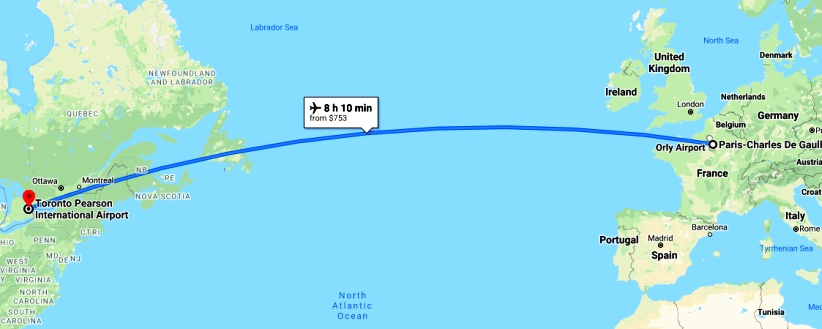
We’d see some of the French countryside as we headed somewhat to the North…
Farms and forests. The diversity of the French countryside was our view for a short while.
…which put us on a trajectory to enable me to photograph the White Cliffs of Dover!
White Cliffs of Dover. Finally I saw them in the daylight!
This is a bit further along the English coastline, the towns of Hythe and Sandgate are in view…
Along England’s South coast. As we travelled at over 30,000ft these towns became tiny to us.
The long stretch over the Atlantic was all in daylight, of course. I had now, obviously, left Europe behind. But the magic of preparing this narrative of the trip has enabled me to learn even more about the places I visited.
To explain that, I have had to go back and ‘find’, via Google Earth and Street View, many of those things seen. I had to locate where many of the photos were taken. Some countries had none, among them Germany, but for the most part it was all available. Where it wasn’t I could still access some individual photos (called ‘photosphere’ as they are 360° views) which did help a little.
Just to give an example, I mentioned in the last post that I hadn’t taken any photos after leaving the Amiens area. Not until I got to the carwash. But to make this story complete I needed to know where that carwash was, and so I went to Google Earth hunting down such places between Amiens and Paris. I had some clues as I looked at each using Street View.
My memory told me it was on the right side of a street which headed towards Paris, that it was in a relatively small place but not too far from Paris. Across that street were everyday houses (Memory, you will see, can fail you…) and that the wash itself was approached from behind the service station to which it was attached. Not so secure in my mind was the thought that it was a Total establishment.
I also remember that it wasn’t too far from a Hotel Formule 1.
There there were the clues in the photo itself:
Carwash clues. I had to look closely at this photo to eventually be able to nail the location.
The apartment building opposite, but apparently not facing the street where the carwash was located, then there was the brick wall alongside the carwash, with that protruding timber beam supporting the eave painted in an obvious white. Note also that you can ‘see through’ the carwash and that there’s no roof to it.
It’s not always easy finding such things, and I regret that there have been a number of photos I took which I couldn’t locate at all. This one absorbed several hours of diligent hunting, but then came a glimmer of light, after rejecting dozens of them as impossible because of the detail of the wash itself. Instead of looking for the carwash, I scoured the background of my picture and started looking for an apartment block like that opposite one.
Bingo, I found this:
Apartments which match. The blue and brown railings, the recessed balconies, the gaps between them and what appears to be the air conditioning on the roof.
How can this be the same carwash? The mystery deepened as I reverted to viewing the carwash.
Comparing it to my photo, there was plenty to go by, including that red steel framework which is actually a part of a cinema and I had taken it for a part of the carwash structure in my photo. But then looking at the front of the carwash on Google Earth…
It’s all different! Not one but two bays in the carwash and that fence around the top, it sure had changed by 2019.
…the carwash had two bays, a high front wall and couldn’t been seen through! Then I looked again, I had to be sure. And I found that the Street View here was dated from May, 2019. And then, as I looked more closely at the apartment building and moved myself into that street, I noticed its Street View date was July, 2018. I swung around towards the carwash from that spot and saw that they were building the new structure for the carwash while the main building remained…
Expansion in 2018. Construction is under way in this picture from 2018.
…and a look at the other end of the service station showed that the roof detail and brickwork were the same there…
Same building. Every detail of the eaves and wall matched my photo.
Curious, I then moved to the roundabout up the road and found that a part of it had pictures from September, 2010 and another part from 2017, which gave me these two views of the carwash as it was when I was there, including in the 2017 view the advertising on the street light signs also visible in my photo:
2010 view. As it used to be, not a good view, but from further around the roundabout…
2017 view. …it’s even more familiar to me as things were evolving. The background here also includes the regular housing I remembered across the street.
The really interesting thing about this little ‘investigation’ is that I got five (yes, five!) different views of the carwash. The two of it as now completed were both from May, 2019, but apparently from the Google Earth camera travelling up and down the street in different directions!
But back to the trip to Toronto. The magnificent aircraft in which I sat was chasing the sun and not keeping pace with it. Eventually Canadian landforms came into sight:
Lots of islands. Sighting land as we came from being over the North Atlantic to over Canada, we saw lots of islands.
Lots of lakes. Further inland we saw the opposite, lots of lakes dotting the countryside.
And soon we were over the outskirts of Toronto. Seeing new housing estates there…
Outskirts of Toronto. Like most big cities, Toronto is expanding, freeways giving easy access to the city.
…and a golf course or two:
Golf course. Golf courses stand out pretty well from the air, the greens and fairways, the trees between them and the little lakes.
We were coming down gradually as we saw these things, as the photos show, and it wasn’t long before we were on the ground experiencing that magic deceleration as reverse thrust was applied and the brakes came on hard. Another safe landing.
After all the formalities at the airport, I was duly picked up and taken to my van, into which I loaded my bags and then I followed the people who’d picked me up to their place. As the lady at whose place I’d left the van lived alone, it was not appropriate for me to stay there the night.
I was shown to a nice room in a nice modern house, introduced to another dog, and tried to sort out all the things I had to do. One of the primary ones was trying to sort out the problems with the van and I fiddled with the fuel pumps but got nowhere. A serious task was retrieving those ‘lost’ photos from my phone’s memory card and my host, who works from home, offered to help with that.
The plan was to stay the night here, and spend most of Friday here also, then there was a party on the Friday night at the home of another of their dog-owning circle further to the West, they would host me for the night Friday before I left.
But I still had Friday to work through…
Repacking completed, the interior of the car cleaned out, I headed off for breakfast and then to return the car. It was here, six and a half weeks earlier when we picked up the car, we saw the crazy man on the roof of another car and various people connected with the agency trying to get him away from there. It felt like it could have been years.
TT Car Transit. They were happy enough to get the car back clean, but surprised at how many kilometres it had travelled.
I was due to fly out at 11:00am on Air Canada flight 881, due to land at Toronto at 1:00pm after an eight-hour flight. When I arrived at TT they sent a man out to inspect the car and note any damage, the mileage etc. I watched as he noted that I had taken the original 8kms on the odometer to 18,205kms, he raised both eyebrows over that!
He duly looked at the scratches on the right hand mirror, another mark on the rear bumper where I’d backed into a post in Pescara and noted them down on his clipboard. I pointed out that I’d removed the restrictor gate in the fuel filler pipe and told him it had fallen into the tank when I did that. Apparently they sell these cars to government departments after just one leasing, I don’t know what level of repairs they receive beforehand.
From there they took me to the airport, just a short drive away, in a people mover and I went through all the formalities. Find the right gate, show the appropriate papers, ensure there’s nothing in the carry-on bags to upset the scanners and x-rays, shoes off, put mobile phones and coins in the tray… shoes on, return mobile phones and coins to pockets… work your way to the loading gates and be ready to board when the 777 is ready.
Of course I had booked a window seat, so this meant that when we taxied down to the end of the runway I was in the right place to get a pic of the Air France Concorde that’s embedded in the airport precinct:
Remember when? Through the fifties and part of the sixties, the dream was for supersonic air transport for the masses. The Concorde was as close as it ever came.
And the massive Airbus A380 operated by Air France on their busiest routes rolled along the runway across from us:
The realisation. Economically transporting hundreds of people at a time became the norm instead.
It’s incredible to think that just four years and three days later these aircraft would go out of service with this airline.
Soon it was our turn on the runway and that powerful rush was felt as we accelerated to take-off speed and lifted into the air. Soon Paris would be left behind…
Putting Paris behind us. The great metropolis spreads out behind as we head a bit to the North.
And the flight was underway:
We’d see some of the French countryside as we headed somewhat to the North…
Farms and forests. The diversity of the French countryside was our view for a short while.
…which put us on a trajectory to enable me to photograph the White Cliffs of Dover!
White Cliffs of Dover. Finally I saw them in the daylight!
This is a bit further along the English coastline, the towns of Hythe and Sandgate are in view…
Along England’s South coast. As we travelled at over 30,000ft these towns became tiny to us.
The long stretch over the Atlantic was all in daylight, of course. I had now, obviously, left Europe behind. But the magic of preparing this narrative of the trip has enabled me to learn even more about the places I visited.
To explain that, I have had to go back and ‘find’, via Google Earth and Street View, many of those things seen. I had to locate where many of the photos were taken. Some countries had none, among them Germany, but for the most part it was all available. Where it wasn’t I could still access some individual photos (called ‘photosphere’ as they are 360° views) which did help a little.
Just to give an example, I mentioned in the last post that I hadn’t taken any photos after leaving the Amiens area. Not until I got to the carwash. But to make this story complete I needed to know where that carwash was, and so I went to Google Earth hunting down such places between Amiens and Paris. I had some clues as I looked at each using Street View.
My memory told me it was on the right side of a street which headed towards Paris, that it was in a relatively small place but not too far from Paris. Across that street were everyday houses (Memory, you will see, can fail you…) and that the wash itself was approached from behind the service station to which it was attached. Not so secure in my mind was the thought that it was a Total establishment.
I also remember that it wasn’t too far from a Hotel Formule 1.
There there were the clues in the photo itself:
Carwash clues. I had to look closely at this photo to eventually be able to nail the location.
The apartment building opposite, but apparently not facing the street where the carwash was located, then there was the brick wall alongside the carwash, with that protruding timber beam supporting the eave painted in an obvious white. Note also that you can ‘see through’ the carwash and that there’s no roof to it.
It’s not always easy finding such things, and I regret that there have been a number of photos I took which I couldn’t locate at all. This one absorbed several hours of diligent hunting, but then came a glimmer of light, after rejecting dozens of them as impossible because of the detail of the wash itself. Instead of looking for the carwash, I scoured the background of my picture and started looking for an apartment block like that opposite one.
Bingo, I found this:
Apartments which match. The blue and brown railings, the recessed balconies, the gaps between them and what appears to be the air conditioning on the roof.
How can this be the same carwash? The mystery deepened as I reverted to viewing the carwash.
Comparing it to my photo, there was plenty to go by, including that red steel framework which is actually a part of a cinema and I had taken it for a part of the carwash structure in my photo. But then looking at the front of the carwash on Google Earth…
It’s all different! Not one but two bays in the carwash and that fence around the top, it sure had changed by 2019.
…the carwash had two bays, a high front wall and couldn’t been seen through! Then I looked again, I had to be sure. And I found that the Street View here was dated from May, 2019. And then, as I looked more closely at the apartment building and moved myself into that street, I noticed its Street View date was July, 2018. I swung around towards the carwash from that spot and saw that they were building the new structure for the carwash while the main building remained…
Expansion in 2018. Construction is under way in this picture from 2018.
…and a look at the other end of the service station showed that the roof detail and brickwork were the same there…
Same building. Every detail of the eaves and wall matched my photo.
Curious, I then moved to the roundabout up the road and found that a part of it had pictures from September, 2010 and another part from 2017, which gave me these two views of the carwash as it was when I was there, including in the 2017 view the advertising on the street light signs also visible in my photo:
2010 view. As it used to be, not a good view, but from further around the roundabout…
2017 view. …it’s even more familiar to me as things were evolving. The background here also includes the regular housing I remembered across the street.
The really interesting thing about this little ‘investigation’ is that I got five (yes, five!) different views of the carwash. The two of it as now completed were both from May, 2019, but apparently from the Google Earth camera travelling up and down the street in different directions!
But back to the trip to Toronto. The magnificent aircraft in which I sat was chasing the sun and not keeping pace with it. Eventually Canadian landforms came into sight:
Lots of islands. Sighting land as we came from being over the North Atlantic to over Canada, we saw lots of islands.
Lots of lakes. Further inland we saw the opposite, lots of lakes dotting the countryside.
And soon we were over the outskirts of Toronto. Seeing new housing estates there…
Outskirts of Toronto. Like most big cities, Toronto is expanding, freeways giving easy access to the city.
…and a golf course or two:
Golf course. Golf courses stand out pretty well from the air, the greens and fairways, the trees between them and the little lakes.
We were coming down gradually as we saw these things, as the photos show, and it wasn’t long before we were on the ground experiencing that magic deceleration as reverse thrust was applied and the brakes came on hard. Another safe landing.
After all the formalities at the airport, I was duly picked up and taken to my van, into which I loaded my bags and then I followed the people who’d picked me up to their place. As the lady at whose place I’d left the van lived alone, it was not appropriate for me to stay there the night.
I was shown to a nice room in a nice modern house, introduced to another dog, and tried to sort out all the things I had to do. One of the primary ones was trying to sort out the problems with the van and I fiddled with the fuel pumps but got nowhere. A serious task was retrieving those ‘lost’ photos from my phone’s memory card and my host, who works from home, offered to help with that.
The plan was to stay the night here, and spend most of Friday here also, then there was a party on the Friday night at the home of another of their dog-owning circle further to the West, they would host me for the night Friday before I left.
But I still had Friday to work through…
Last edited by Ray Bell; Dec 24, 2021 at 09:00 AM.
Thread Starter
|
Captain
Joined: Oct 2005
Posts: 570
Likes: 8
From: The Summit, Queensland, Australia
Friday morning began with a brisk walk in the nearby bush with the dog. Then my host had a couple of errands to run and I took the time to go to the nearby shops. The day started to evaporate fairly quickly and my previous statement to the girl at the hairdresser’s nearer to the airport was forgotten in favour of going to one at those nearby shops. Even that got forgotten and I was still thinking of getting my hair cut over two weeks later in Phoenix!
I also bought a couple of bottles of Australian Yellowtail wine (with a kangaroo on the labels) for the party that night and a couple of memory sticks for my photos to go onto. One for me and one they could keep after helping to recover the photos on the failed memory card. And shame on me, too, for neglecting to take photos during my time with these people Thursday afternoon and much of Friday.
While I’d met these people online, or at least the lady who provided the driveway to park my van while we were in Europe, the secondary link between the three households involved over this two days was their love of dogs. Big dogs. So as the end of the day drew near we all headed for the address where the party was to be held. The dogs were all there:
The dogs. A part of the bonding between the people I was with was their common love of dogs. Big dogs.
On alert. Something has got their attention. Not long after this there was a dramatic event which spoiled the evening.
As darkness fell an unfortunate incident took place in which one of the dogs attacked another and injuries were inflicted. It put a damper on the evening, it’s fair to say, and the party broke up a little earlier than it might have otherwise. Though one thing to come out of the evening was a contact with people I’d met on my 2014 trip.
Ashley and Elias were a couple I’d spent time with in Detroit and I’d lost contact with them. But, having mentioned this prior to flying out to Europe, there’d been some seeking-out going on and I was able to phone them that night.
When the party broke up I had another couple to get to know better, and we talked for some time about home, my trip and things pertinent to them. This couple had a German background and they were very interesting to talk to. Until, eventually, it was time for bed and I went upstairs for a comfortable night’s sleep.
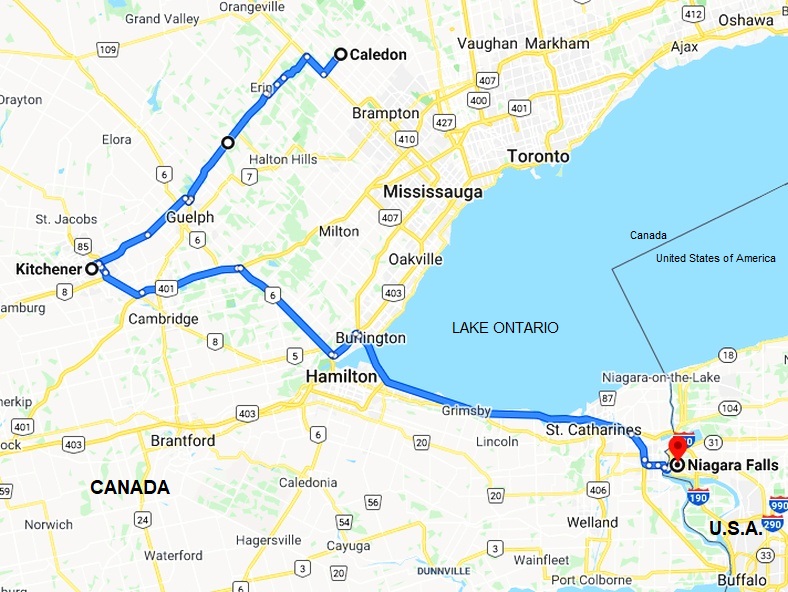
I have to say that I was not all that inspired about going back to Niagara Falls. It was something I was prepared to drop from my first trip should we be short of time, but Janet was keen to see them. Then the second trip I had to go past there with stepson Ashley on board so he would want to see them. Now I had to go back because I promised Sandra I’d take home some fresh photos for her.
Road to Kitchener. I wasn’t on the freeway for the drive to Kitchener, but there wasn’t much traffic.
Of course I was taking notice of things along the way. This barn was nothing like anything I’d seen in Europe, for instance:
An old barn. Once again I was reminded of the way things get left to fall apart in North America. This barn looks like it had a lot of effort go into its building, too.
The van wasn’t running any better than when I’d left it, drinking fuel at an alarming rate but it started every time and got me where I was going. After stopping off to spend time with some more people at Kitchener I turned Southwards towards my day’s destination at the Falls.
Close to the game. Just about any movie about Canada involves ice hockey and Kitchener has its own arena for the game. Their team is the Kitchener Rangers. This is the closest I’ve ever been to such a game.
Along the road I spotted a large paddock full of cars. Interesting cars, a little local car show that was starting to break up after a nice sunny Sunday. Naturally, I stopped and looked at a lot of them, chatted with some of the owners and took some photos.
1933 Chrysler. Beneath that long hood is a straight eight flathead engine, but isn’t the air conditioning more important?
Sixties Chrysler. Another eight-cylinder Chrysler, but this one a V8. In the frame with it are a Camaro and a Saleen Mustang.
Chrysler Sebring. Like the car I’d hired in LA at the beginning of my 2014 trip.
Barracuda. A mid-sixties Barracuda leaves the party, but still in frame are a VW camper and the front of a Camaro SS396. I don’t know what the big wheel’s all about, either.
Studebaker. From the Raymond Leowy designs of the late forties, this 2-door Studebaker features a lot of glass around the back not seen on their sedans.
Challenger. Another one driving off, a Dodge Challenger looks like it’s trying to beat the El Camino to the road home.
I drove on then to Niagara Falls and found somewhere to buy some dinner on the Canadian side. The problem with Niagara Falls coming in from the Canadian side is that it’s just too hard to find your way to the bridge that takes you to the USA. In the course of looking, I started to take photos of the falls with the lights the Canadians shine on them, a nice colourful display.
American Falls. From the Canadian side, the best view of them, enhanced by the coloured searchlights adding to the spectacle.
Canadian Falls. Or Horseshoe Falls, which carry most of the water tumbling to the lower level.
I then crossed the border and wandered around in the darkness getting further photos…
Destined to fall. The turbulent waters heading for the American Falls, much more dramatic at night than in the daytime.
Canadian Falls from US side. Combining the massive water flow with the mists and the lights shining upon them, it all makes a spectacular scene.
Then I located a quiet spot not too far away, and in which I wouldn’t be too conspicuous, to park and sleep for the night. The bed in the back of the van was familiar and comfortable and I slept easily…
I also bought a couple of bottles of Australian Yellowtail wine (with a kangaroo on the labels) for the party that night and a couple of memory sticks for my photos to go onto. One for me and one they could keep after helping to recover the photos on the failed memory card. And shame on me, too, for neglecting to take photos during my time with these people Thursday afternoon and much of Friday.
While I’d met these people online, or at least the lady who provided the driveway to park my van while we were in Europe, the secondary link between the three households involved over this two days was their love of dogs. Big dogs. So as the end of the day drew near we all headed for the address where the party was to be held. The dogs were all there:
The dogs. A part of the bonding between the people I was with was their common love of dogs. Big dogs.
On alert. Something has got their attention. Not long after this there was a dramatic event which spoiled the evening.
As darkness fell an unfortunate incident took place in which one of the dogs attacked another and injuries were inflicted. It put a damper on the evening, it’s fair to say, and the party broke up a little earlier than it might have otherwise. Though one thing to come out of the evening was a contact with people I’d met on my 2014 trip.
Ashley and Elias were a couple I’d spent time with in Detroit and I’d lost contact with them. But, having mentioned this prior to flying out to Europe, there’d been some seeking-out going on and I was able to phone them that night.
When the party broke up I had another couple to get to know better, and we talked for some time about home, my trip and things pertinent to them. This couple had a German background and they were very interesting to talk to. Until, eventually, it was time for bed and I went upstairs for a comfortable night’s sleep.
I have to say that I was not all that inspired about going back to Niagara Falls. It was something I was prepared to drop from my first trip should we be short of time, but Janet was keen to see them. Then the second trip I had to go past there with stepson Ashley on board so he would want to see them. Now I had to go back because I promised Sandra I’d take home some fresh photos for her.
Road to Kitchener. I wasn’t on the freeway for the drive to Kitchener, but there wasn’t much traffic.
Of course I was taking notice of things along the way. This barn was nothing like anything I’d seen in Europe, for instance:
An old barn. Once again I was reminded of the way things get left to fall apart in North America. This barn looks like it had a lot of effort go into its building, too.
The van wasn’t running any better than when I’d left it, drinking fuel at an alarming rate but it started every time and got me where I was going. After stopping off to spend time with some more people at Kitchener I turned Southwards towards my day’s destination at the Falls.
Close to the game. Just about any movie about Canada involves ice hockey and Kitchener has its own arena for the game. Their team is the Kitchener Rangers. This is the closest I’ve ever been to such a game.
Along the road I spotted a large paddock full of cars. Interesting cars, a little local car show that was starting to break up after a nice sunny Sunday. Naturally, I stopped and looked at a lot of them, chatted with some of the owners and took some photos.
1933 Chrysler. Beneath that long hood is a straight eight flathead engine, but isn’t the air conditioning more important?
Sixties Chrysler. Another eight-cylinder Chrysler, but this one a V8. In the frame with it are a Camaro and a Saleen Mustang.
Chrysler Sebring. Like the car I’d hired in LA at the beginning of my 2014 trip.
Barracuda. A mid-sixties Barracuda leaves the party, but still in frame are a VW camper and the front of a Camaro SS396. I don’t know what the big wheel’s all about, either.
Studebaker. From the Raymond Leowy designs of the late forties, this 2-door Studebaker features a lot of glass around the back not seen on their sedans.
Challenger. Another one driving off, a Dodge Challenger looks like it’s trying to beat the El Camino to the road home.
I drove on then to Niagara Falls and found somewhere to buy some dinner on the Canadian side. The problem with Niagara Falls coming in from the Canadian side is that it’s just too hard to find your way to the bridge that takes you to the USA. In the course of looking, I started to take photos of the falls with the lights the Canadians shine on them, a nice colourful display.
American Falls. From the Canadian side, the best view of them, enhanced by the coloured searchlights adding to the spectacle.
Canadian Falls. Or Horseshoe Falls, which carry most of the water tumbling to the lower level.
I then crossed the border and wandered around in the darkness getting further photos…
Destined to fall. The turbulent waters heading for the American Falls, much more dramatic at night than in the daytime.
Canadian Falls from US side. Combining the massive water flow with the mists and the lights shining upon them, it all makes a spectacular scene.
Then I located a quiet spot not too far away, and in which I wouldn’t be too conspicuous, to park and sleep for the night. The bed in the back of the van was familiar and comfortable and I slept easily…
Last edited by Ray Bell; Sep 14, 2020 at 05:53 AM.

